Qianqian Lin, Yuanbo Sun, Zhenghong Liu (2023). Strategies to improve the student engagement of Vocational College class based on design thinking. In: Ergonomics In Design. AHFE Open Access, vol. 77, pp. 346–353. https://doi.org/10.54941/ahfe1003392
Student engagement is an important factor affecting the educational outcomes of colleges, which can help colleges better understand the quality of students' learning and the mechanism of students' effective learning to help colleges make corresponding improvements. While previous research and literature studies have found that students in vocational colleges class have low student engagement. Design thinking is a comprehensive thinking with mature concepts, methods, and tools, which has been widely used in the field of education. This study introduced the design thinking in the vocational colleges class, proposed the teaching activity mode and strategy based on design thinking, tried to use design thinking to intervene students' class behavior, and conducted the strategy by empirical research. The results show that the teaching mode based on design thinking has a positive effect on improving student engagement in class.
Under the background of economic development entering a new stage, China’s vocational education is also undergoing in-depth adjustment and transformation to adapt to the development requirements of domestic social and economic situation. In 2015, the State Council issued the grand blueprint of “Made in China 2025”, calling for highly skilled talents with superb skills and innovative thinking to enrich every corner of industrial development. The popular conception of “learning society”and “career development”indicates that vocational education, as an important part of lifelong education system, should shoulder the great mission of promoting people’s self-development. At present, China attaches more importance to vocational education than any other time period. However, China’s vocational education still faces many challenges (Du, 2018). Due to the low status of vocational education in China in past years. Vocational schools are the choice of students with relatively low scores in the college entrance examination, teachers also report that the stu- dents in the class have a bad attitude in learning, poor self-control, and are not
Strategies to Improve the Student Engagement of Vocational College Class 347
interested in learning, vocational colleges class have low student engagement and classroom teaching is difficult to carry out (Zheng, 2016).
TEACHING STRATEGIES BASED ON DESIGN THINKING Student Engagement
In the 1960s, the word “engagement” was first introduced into the field of education, and then gradually expanded. The famous scholar Astin believes that student involvement refers to “students’ internal psychological acti- vities and external behaviors in a series of activities related to learning” (Astin, 1999), which has a strong connection to the theory of student engage- ment. Types of engagement are often categorized into behavioral engagement, emotional engagement, agentic engagement, and cognitive engagement (Fre- dricks, Blumenfeld, & Paris, 2004; Furlong et al., 2003; Jimerson, Campos, & Greif, 2003).
(1) Behavioral engagement Behavioral engagement entails learner conduct such as following the rules and involvement in learning activities with effort, persistence, and concentration (Birch & Ladd, 1997).
(2) Emotional engagement Emotional engagement refers to the presence of positive emotions in class or during task involvement, such as “interest, enjoyment and enthusiasm” (Skinner et al., 2009). It also refers to the positive and negative emotions a learner experiences in response to the teacher, peers, and the education environment (Gunuc & Kuzu, 2015; Trowler, 2010).
(3) Cognitive engagement Cognitive engagement is defined as the level of student investment in thou- ghtful, strategic, and willing efforts to understand complex ideas or master difficult skills (Fredricks, Blumenfeld, Friedel, & Paris, 2004). Cognitive engagement involves an ability to engage in self-regulated learning and an appreciation for the value of learning. In cognitive engagement, students are motivated to learn, both in and out of the classroom (Gunuc & Kuzu, 2015).
(4) Agentic engagement Agentic engagement refers to the extent of the student’s constructive contri- bution into the flow of the instruction they receive in class such as letting the instructor knows what they want or interested in, expressing opinions, and asking questions (Reeve, 2013). Reeve and Tseng (2011) initially proposed the concept of agentic engagement. They defined it as “students’ constructive contribution into the flow of the instruction they receive” (p. 258).
Desing Thinking Simon first proposed in 1969 that design is a universal way of thinking. In 1987, Peter Rowe, a professor at Harvard School of Design, published the book Design Thinking, which brought design thinking into the public eye. In 1992, Richard Buchanan pointed out that design thinking can creatively solve wicked problems (Peng, 2019). At present, design thinking has been maturely applied in the fields of engineering, management and education,
and a variety of tools and models have been derived, such as Stanford Uni- versity’s 5-step design thinking and the British double diamond model. Due to its goal-oriented, integrates technology and business, emphasizes cultivating students’ thinking methods, it has been proved to be effective in cultivating students’ higher-order thinking and promoting the realization of innovative achievements, is an excellent model of education.
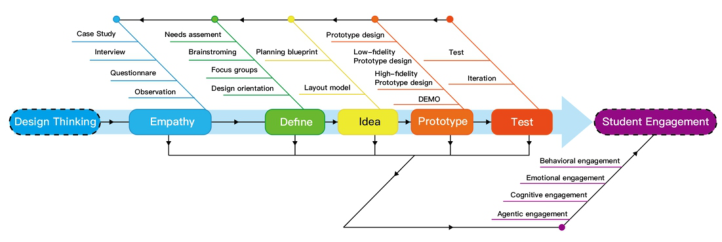
Teaching Strategies Based on Design Thinking The introduction of design thinking into courses to improve student engage- ment is based on the following reasons. Design thinking can be divided into five stages: empathy, define, idea, prototype, and test. In each stage, a large number of tools will be used, such as grouping, interview, brainstorming, user research, planning blueprint, reporting, etc. These methods can arouse stu- dents’ enthusiasm, improve students’ take more time and energy in class, so as to improve student engagement in class to a certain extent. The rationale structure is shown in Figure 1.
Figure 1: The rationale structure.
TEACHING EXPERIMENT DESIGN The teaching strategies were used in the Career Planning course which is offered in the first semester of the third grade of higher vocational college, 144 students in 3 classes are from the College of Art and Design took part in the experiment.
The study adopted a mixed methodology, which was the combination of qualitative and quantitative research. To measure the student engagement in class, questionnaire adapt from Reeve (2013) was used in the research. Due to the limitations of class time and students’ attention, the questions were changed to 9 items, and contains Behavioral Engagement, Emotional Engagement, Agentic Engagement, and Cognitive Engagement (see Table 1). Self-reflection reports also be used in this research as qualitative research to measure student engagement in class. The questionnaire was admini- stered at the beginning of the course to measure the entry level of each group before the teaching and was administered again at the end of the teaching.
Strategies to Improve the Student Engagement of Vocational College Class 349
Table 1. Sample questionnaire adapt from Reeve (Reeve. 2013).
Table available in the original PDF paper.
Dimension Items Behavioral Engagement 1. When I’m in this class, I actively participate in class discussions. 2. When I’m in this class, I listen carefully. Emotional Engagement 3. I enjoy working in class task in this class. 4. This class is fun. 5. When group members work on task in this class, I am enthusiastically involved. Agentic Engagement 6. I let my teacher know what I want to know. 7. During class, I ask questions to help me learn. Cognitive Engagement 8. I try to explain ideas or concepts in my own words. 9. I try to apply acquired knowledge in this class to complete a learning task or solve problems.
Table 2. Compare the results before and after teaching (Q1).
Table available in the original PDF paper.
1. When I’m in this class, I actively participate in class discussions.
Items The ratio at the beginning of the course
The ratio at the end of the course Strongly agree-5 9.03% 18.42% Agree-4 22.92% 29.61% Neither agree nor disagree-3 53.47% 48.68% Disagree-2 10.42% 1.97% Strongly disagree-1 4.17% 1.32%
TEACHING EFFECT AND ANALYSIS WJX (www.wjx.cn) was used to collect the quantitative data of questionnai- res and the qualitative data of the reflective statement online.
(1) Behavioral engagement Behavioral engagement awareness includes 2 questions (Q1-Q2). Accor- ding to the analysis of the questionnaire results, compared with the beginning of the course, the teaching strategies based on design thinking improve stu- dents’ actively participate in class discussions by 9.39%, listen carefully in class by 6.74% (strongly agree).
(2) Emotional engagement Emotional engagement awareness includes 3 questions (Q3-Q5). Accor- ding to the analysis of the questionnaire results, compared with the beginning of the course, the teaching strategies based on design thinking improve stu- dents’ enjoyable working in class task by11.97%, fun in class by 10.56%, involvement in group work by 12.57% (strongly agree).
(3) Cognitive engagement Cognitive engagement awareness includes 2 questions (Q6-Q7). According to the analysis of the questionnaire results, compared with the beginning of the course, the teaching strategies based on design thinking improve students’
Table 3. Compare the results before and after teaching (Q2).
Table available in the original PDF paper.
2. When I’m in this class, I listen carefully.
Items The ratio at the beginning of the course
The ratio at the end of the course Strongly agree-5 15.97% 21.71% Agree-4 31.25% 34.87% Neither agree nor disagree-3 47.92% 42.11% Disagree-2 2.78% 0.66% Strongly disagree-1 2.08% 0.66%
Table 4. Compare the results before and after teaching (Q3).
Table available in the original PDF paper.
3. I enjoy working in class task in this class.
Items The ratio at the beginning of the course
The ratio at the end of the course Strongly agree-5 10.42% 22.37% Agree-4 26.39% 40.13% Neither agree nor disagree-3 54.86% 34.21% Disagree-2 6.25% 1.97% Strongly disagree-1 2.08% 1.32%
Table 5. Compare the results before and after teaching (Q4).
Table available in the original PDF paper.
4. This class is fun.
Items The ratio at the beginning of the course
The ratio at the end of the course Strongly agree-5 11.81% 22.37% Agree-4 29.86% 44.08% Neither agree nor disagree-3 51.39% 30.92% Disagree-2 4.86% 1.97% Strongly disagree-1 2.08% 0.66%
Table 6. Compare the results before and after teaching (Q5).
Table available in the original PDF paper.
5. When group members work on task in this class, I am enthusiastically involved.
Items The ratio at the beginning of the course
The ratio at the end of the course Strongly agree-5 13.19% 25.66% Agree-4 29.17% 44.08% Neither agree nor disagree-3 50.69% 27.63% Disagree-2 4.86% 1.32% Strongly disagree-1 2.08% 1.32%
Strategies to Improve the Student Engagement of Vocational College Class 351
Table 7. Compare the results before and after teaching (Q6).
Table available in the original PDF paper.
6. I let my teacher know what I want to know.
Items The ratio at the beginning of the course
The ratio at the end of the course Strongly agree-5 15.97% 18.42% Agree-4 31.25% 47.37% Neither agree nor disagree-3 45.14% 31.58% Disagree-2 5.56% 1.97% Strongly disagree-1 2.08% 0.66%
Table 8. Compare the results before and after teaching (Q7).
Table available in the original PDF paper.
7. During class, I ask questions to help me learn.
Items The ratio at the beginning of the course
The ratio at the end of the course Strongly agree-5 7.64% 12.5% Agree-4 17.36% 31.58% Neither agree nor disagree-3 56.94% 46.05% Disagree-2 12.5% 7.89% Strongly disagree-1 5.56% 1.97%
share their want to know to teacher in class by 2.45%, ask questions in class by 4.86% (strongly agree).
(4) Agentic engagement Agentic engagement awareness includes 2 questions (Q8-Q9). According to the analysis of the questionnaire results, compared with the beginning of the course, the teaching strategies based on design thinking improve students’ explain concepts in class by 10.75%, apply acquired knowledge to complete a learning task in class by 10.78% (strongly agree).
In the self-reflection report, most of the students also mentioned that they liked this teaching method very much and talked about their fondness for group activities for many times. They hoped to have more practical tasks and have more interaction with teachers and classmates.
Table 9. Compare the results before and after teaching (Q8).
Table available in the original PDF paper.
8. I try to explain ideas or concepts in my own words.
Items The ratio at the beginning of the course
The ratio at the end of the course Strongly agree-5 8.33% 19.08% Agree-4 27.08% 38.16% Neither agree nor disagree-3 52.78% 37.5% Disagree-2 8.33% 3.95% Strongly disagree-1 3.47% 1.32%
Table 10. Compare the results before and after teaching (Q9).
Table available in the original PDF paper.
9. I try to apply acquired knowledge in this class to complete a learning task or solve problems.
Items The ratio at the beginning of the course
The ratio at the end of the course Strongly agree-5 7.64% 18.42% Agree-4 20.83% 33.55% Neither agree nor disagree-3 56.94% 42.11% Disagree-2 11.11% 4.61% Strongly disagree-1 3.47% 1.32%
CONCLUSION
According to the research results, strategies based on design thinking has a positive promoting effect on the improvement of students’ participation, and this model can provide a new classroom teaching paradigm for vocational education. Admittedly, there are shortcomings in this study, for example, the questionnaire needs to be designed more rigorously to follow the characteri- stics of students in vocational colleges, and the improvement of constructed of four kinds of engagement need to be further analysed. Furture research will concentrate on the questionnaire optimize, and more subdivisions will be made on the improvement of the dimensions of four kinds of engagement.
ACKNOWLEDGMENT
The authors would like to acknowledge the teachers and students of the School of Art and Design of Beijing polytechnic for their cooperation, and this study is supported by the Project of Cultivation for young top-motch Talents of Beijing Municipal Institutions,and Research on project teaching to integrate high school Technology Curriculum Integration by design thinking.
REFERENCES
Astin, WA. (1999). Student involvement: a development theory for higher education, PROQUEST PSYCHOLOGY JOURNAL Volume 40 No. 5. Birch, S. H. Ladd, G. W. (1997). The teacher-child relationship and children’s early
school adjustment, JOURNAL OF SCHOOL PSYCHOLOGY Volume 35 No. 1. Du, Canyi. (2018). Challenges and countermeasures of vocational education under the background of “Made in China 2025”, EDUCATION AND VOCATION Volume 12 No. 10. Fredricks, J. A., Blumenfeld, P. C. and Paris, A. H. (2004). School engagement:
Potential of the concept, state of the evidence, REVIEW OF EDUCATIONAL RESEARCH Volume 74 No. 1. Furlong, M. J., Whipple, A. D., St. Jean, G., Simental, J., Soliz, A. and Punthuna, S. (2003). Multiple contexts of school engagement: Moving toward a unifying framework for educational research and practice, THE CALIFORNIA SCHOOL PSYCHOLOGIST Volume 8 No. 1.
Strategies to Improve the Student Engagement of Vocational College Class 353
Gunuc, S. Kuzu, A. (2015). Student engagement scale: development, reliability, and validity, ASSESSMENT & EVALUATION IN HIGHER EDUCATION Volume 40 No. 1. Jimerson, S. R., Campos, E. and Greif, J. L. (2003). Toward an understanding
of definitions and measures of school engagement and related terms, THE CALIFORNIA SCHOOL PSYCHOLOGIST Volume 8 No. 1. Peng, Pinling. (2019). General Psychology. Beijing: Peking University Press. Reeve, J. (2013). How students create motivationally supportive learning environments for themselves: The concept of agentic engagement, JOURNAL OF EDUCATIONAL PSYCHOLOGY Volume 105 No. 3. Reeve, J. Tseng, M. (2011). Agency as a fourth aspect of student engagement
during learning activities, CONTEMPORTARY EDUCATIONAL PSYCHO- LOGY Volume 36 No. 2. Trowler, V. (2010). Student engagement literature review, THE HIGHER EDUCA- TION ACADEMY Volume 12 No. 11. Zheng, Jian. (2016). Summary and analysis of “China Vocational Education
Observation Report” by Mercator China Research Center, Germany, CHINESE VOCATIONAL AND TECHNICAL EDUCATION Volume 33 No. 12.
LISTED IN THE AHFE DIGITAL BOOKSTORE CATALOGUE
Explore the complete digital volume
Ergonomics In Design
Read this individual research paper free through the original publisher, or explore the full digital proceedings book.
ISBN 978-1-958651-53-7
Explore this ISBN in the AHFE Bookstore ↗Listed in the July 2026 bookstore catalogue; search by ISBN to confirm current availability · Digital book purchase optional