Francesco Lolli, Antonio Maria Coruzzolo, Chiara Forgione, Platao Gonçalves Terra Neto (2023). Ergonomic Risk Reduction: A Height-Adjustable Mesh Truck for Picking Activities Evaluated With A Depth Camera. In: Ergonomics In Design. AHFE Open Access, vol. 77, pp. 139–149. https://doi.org/10.54941/ahfe1003371
The correct assessment of ergonomic risks involved in picking activities is considered crucial step for avoiding musculoskeletal disorders in the workforce. In addition, the workplace and related tools should be designed to minimize those risks during daily activities. In this study, the researchers evaluated the benefits earned from introducing a height-adjustable mesh truck to facilitate and mitigate the risks in which operators are subjected. We evaluate the reported risks by exploring an Azure Kinect-based application which can semi-automatically assess the NIOSH index. We performed an experiment involving 20 volunteers who performed a total of 200 picking, statistically demonstrating the benefits that can be obtained with the introduction of a height-adjustable box.
Recently the fourth Industrial Revolution took place, named Industry 4.0 (Liao et al., 2017). Under this revolution organizations, processes and the role of humans in Industrial production has changed (Neumann & Village, 2012). One of the key concepts of Industry 4.0 was the “full automation”pri- nciple (Coronado et al., 2022). However, even if the automation of manual activities improve the working conditions; there are many tasks where auto- mation is not possible (Bortolini et al., 2017). In particular, the most labour intensive activity in logistics is order picking that usually represents 50% of warehouse costs (de Koster et al., 2007). Order picking is also critical from an ergonomic perspective since material handling is one of the most intensive activities from a physical point of view, this is due to high load wei- ght, high repetitive and awkward body postures (Weisnera & Deusea, 2014). These characteristics can cause long-term musculoskeletal injuries to the wor- ker therefore the occupational issue is called work related musculoskeletal
disorders (WMSDs), those disorders negatively impact the workforce per- formance and health conditions. In fact, the U.S. Bureau of Labor Statistics found that 31.4% of the days away from work are imputable to WMSDs (BLS, 2017). WMSDs have also an economic impact that was estimated to be around $20 billion/year in US due to direct costs (Kang et al., 2014). Given this, there is major importance of delivering strategies to reduce WMDSs. Also, to reduce the ergonomic first risk exposure need to be assessed before implementing interventions which will be made to reduce the risk exposure (Vito Modesto Manghisi et al., 2017). To evaluate the ergonomic risks, three methods exists: self-reports, direct measurements and observational ones (Li & Buckle, 1999). The first method is highly affected by workers subjecti- vity (David, 2005) while direct ones are usually highly intrusive based on sensors mounted on workers body as well as their cost is high (Kowalski et al., 2012). The last class of methods is the most used in industrial practice and involve different methods among which we can find: Rapid Upper Limb Assessment (RULA) (Lynn & Corlett, 1993), Rapid Entire Body Assessment (REBA) (Hignett & McAtamney, 2000), U.S. National Institute of Occupati- onal Safety and Health (NIOSH) lifting equation (Snook & Ciriello, 1991), Strain Index (Moore & Garg, 1995), OVAKO Working posture Analysing System (OWAS) (Karhu et al., 1977) and the concise exposure index (OCRA) (Occhipinti, 1998). Among these methods the NIOSH lifting equation is con- sidered the most used method to assess the risks involved in picking activities since it was developed in order to assess the risk of low-back disorders in repe- ated lifting operations (Waters et al., 1994). At the same time observational methods changed a lot in recent years. In fact, to reduce those major weaknes- ses, the increased duration of time needed to perform the video analysis, the low accuracy and high intra-and-inter-observer variability researchers started to integrate Motion Capture Technologies (MOCAP) in the ergonomic eva- luation (Mgbemena et al., 2017). MOCAP can be classified in two different categories: sensor-based and optical side (Seghezzi et al., 2021). Sensor based systems are less used in industrial practice due to the users’ discomfort sensa- tion that is in contrast with a human-centered design (Coruzzolo et al., 2022). On the other hand optical system is not intrusive in the workspace or for the worker and represent a consolidate solution for ergonomic risk assessment (ERA) (Vito M. Manghisi et al., 2020). The most utilized cameras for the scope are Kinects: depth cameras that with a Convolutional Neural Netw- ork (CNN) embedded in the Microsoft SDK (Microsoft, 2021) provide a real time body segmentation. From its introduction, Kinects were utilized in vari- ous studies to conduct ERA. For example OWAS was calculated using Kinect v1 in (Diego-Mas & Alcaide-Marzal, 2014), RULA was semiautomatically calculated in (Vito Modesto Manghisi et al., 2017) using Kinect v2 as simi- larly done in (Plantard et al., 2017) and as done in (Coruzzolo et al., 2022) with Azure Kinect. For a full review of ERA with Kinects we refer to the work of Lunin & Glock, (2021). In this paper, we explore the new Azure Kinect to semi-automatically calculate NIOSH with and without the help of the hei- ght adjustable mesh truck. As far as our knowledge goes and as reported in (Lunin & Glock, 2021) this is the first work in which Azure Kinect is used for NIOSH evaluation. Some previous applications were developed based on
Ergonomic Risk Reduction: A Height-Adjustable Mesh Truck 141
Kinect v1 and v2 that we follow for the development of AzKNIOSH. In par- ticular, Delpresto et al. (Delpresto et al., 2013) developed a feedback system based on Kinect v1 that involved NIOSH, Spector et al. (Spector et al., 2014) developed an application which semi-automatically calculated NIOSH with Kinect v1 while Patrizi et al. ( 2016) compared Kinect v1 with a marker based high end method. Here we propose the introduction of a height adjustable mesh truck to reduce the ergonomic risk in picking activities demonstrating statistically its benefits from an ERA carried out with AzKNIOSH. The paper is structured as follows: Section 1 explains how the semi-automatic NIOSH evaluation is carried out with Azure Kinect using AzKNIOSH, Section 2 con- tains the experiment setting while Section 3 presents our results and Section 4 the conclusion and further research agenda.
AZKNIOSH The NIOSH Lifting Equation analyse the ergonomic risk during manual load lifting providing the Recommended Weight Limit (RWL) (Waters et al., 1993). From the RWL we can calculate the Lifting Index (LI) that provides an insight into the level of risk while considering the lifted object that is obtained by dividing the RWL by the lifted object weight. The LI represents a measure of risk, higher the LI higher the risk involved in the lifting process. The levels of risk related to LI are reported in Table 1.
Table 1. Assignment of risk level based on Lifting Index (HSE (health and safety executive), 2014).
Table available in the original PDF paper.
LI Zone Level of Risk ≤0,85 Green Negligible risk 0,86 - 1 Yellow Medium risk > 1 Red High risk
METHOD
We implemented AzNIOSH on Python 3.8 with an application that semi automatically calculates the NIOSH Lifting Equation utilizing the Azure Kinect Body Tracking SDK (Microsoft, 2021). An algorithm based on CNN’s is integrated in the depth camera to locate 32 joints in the 3D space.
Additional processing was required in order to calculate the NIOSH Lifting Equation multipliers:
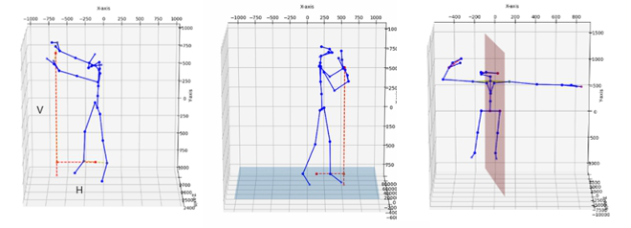
Hands midpoint: defined as the average of three-dimensional coordinates of the hands to calculate Distance Multiplier (DM), which is based on the vertical distance travelled during the lift.
Ankles midpoint: defined as the average of three-dimensional coordinates of the ankles. The two midpoints are used for Horizontal Multiplier (HM) and Vertical Multiplier (VM). As shown in Figure 1 on the right HM repre- sents the horizontal distance between the object and the body (H) and VM is the vertical distance between the object and the floor (V).
Figure 1: On the left: vertical (V) and horizontal (H) distances representation (left) and floor plane representation (right); in the middle floor plane is blue; on the right sagittal plane is shown in red.
Floor plane: defined knowing a point belonging to it (the lowest joint, that corresponds to the foot coordinates in our experiment) and a vector defining its direction (parallel to the z-axis). In Figure 1 in the middle is depicted in blue.
Asymmetric vector: defined as the connection between the projection on floor plane of hands midpoint and ankles midpoint.
Sagittal plane: found imposing its equation perpendicular to shoulder vector and imposing that contains the trunk vector, in Figure 1 on the right and illustrated in red.
Sagittal vector: the intersection between the sagittal plane and the floor plane, used to find the Asymmetric Multiplier (AM), based on the angle between sagittal vector and asymmetric vector.
Right/left hand tip vector: defined as the vectors linking the joints right/left hand and right/left hand tip.
Right/left wrist vector: defined as the vectors linking the joint right/left hand and right/left wrist.
Using right/left hand tip vector and right/left wrist vector researchers mea- sured the fingers angle during lifting, this is used to calculate the Coupling Multiplier (CM). To get final RWL it’s necessary to provide as input the following parameters:
Operator age and gender to calculate the Load Constant (LC);
Lift frequency and duration to calculate Frequency Multiplier (FM);
Qualitative judgment of the grip and possible use of gloves contributing to Coupling Multiplier.
The start and end of the lift i.e., the two frames where the lift starts and ends.
As given in the following equations, RWL is the result of multiplying all the factors then we can obtain LI.
Equation reproduced from the original PDF.
Ergonomic Risk Reduction: A Height-Adjustable Mesh Truck 143
The RWL can then be calculated for both the starting frame of the lift and for the stop frame, therefore the highest LI is the one that represents the lifting risk.
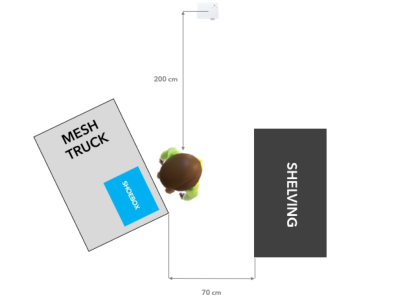
EXPERIMENT SETTING For the video recording. An Azure Kinect was used with the following set- tings: Color mode On 720p, Depth mode On NFOV 2x2 binned, No depth delays, Frames per second (fps) 15, IMU ON, External Sync Standalone, Sync delay 0, Gain Auto. The Kinect was always placed at a height of 110 cm and at 150–200 cm from the subject. The experiment layout, shown from the Azure Kinect in Figure 2 and from a top graphical view in Figure 3 includes:
Five shoeboxes, one on the top of the other, of size 40x30x30 cm, weight 0.50 kg. They were named from A to E, where “Shoebox A” was on the top and “Shoebox E” was the lowest one.
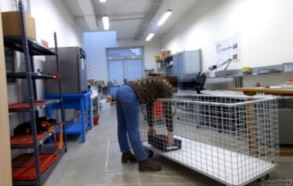
A mesh truck of size 120x100x80 (h) cm, 67 cm usable height, where the shoeboxes were located. This is a height-adjustable mesh truck because its bottom part was moving, through mechanical non automated tools, to facilitate the lifting action as shown in Figure 2.
A shelving of size 2000x500x1200 (h) cm where boxes were downloaded on the fourth shelf, 119 cm heigh, shown in Figure 2 and with a top view graphical representation in Figure 3.
Twenty volunteers participated in the experiment, lifting the shoeboxes from the mesh truck to the shelf. For each box two settings were analyzed: with the bottom part of the mesh truck fixed at 15 cm from the ground and the height-adjustable mesh truck with the moving bottom depending to the box vertical location. To observe the effect of the height-adjustable mesh truck on ergonomic risk assessment we populated a dataset with 200 videos. Volunteers’ data summarized in the following: 7 female and 13 males; ave- rage age is 34.9 years old with a standard deviation of 11.1 (the youngest is 22 years old and the oldest is 54 years old); average height is 173.5 cm with a standard deviation of 8.3 (the taller is 190 cm height and the shortest is 160 cm). Other useful information to calculate semi-automatic NIOSH Lif- ting Equation are: the lift frequency was 7 lift/min; the lift duration was 8 hours; there was not optimal handle and volunteers didn’t use gloves; we defined manually the start and stop frames for each lift. After the data
Figure 2: Lifting action with fixed mesh truck (left) and lifting action with height- adjustable mesh truck (right).Figure 3: Experiment layout top view.
collection it was possible to compare the results of NIOSH Lifting Equation between the two lifting settings.
RESULTS
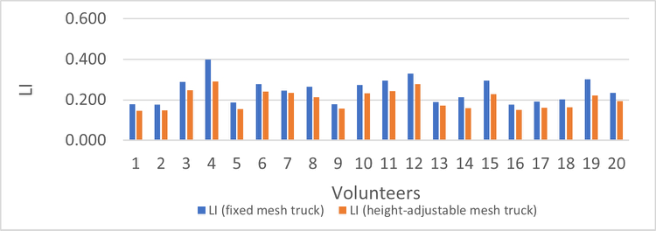
The 200 videos captured by Azure Kinect have been converted from .mkv files to .json file, this was done in order to give input for the semi-automatic NIOSH Lifting Equation carried out with AzKNIOSH. From the ergonomic risk assessment, we tested if there were some beneficial effects on the Lif- ting Index given by the height-adjustable mesh truck respect to the base one. To do that for each lifting we considered only the LI of the lift start frame, because the height-adjustable mesh truck affects just the lift from/to it and did not affect the disposal of the box in shelves. As shown in Figure 4, there is an overall average improvement of the Lifting Index of 17.1% among all volunteers with peak of 27%.
Analysing the results revealed a link between the percentage of impro- vement and the volunteer height, calculated correlation index confirms our supposition being equal to −0.356: shortest people have more difficulty to reach the shoeboxes, especially the lowest on the mesh truck, without the
Figure 4: Comparison of lifting index calculated with fixed ad height-adjustable mesh truck for each volunteer.
Ergonomic Risk Reduction: A Height-Adjustable Mesh Truck 145
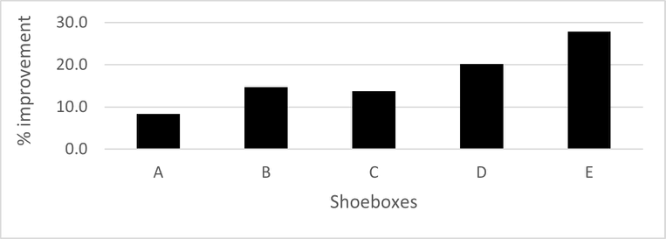
height-adjustable platform; moving it up they can lift the load with a cor- rect body posture and a better LI. Additionally, we found a significant percentage improvement for each box as reported in Figure 5. Correlation index calculated between shoebox position on the mesh truck and percen- tage improvement is 0.952, showing that the improvement is related to the boxes location on the mesh truck: Shoebox A is on the top of the pile, so the lift is not critical because is easily reachable; most percentage improvement is for Shoebox E because is the lowest one in the mesh truck and pick it up is very difficult, especially for short volunteers. To reach it volunteers must assume dangerous posture which involves a higher LI. By adjusting the mesh truck bottom part height is possible to take it on a height of 65 cm from the ground, leading to a better LI with an improvement of 27.9% for the lowest shoebox.
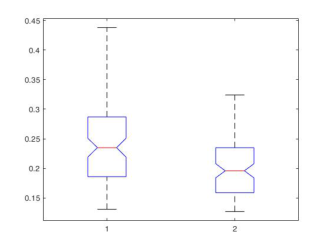
The researchers also carried out an ANOVA test on LI calculated for each lift to statistically validate that they belong to different populations varying with the usage of fixed mesh truck ground or the hight-adjustable one. First, we considered all the LI obtained with the fixed mesh truck ground and with the moving one independently on the shoebox and on the volunteer conside- red. We obtain a p-value of 1.27 e-06 that statistically confirm the reduction of LI obtainable with a mobile ground of the mesh truck. This difference is also visible in Figure 6 where the boxplot of this ANOVA was reported.
Figure 5: Percentage improvement between the two lifting settings for each shoebox.Figure 6: ANOVA boxplot for LI with fixed mesh truck (1) and LI with height-adjustable mesh truck (2).Table 2. P-value for different shoeboxes.
Table available in the original PDF paper.
SHOEBOX A B C D E p - value 0.3008 0.0568 0.0744 0.0107 0.0001
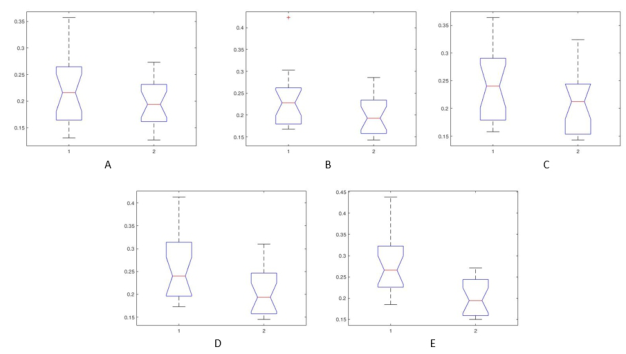
Figure 7: ANOVA boxplot for LI with fixed mesh truck (1) and LI with height-adjustable mesh truck (2), for each shoebox.
The lifts for shoebox type were grouped, then ANOVA test applied to the data. As shown in Table 2 for the three shoeboxes starting from the top (sho- eboxes A, B and C), p-value proves there is no evidence to differentiate LI related to the two different settings. The p-value of the two lowest shoe boxes (shoeboxes D and E) is significant to accept the null hypothesis, so we can confirm that the usage of height-adjustable mesh truck affects the lifting of the lowest shoeboxes the most. Figure 7 illustrates the means of the two dif- ferent groups for shoeboxes A, B and C are very closed, while the difference of the means between groups for shoeboxes D and E are significant different.
CONCLUSION
Applying strategies to reduce the ergonomic risk involved in picking activities is crucial since it is the most labor intensive and critical activities in wareh- ouses (Weisnera & Deusea, 2014) (de Koster et al., 2007). In this work we evaluated the introduction of an heigh adjustable mesh truck to reduce the ergonomic risk of pickers. The evaluation was carried out with a new applica- tion based on Azure Kinect, AzKNIOSH, that semi-automatically calculates the said risk. In this study the researchers collect 200 videos from 20 different volunteers and we found an average risk reduction of 17.1% with peak of 27%. We also conduct an ANOVA on the two groups of LI, with and without the adjustable height mesh truck, that statistically demonstrates the benefits earnable from this tool. Extensions of this work would include both an eco- nomic analysis and the creation of “intelligent” mesh truck that is able to automatically adjust its height based on the quantity it contains.
Ergonomic Risk Reduction: A Height-Adjustable Mesh Truck 147
REFERENCES
BLS. (2017). Employer-Reported Workplace Injuries and Illnesses. U. S. Department of Labor, 202, 1–4. www.bls.gov/web/osh/cd_r75.htm Bortolini, M., Ferrari, E., Gamberi, M., Pilati, F., Faccio, M., Bortolini, M.,
Ferrari, E., Gamberi, M., Pilati, F., Faccio, M., Bortolini, M., Ferrari, E., & Pilati, F. (2017). system the Industry a framework Assembly system the Industry a fra- mework Assembly system the Industry a. IFAC-PapersOnLine, 50(1), 5700–5705. https://doi.org/10.1016/j.ifacol.2017.08.1121. Coronado, E., Kiyokawa, T., Ricardez, G. A. G., Ramirez-Alpizar, I. G., Venture, G., & Yamanobe, N. (2022). Evaluating quality in human-robot interaction: A systematic search and classification of performance and human-centered factors, measures and metrics towards an industry 5.0. Journal of Manufacturing Systems, 63, 392–410. https://doi.org/10.1016/J. JMSY.2022.04.007. Coruzzolo, A. M., Lolli, F., Amicosante, N., Kumar, H., Thupaki, P., & Agarwal, S.
(2022). Comparing semiautomatic Rapid Upper Limb Assessments (RULA): Azure Kinect versus RGB-based machine vision algorithm. Physical Ergonomics and Human Factors, 63(63), 54–61. https://doi.org/10.54941/AHFE1002596. David, G. C. (2005). Ergonomic methods for assessing exposure to risk factors for work-related musculoskeletal disorders. Occupational Medicine, 55(3), 190–199. https://doi.org/10.1093/occmed/kqi082. de Koster, R., Le-Duc, T., & Roodbergen, K. J. (2007). Design and control of
warehouse order picking: A literature review. European Journal of Operational Research, 182(2), 481–501. https://doi.org/10.1016/j.ejor.2006.07.009. Delpresto, J., Duan, C., Layiktez, L. M., Moju-Igbene, E. G., Wood, M. B., & Beling, P. A. (2013). Safe lifting: An adaptive training system for factory workers using the Microsoft Kinect. 2013 IEEE Systems and Information Engineering Design Symposium, SIEDS 2013, 64–69. https://doi.org/10.1109/SIEDS.2013.6549495 Diego-Mas, J. A., & Alcaide-Marzal, J. (2014). Using KinectTM sensor in observatio-
nal methods for assessing postures at work. Applied Ergonomics, 45(4), 976–985. https://doi.org/10.1016/j.apergo.2013.12.001. Hignett, S., & McAtamney, L. (2000). Rapid Entire Body Assessment (REBA). Applied Ergonomics, 31(2), 201–205. https://doi.org/10.1016/S0003- 6870(99)00039-3. HSE (Health and Safety Executive). (2014). Risk Assessment: A Brief Guide to Controlling Risks in the Workplace, INDG163 (rev4). Available at http://www.hse.gov.uk/pubns/indg163.pdf. https://www.hse.gov.uk/pubns/ind g163.pdf. Kang, D., Kim, Y. K., Kim, E. A., Kim, D. H., Kim, I., Kim, H. R., Min, K. B., Jung-Choi, K., Oh, S. S., & Koh, S. B. (2014). Prevention of Work-Related Muscu- loskeletal Disorders. In Annals of Occupational and Environmental Medicine (Vol. 26, Issue 1, pp. 1–2). BioMed Central Ltd. https://doi.org/10.1186/2052- 4374-26-14. Karhu, O., Kansi, P., & Kuorinka, I. (1977). Correcting working postures in
industry: A practical method for analysis. Applied Ergonomics, 8(4), 199–201. https://doi.org/10.1016/0003-6870(77)90164-8. Kowalski, K., Rhodes, R., Naylor, P. J., Tuokko, H., & MacDonald, S. (2012).
Direct and indirect measurement of physical activity in older adults: A systematic review of the literature. International Journal of Behavioral Nutrition and Physical Activity, 9(August 2014). https://doi.org/10.1186/1479-5868-9-148. Li, G., & Buckle, P. (1999). Current techniques for assessing physical exposure to work-related musculoskeletal risks, with emphasis on posture-based methods. In Ergonomics (Vol. 42, Issue 5, pp. 674–695). Taylor & Francis Ltd. https://doi.or g/10.1080/001401399185388.
Liao, Y., Deschamps, F., Loures, E. de F. R., & Ramos, L. F. P. (2017). Past, present and future of Industry 4.0 - a systematic literature review and research agenda proposal. International Journal of Production Research, 55(12), 3609–3629. https://doi.org/10.1080/00207543.2017.1308576 Lunin, A., & Glock, C. H. (2021). Systematic review of Kinect-based solutions for
physical risk assessment in manual materials handling in industrial and laboratory environments. Computers & Industrial Engineering, 107660. https://doi.org/10. 1016/j.cie.2021.107660. Lynn, M., & Corlett, N. (1993). RULA: A survey method for the investigation of work-related upper limb disorders. Applied Ergonomics, 24(2), 91–99. Manghisi, Vito M., Uva, A. E., Fiorentino, M., Gattullo, M., Boccaccio, A., & Evan-
gelista, A. (2020). Automatic ergonomic postural risk monitoring on the factory shopfloor -The Ergosentinel tool. Procedia Manufacturing, 42(2019), 97–103. https://doi.org/10.1016/j.promfg.2020.02.091. Manghisi, Vito Modesto, Uva, A. E., Fiorentino, M., Bevilacqua, V., Trotta, G. F., & Monno, G. (2017). Real time RULA assessment using Kinect v2 sensor. Applied Ergonomics, 65, 481–491. https://doi.org/10.1016/j.apergo.2017.02.015. Mgbemena, C. E., Oyekan, J., Hutabarat, W., Fletcher, S., XU, Y., & Tiwari, A.
(2017). Optimum Kinect Setup for Real-Time Ergonomic Risk Assessment on the Shop Floor. Contemporary Ergonomics and Human Factors 2017, 265–272. https://www.ergonomics.org.uk/product/contemporary-ergonomics-hu man-factors-2017/. Microsoft. (2021). Azure Kinect Body Tracking SDK | Microsoft Docs. https://docs .microsoft.com/it-it/azure/kinect-dk/body-sdk-download. Moore, J. S., & Garg, A. (1995). The strain index: A proposed method to analyze jobs
for risk of distal upper extremity disorders. American Industrial Hygiene Associ- ation Journal, 56(5), 443–458. https://doi.org/10.1080/15428119591016863. Neumann, W. P., & Village, J. (2012). Ergonomics action research II: A framework for integrating HF into work system design. Ergonomics, 55(10), 1140–1156. https://doi.org/10.1080/00140139.2012.706714. Occhipinti, E. (1998). OCRA: A concise index for the assessment of exposure to
repetitive movements of the upper limbs. Ergonomics, 41(9), 1290–1311. https: //doi.org/10.1080/001401398186315. Patrizi, A., Pennestrì, E., & Valentini, P. P. (2016). Comparison between low-cost marker-less and high-end marker-based motion capture systems for the computer- aided assessment of working ergonomics. Ergonomics, 59(1), 155–162. https://do i.org/10.1080/00140139.2015.1057238. Plantard, P., Shum, H. P. H., Le Pierres, A. S., & Multon, F. (2017). Validation of
an ergonomic assessment method using Kinect data in real workplace conditi- ons. Applied Ergonomics, 65, 562–569. https://doi.org/10.1016/j.apergo.2016. 10.015. Seghezzi, E., Locatelli, M., Pellegrini, L., Pattini, G., Di Giuda, G. M., Tagliabue, L. C., & Boella, G. (2021). Towards an occupancy-oriented digital twin for facility management: Test campaign and sensors assessment. Applied Sciences (Switzerland), 11(7). https://doi.org/10.3390/app11073108. Snook, S. H., & Ciriello, V. M. (1991). The design of manual handling tasks:
Revised tables of maximum acceptable weights and forces. Ergonomics, 34(9), 1197–1213. https://doi.org/10.1080/00140139108964855. Spector, J. T., Lieblich, M., Bao, S., McQuade, K., & Hughes, M. (2014). Automation of Workplace Lifting Hazard Assessment for Musculoskeletal Injury Prevention. Annals of Occupational and Environmental Medicine, 26(1), 15. https://doi.org/ 10.1186/2052-4374-26-15.
Ergonomic Risk Reduction: A Height-Adjustable Mesh Truck 149
Waters, T. R., Ph, D., Putz-anderson, V., Garg, A., & Centers, P. D. (1994). Applications Manual For the Revised NIOSH Lifting Equation Table of Contents. https://doi.org/10.26616/NIOSHPUB94110. Waters, T. R., Putz-Anderson, V., Garg, A., & Fine, L. J. (1993). Revised NIOSH
equation for the design and evaluation of manual lifting tasks. Ergonomics, 36(7), 749–776. https://doi.org/10.1080/00140139308967940. Weisnera, K., & Deusea, J. (2014). Assessment methodology to design an ergonomic and sustainable order picking system using motion capturing systems. Procedia CIRP, 17, 422–427. https://doi.org/10.1016/J. PROCIR.2014.01.046.
LISTED IN THE AHFE DIGITAL BOOKSTORE CATALOGUE
Explore the complete digital volume
Ergonomics In Design
Read this individual research paper free through the original publisher, or explore the full digital proceedings book.
ISBN 978-1-958651-53-7
Explore this ISBN in the AHFE Bookstore ↗Listed in the July 2026 bookstore catalogue; search by ISBN to confirm current availability · Digital book purchase optional