Antonio Maria Coruzzolo, Chiara Forgione, Christian Di Natali, Francesco Lolli (2024). Ergonomic risk reduction in picking activities: evaluation of an active exoskeleton through Azure Kinect. In: Physical Ergonomics and Human Factors. AHFE Open Access, vol. 147, pp. 117–127. https://doi.org/10.54941/ahfe1005184
Reducing the ergonomic risk involved in picking activities is fundamental to ensure the health of the workers by minimizing the occurrence of musculoskeletal disorders. Recently exoskeletons have been introduced to support workers and reduce the overload. In this paper exploiting a depth camera we evaluated the risk involved in picking activities with and without the support of an active exoskeleton. For the scope 5 different subjects performed 42 lifting actions with and without the active exoskeleton for a total of 420 total lifts. The task was to reproduce a real logistical scenario of palletizing boxes in the laboratory. The lifting actions were recorded in a laboratory setting with the Azure Kinect depth camera benchmarking the posture with and without the active exoskeleton. For the risk assessment we exploited a tool based on the Azure Kinect to automatically calculate the NIOSH lifting equation named AzKNIOSH. Results statistically demonstrated that the exoskeleton does not affect the posture during the lift while it has a beneficial effect on the lifting index considering a decreased load weight.
Work-related musculoskeletal disorders (WMSDs) pose a significant chal- lenge to occupational health, with evidence indicating their prevalence as a major workplace concern (Lu et al., 2014). These disorders can be cate- gorized based on the specific site interested, such as back pain, upper limb disorders, and lower limb pain (Lucas et al., 2021). Recently, under the fourth Industrial Revolution organizations and industrial processes under- went transformative changes (Coronado et al., 2022). Automation has significantly improved working conditions but certain tasks, particularly in logistics, remain challenging to automate, with order picking standing out as one of the most labour-intensive activities (de Koster et al., 2007).
Order picking also poses ergonomic challenges, contributing to WMSDs due to factors like heavy load weight and repetitive, awkward body pos- tures (Weisnera & Deusea, 2014). These WMSDs lead to long-term injuries, with 31.4% of workdays lost attributed to them, as reported by the US Bureau of Labor Statistics (BLS, 2017). Among these WMSDs it has been estimated that low-back pain account for between 26% and 50% of the total (Punnett & Wegman, 2004). WMSDs that have also a high economic impact estimated in $20 billion annually in the US only for direct costs (Kang et al., 2014). Given their economic and social impact there is a clear imperative for strategies aimed at reducing WMSDs in the workplace. Various ergonomic interventions have been proposed for the scope, includ- ing improvements in lifting techniques, foot positioning, and lifting height adjustments (Hoozemans et al., 2008) (Marras et al., 1999). However, the effectiveness of these ergonomic solutions is not universal and are quite specifics e.g., prescriptions to lift a box that is too large to fit between the knees (Kingma et al., 2010). In response to this challenge, there is a grow- ing interest in the use of industrial exoskeletons, specifically designed to address manual material handling (MMH) tasks (Toxiri et al., 2019). Eval- uating the effectiveness of these exoskeletons involves a range of metrics, including human biomechanics, lifting behaviour, electromyography, phys- iological parameters, and exoskeleton-related parameters (Guerrero et al., 2012; Huysamen et al., 2018a; Koopman et al., 2019, 2020; Pesenti et al., 2021). However, a consensus on evaluation methods and metrics for occupa- tional exoskeletons is still evolving and a standardized approach is missing. From an ergonomic perspective, there is currently no established procedure to evaluate the benefits provided by an exoskeleton. However, there are some experimental methods under development (Di Natali et al., 2021; Spada et al., 2018; Zelik et al., 2022). Recent studies revealed that work-related low back disorders alone account for a substantial portion of reported WMSDs (Kim et al., 2010; Punnett & Wegman, 2004). For this reason, back support devices target the reduction of compressive load on the spinal discs, mit- igating associated injury risks during lifting tasks (de Looze et al., 2016). Recent evaluations based on electromyography revealed a reduction from 10 up to 40% of the total activation of low back muscles (erector spinae) using active low back support exoskeleton (Huysamen et al., 2018b; Lanotte et al., 2018). At the same time classical evaluations of manual activities car- ried out in the Industrial field are quite different from the ones exploited in laboratory setting to evaluate the impact of exoskeletons. In fact, to assess ergonomic risk in the industrial field, three methods are commonly used: self- reports, direct measurements, and observational techniques (Li & Buckle, 1999). Self-reports are subjective and influenced by worker bias (David, 2005), while direct measurements, relying on body-mounted sensors, are intrusive and expensive (Kowalski et al., 2012). Among the observational methods the NIOSH lifting equation was particularly designed for assess- ing the risk in repetitive lifting tasks (Lu et al., 2014; Waters et al., 1993). Observational methods that have evolved, incorporating Motion Capture Technologies (MOCAP) to address limitations like time-consuming video analysis and high variability (Mgbemena et al., 2017). MOCAP systems are
Ergonomic Risk Reduction in Picking Activities: Evaluation of an Active Exoskeleton 119
categorized as sensor-based and optical (Seghezzi et al., 2021). Sensor-based systems are less common due to user discomfort, while optical systems, like Kinect cameras, are non-intrusive and established for ergonomic risk assess- ment (ERA) (Manghisi et al., 2020). In this paper we evaluate the impact of an active exoskeleton for low back support with an Azure Kinect based application to evaluate the NIOSH lifting equation named AzKNIOSH (Lolli et al., 2023), that as far as our knowledge goes is a novel contribution for the literature. In particular, with AzKNIOSH we evaluate the impact of the exoskeleton on the postures during the lift considering no load reduction and a load reduction of one third of the weight since a previous study introduced the concept of equivalent weight for the same exoskeleton using electromyo- graphy (Natali et al., 2021). The paper is structured as follows: Section 1 presents the methods of the research in particular Section 1.1 illustrates the exploited exoskeleton while Section 1.2 briefly introduces AzKNIOSH, Sec- tion 3 illustrates the experiment setting while Section 4 presents the results, lastly conclusions are stated together with some future research agenda.
METHODS
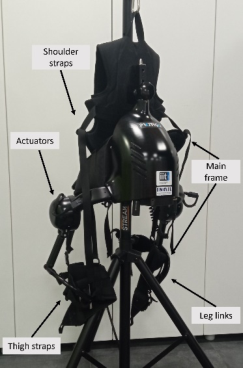
Exoskeleton Charateristics The exoskeleton here employed named XoTrunk, is an active back-support device designed for assisting workers in manual material handling tasks (Figure 1) (Poliero et al., 2022). Worn like a backpack, XoTrunk features articulated structures on the thighs and contributes to extension torque at the lower back and hips. It consists of a main rigid frame housing on-board electronics, strapped onto the wearer with custom-made soft braces. Two actuators generate torques between the back frame and articulated leg links. Details on the actuators and low-level control are provided in (Di Natali et al., 2020) while kinematics and physical attachments are described in (Sposito et al., 2020). Control of the exoskeleton runs in real-time, involving a high- level layer detecting activities (e.g., walking, bending) and a mid-level layer adjusting torque patterns accordingly (Toxiri et al., 2018). The exoskeleton can generate torques from 0 to 30 Nm (Poliero et al., 2022).
AzKNIOSH The NIOSH Lifting Equation assesses ergonomic risk in manual load lifting by determining the Recommended Weight Limit (RWL), which is then used to calculate the Lifting Index (LI) (Snook & Ciriello, 1991). The LI offers insights into risk levels by considering the lifted object’s weight in relation to the RWL. Higher LI values indicate increased risk during lifting. AzKNIOSH, implemented in Python 3.8, semi-automatically calculates the NIOSH Lifting Equation using the Azure Kinect Body Tracking SDK (Microsoft, 2021). The system employs the depth camera with a CNN-based algorithm to locate 32 joints in 3D space. Additional processing is performed to calculate NIOSH Lifting Equation multipliers, including Distance Multiplier (DM), Horizon- tal Multiplier (HM), Vertical Multiplier (VM), Asymmetric Multiplier (AM),
and Coupling Multiplier (CM) as described in (Lolli et al., 2023). In addition, some manual inputs are required:
Operator age and gender to calculate the Load Constant (LC).
Lift frequency and duration to calculate Frequency Multiplier (FM).
Qualitative judgment of the grip and possible use of gloves contributing to Coupling Multiplier (CM).
The start and end of the lift i.e., the two frames where the lift starts and ends.
Figure 1: Exploited exoskeleton.
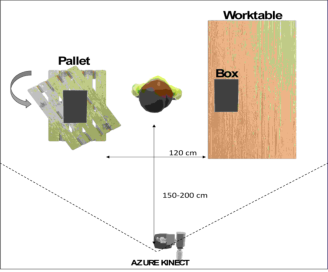
EXPERIMENT SETTING For video recording, we utilized an Azure Kinect configured with specific settings: Color mode set to 720p, Depth mode set to NFOV 2x2 binned, No depth delays, Frames per second (fps) at 15, IMU ON, External Sync Standalone, Sync delay set to 0, and Gain Auto. The Kinect was consis- tently positioned at a height of 110 cm and at a distance of 150–200 cm from the subject. The experimental setup, illustrated by a top-view graphical representation in Figure 2, comprised the following elements:
9 shoeboxes of size 35x22x13 cm.
3 medium boxes of size 57x39x42 cm.
A table with a height of 72 cm.
A pallet with a height of 10 cm.
The experimental routine consisted of:
Unloading the 9 shoeboxes, one of the tops of each other for a total height of 135 cm, from the pallet to the table in two different columns (the first one with 5 shoeboxes the other with 4). Weights of the 9 boxes are:
Re-loading the pallet with the 9 shoeboxes from the table.
Ergonomic Risk Reduction in Picking Activities: Evaluation of an Active Exoskeleton 121
Unloading the 3 medium size boxes, one of the tops of each other for a total height of 90 cm.
Re-loading the pallet with the 3 medium size boxes from the table.
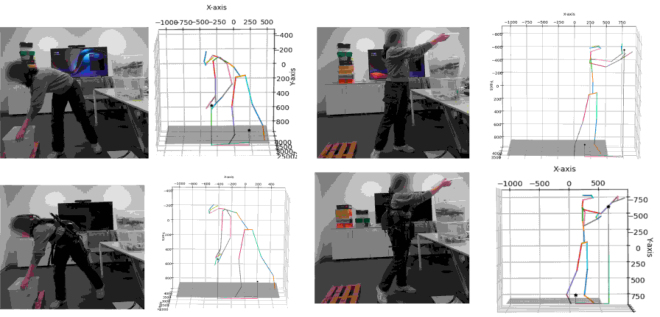
However, the first two point of the routine were repeated with two dif- ferent pallet orientations as displayed in Figure 2 resulting in a total of 42 lifting actions for each subject. These 42 lifts were executed by each subject with and without the support of the exoskeleton, thus 84 lifts were recorder for each subject. In the experiment 5 different subjects were involved, 3 males and two females (avg. age: 29.8 years, std:3.34 years; avg. height: 180.2 cm std: 8.22 cm; avg. weight: 73.2 kg std: 8.31 kg) and performed a total of 420 lifting actions. Since the LI has been calculated for each lift at its start and at its end a total of 840 LI, 420 with and 420 without the exoskeleton have been benchmarked. Figure 3 reports the same lift executed with and with- out the exoskeleton by the third subject together with its body segmentation provided by the Azure Kinect and with the vertical and horizontal distances during the lift.
Figure 2: Top view of the set up.Figure 3: Same lift performed with and without the exoskeleton by the third subject with segmentation of the body and vertical and horizontal distance.
The first 9 shoeboxes, in order of the first picking from the pallet, have a weight of: 11-5-10-8-3-8-8-3-3 kg. While the medium size shoeboxes have all a weight of 12 kg. The grip was evaluated as fair for the shoeboxes thus a value of 1 was exploited for CM and as good, value of 2, for the medium size boxes where handles are present. Other useful information to calculate semi-automatic the LI: lift frequency of 2 lift/min for each shoebox and of 3 lift/min for each medium size box; the lift duration of 6 hours for both boxes. It has to be reminded that for each video start and end of each lift where manually identified.
RESULTS
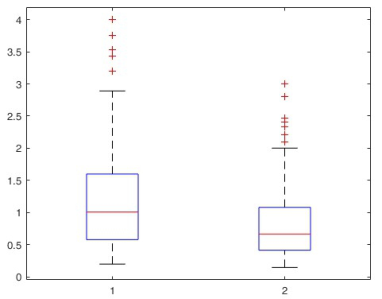
The 840 LIs obtained have been analyzed through an ANOVA without con- sidering any weights reduction obtainable from the exoskeleton. Thus, the 420 LIs without the exoskeleton have been benchmarked with the 420 wear- ing it only in terms of postures. The results of a t-test between these two groups showed that no significant statistical differences have been observed since the resulting p-value was of 0.59 rejecting the null hyphothesis. In particular, without the exoskeleton, the mean LI was 1.16 with a standard deviation of 0.74, while it was 1.17 with the exoskeleton with a standard deviation of 0.72. From this first analysis, we can conclude that the exoskele- ton does not impact the posture during the lifts in the tested experiment. However, even if the posture is not affected by the exoskeleton, it can pro- vide a weight reduction of the lifted load. In fact, for this exoskeleton, we can apply the equivalent weight approach (Di Natali et al., 2021). The equivalent weight approach requires an assessment of the impact of the exoskeleton on the ES through a dedicated and task-specific experimental section. Moreover, we could hypnotize that the results obtained in Di Natali et al. (2021) can be applied to the specific task to show the potential impact that an exoskeleton combined with the proposed method can have on the ergonomic assessment of a task. Di Natali et al. (2021) demonstrated that XoTrunk could reduce the perceived weight by about 30%. Since the application is very similar, we decided to take advantage of this preliminary result for the work presented in this paper with the main goal of showing a methodology to automatize the ergonomic assessment of a worker wearing an exoskeleton. For this rea- son, we re-calculated all the LI with the exoskeleton reducing the weight lifted by 30%. This time the p-value resulting from the t-test was 1.58 1e-41 confirming the different distributions of the two groups of LI. In particular this time LI with the exoskeleton and the weight reduction has a mean value of 0.81 and a standard deviation of 0.54, resulting box plot is shown in Figure 5.
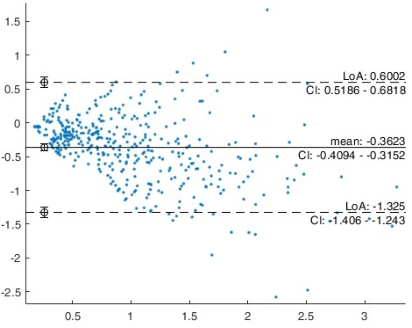
From Figure 5 the benefits earnable from the weight reduction provided by the exoskeleton are clear, with a mean difference of -0.36 between the two as reported in Figure 6 where the Bland Altman plot of the two groups of data is reported.
Ergonomic Risk Reduction in Picking Activities: Evaluation of an Active Exoskeleton 123
Figure 4: Box plot of the LI without the exoskeleton (1) and with the exoskeleton and weight reduction (2).Figure 5: Bland Altman plot of the LI without the exoskeleton and with the exoskeleton.
From the Bland Altman plot we can see that there are only a few outliers, less than 5% of the data, and that the differences distribution is quite sparse but with a mean difference of -0.36. The sparse distribution of the data can be interpreted with the different effects on the different subjects, an aspect that should be further investigated.
CONCLUSION
In this paper an evaluation of the postures adopted during liftings activities with and without the help of an active exoskeleton to support low back, XoTrunk, has been carried out exploiting a depth camera. In particular, the Azure Kinect has been exploited together with an application able to semi- automatically calculate the NIOSH lifting equation and its Lifting Index (LI). The laboratory experiment involved 5 different subjects that performed 84 lifts without the help of the exoskeleton and 84 with its support for a total of 840 total lifts. The data analysis statistically demonstrates that the posture of the subjects was not affected by the exoskeleton in terms of LI. While it was
also demonstrated that considering an average weight reduction of one third as found in a recent study that involved the same exoskeleton (Di Natali et al., 2021) the resulting mean LI reduction is of -0.36 following the same trend. However, the impact of the exoskeleton varied between subjects with a sparse distribution thus future research must include a wider sample to comprehend its impact based on subject characteristics.
Informed Consent Statement: The experiment was approved by the Ethical Committee of Liguria (protocol reference number: CER Liguria 001/2019) and complies with the Helsinki Declaration. All the subjects signed a con- sent form prior to participating, after a full explanation of the experimental procedure.
REFERENCES
BLS. (2017). Employer-Reported Workplace Injuries and Illnesses. U.S. Department of Labor, 202, 1–4. www.bls.gov/web/osh/cd_r75.htm. Coronado, E., Kiyokawa, T., Ricardez, G. A. G., Ramirez-Alpizar, I. G., Venture,
G., & Yamanobe, N. (2022). Evaluating quality in human-robot interaction: A systematic search and classification of performance and human-centered factors, measures and metrics towards an industry 5.0. Journal of Manufacturing Systems, 63, 392–410. https://doi.org/10.1016/J. JMSY.2022.04.007 David, G. C. (2005). Ergonomic methods for assessing exposure to risk factors for work-related musculoskeletal disorders. Occupational Medicine, 55(3), 190–199. https://doi.org/10.1093/occmed/kqi082 de Koster, R., Le-Duc, T., & Roodbergen, K. J. (2007). Design and control of
warehouse order picking: A literature review. European Journal of Operational Research, 182(2), 481–501. https://doi.org/10.1016/j.ejor.2006.07.009 de Looze, M. P., Bosch, T., Krause, F., Stadler, K. S., & O’Sullivan, L. W. (2016).
Exoskeletons for industrial application and their potential effects on physical work load. Ergonomics, 59(5), 671–681. https://doi.org/10.1080/00140139. 2015.1081988 Di Natali, C., Chini, G., Toxiri, S., Monica, L., Anastasi, S., Draicchio, F., Caldwell, D. G., & Ortiz, J. (2021). Equivalent weight: Connecting exoskeleton effectiveness with ergonomic risk during manual material handling. International Journal of Environmental Research and Public Health, 18(5), 1–25. https://doi.org/10.3390/ ijerph18052677 Di Natali, C., Toxiri, S., Ioakeimidis, S., Caldwell, D. G., & Ortiz, J. (2020). System-
atic framework for performance evaluation of exoskeleton actuators. Wearable Technologies, 1, e4. https://doi.org/10.1017/WTC.2020.5 Guerrero, C. R., Marinero, J. F., Turiel, J. P., & Farina, P. R. (2012). Using psychophysiological feedback to enhance physical human robot interaction in a cooperative scenario. Proceedings of the IEEE RAS and EMBS International Conference on Biomedical Robotics and Biomechatronics, 1176–1181. https: //doi.org/10.1109/BIOROB.2012.6290845 Hoozemans, M. J. M., Kingma, I., de Vries, W., & van Dieën, J. (2008). Effect of
lifting height and load mass on low back loading. Ergonomics, 51(7), 1053–1063. https://doi.org/10.1080/00140130801958642 Huysamen, K., de Looze, M., Bosch, T., Ortiz, J., Toxiri, S., & O’Sullivan, L.
W. (2018a). Assessment of an active industrial exoskeleton to aid dynamic lift- ing and lowering manual handling tasks. Applied Ergonomics, 68, 125–131. https://doi.org/10.1016/J. APERGO.2017.11.004
Ergonomic Risk Reduction in Picking Activities: Evaluation of an Active Exoskeleton 125
Huysamen, K., de Looze, M., Bosch, T., Ortiz, J., Toxiri, S., & O’Sullivan, L.
W. (2018b). Assessment of an active industrial exoskeleton to aid dynamic lift- ing and lowering manual handling tasks. Applied Ergonomics, 68, 125–131. https://doi.org/10.1016/J. APERGO.2017.11.004 Kang, D., Kim, Y. K., Kim, E. A., Kim, D. H., Kim, I., Kim, H. R., Min, K. B., Jung-Choi, K., Oh, S. S., & Koh, S. B. (2014). Prevention of Work-Related Mus- culoskeletal Disorders. In Annals of Occupational and Environmental Medicine (Vol. 26, Issue 1, pp. 1–2). BioMed Central Ltd. https://doi.org/10.1186/2052- 4374-26-14 Kim, K. H., Kim, K. S., Kim, D. S., Jang, S. J., Hong, K. H., & Yoo, S. W. (2010).
Characteristics of Work-related Musculoskeletal Disorders in Korea and Their Work-relatedness Evaluation. Journal of Korean Medical Science, 25(Suppl), S77. https://doi.org/10.3346/JKMS.2010.25. S. S77 Kingma, I., Faber, G. S., & van Dieën, J. H. (2010). How to lift a box that is too large to fit between the knees. Ergonomics, 53(10), 1228–1238. https://doi.org/ 10.1080/00140139.2010.512983 Koopman, A. S., Kingma, I., de Looze, M. P., & van Dieën, J. H. (2020).
Effects of a passive back exoskeleton on the mechanical loading of the low-back during symmetric lifting. Journal of Biomechanics, 102, 109486. https://doi.org/10.1016/J. JBIOMECH.2019.109486 Koopman, A. S., Toxiri, S., Power, V., Kingma, I., van Dieën, J. H., Ortiz, J., & de Looze, M. P. (2019). The effect of control strategies for an active back- support exoskeleton on spine loading and kinematics during lifting. Journal of Biomechanics, 91, 14–22. https://doi.org/10.1016/J. JBIOMECH.2019.04.044 Kowalski, K., Rhodes, R., Naylor, P. J., Tuokko, H., & MacDonald, S. (2012).
Direct and indirect measurement of physical activity in older adults: A system- atic review of the literature. International Journal of Behavioral Nutrition and Physical Activity, 9(August 2014). https://doi.org/10.1186/1479-5868-9-148 Lanotte, F., Grazi, L., Chen, B., Vitiello, N., & Crea, S. (2018). A Low-Back Exoskeleton can Reduce the Erector Spinae Muscles Activity during Freestyle Symmetrical Load Lifting Tasks. Proceedings of the IEEE RAS and EMBS International Con- ference on Biomedical Robotics and Biomechatronics, 2018-August, 701–706. https://doi.org/10.1109/BIOROB.2018.8488094 Li, G., & Buckle, P. (1999). Current techniques for assessing physical exposure to
work-related musculoskeletal risks, with emphasis on posture-based methods. In Ergonomics (Vol. 42, Issue 5, pp. 674–695). Taylor & Francis Ltd. https://doi.or g/10.1080/001401399185388 Lolli, F., Coruzzolo, A. M., Forgione, C., & Gonçalves Terra Neto, P. (2023).
Ergonomic Risk Reduction: A Height-Adjustable Mesh Truck for Picking Activi- ties Evaluated With A Depth Camera. Ergonomics In Design, 77. https://doi.org/ 10.54941/AHFE1003371 Lu, M. L., Waters, T. R., Krieg, E., & Werren, D. (2014). Efficacy of the Revised NIOSH Lifting Equation to Predict Risk of Low-Back Pain Associated With Man- ual Lifting: A One-Year Prospective Study. Human Factors, 56(1), 73. https: //doi.org/10.1177/0018720813513608 Lucas, J., Connor, E., & Bose, J. (2021). Back, Lower Limb, and Upper Limb Pain
Among U. S. Adults, 2019. https://doi.org/10.15620/CDC:107894 Manghisi, V. M., Uva, A. E., Fiorentino, M., Gattullo, M., Boccaccio, A., & Evangelista, A. (2020). Automatic ergonomic postural risk monitoring on the factory shopfloor -The Ergosentinel tool. Procedia Manufacturing, 42(2019), 97–103. https://doi.org/10.1016/j.promfg.2020.02.091
Marras, W. S., Granata, K. P., Davis, K. G., Allread, W. G., & Jorgensen, M. J.
(1999). Effects of box features on spine loading during warehouse order selecting. Ergonomics, 42(7), 980–996. https://doi.org/10.1080/001401399185252 Mgbemena, C. Edith., Oyekan, J., Hutabarat, W., Fletcher, S., XU, Y., & Tiwari, A. (2017). Optimum Kinect Setup for Real-Time Ergonomic Risk Assess- ment on the Shop Floor. Contemporary Ergonomics and Human Factors 2017, 265–272. https://www.ergonomics.org.uk/product/contemporary-ergonomics-hu man-factors-2017/ Microsoft. (2021). Azure Kinect Body Tracking SDK | Microsoft Docs. https://docs
.microsoft.com/it-it/azure/kinect-dk/body-sdk-download Pesenti, M., Antonietti, A., Gandolla, M., & Pedrocchi, A. (2021). Towards a Functional Performance Validation Standard for Industrial Low-Back Exoskele- tons: State of the Art Review. Sensors 2021, Vol. 21, Page 808, 21(3), 808. https://doi.org/10.3390/S21030808 Poliero, T., Fanti, V., Sposito, M., Caldwell, D. G., & Natali, C. Di. (2022). Active and
Passive Back-Support Exoskeletons: A Comparison in Static and Dynamic Tasks. IEEE Robotics and Automation Letters, 7(3), 8463. https://doi.org/10.1109/LR A.2022.3188439 Punnett, L., & Wegman, D. H. (2004). Work-related musculoskeletal disorders: The epidemiologic evidence and the debate. Journal of Electromyography and Kinesiology, 14(1), 13–23. https://doi.org/10.1016/j.jelekin.2003.09.015 Seghezzi, E., Locatelli, M., Pellegrini, L., Pattini, G., Di Giuda, G. M., Tagliabue,
L. C., & Boella, G. (2021). Towards an occupancy-oriented digital twin for facility management: Test campaign and sensors assessment. Applied Sciences (Switzerland), 11(7). https://doi.org/10.3390/app11073108 Snook, S. H., & Ciriello, V. M. (1991). The design of manual handling tasks: Revised tables of maximum acceptable weights and forces. Ergonomics, 34(9), 1197–1213. https://doi.org/10.1080/00140139108964855 Spada, S., Ghibaudo, L., Gilotta, S., Gastaldi, L., & Cavatorta, M. P. (2018). Anal-
ysis of exoskeleton introduction in industrial reality: Main issues and EAWS risk assessment. Advances in Intelligent Systems and Computing, 602, 236–244. https://doi.org/10.1007/978-3-319-60825-9_26 Sposito, M., Di Natali, C., Toxiri, S., Caldwell, D. G., De Momi, E., & Ortiz, J. (2020). Exoskeleton kinematic design robustness: An assessment method to account for human variability. Wearable Technologies, 1, e7. https://doi.org/10. 1017/WTC.2020.7 Toxiri, S., Koopman, A. S., Lazzaroni, M., Ortiz, J., Power, V., de Looze, M. P.,
O’Sullivan, L., & Caldwell, D. G. (2018). Rationale, Implementation and Evalu- ation of Assistive Strategies for an Active Back-Support Exoskeleton. Frontiers in Robotics and AI, 5(MAY). https://doi.org/10.3389/FROBT.2018.00053 Toxiri, S., Näf, M. B., Lazzaroni, M., Fernández, J., Sposito, M., Poliero, T., Monica, L., Anastasi, S., Caldwell, D. G., & Ortiz, J. (2019). Back-Support Exoskeletons for Occupational Use: An Overview of Technological Advances and Trends. IISE Transactions on Occupational Ergonomics and Human Factors, 7(3–4), 237–249. https://doi.org/10.1080/24725838.2019.1626303 Waters, T. R., Putz-Anderson, V., Garg, A., & Fine, L. J. (1993). Revised NIOSH
equation for the design and evaluation of manual lifting tasks. Ergonomics, 36(7), 749–776. https://doi.org/10.1080/00140139308967940
Ergonomic Risk Reduction in Picking Activities: Evaluation of an Active Exoskeleton 127
Weisnera, K., & Deusea, J. (2014). Assessment methodology to design an ergonomic and sustainable order picking system using motion capturing systems. Procedia CIRP, 17, 422–427/. https://doi.org/10.1016/J. PROCIR.2014.01.046 Zelik, K. E., Nurse, C. A., Schall, M. C., Sesek, R. F., Marino, M. C., & Gallagher, S. (2022). An ergonomic assessment tool for evaluating the effect of back exoskeletons on injury risk. Applied Ergonomics, 99. https://doi.org/10.1016/J. APERGO.2021.103619
LISTED IN THE AHFE DIGITAL BOOKSTORE CATALOGUE
Explore the complete digital volume
Physical Ergonomics and Human Factors
Read this individual research paper free through the original publisher, or explore the full digital proceedings book.
ISBN 978-1-964867-23-6
Explore this ISBN in the AHFE Bookstore ↗Listed in the July 2026 bookstore catalogue; search by ISBN to confirm current availability · Digital book purchase optional