Diana Madelane, Henrijs Kalkis, Zenija Roja (2024). Ergonomic Work Environment Risks for Diesel Locomotive Drivers in Latvia and Health Promotion Measures. In: Physical Ergonomics and Human Factors. AHFE Open Access, vol. 147, pp. 108–116. https://doi.org/10.54941/ahfe1005183
In Latvia, the rail transport sector plays an important role in the national economy. Rail transport sector work is provided by different people who work in different professions, including diesel locomotive drivers. The aim of this research was to study and analyze ergonomic risks for drivers of diesel locomotives and develop health promotion measures. Such methods were selected for the research: questionnaire of the workers (Total 116 employees), key indicator method for analysis of manual handling operations, Quick Exposure Check and Rapid Upper Limb Assessment for assessing the load on different body parts. The ergonomic evaluation has determined that the diesel locomotive drivers are subjected to a risk level III concerning strain on their wrists and hands, while their shoulders and arms are at a risk level II. According to the Rapid Upper Limb Assessment, the final evaluation of the strain on the workers’ hands is categorized as high. The study concludes that diesel locomotive operators face substantial ergonomic risks in their work environment. The ergonomic risk assessment methodologies utilized in the study indicate that these operators are subjected to considerable strain, particularly on their wrists, neck, and shoulders, which is overall classified as risk level III. Hence the use of a combination of several ergonomic risk assessment methods is essential to come up with more precise results.
In the world, including Latvia, occupational diseases related to ergonomic risks at work are increasing rapidly in recent years. Research has shown that ergonomic risks at work cause work related musculoskeletal disor- ders (WRMSD) (Hulshof et al., 2021), which are associated with long-term absence from work. In addition, it has been found that psychosocial occu- pational risks often exacerbate health problems for employees caused by ergonomic risks (Buckle, 2005). In their daily work, locomotive drivers are exposed to various risk factors of the work environment, including physical and mental risks and their combined effects on safety and health (Grabar, 2002). Cognitive risks at work play a significant role: for high punctual- ity, precision, alertness and responsibility at work, as well as knowledge and
Ergonomic Work Environment Risks for Diesel Locomotive Drivers in Latvia 109
endurance (Warmerdam et al., 2018; Fan et al., 2022). Nowadays, an urgent problem is increasingly facing the challenge of an ageing workforce, as well as the increase in occupational diseases among the representatives of the men- tioned profession, considering the employees have a long service history and as well as being exposed to great physical and mental stress at work (Kalkis et al., 2015).
Diesel locomotive drivers, like other rail professionals, play a crucial role in the system of human-machine-environment system. They should be able to control the situation, be responsible and punctual, precise and alert, knowl- edgeable and resilient (Hranicky et al., 2021). The working conditions of diesel locomotive drivers are physically demanding and morally difficult. Research shows that the most important risks for locomotive drivers are ergonomic risks, incl. physical fatigue, forced postures and repetitive move- ments (Fan et al., 2022) at work, which can contribute to musculoskeletal health problems. Locomotive drivers are also exposed to physical hazards (noise and vibration) during their work, which can cause disorders of the nervous system, heart and circulatory system and cause hearing damage. The combined effect of the mentioned risks can contribute to occupational accidents (Fan et al., 2022). Latvia, as well as other countries, is increas- ingly facing the challenge of an ageing workforce (Kalkis et al., 2015) and WRMSDs are increasing annually in Latvia (European Agency for Safety and Health at Work, 2019) and physical overload is still a problem in many coun- tries (Ingram and Symmons, 2018). Researchers have shown that ergonomic working conditions as well as a safety culture play an important role in health promotion for transport drivers (Pickard, 2022; Grabar, 2002).
The aim of this research was to study and analyze ergonomic risks for drivers of diesel locomotives and develop health promotion measures. In total 116 diesel locomotive drivers (all males) were involved in the study. The selec- tion criteria were as follows: full consent to participate in the study, and the locomotive drivers no acute or chronic WRMSDs were detected in locomo- tive drivers according to the results of the compulsory health examination. Study has been approved by Ethics committee of University of Latvia.
MATERIALS AND METHODS
This study involved a survey of diesel locomotive drivers to obtain their views on ergonomic risks in the workplace and their impact on employees‘ health. To assess ergonomic risks, Key indicator method for manual handling operations (KIM-MHO) was applied (Steinberg, 2012). As workers mainly complained of tension in their arms during the survey, while the impact of load on different parts of the body was assessed and evaluated using the Quick Exposure Check (QEC) (David et al., 2005) and Rapid Upper Limb Assessment (RULA) methods (McAtamney and Corlett, 1993).
Employee Survey The employee questionnaire is designed and tailored to meet specific needs and objectives. The questions included in the questionnaire were tailored to the situation and the purpose of the study. The aim of the survey was
to understand employees’ views on existing ergonomic risks at work and their subjective views on improving working conditions. The questionnaire consisted primarily of 3 parts: age of the employee, length of service in the occupation and perception of ergonomic risks at work and ways to improve them. The questionnaire was voluntary. The survey was completed by 116 locomotive drivers, all right-handed males.
Key Indicator Method for Manual Handling Operations (KIM-MHO) The Key indicator method developed at the German Federal Institute of Occupational Safety and Health, Dortmund, is applicable for general ergonomic risk assessment and is easy to apply in practice. KIM-MHO method is useful to select if the work process involves monotonous or repetitive hand movements. The results of the risk assessment of the work environment are determined on the basis of the physical workload assessment score (Steinberg, 2012).
Quick Exposure Check of Ergonomic Risks (QEC Method) Quick Exposure Check (QEC method) method is used in calculations where it is necessary to evaluate the magnitude of the load imposed on an employee’s musculoskeletal system. The method is based on employee and observer eval- uations of various questionnaire items. Once the employee and observer responses have been obtained, the scores are counted and the risks are interpreted.
QEC method (David et al., 2005) focuses on parts of the human body:
Back (load weight; operating time, etc.)
Neck (time of action, posture, etc.)
Shoulders/arms (weight, duration, etc.)
Wrists/Hands (strength, posture, frequency of movement, etc.)
Other factors (pace, vibration, stress, driving).
The Rapid Upper Limb Assessment (RULA Method) The RULA method (McAtamney et al., 1992) is designed to determine the uncomfortable position of the body during work and determine the urgency of risk reduction measures. The assessment results in an overall score corresponding to one of four levels:
Level 1 (1 or 2 points) - it is permissible to be in this posture, for a short period of time.
Level 2 (3 or 4 points) - requires in-depth study of the workload.
Level 3 (5 or 6 points) - define measures to reduce risk.
Level 4 (7 points) - immediate elimination or reduction of hand strain.
RESULTS AND DISCUSSION
Characteristics of the Research Base Description of the cabin. The main working area for the driver is the locomotive cabin, which is his workplace and is equipped with information
Ergonomic Work Environment Risks for Diesel Locomotive Drivers in Latvia 111
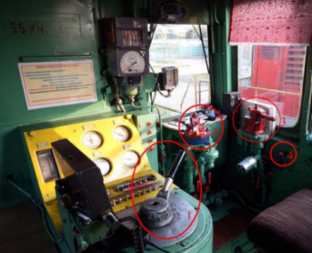
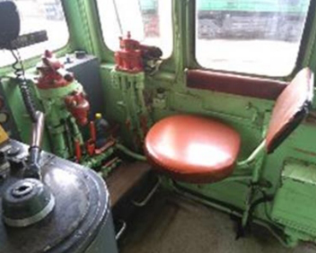
display devices and controls. This is the space where the controls and the driver’s engine operations are located in order to control the locomotive (see Figure 1 and 2).
Figure 1: Locomotive driver workplace (picture from authors’ archive, 2019).Figure 2: Workplace and driver’s chair (picture from authors’ archive, 2019).
Permanent and periodic information displays are located within the driver’s workstation information field at 800–950 mm from the eyes. Mean- while, the most important devices - speedometer, brake gauges, power meters and voltmeters, and traction motors - are within the optimal information field of the driver’s workstation. Seldom-used indicators and alarms can be located above the front window, on the front and rear walls of the cab. The controls and main information display on diesel locomotives are duplicated and located on two control panels installed diagonally on the right and left side of the driver’s cabin. The layout of the control panel and the driver’s and assistant driver’s seats provide comfort for all driving operations. An opti- mum height of the upper edge of the control panel is 700–1000 mm from the floor. It is advisable to tilt the control panel at an angle of 6–10
to the horizontal plane and the information panel of the remote control at an angle of 35
–45
to the vertical plane. Under the control panel there are recesses for the driver’s feet. Handles or handlebars are used to steer locomotives. The forward and reverse direction of movement of the revolver handle cor- respond to the direction of movement of the locomotive. Force required to move the handle (steering) from its fixed position shall not exceed 50 N. The
handle of the control device shall be to the left of the driver and shall be eas- ily accessible. The reverser handle, the driver’s valve and the auxiliary brake valve are in an optimum position or within easy reach. The driver’s valve and the auxiliary brake valve are installed on the right-hand side of the control panel. The brake handles must be shaped and sized to ensure a comfortable grip and a secure hold.
Seating description. A distance from the vertical axis of the driver’s seat to the front window between 500 and 1200 mm is provided. The seats are positioned relative to the side window to allow the driver to observe the locomotive in a seated position. Sitting chairs are installed at the driver’s workstation and are firmly fixed to the cab floor. The chair design assembly allow adjustment of the seat position in height and 360
rotation about the vertical axis of the support, with the ability to lock the chair in the desired position.
Employee Survey Results The survey was completed by 116 locomotive drivers, all men. The major- ity of employees are aged between 50 and 60 years and represent 40.5% of the total number of employees, whereas 33.6% of the total respondents have worked as locomotive drivers between 30 and 39 years. It should be noted that several locomotive engineers are due to retire shortly, and some locomotive engineers have already reached retirement age while still work- ing. In the near future, 40.5% of these employees will reach retirement age, which implies a need for employers to react promptly to maintain the work- ing capacity of existing employees, to improve working conditions and to attract new employees. It has been found that 49.1% of the total locomotive drivers do not perform physical exercises during work. This fact may be due to the possibility that the nature of the work does not necessarily allow it. While 31.0% of respondents rarely exercise during working hours, 19.8% of workers try to perform regular exercises during working hours. Exercises can only be performed while the locomotive is stationary (not in motion), but the number of such moments is rather reduced and depends on how busy the station is. It is impossible to carry out exercises during the work pro- cess (movement) as the driver must constantly watch the road and perform various measures to increase and decrease the speed of the locomotive, peri- odically respond on the walkie-talkie, monitor for people or animals. During this period, the diesel locomotive driver remains seated. The survey found that a higher proportion of locomotive drivers - 65, which is approximately 56.0% of the total, seldom exercise outside work, 16.4% do not exercise, whereas 27.6% practice sport activities regularly outside work. Locomotive engineers have a wide range of interests: some go to the swimming pool, some take up pedaling or cycling. It should be noted that gym attendance is very popular among locomotive drivers. 37.1% of the total locomotive drivers responded that they occasionally feel tension in their hands, while 39.7% do not feel tension in their hands and 23.3% of the total feel tension in their hands when performing their work duties. According to the results of the study, the difference in the answers given by the workers is due to dif- ferences in the length of time the workers have been exposed to the risks of
Ergonomic Work Environment Risks for Diesel Locomotive Drivers in Latvia 113
the working environment, the individual level of fitness of the workers, their ability to work, and their physical condition. 32.8% of the total respondents experience back pain, 21.6% do not experience back pain and 45.7% occa- sionally experience back pain after work. A possible cause of the pain is the construction of the work chair: no armrest and no lumbar support. Com- paring the data with the results of another study, it is found that the results of the employee survey on this issue are similar: a higher proportion (41%) of employee’s report that they have a heavy strain on their arms, legs, back. Other authors have proven in their research that inadequate working condi- tions, i.e. an unsuitable chair without back support and armrests can cause WRMSD’s (Rodrigues et al., 2017).
Key Indicator Method for Manual Handling Operations (KIM-MHO) A locomotive driver’s shift lasts 12 hours, of which the locomotive driver drives the locomotive for approximately 6 hours and performs about 660 hand movements, i.e. about 1.8 movements per minute. This work involves strain on the arms and hands as well as on the body as a whole, the calculation follows (see Table 1).
The calculated score of 30 points corresponds to a risk level of III, i.e. a significantly increased strain on the worker’s hands and body as a whole. Sig- nificant risks are likely to arise as the work chairs at the driver’s workstation are not ergonomically, the chairs do not have armrests and often cannot be adjusted in height. This is also in accordance with the studies of other authors (Juul-Kristensen et al., 2005). Periodically, the worker has to lean forward to change control switches or press a vigilance button, and additional strain is caused by vibration and noise in the workplace.
Table 1. Risk score calculation using KIM-MHO.
Table available in the original PDF paper.
Title Score Comments Strength indicator 1 The locomotive driver makes on average 1.8 hand movements per minute, including turning control switches and pushing the vigilance button. Manual operation of the control switches is not necessary for long periods of time, therefore the “movements” column of the table should be selected for calculation. Organisational indicator
0,5 Work is strictly regulated, but locomotive drivers are entitled to request a break for 20 minutes and leave the locomotive. Work is monotonous, but hand motions vary from time to time Conditions indicator
0,5 Following the movement and safety aspects of a locomotive may blind the driver with sunlight; vibration and noise are inside the locomotive. Handles on the control panel are sufficiently large and comfortable to grip, without objects that would impede freedom of movement Posture indicator 2 Periodically during work, the worker has to lean forward (to toggle the control switches), without being locked in position, meaning the worker returns to his/her normal position when the movement is completed. The worker needs to turn his/her head periodically (e.g. to look out of a window to the rear), but this movement is infrequent and not rapid Motion indicator 2 Hand - arm movements are improper Intensity indicator 5 Frequent and repetitive hand movements on average last 6 hours per shift, intermittently.
Quick Exposure Check (QEC Method) The locomotive driver is forced to be seated for more than 50 % of the work- ing time and such strain has also been discussed in another study (Fan et al., 2022). The result was scored for back, shoulders/arms, hands/wrists, neck, respectively, using a scoring table (see Table 2). According to the QEC risk assessment, the highest strain is found to be on the locomotive engineer’s neck - risk level III. It means that it is necessary to reduce the strain on the neck - the work chair should be equipped with a head (neck) support as a priority.
The vibration in the locomotive cabin should also be addressed and studied further as the negative impact of vibration on locomotive drivers has also been proven in other studies (Sorainen and Rytkönen, 1999). The strain on the worker’s wrists and hands has been assessed at risk level III, while the risk to the shoulders and arms has been assessed at risk level II.
Table 2. Risk score calculation using QEC method.
Table available in the original PDF paper.
Item Score Risk level Back 20 I Shoulders/arms 30 II Hands/wrists 32 III Neck 14 III
This outcome is possible because the worker is continuously turning han- dles with his hands during work, continuously pressing the vigilance button, and is also required to clean the locomotive at the end of the shift (cleaning oil leaks, etc.). This is consistent with the survey results that the majority of workers feel strain in their hands.
The Rapid Upper Limb Assessment (RULA method) The load on the hands has been calculated using the RULA method and the results are summarized in Table 3. The final rating for the strain on the worker’s hands is high. Such result is probably due to the fact that the loco- motive driver makes about 1.8 hand movements per minute during work, and in addition, the work chair has no arm support and the hands need to be stretched and rotated at the same time during the work process. The survey also indicates that the majority of workers feel or occasionally feel tension in their hands. The survey results may differ slightly from the risk calculation as all employees have different work experience on the locomo- tive and formerly worked on other series of locomotives and under different working conditions. The obtained results agree with the studies of other authors, which determined that drivers showed that their neck, lower back, lower legs, upper limbs and hands were the top five most common body parts associated with ergonomics problems in the work (Das and Mallick, 2021).
Ergonomic Work Environment Risks for Diesel Locomotive Drivers in Latvia 115
Table 3. Risk score calculation using RULA method.
Table available in the original PDF paper.
Step Position Points Comments A - Hand and wrist analysis
4 Apply the values obtained from steps 1, 2, 3 and 4
1 Upper arm 3 On average, the worker’s arms move at an angle of 20–45 degrees when flicking the control switches and pressing the vigilance button, and it requires reaching towards the control switches, thus pushing the shoulders forward. 2 Lower arm 2 At height, the worker is not required to reach anywhere and the arms do not cross the midline during work, but occasionally move away from the body 3 Wrist position 2 During the process, the wrist must be rotated and the wrist movement is not deflected 4 Wrist twist 1 during work, wrists should be turned, but this is not close to the limits of possibility. 5 Points for pose (A)
6 Sum the scores obtained in steps 5, 6 and 7
6 Muscle strain 0 No more than 4 operations per minute, no more than 1 minute of work hold 7 Force/mass 2 The applied force, according to the technical documentation, cannot exceed 50 N. Frequent operation. 8 Total arm/hand points B- Neck, Torso and Leg Analysis
9 Position of the neck
3 The panel is below the eye line, the worker is forced to tilt his head about 20
while his neck is tilted to the side. 10 11 12 13 14 15
3 1 4 0 2 6
Trunk position Leg position Pose values Muscle strain Strength Neck/trunk/ leg points
Occasional work, but need to lean about 20–60
Legs and feet are supported Values obtained from steps 10 and 11 Activities do not occur more than 4 times per minute Force applied, according to the technical documentation, cannot exceed 50 N. Frequent operation. Sum the scores obtained in steps 12, 13 and 14. Final Score 7 Immediate investigation of the strain on the hands and measures to prevent the risk are needed
Health promotion measures are focused on good sitting chair for locomo- tive drivers and the regular physical activities during the work and outside the work time. Several measures were focused on how to minimize psychoemo- tional stress at work and it included work life balance model implementation at the workplace.
CONCLUSION
The research concludes that ergonomic risks at work are significant for diesel locomotive drivers. The ergonomic risk assessment methods applied in the research showed that locomotive drivers are exposed to significant strain (risk level III), particularly on the wrists, neck and shoulders. The study will continue to investigate the association of psychosocial risks with WRMSDs caused by ergonomic risks.
REFERENCES
Buckle, P. (2005). Ergonomics and musculoskeletal disorders: overview. Occup Med (Lond). 55(3): 164–7.
Das, S., Mallick, B, (2021). Study on Postural Analysis and Ergonomic Interference on Drivers. Available: https://ssrn.com/abstract=3846861. David, G., Woods, V., Buckle, P. (2005). Further Development of the Usabil-
ity and Validity of the Quick Exposure Check. HSE Books, Sudbury, Suffolk. RR211/2005. Available: http://www.hse.gov.uk/research/rrpdf/rr211.pdfS. European Agency for Safety and Health at Work. (2019). Available: https://osha.europa.eu/sites/default/files/Work-related_MSDs_prevalence_co sts_and_demographics_in_the_EU_report.pdf. Fan, C., Huang, S., Lin, S., Xu, D., Peng, Y., Yi, S. (2022). Types, risk factors, consequences and methods of determination. Driver fatigue and distraction, Computational Intelligence and Neuroscience. 24, 2022:8328077. Grabar I. (2002). Ergonomic Diagnosis of the Driver’s Workplace in an Electric
Locomotive. Int J Occup Saf Ergon. 8(2): 225–42. Hranicky, M. P., ˇCerna, L., Kuka, A. (2021). Application of the Theory of Constraints for railway personnel. Transportation Research Procedia. 53, 31–38. Hulshof, C. T. J., Pega, F., Neupane, S., van der Molen, H. F., Colosio, C., Daams,
J. G., Descatha, A., Kc. P., Kuijer, P. P. F. M, Mandic-Rajcevic, S., Masci, F., Mor- gan, R. L., Nygård, C. H., Oakman, J., Proper, K. I., Solovieva, S., Frings-Dresen, M. H. W. (2021). The prevalence of occupational exposure to ergonomic risk fac- tors: A systematic review and meta-analysis from the WHO/ILO Joint Estimates of the Work-related Burden of Disease and Injury. Environ Int. 146:106157. Ingram, M., Symmons, D. P. M. (2018). The burden of musculoskeletal conditions.
Medicine. 46:152–5. Juul-Kristensen, B., Jensen, C. (2005). Self-reported workplace related ergonomic conditions as prognostic factors for musculoskeletal symptoms: The bit follow-up study on office workers. Occup Environ Med. 2: (3):188–94. Kalkis, V., Roja, Z., Kalkis, H. (2008). Work environment risk assessment methods.
Riga. Latvian Education Fund, 243 p. (in Latvian). Kalkis, V., Roja, Z., Kalkis, H. (2015). Occupational health and risks at work. Riga, Medicinas apgads, 500 p (in Latvian). McAtamney, L., Corlett, E. N. (1993). RULA: A survey method for the investigation
of work-related upper limb disorders. Appl. Ergon. 24:91–99. Pickard, O., Burton, P., Yamada, H., Schram, B., Canetti, E. F. D., Orr, R. (2022).
Musculoskeletal Disorders Associated with Occupational Driving: A Systematic Review Spanning 2006–2021. Int J Environ Res Public Health. 19(11):6837. Rodrigues, M., Leite, R. D. V., Lelis, C. M., Chaves, T. C. (2017). Differences in Ergonomic and Workstation Factors Between Computer Office Workers with and Without Reported Musculoskeletal Pain. Work. Vol. 57, no. 4, pp. 563–572. Sorainen, E., Rytkönen, E. (1999). Whole-body vibration of locomotive engineers.
Am Ind Hyg Assoc J. 60(3): 409–11. Steinberg, U. (2012). New tools in Germany: development and appliance of the first two KIM (“lifting, holding and carrying” and “pulling and pushing”) and practical use of these methods, Work: A Journal of Prevention, Assessment and Rehabilitation. 41, pp. 3990–3996. Warmerdam, A., Newnam, S., Wang, Y., Sheppard, D., Griffin, M., Stevenson, M.
(2018). High performance workplace systems’ influence on safety attitudes and occupational driver behaviour. Safety Science. Volume 106. 146–153.
LISTED IN THE AHFE DIGITAL BOOKSTORE CATALOGUE
Explore the complete digital volume
Physical Ergonomics and Human Factors
Read this individual research paper free through the original publisher, or explore the full digital proceedings book.
ISBN 978-1-964867-23-6
Explore this ISBN in the AHFE Bookstore ↗Listed in the July 2026 bookstore catalogue; search by ISBN to confirm current availability · Digital book purchase optional