Valdis Kalkis, Zenija Roja, Henrijs Kalkis (2018). Methodology of Physical Load Risk Assessment in Latvia. In: Advances in Physical Ergonomics and Human Factors: Part II. AHFE Open Access, vol. 2. https://doi.org/10.54941/ahfe100082
Occupational safety and health have a considerable value for employees and employers in Latvia. Despite the fact that modern production systems involve highly specialized and complex machinery, there are many human activities including manual tasks that have not been automated due to flexibility requirements. Physical overloading is caused, for example, by lifting or pushing heavy objects, daily use of vibratory tools or prolonged work while bending over. Insufficient physical load (lack of activities) is caused, for example, by prolonged sedentary work without periodic breaks for movement. The importance of psycho-emotional factors, including stress at work, should also be taken into account here. Musculoskeletal complaints are responsible for one-third of the reported cases of absenteeism and disability. Therefore, physical load forms the core of the problem, and is one of the main factors hindering sustained healthy, productive work, and wellbeing. This calls for the development of practical exposure assessment tools, particularly for health and safety practitioners, to quickly assess an exposure to ergonomic risks. The knowledge of the risk and corresponding risk assessment methods are aim of investigation and provide basis for the formulation and implementation of preventive measures. The road building workers, textile sewers and cutters, as well as fire-fighters-rescuers, who are employed in a wide range of tasks, were used as an example of ergonomic risk analysis.Several tools for description and assessment of ergonomic risks applying subjective, mathematical and experimental (objective) methods were used. The chosen tools and technique are: Extended Nordic Musculoskeletal Questionnaire (NMQ-E); KIM (exposure scores for pushing/pulling, carrying), QEC (exposure levels for main body regions), OWAS (time sampling for body postures and force), RULA (categorization of upper limb postures and force with action levels), MAC (manual handling assessment charts), NIOSH (lifting equations, biomechanical load limits), SI (the strain index), workload energy expenditure (WEE), heart rate monitoring (HRM), myotonometry (MYO), NASA-TLX (mental and physical workload interaction/task load index), WAI (work ability index). The chosen methods have been categorized under four main headings: 1) self-reports from workers, 2) observation methods, 3) mathematical methods, 4) direct measurement of exposure variables at work.Analysing these methods it was established that KIM, QEC, NIOSH, OWAS, WAI and HRM are more suitable for quick assessment of the ergonomic risks at work, while the RULA, WEE and MYO are more complicated for quick assessment. It was found that employee's subjective point of view on workload does not always coincide with the objective measurement results. It was concluded that the physical load assessment methods, analysed in this study, are successfully introduced in Latvia, and preventive measures, such as medical hypnotherapy, including cognitive hypnotherapy and self-hypnosis training sessions, are effective methods to decrease composite chronic pain intensity, as well as to decrease psychogenic tension and muscle fatigue, and to increase the life quality.
Occupational safety and health (OSH) that can be attributed also to human factors or ergonomics (HFE) has a considerable value for the employees and employers in Latvia. OSH and HFE became more significant after joining the European Union (EU) in 2004 due to new regulations and EU standards of OSH, comprising also requirements for workload, e.g. moving heavy loads. Therefore, HFE in Latvia is a relatively new field for practical work and science investigations. Formerly in Latvia, practical work and research related to human factors took place only in the field of work physiology, and specific ergonomic risk assessment tools were not used.
It is known that HFE has a great potential to contribute to the design of all kinds of systems with people (work systems, product/service systems) and focuses on two related outcomes: performance and well-being (Dul et al., 2012). At the same time, almost 30% of employees in Latvia report an increase in physical workload and nearly 45% report increasing psycho-emotional stress (Woolfson et al., 2008). It has been admitted that work-related musculoskeletal disorders (WRMSDs) such as back pain, arm or neck strains or diseases of the joints account for up to half of all cases of occupational diseases among the Latvian workforce. Just in the manufacturing sector, the average costs of lost working days to employers were estimated to be between 1.3 per cent and 4.7 per cent of total labour costs (State Labour Inspection of Latvia, 2010). Yet, the enormous impact of WRMSDs on Latvian organisations (lost productivity, wider society in health care and the costs of disability) is not recognised by key decision-makers like Ministry of Welfare, Latvian Employers' Confederation, etc., mainly due to the lack of suitable methodology of ergonomic risk assessment and strategy of production process management with integrated ergonomics. It was stated in the recently released project “Fit for Work?”, which is part of a wider programme of work across European and other countries, defining that health policy must be aimed at the early diagnosis of WRMSDs, its treatment and rehabilitation for people to return to work sooner (Zheltoukhovaet al., 2012).
As elsewhere in the world, despite the fact that modern production systems involve highly specialized and complex machinery, in Latvia also there are many human activities including manual tasks that are not automated due to flexibility requirements. Physical overloading is caused for example by lifting or pushing heavy objects, daily use of vibratory tools or prolonged work while bending over. Insufficient physical load (lack of activities) is caused, for example, by prolonged sedentary work without periodic breaks for movement. This calls for the development of a practical assessment methodology and different tools for health and safety practitioners. Until now ergonomic stress assessment in Latvia was made by applying simple ergonomics evaluation methods, mostly based on mathematical calculations and subjective opinions.
The road building industry, clothing industry and fire-fighting, where workers are employed in a wide range of tasks were used as a sample for ergonomic risk analysis and selection of suitable risk assessment tools. The cases selected for this research represent a sampling from ergonomic interventions performed by different employees: road workers, pavers, textile sewers and cutters, as well as fire-fighters-rescuers. All employees are subjected to awkward postures and overexertion of specific parts of body, high repetition, and long work hours, etc., which is sometimes accompanied by psycho-emotional stress.
The focus of this article is to evaluate diverse, implemented case studies of physical load situations using suitable risk assessment tools and quantitative physiological measuring (experimental) methods (heart rate monitoring and myotonometry) to determine if this inclusive methodology is good enough to define a combination of efficient work conditions and low health risks, especially for small and medium enterprises (SMEs). Evaluation of the strategy model for ergonomics integration in process management is also taken into consideration.
BASIC RISK ASSESSMENT TOOLS USED IN LATVIA TO SUPPORT ERGONOMIC PROBLEMS AND PHYSICAL LOAD INVESTIGATIONS Identification of Ergonomic Problems
An important part of the physical load investigations, as well as of ergonomic problems and ergonomics integration in process management, is a review of facilities, specific workstation designs and work practices, and the overall production process, from ergonomics perspective. This includes identifying existing problems, which can be determined by reviewing the workers’ reports. Therefore, observations of workplace conditions and work processes, ergonomic job analyses, workplace surveys, and worker interviews are common proactive methods for identifying ergonomics related injury risks, as well as their compliance with physiological and psychological abilities.
Aspects in Checklists: Lifting and carrying, pushing and pulling; Hand-arm tasks, working postures, work with display units; Energetic over load (exerting excessive force) and under load (the same posture for long periods of time); Presence of physical (including combined exposure of vibration and cold temperature with other risk factors) and psychoemotional complaints; Presence of musculoskeletal problems (the nature and severity of self-rated Physical Ergonomics II (2018) musculoskeletal symptoms, intensity of pain); Job demand and social support.
Data Collection Methods: 1) Extended version of Nordic Musculoskeletal Questionnaire − NMQ-E (Roja et al., 2013); 2) Brief Pain Inventory – BPI (Cleeland and Ryan, 1994); 3) Quality of Life Scale – QOLS (Cowan and Kelley, 2003); 4) Sunnen Trance scale – STS (Sunnen, 2002); 5) Work Ability Index – WAI (Tuomi et al., 1998); 6) Strain Index – SI (Moore and Garg, 1995).
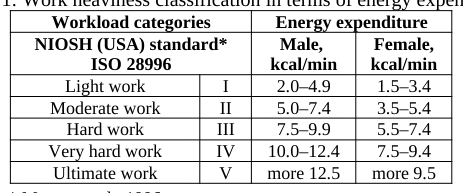
Assessment of Ergonomic Risks Qualitative, Semi-quantitative and Quantitative Methods: 1) Key Item method (KIM) − as the main method for assessment of the work hardness or danger assessment of the manual handling (lifting, holding, carrying and pushing) of heavy loads. Method doesn´t need exact measurements and is applied for all kinds of physical workloads. Therefore, the method can be integrated in technology and company management of OSH and can be used for epidemiological studies on enterprises level too. Method has been developed in Germany (Steinberg et al., 2006); 2) Quick Exposure Check (QEC) − for identification and assessment of workload’s influence on different body parts. Method has been developed in USA (Brown and Li, 2003); 3) Ovako Working Posture Analysis System (OWAS) – for identification of most common work postures for different kind of work. Method has been developed in Finland (Louhevaara and Suurnäkki, 1992); 4) Manual Handling Assessment Charts (MAC) – for assessment the most common risk factors in lifting (and lowering), carrying and team handling operations. Method has been developed in North West England (HSE Books, 2013). 5) Rapid Upper Limb Assessment (RULA) − for estimating the risks of work-related upper limb disorders. Method has been developed in England (McAtamney and Corlett, 1993); 6) Snook Tables (ST) – web-assisted online tool to performe manual material handling tasks without over exertion with the primary goal of supporting ergonomic design interventions. Method has been developed in USA (Snook and Ciriello, 1991). 7) NIOSH Lifting Equation – for the calculation of conditions of lifting and moving of heavy loads. Equation has been developed in USA (Waters et al., 1993); 8) Task Load Index (NASA-TLX) [Equation or mathematical symbol available in the original paper PDF] for assessment of interaction of physical and mental workload. Method has been developed in USA National Aeronautics and Space Administration (Hart and Staveland, 1988). 9) Calculation of Energy Consumption (CEC) during dynamic and static work (Roja et al., 2006a). Experimental (objective) Methods: 1) Heart Rate Monitoring (HRM) for measuring of metabolic energy (kcal/min) to determine the work ability and degree of hardness carried out using POLAR S810iTM Heart Rate Monitor device (Rennie et al.,2001). Work heaviness in terms of energy expenditure was classified according to classification scale is shown in Table 1.
Table 1: Work heaviness classification in terms of energy expenditure Workload categories Energy expenditure NIOSH (USA) standard*
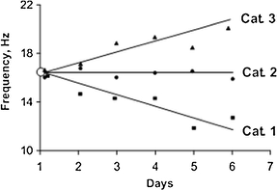
2) Myotonometry (MYO) for assessment of the functional state of skeletal muscles and fatigue determining the muscular tonus, contraction frequency and hardness using MYOTON-3 device (Vain and Kums, 2002). According to regression analysis of MYO data, the slope of the lines (trendline) reflects the condition of the muscles after one-week work cycle (Roja et al., 2006b). Figure 1 shows the classification of the MYO data: Category I – subject is able to relax the muscle; Category II – muscle is able to adapt to the workload and to relax partly; Category III – muscle is not able to relax (muscle tone is increased which associate with muscles fatigue).
Figure 1. Muscle tone categories according to regression analysis of MYO data (Roja et al., 2006b)
The Medical Hypnotherapy (MH) Program − method for mind-body relaxation and to decrease composite chronic pain intensity, psychogenic tension and muscle fatigue The MH program (Roja et al., 2013) was continued for 9 months and included cognitive hypnotherapy (CH) (Roja, 2007) and self-hypnosis (SH) (Sadigh, 2001). At the same time all participants continued performing relaxation exercises during the work breaks (2–3 minutes after 60 minutes of work), and remedial gymnastics or swimming (45 minutes twice per week) after the work. These activities are aimed to reduce emotional tension, as well as to promote the relaxation of tired muscles.
STRATEGY MODEL FOR ERGONOMICS INTEGRATION IN PROCESS MANAGEMENT Ergonomics integration is provided by interaction between process management and ergonomics management, which results in changes in process management. This model shown in Figure 2.
STRATEGY OF ERGONOMICS INTEGRATION
IN PROCESS MANAGEMENT Process management Ergonomics management Feedback Feedback
DEVELOPMENT OF SOCIO- Human resources
- Workabilities Technical resources
- Psychosocial comfort - Motivation for work
- Technologies - Tools
- Health and safety
- Machines
TECHNICAL SYSTEM Organisational resources - Management provision - Task planning - Financing of changes - Training of employees - Human resources
- Work life quality - Equipment
CHANGES IN PROCESS MANAGEMENT Participation of
Consumer/ Availability of
Flexible approach stakeholders
information Participation of employees Management support Client
Planning Organizing Controlling Motivating PRODUCTION PROCESS Raw materials Information Products Programmes Services Information
Skills Knowledge
Assessment of Ergonomic Risks
Identification of Ergonomic Problems Ergonomic solutions
Analysis of solution effectiveness
Satisfaction of employees
Growth of productivity Reduction of costs Process and product quality
SOCIAL RESPONSIBILITY
SUSTAINABLE DEVELOPMENT
Figure 2. The model “Ergonomics integration in process management”. (Kalkis, 2013) The model “Ergonomics integration in process management” includes structure elements, which are complex and synergic. In the model, strategy of production process management is based on the development of socio-technical system, which is characterised by: 1) Human resources (workability for work, motivation for work, psychosocial comfort in work environment, individual health and safety at work, as well as quality of work life in general); 2) technical resources include tools, technological equipment, automated lines, etc.; 3) Organisational resources, which include division of work functions and tasks, planning, process management improvement, work organisation, training of employees, etc. The changes in process management are a united aggregate of functioning activities, including not only process management elements, but also elements of ergonomics management, such as risk identification methodologies, qualitative and quantitative risk assessment methods, as well as analysis of ergonomics solution effectiveness. Thus, the management processes with integrated ergonomics, manufacturing process and product quality are provided in conformity with the European Foundation for Quality Management (EFQM) Excellence Model.
Figure available in the original PDF paper.
RESULTS AND DISCUSSION
Web-based surveys were developed to investigate the ergonomic tools used by practicing Latvian Ergonomic Society (LES) members for the ergonomics risk analysis in the workplace. All LES members have a higher professional education in the field of occupational health and work safety, and have qualification − senior specialist of labour protection. Many of them are working as competent authorities in the field of labour protection, thus, working on a project that also requires the ergonomic risk assessment. Figure 3 shows ergonomics analysis tools, most frequently used by the Latvian labour protection specialists.
100
80
60
40
20
protection specialists
% of responses by labour
0
SI
ST
BPI
KIM
WAI
CEC
QEC
MAC
HRM
MYO
NMQ
Other
RULA
QOLS
OWAS
NIOSH
NASA-TLX
Figure 3. The ergonomics analysis tools most frequently used by the Latvian labour protection specialists surveyed (n = 250).
Figure available in the original PDF paper.
Notes: Kim−Key Item method, QEC−Quick Exposure Check, OWAS−Ovako Working Posture Analysis, MAC−Manual Handling Charts, RULA−Rapid Upper Limb Assessment, ST−Snook Tables, NIOSH−Lifting Equation, NASA-TLX−Task Load Index, CEC−Calculation of Energy Consumption, HRM−Heart Rate Monitoring, MYO−Myotonometry, NMQ−Nordic Musculoskeletal Questionnaire, BPI−Brief Pain Inventory, QOLS−Quality of Life Scale, SI−Strain Index, WAI−Strain Index.
The results of the present study show that KIM, QEC, RULA, the NIOSH equation, HRM, OWAS and the WAI were among the top seven most used tools. It was also stated that the RULA, CEC and MYO are more complicated for quick assessment and needs further investigations. These chosen methods give workload assessment results that are comparative with objective heart rate monitoring and myotonometry. The results of the present study are in accordance with the results published in the work (Pascual and Nagvi, 2008), where the NIOSH equation, RULA, the strain index, Snook tables, physical demand analysis, and biomechanical investigations are recommended by certified ergonomists.
The similar web-based surveys were developed in order to determine the importance of ergonomics from the employee’s point of view. In total 80 employees from the chosen industries completed questionnaires, providing us with the information regarding the role of ergonomics for workplace health promotion and workers` participation in solution of the ergonomics problems. Results of survey are shown in Figure 4. The results of this study show that employees actually do not understand the role of ergonomics and their involvement in the company’s quality management process is negligible. At the same time, it should be noted that their workload and workplace conditions for the greatest part are appropriate.
100
1- Employees knows the importance of ergonomics
80
2- Employees are involved in ergonomics problem-solving 3- Employees workplace conditions are good
60
4- Employees' views are taken into account 5- Employees can affect the working conditions
40
6- Features of ergonomic solutions are provided 7- The workload is appropriate
20
8- The workload is manageable
% of responses by emploees
0
1 2 3 4 5 6 7 8
Figure 4. Responses by employees (n = 80) regarding the role of ergonomics for workplace health promotion.
Figure available in the original PDF paper.
Inquiries of the selected employees, whose physical load was analysed in this study, are reflected in our previous studies (Roja et al., 2006b; Roja et al., 2009, Roja et al., 2012 and Roja et al., 2013), and include such background factors of the subjects: sex, mean age, weight, rest heart rate, pain in several body parts, existence of fatigue. Musculoskeletal complaints are responsible for approximately one-third of the reported cases of absenteeism and disability. Therefore, physical load forms the core of the problem, and is one of the main factors hindering sustained healthy and productive work. Knowledge of the risks involved in a particular type of work and work heaviness classification provides the basis for the formulation and implementation of preventive measures, for example, medical hypnotherapy for employees suffering from chronic pain.
Due to the variety of measures, measurement methods, analysis techniques, and categorization systems used and established by various workload analyses studies, it is often difficult to compare and integrate findings of different studies. The differences in assessment methodology often confuse labour protection specialists. For example, in assessing the repetitiveness of tasks, some researchers measured work cycle time, whereas others counted only the number of motions in the wrist. Therefore, a systematic comparison of the assessment methodologies is needed for evaluation and control of workload in the workplace.
In our studies, we used two types of dimensions for assessment: cycle time (the length of time for the completion of a work cycle) and frequency (the number of work cycles, movements, or force exertions per unit time). The work cycle time and work cycle frequency measures are convertible to each other by the following formula: f = L−R/W, where: f = frequency of overall (or fundamental) work cycle; L = length of separate work stage; W = overall (or fundamental) work cycle time; R = rest time between overall (or fundamental) work cycles.
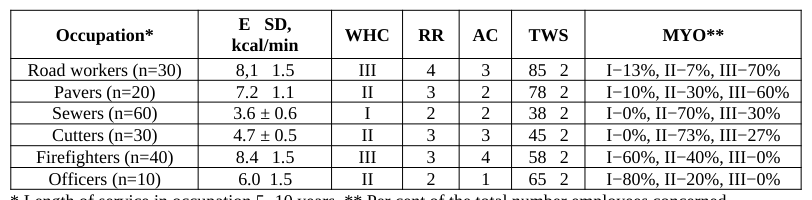
Examples of research results of ergonomic risk analysis, reflecting the physical exertion risks for selected occupations are summed up in Table 2. In these examples, the physical load (work heaviness degree) has been analysed using the following methods: KIM, OWAS, NASA-TLX, HRM, and MYO.
Table 2: Workers[Equation or mathematical symbol available in the original paper PDF] energy expenditure from the HRM data (mean E), work heaviness category (WHC), key item method risk range (RR), OWAS action category (AC), NASA-TLX total workload scores (mean TWS), and myotonometry category (MYO).
As can be seen from HRM data, the work heaviness degree for chosen occupations is different, accordingly [Equation or mathematical symbol available in the original paper PDF] light and hard work. These objective measurements coincide with other ergonomic risk assessment data. It was stated also that the period required for the heart rate to relax is longer when performing the work with a high intensity (WHC = III) − normal state is regained only in 30- minute time. After having assessed individual work phases by OWAS, it was found out that the most serious risks to the skeletal and muscular system of the workers are possible when heavy loads are lifted with stretched arms too high from the ground. For this reason, when thinking of work organization attention has to be paid to the factors that make the performance of the work more difficult (great distances to move heavy loads, etc.).
In our investigations, combined physical and mental workload was estimated experimentally using HRM, which give the actual workload category from energy expenditure data. The interaction of a mental and physical load using NASA-TLX software allowed estimating the total workload and comparing the weight scores (or significance) in percent of different demands according to the value scale offered by software. For example, the results of NASA-TLX analysis show that highest degree of total workload, considering mental and physical load interaction, was identified for fire-fighters-commanding officers (see Table 2). It is due to the fact that they have high psycho- emotional load and actively participated in fire-fighting work that contained physical exercises, temporary demands, the effort and high frustration level were also taken into consideration.
In this study, assessment of the functional state of skeletal muscle was carried out using myotonometric measurements. The working principle of MYO lies in using acceleration probe to record how peripheral skeletal muscle or its part react to the mechanical impact (testing end mass 20 grams, duration 15 milliseconds) and the following analysis of the resulting signal (Roja et al., 2006b). The frequency of the damped oscillations (Hz) characterizes the tissue tone or functional state. Muscles stiffness (N/m) reflects the resistance of tissue to the force that changes its shape, which associates with the fatigue degree. MYO show not only muscle tone and fatigue degree.
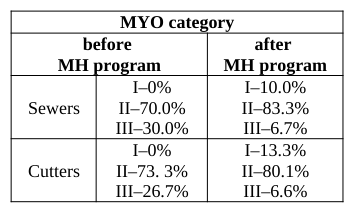
As MYO measurements reflect the functional state of skeletal muscles, a method can also be used to determine the cause of chronic pain and help to choose appropriate rehabilitation or relaxation methods. MYO measurements show, for example, that the cause of chronic pain is not each time related to great workload, muscle fatigue and increase in muscle tone. In our investigation (Roja et al., 2013) it was stated that the muscle tone in 70% of sewers (from n = 60) and 73% of cutters (from n = 30) met MYO category II, respectively, but frequency of muscle contractions did not exceed norm. Consequently, their workload was adapted to the work speed and working conditions. Analysing the data acquired by MYO measurements it can be concluded that, in general, the employees suffered from psychosomatic chronic pain caused by psycho-emotional and psychosocial factors, such as negative life events, psycho-traumatic interpersonal relationships at the workplace, mood disorders, and frustration related to work performance. This was also proved during the research, because at the end of the MH program the impact of psychological factors significantly decreased, which was testified by the pain interference and life quality improvement. It was stated that after MH program (CH and SH therapy for mind-body relaxation) the muscle tone significantly decrease, and workers can even be attributed to the first MYO category. The number of employees who had been previously attributed to a MYO category 3 decreases as well. The percentage of the participants with differences in their muscle tone (MYO categories) before and after MH program is shown in Table 3.
Table 3: Percent of sewers (n = 60) and cutters (n = 30) with differences in their muscle tone before and after MH program MYO category before MH program after MH program
CONCLUSIONS
The physical load assessment methods analysed in this study are successfully introduced in Latvia. The complex ergonomics analysis consisting of workload energy calculation, assessment of working postures and movements, as well as the objective measurements of metabolic energy consumption and skeletal muscles functional state is appropriate to assess the degree of work heaviness. That may provide prognosis of occupational pathology or workrelated musculoskeletal disorders and help to choose the appropriate early multidisciplinary rehabilitation methods. It was stated that employees actually do not understand the role of ergonomics, and their involvement in the company's quality management process is negligible. Therefore, ergonomics integration in process management, development of socio-technical system, appropriate ergonomics solutions, its organizing and controlling is needed.
REFERENCES
AS Inspecta Latvia and RSU DVVI (2007), ESF Survey “Working conditions and risks in Latvia”, Riga, Latvia. Brown, R. and Li, G. (2003) “The development of action levels for the Quick Exposure Check (QEC) system”, in: Contemporary Ergonomics, P.T. McCabe (Ed.), London: Taylor & Francis, pp. 41-46. Cleeland, C.S., Ryan, K.M. (1994), “Pain assessment: global use of the Brief Pain Inventory”, Ann Acad Med Singapore, 23(2),
129-138. Cowan, P., Kelley, N. (2003), “Quality of Life Scale: a measure of function for people with pain”, Rocklin: American Chronic Pain Association. Dul, J., Bruder, R., Buckle, P., Carayon, P., Falzon, P., Marras, W.S., Wilson, J.R., van der Doelen, B. (2012) “A strategy for
human factors/ergonomics: developing the discipline and profession”. Ergonomics, 55(4), 377-395. Hart, S.G., Staveland, L.E. (1988), “Development of NASA-TLX (Task Load Index): Results of empirical and theoretical research”, in: P.A. Hancock and N. Meshkati (Eds.) Human mental workload, Amsterdam: North-Holland, pp.139-183. Hart, S.G., Staveland, L.E. (1988), “Development of NASA-TLX (Task Load Index): Results of empirical and theoretical
research”, in: Hancock, A. and Meshkati, N. (Eds.). Human mental workload Amsterdam, North-Holland, pp. 139–183. HSE Books (2013), “Manual handling assessment charts (the MAC tool)”, HSE BOOKS, Merseyside, North West England, ISBN 9780717665549. Kalkis, H. (2013). “The integration of ergonomics into production processes to improve manufacturing management in Latvian
enterprises”. Doctoral Thesis, Riga, Latvia. Kuorinka, I., Jonsson, B., Kilbom, A., Vinterberg, H., Biering-Sørenson, F., Andersson, G, Jørgenson, K. (1987), “Standardised Nordic questionnaires for the analysis of musculoskeletal symptoms”, Applied Ergonomics, 18(3), 233-237. Louhevaara, V., Suurnäkki, T. (1992), “OWAS: Training Publication II”. Finish Institute for Occupational Health, Helsinki. Mantoe, H.I., Kemper, W.M., Saris, M., Wasshburn, R.A. (1996), “Measuring Physical Activity and Energy Expenditure”,
Human Kinetics Publishers, Champaign, Illinois, USA. McAtamney, L., Corlett E.N. (1993), “RULA: a survey method for the investigation of work related upper limb disorders”, Applied Ergonomic, 24, 91-99. Moore, J.S., Garg, A. (1995), “The strain index: a proposed method to analyze jobs for risk of distal upper extremity disorders”,
Am Ind Hyg Assoc J., 56(5), 443-458. Pascual, S. A., Nagvi, N. (2008), “An Investigation of Ergonomics Analysis Tools Used in Industry in the Identification of Work- Related Musculoskeletal Disorders”, Int J Occup Saf Ergon, 14(2), 237-245. Rennie, K.L., Hennings, S.J., Mitchell, J., Wareham, N.J. (2001), “Estimating energy expenditure by heart-rate monitoring
without individual calibration”, Medicine and Science in Sports and Exercise, 33, 939-945. Roja, I. (2007), “Use of cognitive hypnodrama in medical hypnotherapy” (in Latvian), Europrint, Riga, Latvia. Roja, Z., Eglite, V., Eglite, M., Kalkis, V., Kalkis, H., (2006a), “Assessment of road building worker physical workload using qualitative and quantitative ergonomical risk analysis methods”, Proceed Latvian Acad Sci, Section B, 60(2), 20-30. Roja, Z., Kalkis, V., Eglite, M., Vain, A., Kalkis, H., (2006b), “Assessment of skeletal muscles fatigue of road maintenance
workers based on heart rate monitoring and myotonometry”, J Occup Med Toxicol, 1, 20-28. Roja, Z., Kalkis, V., Kalkis, H., Palmsalu, I., Ievins, J., Berzins, J. “Influence of Combined Labour Environment Risk Factors on Employees of the Sewing Enterprise and Practical Solutions”, Safety of Technogenic Environment, Riga Technical University, 57-60, ISSN: 2255-6923. Roja, Z., Kalkis, V., Kalkis, H., Pencis, I. (2009), “Assessment of firefighters-rescuers work severity in relation between
interaction of physical and mental load”, Proceed Latvian Acad Sci, Section B, 63(6), 20-30. Roja, Z., Kalkis, V., Roja, I., Kalkis H. (2013), “The effects of a medical hypnotherapy on clothing industry employees suffering from chronic pain”, J Occup Med Toxicol, 8:25, http://www.occup-med.com/content/8/1/25. Sadigh, M.R. (2001), “Autogenic training: a mind-body approach to the treatment of fibromyalgia and chronic pain syndrome”,
New York, The Haworth Medical Press. Snook, S.H., Ciriello, V.M. (1991), “The design of manual handling tasks: revised tables of maximum acceptable weights and forces”, Ergonomics, 34(9),197–213. State Labour Inspection of Latvia (2010), “Annual Report”, Riga, Latvia. Steinberg, U., Caffier, G., Liebers, F., (2006) “Assessment of Manual Material Handling based on Key Indicators – German
Guidelines“, in: Handbook of Standards in Ergonomics and Human Factors. Ed. by W. Karwowski. Lawrenz Erlbaum Associates. Mahwah, New Jersey, London, pp. 319-338. Sunnen, G. (2002), “Medicai hypnosis in the hospital”, European J Clinical Hypnosis, 5(2), 18-24. Tuomi, K., Ilmarinen, J., Jahkola, A., Katajarinne, L., Tulkki, A. (1998), “Work Ability Index”, 2nd revised edn. Helsinki: Finnish Institute of Occupational Health. Vain, A., Kums, T. (2002), “Criteria for Preventing Overtraining of the Musculoskeletal System of Gymnasts”, Biology of Sport,
19(4), 329-345. Physical Ergonomics II (2018)
Waters, T.R, Putz-Anderson, V., Garg A., Fine, L.J. (1993), “Revised NIOSH equation for the design and evaluation of manual lifting tasks”. Ergonomics. 36(7), 749-76. Woolfson, C., Calite, D., Kallaste, E. (2008), “Employee voice and working environment in post-communist member states: an
empirical analysis of Estonia, Latvia and Lithuania”. Industrial Relations Journal, 39, 314-334. Zheltoukhova K., Thomas, R., Bevan, S. (2012), “Fit For Work? Musculoskeletal Disorders and the Latvian Labour Market”.
The Work Foundation, Landec Ltd., Lancaster University, London.
LISTED IN THE AHFE DIGITAL BOOKSTORE CATALOGUE
Explore the complete digital volume
Advances in Physical Ergonomics and Human Factors: Part II
Read this individual research paper free through the original publisher, or explore the full digital proceedings book.
ISBN 978-1-4951-2105-0
Explore this ISBN in the AHFE Bookstore ↗Listed in the July 2026 bookstore catalogue; search by ISBN to confirm current availability · Digital book purchase optional