Januário LB, Moreira RFC, Barros FC, Oliveira AB (2018). Physical Exercise Program to Control Musculoskeletal Symptoms Among Sewing Machine Workers of an Aircraft Maintenance Company. In: Advances in Physical Ergonomics and Human Factors: Part II. AHFE Open Access, vol. 2. https://doi.org/10.54941/ahfe100060
Sewing machine workers have high prevalence of WMSDs in neck-shoulder, wrists and lower back region. It is known that occupational physical exercises programs have positive benefits regarding complaints and absenteeism due to musculoskeletal symptoms. Therefore, the aims of this study were to evaluate ergonomic, musculoskeletal and psychosocial conditions of workers from an upholstery and sewing sector, and investigate the effectiveness of a physical exercise program applied at the occupational environment. Fifteen workers (44.5 ± 8.8 years old) took part of the study. Musculoskeletal symptoms were evaluated through the Nordic Musculoskeletal Questionnaire (NMQ), Roland–Morris Disability Questionnaire (RDQ) and a standardized physical examination. Psychosocial indicators were evaluated from the Job Content Questionnaire (JCQ) and Utrecht Work Engagement Scale (UWES), while the Ergonomic Workplace Analysis (EWA) protocol was applied to assess workplace conditions. The physical exercise program was applied twice a week for 30 minutes, during 12 weeks. It was composed by warm-up, strengthening and stretching exercises. A significant reduction on musculoskeletal symptoms were observed for wrists/hands and lumbar spine considering results from the NMQ, and for all body regions assessed through the physical examination, except for elbows. Moreover, psychosocial indicators have shown significant improvement. These benefits increase workability and promote better quality of life to the workers, and can be reproduced in other workplaces.
Work Related Musculoskeletal Disorders (WRMDs) are one of the most prevalent occupational diseases all over the world. It is responsible for absenteeism, early retirement and disabilities (Bergstrom et al., 2007; Nyman et al., 2007; Lund et al., 2006; David et al., 2008, Bevan et al., 2009). A number of epidemiologic studies have demonstrated an association between work overload and musculoskeletal disorders (Engels, 1996; Bernard, 1997; Burdorf and Sorock, 1997; Trinkoff et al., 2003). In addition to ergonomic factors, psychosocial risk factors such as high demand, low job control and lack of social support have also been recognized as contributing factors to the development of musculoskeletal disorders. Exposure to low-level and monotonous tasks during prolonged periods results in strain on the neck-shoulder region (Punnett e Bergqvist, 1997; Cote et al., 2008). It occurs in workplaces involving tasks such as computer work (Arvidsson et al., 2008), oral care activities (Hayes et al., 2009), industrial repetitive tasks (Mathiassen and Winkel, 1996), and sewing machine work (Wang et al., 2009).
This strain is based on the Cinderella hypothesis, which considers the principle of size-ordered MU recruitment (Hägg, 1991). Few studies evaluating sewing machine workers are available in the literature. Therefore, there is no agreement regarding the methodology to evaluate this work, and the prevalence of musculoskeletal symptoms among the workers is not completely known (Wang et al., 2009). According to the available studies, musculoskeletal complaints are present in the neck-shoulder region (Wang et al., 2010; Zhang, 2011), wrists and hands, lumbar spine and lower limbs (Sealetsa and Thatcher, 2011).
Sewing machine operators are susceptible to develop musculoskeletal symptoms due to exposure to occupational environments without anthropometric adjustments, high work pace, repetitive and stereotyped movements, requiring the maintenance of awkward postures and static seated position (Kaergaard and Andersen, 2000; Schibye et al, 1995; Sealetsa and Thatcher, 2011). The prolonged exposure to these risk factors (Lassen et al., 2005), associated with psychosocial factors (Ariens et al., 2001; Bongers et al., 1993) also influence on the onset and development of WRMDs.
One of the most accepted theories to avoid the mechanism associated with muscular pain and the development of WRMDs is to increase variability of muscle activation during stereotyped monotonous work (Madeleine et al., 2008 a, b; Mathiassen, 2003). This variability can be inserted in occupational environment through the rotation of workstations and tasks, reduction of the work period or through the implementation of regular pauses or exercises. (Mathiassen, 2006; Galinsky et al., 2000; Galinsky et al., 2007; McLean et al., 2001).
Previous studies show that physical exercise programs in occupational environment is a common method adopted for controlling musculoskeletal pain (Burton et al., 2006; Bell and Burnett, 2009). This strategy has positive effects on complaints, absenteeism and musculoskeletal pain (Linton e Van Tulder, 2001; Waddell e Burton, 2001; Tveito et al., 2004; Busch et al., 2008), especially on neck/shoulder and low back regions (Andersen et al., 2008; Andersen et al., 2010; Blangsted et al., 2008; Hayden et al., 2005).
Therefore, the aims of this study were: (1) to evaluate ergonomics, musculoskeletal and psychosocial conditions of workers from an upholstery and sewing sector of an aircraft company; and (2) to investigate the effectiveness of a physical exercise program, applied for 12 weeks at the occupational environment, to control musculoskeletal complaints. Besides contributing with information about upholstery and sewing work, we hypothesize that the physical exercise program will reduce musculoskeletal complaints.
METHODS
All workers (20 subjects) from the upholstery and sewing sector of an aircraft maintenance company were invited to participate. Subjects working for at least 12 months with sewing activities and remaining at their workplace for over a month prior to the data collection were included. Workers who reported any circulatory, rheumatic or inflammatory systemic disease or presented any musculoskeletal disorders resulting from trauma were excluded. The sector manager and the production analyst participated in the exercise program. However, they were not included due to large divergences in job nature. Three subjects refuse to participate. Therefore, fifteen workers were evaluated (11 female and 4 male). All participants signed an informed consented form approved by the local ethics committee (protocol #379.658/2013). An initial survey was applied to assess personal information and previous sewing experience. The main characteristics of the workers are shown in Table 1. About 67% of workers were exclusively sewing machine workers and the remaining workers also performed others tasks, such as cutting fabric and inspection of the final product.
Table 1. Characteristics of the workers. Age (M±SD) 44.5 ± 8.8 years Weight (M±SD) 72.8 ± 12.3 kg Height (M±SD) 1.64 ± 0.08 m Time at the company (M±SD) 7.1 ± 5.4 years Smokers (%) 0 Physically active (%) 53.3 M: mean; SD: standard deviation.
Table available in the original PDF paper.
Simultaneously to the application of the initial survey, questionnaires aiming to assess musculoskeletal symptoms and psychosocial indicators were also applied. Moreover, a standardized physical examination (SPE – Ohlsson et al., 1994) and the Ergonomic Workplace Analysis (EWA – Ahonen et al., 1989) were performed. After completing 12 weeks of exercises, all evaluation protocols were reapplied for comparison, except the EWA.
Musculoskeletal symptoms The Nordic Musculoskeletal Questionnaire (NMQ) and the Roland–Morris Disability Questionnaire (RDQ) were applied to evaluate the main musculoskeletal symptoms. The NMQ is a worldwide self-administered questionnaire, used to standardize the report of musculoskeletal complaints and guide the evaluation of physical conditions of the work environment based on subjects’ complaints (Kuorinka et al., 1987; Pinheiro et al., 2002). This questionnaire considers nine anatomical body regions, and four questions: annual and weekly prevalence of symptoms, functional incapacity and search for medical assistance in the last 12 months (Barros and Alexandre, 2003). An adapted version was used considering the past three months instead of last 12 months in order to evaluate the effects of the exercise program on musculoskeletal symptoms (Tsauo et al., 2004). A graduated scale of pain, associated with the NMQ question “Have you at any time during the last 3 months had trouble in:”, was applied for each one the nine regions, in order to measure pain intensity in all regions signed as “yes”.
The RDQ evaluates possible daily life impairments due to low back pain. It is based on 24 yes-no questions (Roland and Morris, 1983), resulting from the Sickness Impact Profile (SIP). Originally, it was developed to be used in primary care at the United Kingdom, but nowadays it is used in research studies and clinical practice. The translation to the Brazilian Portuguese was proposed and provided by the authors (Roland and Fairbank, 2000). Considering the need to understand the pain in a global situation, the pain intensity also was evaluated through Visual Analog Scale (VAS - Von Korff et al., 2000).
Pychosocial indicators The short version of the Job Content Questionnaire (JCQ) and the Utrecht Work Engagement Scale (UWES) were applied in order to evaluate some psychosocial indicators. The JCQ was elaborated based on a questionnaire developed by Karasek in 1979 containing originally 49 questions relating demand and control over the work, in order to establish a relationship between suffered stress and elevated number of illness on a specific work sector. Töres Theorell elaborated, in 1988, a shorter version of the JCQ (Alves et al., 2004), containing 17 questions (five to evaluate demand, six to evaluate control and six to evaluate social support). This scale was translated and validated to Portuguese language by Alves et al. in 2004.
The UWES is a questionnaire that assesses the levels of engagement, vigor, dedication and absorption that each subject has in relation to his/her work. Therefore, it requires the worker about the positive aspects of working activities instead of burnout, like most of psychosocial questionnaires. It contains 17 questions and is divided into 6 items related to vigor, 5 items related to dedication and 6 items related to absorption. The total score reflects the work engagement. A Brazilian Portuguese version of this questionnaire is provided by the authors (Schaufeli and Bakker, 2003).
Standardized physical examination After filling out the questionnaires, the workers were individually examined at a clinical set inside the company. The physical examination was performed by a trained physical therapist. It was performed according to the standardized physical examination protocol proposed by the Department of Occupational and Environmental Medicine, Lund, Sweden (Ohlsson et al., 1994).
Ergonomic Workplace Analysis The EWA protocol was proposed by the Finnish Institute of Occupational Health (Ahonen et al., 1989) and includes 14 items. The last two items (13- Thermal environment and 14- Noise) were qualitatively accessed. Each one of the items was analyzed based on the analyst’s score, ranging from 1 (best) to 5 (worst), and on the workers’ score (good, fair, poor and very poor). Besides contributing to understand the work condition, this protocol also contributes for a participative approach since it includes workers’ opinion. The EWA protocol was applied during a regular working day.
Physical Exercise Program
The physical exercise program was applied in the sewing sector, twice a week, for 12 weeks. Each session lasted 30 minutes. Two physical therapists supervised every session and all the workers participated on, at least, 80% of the sessions.
The schedule adopted to implement the exercise program was agreed with workers and managers. It was performed on Tuesdays and Thursdays, from 02:40 to 03:10 pm. This schedule was adopted to ensure that workers from both shifts could participate together. The exercise program was planned based on the evidences presented by Coury, Moreira e Dias (2009) and focused on the main musculoskeletal complaints identified. Therapeutic exercises reported by McGill (2002) and Kisner & Colby (2002) were applied. The program consisted on three steps: a) 5 minutes of warm-up exercises: whole body aerobic exercises, aiming to increase muscle temperature, promote hyperthermia and vasodilatation to increase the muscle blood flow (Gray and Nimmo, 2001). Moreover, it could stimulate muscle contraction and reduce the passive stiffness of joints and muscles (Wright, 1973). The warm-up exercises were alternated along the sessions and involved stationary running, jumping jacks, forth and back jumps, and dancing steps. Music was played in this first stage in order to stimulate workers during the exercises;
b) 20 minutes of strengthening exercises: This stage was subdivided into two sets. The first set was constituted by upper limb strengthening using rubber bands. Initially, all workers performed the exercises using red rubber bands (Theraband®) providing 1.7 kg of resistance at 100% elongation. When the workers felt comfortable with the resistance provided by the red rubber band, it was changed to a green rubber band (Theraband®), providing 2.1 kg of resistance at 100% elongation (Theraband web site, February/2014). Three sets of 10 repetitions were performed in the beginning of the program. The repetitions were enhanced to 15. Detailed description of upper limb strengthening exercises are presented below:
Shoulder lateral rotators’ exercise: the worker maintained the standing position, looking forward, with the arms alongside the trunk and elbows flexed at 90°. They were instructed to perform bilateral lateral shoulder rotation, maintaining the elbows next to the trunk (Figure 1a).
Figure 1. a) Shoulder lateral rotators’ exercise; b) Shoulder flexion exercise.
Figure available in the original PDF paper.
Shoulder flexion exercise: the worker maintained the standing position, looking forward, with the arms alongside the trunk, and the rubber band trapped bellows his/her foot. They were instructed to bilaterally perform a shoulder flexion at the scapular plane until they reach the shoulder joint line (Figure 1b).
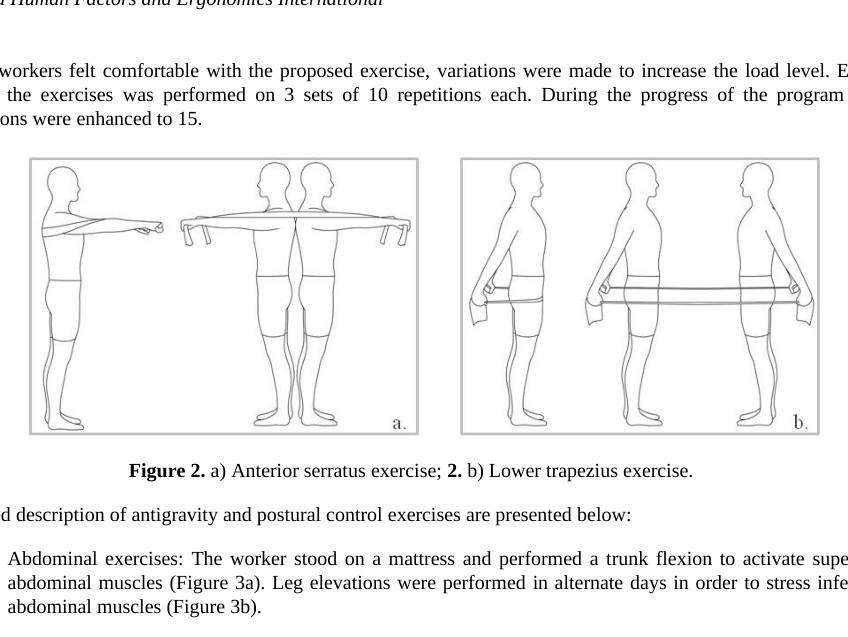
Anterior serratus exercise: this exercise could be performed individually or in pairs. The worker maintained the standing position, looking forward and aligned the rubber band on the shoulder line. Both shoulders were flexed at 90°, and the workers were instructed to perform a scapular protraction (Figure 2a).
Lower trapezius exercise: this exercise could be performed individually or in pairs. The worker maintained the standing position, facing each other when the exercise was performed in pairs, and aligned the rubber band on the hips line. The shoulders were placed on neutral position and the workers were instructed to perform a bilateral extension (Figure 2b).
The second set of strengthening exercises was constituted by antigravity and postural control exercises using eccentric, concentric and isometric contractions, aiming to strengthen abdominals and trunk extensors muscles.
When workers felt comfortable with the proposed exercise, variations were made to increase the load level. Each one of the exercises was performed on 3 sets of 10 repetitions each. During the progress of the program the repetitions were enhanced to 15.
Figure 2. a) Anterior serratus exercise; 2. b) Lower trapezius exercise.
Figure available in the original PDF paper.
Detailed description of antigravity and postural control exercises are presented below:
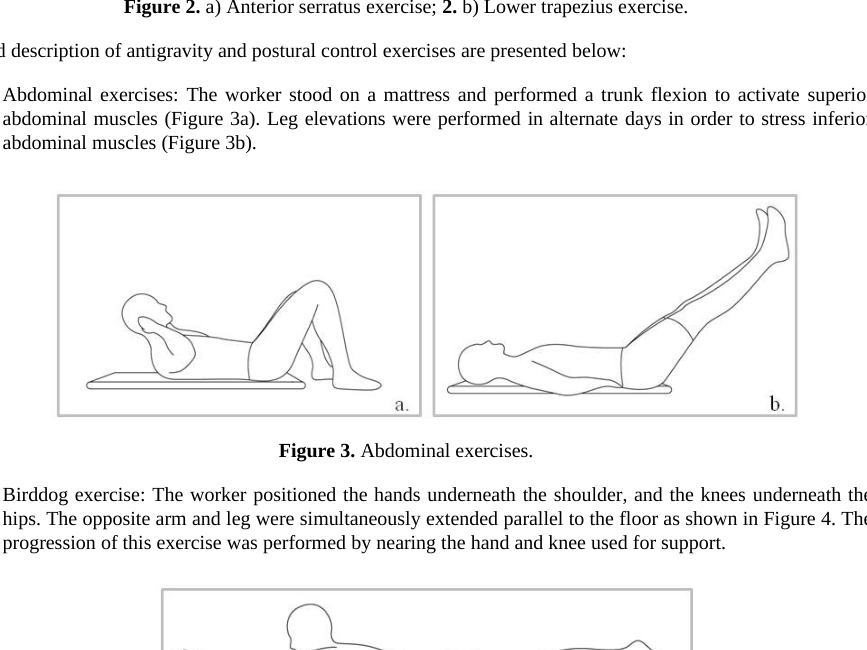
Abdominal exercises: The worker stood on a mattress and performed a trunk flexion to activate superior abdominal muscles (Figure 3a). Leg elevations were performed in alternate days in order to stress inferior abdominal muscles (Figure 3b).
Figure 3. Abdominal exercises.
Birddog exercise: The worker positioned the hands underneath the shoulder, and the knees underneath the hips. The opposite arm and leg were simultaneously extended parallel to the floor as shown in Figure 4. The progression of this exercise was performed by nearing the hand and knee used for support.
Figure 4. Birddog exercise.
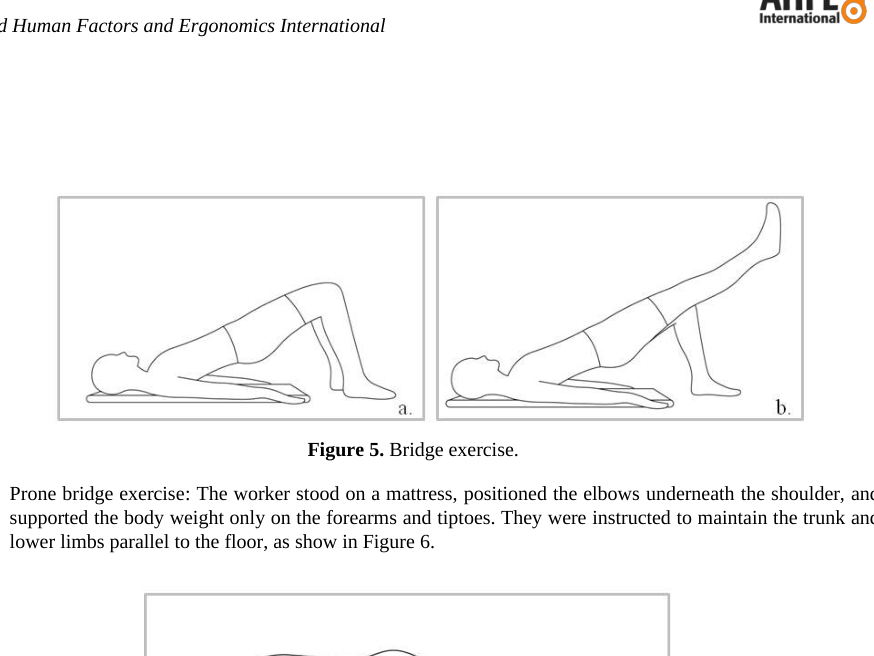
Bridge exercise: The worker stood on a mattress and supported arms alongside the trunk, performing hip elevation (Figure 5a). The progression of this exercise was performed through knee extension associated with hip elevation (Figure 5b).
Figure 5. Bridge exercise.
Figure available in the original PDF paper.
Prone bridge exercise: The worker stood on a mattress, positioned the elbows underneath the shoulder, and supported the body weight only on the forearms and tiptoes. They were instructed to maintain the trunk and lower limbs parallel to the floor, as show in Figure 6.
Figure 6. Prone bridge exercise.
c) 5 minutes of stretching exercises: During the last stage of the session, stretching exercises were performed for neck/shoulder muscles, trunk extensors muscles and lower limbs posterior chain muscles. The stretching increases the length of musculotendinous units, decreasing the muscular tension and increasing muscle length. This effect allows increasing range of motion in joints, besides promoting muscle relaxation (Mchugh and Cosgrave, 2010; Page et al., 2012).
Data Analysis Data were processed according to the instructions of each questionnaire, and descriptively presented. For the NMQ, each question (weekly and 3 month complaints, functional disability and seeking for health assistance) was analyzed according to the frequency of positive responses. For the RDQ, each positive question was summed and the range varied from 0 (no disability) to 24 (maximum disability). The positive answer for each test composing the physical examination was scored as 1. The scores were summed for each body region (neck, shoulder, elbow and wrists/hands). Moreover, the criteria,proposed by Ohlsson et al. (1994) were used to establish diagnosis for musculoskeletal disorders.
The scores obtained through the JCQ were used to classify the worker as active (high demand and high control), passive (low demand and low control), high strain (high demand and low control) and low strain (low demand and high control). The scores were classified as low or high according to the median obtained from the collected data. The same procedure was conducted to classify the social support. Vigor, dedication and absorption domains of UWES are scored by the worker from 0 to 6. The sum of the results of each domain is ranked from very bad to very good, according to a normative table proposed by Schaufeli and Bakker (2003). The data obtained from the EWA protocol was descriptively analyzed for both the analyst's and workers’ assessment.
All results were tested for normal distribution (Shapiro Wilk’s test) and homoscedasticity (Levene's test). If these assumptions were attended, a paired t-test was used to compare variables from pre and post training. Alternatively, Wilcoxon’s test was used to compare non-parametric data. All categorical, pre and post data were compared through Chi-square test. All statistical analysis was conducted in SPSS software (Statistical Package for Social Science, vol. 17), with significance level of 0.05 (5%).
RESULTS AND DISCUSSION
After completing 24 exercise sessions, all evaluation protocols were reapplied and the results compared. The main outcomes regarding NMQ are presented in Tables 2 and 3.
Table 2. Workers reporting symptoms in the last 3 months Pre - n (%) Post- n (%) P-value Neck 10 (66.7) 6 (40) 0.14
There was a significant reduction of symptoms reported for lower back and wrists/hands in the past 3 months. When considering the graduated scale applied for each region labeled as “yes” (Table 3), there was a significant reduction in pain intensity reported for shoulders, lower back and hips/thighs.
Table 3. Mean (M), standard deviation (SD) and 5-95% confidence interval (CI) from the values obtained with the graduated scale applied for each body region labeled as “yes” in the NMQ.
There was a significant reduction of self-reported pain in wrist/hands, but the results from the graduated scale were not conclusive. Even though the rate of self-reported pain reduced after the exercise program, the mean intensity of pain was higher. It happened because only one subject reported pain intensity, causing conflicted results between NMQ and the graduated scale. The opposite occurred for the hips/thighs region. Even though a significant difference between the self-reported pain was not found, there was a significant reduction in pain intensity. Once the physical exercise program was not focused on the lower limbs, it is possible that this fact resulted from an isolate acute episode of pain.
Considering the RDQ, only one worker reported disability due low back pain (score higher than 14) in the pre evaluation. Although most of subjects reported symptoms in the lower back region, these symptoms have not lead to disability according to RDQ. The mean score for RDQ was 5.38 (±5.45) points, with pain intensity score of 4.08 (±2.46) according to VAS. After the intervention, the mean score for RDQ was 0.13 (±0.35) points, with pain intensity scoring 0.25 (±0.13). The results related to musculoskeletal complaints (NMQ, graduated scale and RDQ) show that the exercise program significantly reduced the self-reported rate and intensity of low back pain. A systematic review performed by Van Middelkoop et al. (2010) has reported the benefits of physical exercise on occupational environment to reduce intensity of low back pain and physical disability.
Table 4 presents data of the physical examination. There was a significant reduction of signals and symptoms in neck, shoulders and wrists/hands. Shoulder was the region with more signals and symptoms in the pre evaluation. It has also presented high rate of self-reported pain. Wang et al. (2009) also presented similar results with almost 90% of the symptomatic subjects reporting shoulder pain in NMQ. A systematic review by Ylinen et al. (2007) verified the effectiveness of resistance exercise on reducing musculoskeletal symptoms in neck and shoulder regions. These results could be observed through both the graduated scale and physical examination.
Table 4. Mean (M), standard deviation (SD) and 5-95% confidence interval (CI) of the signals and symptoms observed through the physical examination.
Pre Post P-value Maximal score M (SD) CI M (SD) CI Neck 64 7 (4) 5.0 - 9.0 3.2 (1.5) 2.4 - 3.9 0.01** Shoulders 44 13.5 (11) 7.9 -19 5.4 (3.8) 3.5 - 7.4 0.04* Elbow 34 3 (1.4) 2.3 - 3.7 0.0 --- 0.18 Wrists/Hands 68 7.2 (5.1) 4.6 - 9.8 2.8 (1.3) 2.1 - 3.4 0.01** * Significant difference: P < 0.05; **P < 0.01.
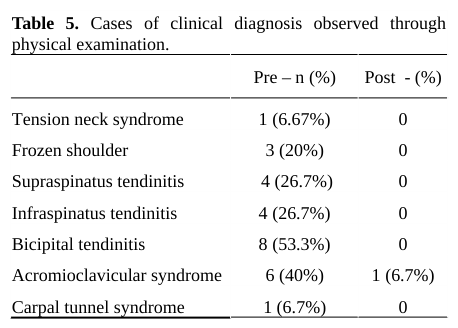
Data of the diagnosis established according to the criteria proposed by the authors (Ohlsson et al., 1994) are presented in Table 5. There was a reduction in cases of shoulders disorders. The other possible diagnoses reported at physical examination were not reported because none of subjects presented enough signals and symptoms for a close diagnosis either in pre or post evaluation.
Table 5. Cases of clinical diagnosis observed through physical examination.
Table available in the original PDF paper.
Data of the JCQ and UWES are presented in Tables 6 and 7, respectively. No differences were found between pre and post evaluations for both demand-control (Table 6) and work engagement (Table 7). According to the JCQ, in general the workers were initially classified as active (33.3%) or low strain (26.7%). After the physical exercise program, most of the workers were classified as low strain (53.3%). The literature reports different demand-control profiles for the sewing machine workers population. Karasek and Theorell (1990) reported that these workers have high strain profiles. Table 6 shows that most workers presented high demand, control, and social support scores at the pre evaluation. After the intervention, only the demand level presented mainly the lower score.
Table 6. Results of the job content questionnaire.
Table available in the original PDF paper.
Demand Control Social Support Previous Post p-value* Previous Post p-value* Previous Post p-value* High 8 (53.3) 4 (26.7) 0.136 9 (60) 11 (73.3) 0.439 8 (53.3) 9 (53.3) 1.000 Low 4 (46.3) 11 (73.3) 6 (40) 4 (26.7) 7 (46.7) 8 (46.7) * Chi-square test.
No domain has received the score very low in UWES, both in pre and post evaluation (Table 7). Although a slight improvement in pre and post evaluation can be noticed for all UWES domains, no significant difference was found. These results may be attributed to the period when the questionnaires were applied. At the pre evaluation, the sector had a high production demand due to seasonal characteristics of the aircraft maintenance industry. On the other hand, the second evaluation has occurred in the late December, when most of aircraft are flying instead of being on the hangar for maintenance. These results were expected, once organizational factors are not changed due to the exercise program.
Table 7. Results of the Utrecht work engagement scale.
Table available in the original PDF paper.
Vigor Dedication Absorption Engagement Pre Post p-value Pre Post p-value Pre Post p-value Pre Post p-value Very high 2 (13.3) 1 (6.7)
The results of the EWA protocol are shown in Table 8. The environment has not been considered adequate according to ergonomic guidelines (analyst’s score). Therefore, the workers have considerate it mostly fair.
Table 8. Scores of the ergonomic workplace analysis protocol according to the analyst’s and workers’ assessment.
Table available in the original PDF paper.
Items evaluated Analist’s score Workers’ assessment Good (%) Fair (%) Poor (%) Very Poor (%) 1- Work Site 3 15 65 20 0
14- Noise * 10 50 30 10 * not accurately measured due to lack of appropriated equipment.
An important limitation of the study is the lack of a control group. However, the limited number of workers in the lean production systems and ethical aspects have impaired the creation of this group. However, according to the detailed description of the exercise program, randomized controlled trials can be developed in order to improve the quality of the evidence presented here.
CONCLUSIONS
The occupational physical exercise program proposed and applied in this sytudy reduced symptoms and reported pain for the neck, shoulders, wrists/ hands and lower back. Although no change in psychossocial factors would be expected, a slight but non-significant improve was noticed in those variables. These benefits can improve workability and promote better quality of life to the workers.
REFERENCES
Ahonen M., Launis M., Kuorinka T. (1989), “Ergonomic Workplace Analysis”. Helsinki, Finland: Institute of Occupational Health, Ergonomics Section. Alves M.G.M., Chon D., Faerstein E., Lopes C.S., Werneck G.L. (2004), “Short version of the “job stress scale”: a Portuguese-
language adaptation”. Revista de Saúde Pública, 38(2): 164-71. Andersen L.L., Kjaer M., Sogaard K., Hansen L., Kryger A.I., Sjogaard G. (2008), “Effect of two contrasting types of physical exercise on chronic neck muscle pain” Arthritis Rheum;59:84–91. Andersen L.L., Christensen K.B., Holtermann A.,. Poulsen O.M., Sjøgaard G., Pedersen M.T., Hansen E.A. (2010), “Effect of
physical exercise interventions on musculoskeletal pain in all body regions among office workers: A one-year randomized controlled trial.” Manual Therapy 15: 100–104. Ariens G.A.M., Mechelen W.V., Bongers P.M., Bouter L.M., Wal G.V.D.W. (2000), “Physical risk factors for neck pain.”
Scand J Work Environ Health;26 (1):7 – 19. Arvidsson I., Axmon A., Skerfving S. (2008), “Follow-up study of musculoskeletal disorders 20 months after the introduction of a mouse-based computer system”. Scand J Work Environ Health, 34:374-380. Barros E.N.C., Alexandre N.M.C. (2003), “Cross-cultural adaptation of the Nordic Musculoskeletal Questionnaire”.
International Nursing Review. 50:101-108. Bell J.A., Burnett A. (2009), “Exercise for the primary, secondary and tertiary prevention of low back pain in the workplace: a systematic review”. J Occup Rehabil 2009;19:8-24. Bergstrom G., Bodin L., Bertilsson H., Jensen I.B. (2007), “Risk factors for new episodes of sick leave due to neck or back pain
in a working population. A prospective study with an 18-month and a three-year follow-up”. Journal of Occupational and Environmental Medicine, v. 64, n. 4, p. 279-287. Bernard, B. P. (1997) Introduction. In: BERNARD B. P (Eds). “Musculoskeletal disorders and workplace factors: A critical review of epidemiologic evidence for work-related musculoskeletal disorders of the neck, upper extremity, and low back.” United States: Cincinnati - National Institute for Occupational Safety and Health, p. 1-14. Bevan S., Quadrello T., Mcgee R., Mahdon M., Vovrovsky A., Barham L. (2009), “Fit for work—musculoskeletal disorders in
the European workforce”. The work foundation. Ref type: report. Blangsted A.K., Søgaard K., Hansen E.A., Hannerz H., Sjøgaard G. (2008), “One-year randomized controlled trial with different physical-activity programs to reduce musculoskeletal symptoms in the neck and shoulders among office workers.” Scandinavian Journal of Work and Environmental Health, v. 34, n. 1, p. 55-65. Bongers P.M., De Winter C.R., Kompier M.A.J., Hieldebrandt V.H. (1993), “Psychosocial factors at work and musculoskeletal
diseases”. Scandinavian Journal of Work, Environment and Health. 19:297-312. Burdorf A., Sorock G. (1997), “Positive and negative evidence of risk factors for back disorders”. Scandinavian Journal of Work, Environment & Health, v. 23, n. 4, p. 243-256. Burton A.K., Balagué F., Cardon G., Eriksen H.R., Henrotin Y., Lahad A., Leclerk A., Müller G., van der Beek A.J. (2006),
“European guidelines for prevention in low back pain: November 2004”. Eur Spine J;15(Suppl 2):136-68. Busch A.J., Barber K.A.R., Overend T.J., Peloso P.M.J., Schachter C.L. (2008), “Exercise for treating fibromyalgia syndrome.”
J Rheumatol, 35(6):1130-44, 2008. Cote P., Velde G van Der, Cassidy J.D., Carroll L.J., Hogg-Johnson S., Holm L.W., Carragee E.J., Haldeman S., Nordin M., Hurwitz E.L., Guzman J., Peloso P.M. (2008), “The burden and determinants of neck pain in workers – Results of the bone and joint decade 2000–2010 task force on neck pain and its associated disorders”. Spine, 33:60-74. Coury H.J.C.G., Moreira R.F.C., Dias N.B.D. (2009), “Evaluation of workplace exercise effectiveness on neck, shoulder and low
back pain control: a systematic review.”, Brazilian Journal of Physical Therapy, v. 13, n. 6, p. 461-79. David G., Woods V., Li G., Buckle P. (2008), “The development of the Quick Exposure Check (QEC) for assessing exposure to risk factors for work-related musculoskeletal disorders”. Applied Ergonomics, v. 39, n. 1, p. 57-69. Engels J., Van Der Gulden J., Senden T., Van’t Hof B. (1996), “Work-related risk factors for musculoskeletal complaints in the
nursing profession: results of a questionnaire survey.” Journal of Occupational Environment Medicine, v. 53, p. 636–41. Galinsky T., Swanson N., Sauter S., Dunkin R., Hurrell J., Schleifer L. (2007), “Supplementary breaks and stretching exercises for data entry operators: a follow-up field study”. Am J Ind Med. v.50, n.7, p.519-527. Galinsky T., Swanson N.G., Sauter S.L., Hurrell J.J., Schleifer L.M. (2000) “A field study of supplementary rest breaks for data-
entry operators”. Ergonomics, 43:622-638. Gray S.C., Nimmo M.A., (2001), “Effects of active, passive or no warm-up on metabolism and performance during shortduration high intensity exercise”. J Sport Sci;19:693–700. Hägg G. (1991), “Static workloads and occupational myalgia – a new explanation model”. Electromyographical kinesiology
Edited by: Anderson PA, Hobart DJ, Danoff JV. Amsterdam: Elsevier Science Publishers; 141-144. Hayden J.A., Van Tulder M.W., Malmivaara A., Koes B.W. (2005), “Exercise therapy for treatment of non-specific low back pain.” Cochrane Database Syst Rev.
Hayes M.J., Smith D.R., Cockrell D. (2009),“A systematic review of musculoskeletal disorders among dental professionals.” Int J Dent Hyg; 7: 159-65. Kaergaard A., ANDERSEN J.H. (2000), “Musculoskeletal disorders of the neck and shoulders in female sewing machine
operators: prevalence, incidence and prognosis”. Occupational Environmental Medicine 57, 528–534. Karasek R.A. (1979), “Job Demand, job decision latitude, and mental strain: implications for job redesign”. Administrative Science Quarterly 24:285-308. Karasek R., Theorell T. (1990), “Stress, Productivity and the Reconstruction of Working Life”, Basic Books, HealthyWork, New
York. Kisner C., Colby L.A. (2002), “Therapeutic Exercise: Foundations and Techniques”, 3rd ed. Philadelphia, Pa: FA Davis Co. Kuorinka I., Jonsson B., Kilbom A., Vinterberg H., Biering-Sørensen F., Andersson G., Jørgensen K. (1987), “Standardized Nordic questionnaire for the analysis of musculoskeletal symptoms”. Applied Ergonomics, v. 18, n. 3, p. 233-237. Lassen C.F., Mikkelsen S., Kryger A.I., Andersen J.H. (2005), “Risk factors for persistent elbow, forearm and hand pain among
computer workers”. Scandinavian Journal of Work Environmental Health, 31(2):122-131. Linton S.J., van Tulder M.W. (2001), “Preventive interventions for back and neck pain problems: what is the evidence?” Spine, v. 26, n. 7; p. 778–787. Lund T., Labriola M., Christensen K.B., Bultmann U., Villadsen E. (2006), “Physical work environment risk factors for long
term sickness absence: Prospective findings among a cohort of 5357 employees in Denmark”. British Medical Journal of Clinical Research, v. 332, n. 7539, p. 449–452. Madeleine P., Mathiassen S.E., Arendt-Nielsen L. (2008a), “Changes in the degree of motor variability associated with experimental and chronic neck–shoulder pain during a standardized repetitive arm movement.” Exp Brain Res; 185: 689– 98. Madeleine P., Voigt M., Mathiassen S.E. (2008b), “The size of cycle-to-cycle variability in biomechanical exposure among
butchers performing a standardized cutting task”. Ergonomics;51:1078–95. Mathiassen S.E., Winkel J. (1996), “Physiological comparison of three interventions in light assembly work: reduced work pace, increased break allowance and shortened working days.” Int Arch Occup Environ Health;68(2):94-108. Mathiassen S.E., Möller T., Forsman M. (2003), “Variability in mechanical exposure within and between individuals performing
a highly constrained industrial work task.” Ergonomics;46:800–24. Mathiassen, S.E. (2006), “Diversity and variation in biomechanical exposure; What is it, and Why Would we like to know?”
Ergonomics. v.37, p.419-427. McGill S.M. (2002) “Lumbar spine stability: myths and realities”. In: McGill SM. Low back disorders: evidence-based prevention and rehabilitation. Champaign, IL: Human Kinetics Publishers; 2002. P. 137-47. McHugh M. P., Cosgrave C. H. (2010), “To stretch or not to stretch: the role of stretching in injury prevention and
performance.” Scand J Med Sci Sports: 20: 169–181 McLean L., Tingley M., Scott R.N., Rickards J. (2001), “Computer terminal work and the benefit of microbreaks.” Applied Ergonomics, 32:225-237. Nyman T., Grooten W.J., Wiktorin C., Liwing J., Norrman L., (2007), “Sickness absence and concurrent low back and neck-
shoulder pain: results from the MUSIC-Norrtalje study”. European Spine Journal, v. 16, n. 5, p. 631-618. Ohlsson K., Attewell R.G., Johnsson B., Ahlm A., Skerfving S. (1994), “An assessment of neck and upper extremity disorders by questionnaire and clinical examination”. Ergonomics. 37:891-897. Page F. (2012), “Current concepts in muscle stretching for exercise and rehabilitation”. The International Journal of Sports
Physical Therapy, Volume 7, Number 1,February, Page 109. Pinheiro F.A., Tróccolia B.T., Carvalho C.V. (2002), “Validação do Questionário Nórdico de Sintomas Osteomusculares como medida de morbidade”. Revista Saúde Pública, 36(3): 307-12. Punnett L., Bergqvist U. (1997), “Visual display unit work and upper extremity musculoskeletal disorders. A review of
epidemiological findings”. Arbete och Halsa 16, 1–161. Roland M., Fairbank J. (2000),“The Roland–Morris Disability Questionnaire and the Oswestry Disability Questionnaire”.
SPINE Volume 25, Number 24, pp 3115–3124. Roland M., Morris R. (1983), “A study of the natural history of back pain: I. Development of a reliable and sensitive measure of disability in low-back pain”. Spine;8:141–4. Schaufeli W., Bakker A. (2003), “UWES: Utrecht Work Engagement Scale. User’s Manual”. Occupational Health Psychology
Unit, Utrecht University. Schibye B., Skov T., Ekner D., Christiansen J.U., Sjogaard G.(1995), “Musculoskeletal symptoms among sewing machine operators.” Scand J Work Environ Health 1:427-34. Sealetsa O.J., Thatcher A. (2011), “Ergonomics issues among sewing machine operators in the textile manufacturing industry in
Botswana.” Work 38, 279–289 279, Therand website: http://www.thera-band.com/faqs_consumer.php. “What resistance or force is produced by the bands and tubing?” Accessed on February of 2014. Tsauo J.Y., Lee H.Y., Hsu J.H., Chen C.Y., Chen C.J. (2004), “Physical exercise and health education for neck and shoulder
complaints among sedentary workers”. J Rehabil Med;36(6):253-7.
Tveito T.H., Hysing M., Eriksen H.R. (2004), “Low back pain interventions at the workplace: a systematic literature review.”
Occupational Medicine, v. 54, n. 1, p.3-13. Trinkoff A.M., Lipscomb J.A., Geiger-Brown J., Storr C.L., Brady B.A. (2003) “Perceived Physical Demands and Reported Musculoskeletal Problems in Registered Nurses”. Am J Prev Med;24(3):270-5. Van Middelkoop M., Rubinstein S.M., Kuijpers T., Verhagen A.P., Ostelo R., Koes B.W., van Tulder M.W. (2011), “A
systematic review on the effectiveness of physical and rehabilitation interventions for chronic nonspecific low back pain.” Eur Spine J;20(1):19-39. Von Korff M.,Jensen M.P., Karoly P. (2000), “Assessing Global Pain Severity by Self-Report in Clinical and Health Services Research”. SPINE Volume 25, Number 24, pp 3140–3151, Lippincott Williams & Wilkins, Inc. Waddell G., Burton A.K. (2001), “Occupational health guidelines for the management of low back pain at work: evidence
review.” Occupational Medicine (Oxford, England), 51:124–135. Wang P.C., Harrison R.J., Yu F., Rempel D.M., Ritz B.R. (2010), “Follow-Up of Neck and Shoulder Pain Among Sewing Machine Operators: The Los Angeles Garment Study”. American Journal of Industrial Medicine 53:352–360. Wang P.C., Rempel D.M., Hurwitz E.L., Harrison R.J., Janowitz I., Ritz B.R. (2009), “Self-reported pain and physical signs for
musculoskeletal disorders in the upper body region among Los Angeles garment workers”. Work 34: 79–87 79. Wright V. (1973), “Stiffness: a review of its measurement and physiological importance”. Physiotherapy;59(4):107–11. Ylinen J. (2007), “Physical exercises and functional rehabilitation for the management of chronic neck pain.” Europa Medicophysica, v. 43, v. 1, p. 119-32. Zhang F., He L., Wu S., Li J., Ye K., Wang S. (2011), “Quantify work load and muscle functional activation patterns in neck-
shoulder muscles of female sewing machine operators using surface electromyogram”. Chinese Medical Journal; 124 (22):3731-3737 3731
LISTED IN THE AHFE DIGITAL BOOKSTORE CATALOGUE
Explore the complete digital volume
Advances in Physical Ergonomics and Human Factors: Part II
Read this individual research paper free through the original publisher, or explore the full digital proceedings book.
ISBN 978-1-4951-2105-0
Explore this ISBN in the AHFE Bookstore ↗Listed in the July 2026 bookstore catalogue; search by ISBN to confirm current availability · Digital book purchase optional