Pratibha Joshi, Renu Jethi, Nirmal Chandra, M.L.Roy, Atheequlla G.A, H.L.Kharbirkar (2018). Anthropometry of Indian Hill Women for Development of Agricultural Implements. In: Advances in Physical Ergonomics and Human Factors: Part II. AHFE Open Access, vol. 2. https://doi.org/10.54941/ahfe100069
Anthropometry deals with the measurements of physical properties which are essentials for designing any tools or equipments. For designing ergonomically sound women friendly technology and assessment of nutritional status anthropometry has the pivotal role. In the present study anthropometric measurements of 45 body dimensions of women and nutrition related measurements of body type were documented from farm women’s in hills of Uttarakhand. The aim of this study is to document the mean and percentile range of static and dynamic anthropometric measurements and to provide a comprehensive data for use by anthropologists, nutritionist and ergonomic practitioners who are engaged in designing and evaluating mechanized technologies for women. Various body dimensions in standing and sitting positions, reach measurements, determinants of body fat and Body Mass Index (BMI) were recorded for hill women working in the agricultural domain. Total 100 women extensively involved in agricultural operations were chosen for the study and reference data to specify the physical dimensions for enhancing operational ability, safety, and convenience and comfort were recorded. Skinfold thickness was measured at four sites i.e. biceps, triceps, subscapula and suprailiac. The data(mean ± Standard Deviation) in centimeters pertaining to stature 149.5 ± 9.04, Standing eye height 140.96 ± 6.89, Standing cervical height 129.33 ± 6.21, Standing shoulder height 123.63 ± 4.86 , Naval height 99.67 ± 2.02, Hip Breadth (Standing) 102.12 ± 6.11, Chest depth 85.80 ± 5.58, Chest Breadth 91.13 ± 4.48, Arm Span 57.66 ± 3.41, Elbow span 38.48 ± 2.22, Arm Length 50.12 ± 1.57, Ankle height 7.73 ± 1.01, Thigh Circumference 45.26 ± 4.28, Calf Circumference 29.54 ± 4.08, Sitting measurements, head and face, hand and foot anthropometry and reaches were incorporated. The range of biceps, triceps, subscapula and suprailiac for farm women varied between 3.9 to 8.1 mm, 6.2 to 10.8mm, 8.4 to 15.2 mm and 7.5 to 12.5 with the average of 5.9 ± 0.9 mm, 8.08 ± 1.8 mm, 12.75 ± 1.6 mm, 10.5 ± 3.5 mm respectively. It was found that body density of subjects was ranged from 1.03 to 1.06, with mean of 1.04 ± 0.003 and percent body fat was 24.5 ± 1.4. The subjects were classified into categories of chronic energy deficient, normal and obese on the basis of Body Mass Index. It was found that 46 percent were undernourished, 33.3 percent women were normal, 18 percent low normal and only 1.6 percent overweight.
Importantly, women are involved in more strenuous activities as compared to men. Studies on agricultural operations show an increasing involvement of women in crop production. Many of such activities are drudgery prone to varying degree. Even women suffer from different health problems which adversely affect their working efficiency and family welfare. Women have shorter time to rest than men and environmental degradation is increasing women’s workload. (Mariama and Janet, 2000). Uttarakhand is one of the few states in India where an overwhelming number of women have always been a part of the active work force due to their total involvement with agriculture, forest protection, cattle care, and dairying.
Anthropometrics is the study of human body measurements. Many disciplines make use of anthropometry; advances have been made in medicine, anthropology, military science, criminology, engineering and design with its application. Its earliest practical use was the development of a system to identify criminals in France in the late nineteenth century by Alphonse Bertillon (Akintilo, A. 2001). Anthropologists use historical anthropometry to understand economic and social changes in a culture. (Cuff,2004). Anthropometry involves systematic measurement of the physical characteristics of human body, primarily dimensional descriptors of body size and shape. The anthropometric data are used in ergonomics as reference data in planning ergonomic workplace layouts, to specify the physical dimensions of equipment, evaluating a wide range of products from clothing to spacecraft to “fit the task to the man” (Grandjean, 1980), thus enhancing operational ability, safety, convenience and comfort while performing tasks without augmenting work efficiency and reducing work cost (Verghese et al. 1989). The anthropometric measurements based upon area of application mentioned as basic body size descriptors, key dimensions for sizing and design of personal items, clothing and personal equipment pattern, dimensions used to develop manikins or test dummies, dimensions useful for the design and sizing of load carrying equipment, dimensions recommended for use in standards. The human geometry and the geometry of the product must be suitably fitted together (Kreifeldt, 1991) for safety as well as for functional reasons. Thus appropriate anthropometric applications are necessary for a ‘human compatible’ designed product. Anthropometry is the approach, which deals with the measurements of the human external body dimensions in static and dynamic conditions (Chakrabarti, 1997). Anthropometric data are fundamental to the design of safe and usable products (Norris and Wilson, 1997), and the benefits of using these data in designing process are widely recognized. Gite and Yadav (1989) reported that in Indian agriculture, hand tools, animal-drawn equipment and tractor/power operated machinery are extensively used for various operations. The equipment are either operated or controlled by human workers. Use of anthropometric data can help in the proper design of equipment for better efficiency and more human comfort. They identified 52 body dimensions for the design of the equipment and proposed that extensive surveys should be carried out in different regions of the country to generate the necessary data useful in farm machinery design. Anthropometric data of female agricultural workers are also important for the rationalization of the design of agricultural hand tools and equipment (Philip GS, Tewari VK, 2000, Tewari VK 2004)
IMPORTANCE AND USE OF ANTHROPOMETRY Anthropometry data sets are one way of bringing the physical dimensions of users into the designing process, however, there are limitations for design teams using these. Information sources are also fragmented making it difficult for the practicing designer to locate and compile relevant data (Porter et al., 1999).
Dewangan (2005) conducted a survey of thirty-three anthropometric dimensions from 280 male farmers belonging to 7 states of eastern region. Range, mean, standard deviation, coefficient of variation, 5th, 50th, and 95th percentile for each anthropometric dimension were calculated for entire region. The anthropometric dimensions of farm youths of the North-Eastern Region were compared with those of the northern, eastern, southern and western regions of India. It was found that the people of the North-Eastern Region had most of the body dimensions lower than those from other regions except southern and eastern regions of India. It was also stated that for efficient designing of tools and machines for higher productivity, the anthropometric data of the operators are very essential. They conducted head-and-face anthropometric survey of Chinese workers and reported millions of workers in China rely on respirators and other personal protective equipment to reduce the risk of injury and occupational diseases. An anthropometric survey of Chinese civilian workers was conducted in 2006, with a total of 3000 subjects (2026 males and 974 females) between the ages of 18 and 66 years. Some representative indices as facial dimensions (face length, face width, nose protrusion, and nasal root breadth), height, weight, neck circumference, waist circumference and hip circumference were measured. Through comparison with the facial dimensions of American subjects, this study indicated that Chinese civilian workers have shorter face length, smaller nose protrusion, larger face width and longer lip length.
Dhyani (2007) cited in her research study that, anthropometry is an integral part of human limitations and capabilities and the fact that the anthropometric dimensions vary significantly from individual to individual. It is essential to consider the range of variability in general body size, gender, racial/ethnic differences while designing the tools and equipment. In the light of above discussion, 45 body dimensions of 100 farm women were measured in the present study, which are found to be applicable in the design of various agricultural equipment. The Body composition of farm women was also recorded by using Body Fat Analyzer.
Materials and Methods
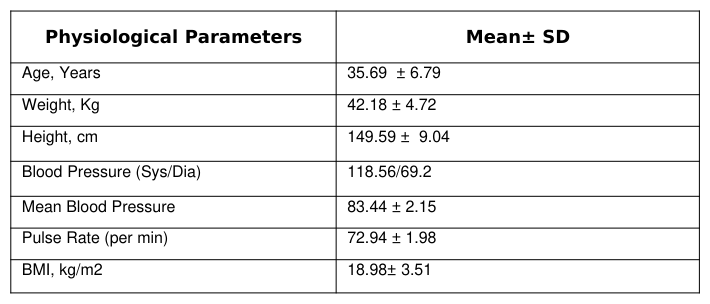
Three adopted villages were selected of VPKAS, Almora, Uttarakhand. Hundred farm women aged between 20-35 years from adopted villages were selected for anthropometric measurements and 60 farm women from high, mid and low altitudinal hill zone was selected for nutritional assessment. Simple random sampling was used to select farm women. Various anthropometric measurements of farm women, nutritional profile and anthropometry related to nutritional assessment were taken into considerations. The subjects who are free from any acute and chronic illness and not under any kind of medication were selected for data collection. The physiological characteristics of the subjects were presented in table 1. The nutritive values for the quantity of raw foods consumed by the individual respondent were calculated by using food composition tables (Gopalan et al. 1989) and compared with the recommended Daily Allowances (RDA).
Table 1: Physiological parameters of the subjects Physiological Parameters Mean± SD
RESULT AND DISCUSSION
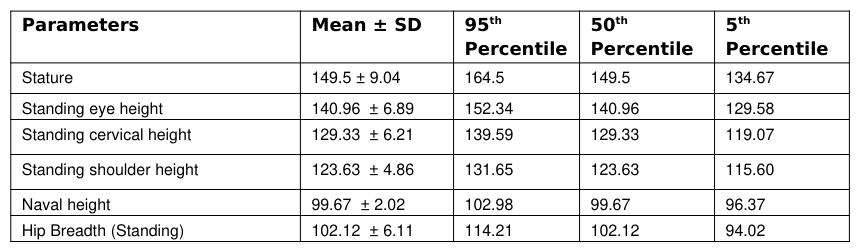
Anthropometric Data of Indian Hill Women Anthropometric data such as Stature, Standing eye height, Standing cervical height, Standing shoulder height, Naval height, Hip Breadth (Standing), Chest depth, Chest Breadth, Arm Span, Elbow span, Arm Length, Ankle height, Thigh Circumference, Calf Circumference, Sitting height, Eye Height, Sitting, Trunk Height, Sitting (Cervical), Shoulder height sitting to Acromion, Upper lumbar Height, Sitting, Lower lumbar Height, Sitting, Sitting Elbow Height, Knee height, sitting, Popliteal height, Thigh Clearance Height sitting, Buttock-Knee Length, Buttock-Heel Length, Shoulder Breadth (bi-deltoid), Shoulder elbow length, Elbow Finger tip length, Vertical arm reach, sitting, Functional arm reach, Grip Breadth, Bicep Circumference, Chest circumference, various head, hand and foot measurements (table 2) were recorded with anthropometric kit. Along with mean and standard deviations 95th and 5th percentiles were also worked out which is prerequisite for designing any ergonomically sound women friendly tools and equipment.
Table 2: Anthropometric Data of Indian Hill Women Parameters Mean ± SD 95th
Thakur and Sharma in 1998 ergonomically assessed various activities performed by women farmers. Anthropometric measurements of the women farmers in standing postures were taken to design and modify agricultural implements for the operations i.e. digging of land, leveling, weeding. Hoeing, sowing and application of fertilizers. For harvesting improved sickle was designed taken into account the anthropometric measurements of hand and palm.
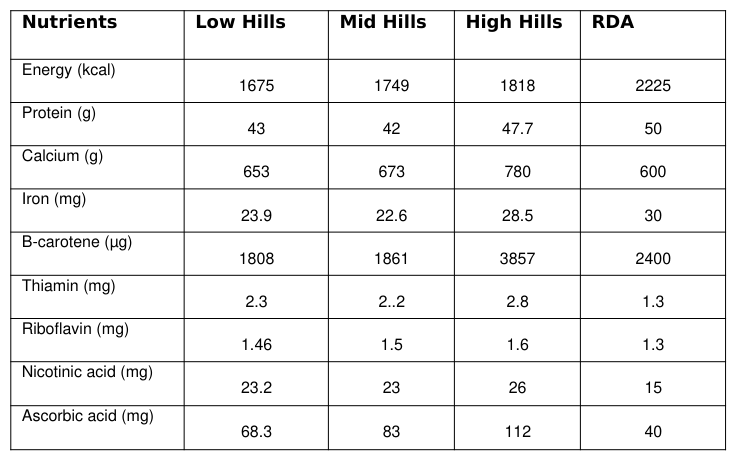
Nutrient Intake of Hill Women Nutrients intake in farm women of low, mid and high altitudinal zones of Uttarakhand is depicted in table 3, which shows that the nutrients as energy, protein, beta carotene, ascorbic acid etc were found low as compared to Recommended Dietary Intake.
Table 3: Nutrients Intake of Hill Women Nutrients Low Hills Mid Hills High Hills RDA
Pant (2002) also reported the average energy intake by the rural women of the Central Himalaya below the standard requirement. Dobhal et al. (2003) also reported that average intake of energy was lower than RDA among women of Uttarkashi. The average protein consumption by women in non-adopted village was less than recommended level. It was found that the coarse grains i.e, ragi and barnyard millet which are rich in calcium content being the part of the diet contributes towards higher intake of calcium, β-carotene and ascorbic acid. The average iron consumption by respondents in adopted and non-adopted village was 18 mg and 16 mg respectively which is 40 and 46.6 per cent less than recommended level (30 mg). In India nearly 70 per cent of women are estimated to be iron deficient. Iron deficiency can exist without anemia. Iron Deficiency Anemia (IDA) is very late manifestation of iron deficiency because iron deficiency is very well tolerated. Anemia does not develop till storage iron is exhausted (Shah, 2004). The main reasons for IDA have been determined to be inadequate intake of iron, low bioavailability (1-6 percent) of dietary iron from plant foods (Rao et al., 1983).
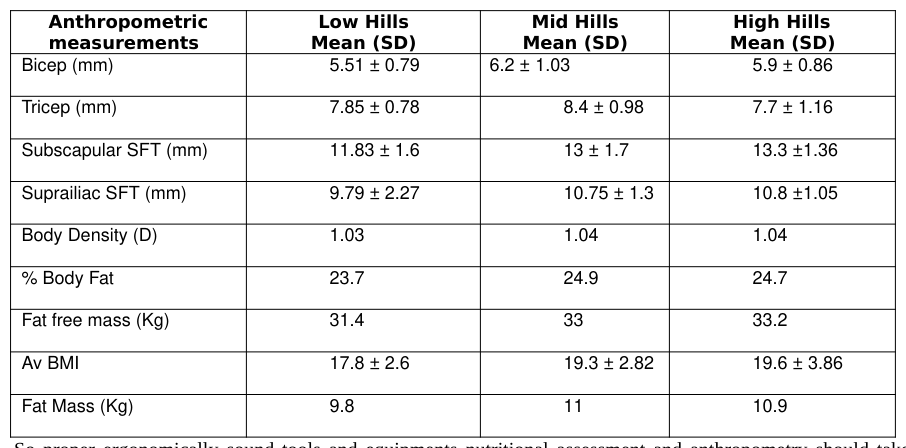
Anthropometry related to nutrition Anthropometric data related to nutrition were also assessed and presented in table 4, which shows that women in N-W Himalayan region is malnourished and they have very keen body mass and fat free mass.
Table 4: Anthropometric data of Hill Women related to nutrition Anthropometric measurements Low Hills Mean (SD) Mid Hills Mean (SD) High Hills Mean (SD) Bicep (mm) 5.51 ± 0.79 6.2 ± 1.03 5.9 ± 0.86
So proper ergonomically sound tools and equipments nutritional assessment and anthropometry should taken into considerations along with energy intake, energy consumption and other physiological parameters of subjects.
CONCLUSIONS
This study documented the mean and percentile range of static and dynamic anthropometric measurements and to provide a comprehensive data for use by anthropologists, nutritionist and ergonomic practitioners who are engaged in designing and evaluating mechanized technologies for women. Various body dimensions in standing and sitting positions, reach measurements, determinants of body fat and Body Mass Index (BMI) were recorded for hill women working in the agricultural domain.
REFERENCES
Akintilo, A. (2001), “A study in ergonomic design and their application with society”. Design development in the home office. Retrieved April 12, 2005, from http://userpages.umbc.edu/~aakint1/thechair.html Chakrabarti, D. (1997), “Ergonomics of the design of products, equipments and accessories”, Indian Journal of Indus
Med, 20 (2):49-63. Cuff, T. (2004), “Historical anthropometrics”, EH.Net Encyclopedia. Dewangan, K. N. Prasanakumar, G.V. Sujap, L., Chaudhary, M.D. (2005), “Anthropometric dimensions of farm youth of the north eastern region of India”, International Journal of Industrial Ergonomics, 11: 979-989. Dhobhal, N., Raghuvanshi, R.S. (2003), “Nutritional profile of women of district Uttarkashi”, M.Sc Thesis
(Unpublished), G.B. Pant University of Agriculture and Technology, Pantnagar. Dhyani,, V. (2007), “Ergonomic studies on modes of carrying load by hill women”, Ph.D. Thesis, GB Pant University of Agriculture and Technology, Pantnagar, India. Gite, L.P., Yadav, B.G. (1989), “Anthropometric survey for agricultural machinery design”, An Indian case study.
Applied Ergonomics, 20 (3):191-196. Gopalan, C. Rama Sastri, B.V., Balasubramanyam, S.C. (1989), “Food Composition Tables” in Nutritive Value of
Indian Foods, 2nd ed., Vol 1. National Institute of Nutrition (ICMR). Hyderabad, 1989, pp. 47-67. Grandjean, E. (1980), “Fitting the task to the man-an ergonomic approach”. Taylor and Francis Ltd, London. pp. 77-
81. Kreifeldt, J.G. (1991), “Application of ergonomics in product designing”. Proc. International Symposium on Ergonomics, Occupational Health Safety and Environment, held at 1st Dec. IIT, Bombay, India. Mariama A, Henshall J. (1995), “Gender and the environment: women’s time use as a measure of environment
change”, Global environmental change. 1995; 5 (4): 337-346. Norris, B.J., Wilson, J.R. (1997), “Designing safety into products making ergonomics evaluation a part of the design process”, The University of Nottingham, Nottingham,U.K. Pant, B. R. (2002), “Drudgery and nutrition status of the rural women in the central himalaya (Uttarakhand
Himalaya)”, The Indonesian Journal of Geography, 34(1): 1-16. Philip, G.S., Tewari, V.K. (2000), “Anthropometry of Indian female agricultural workers and implication on tool design”, Agric Mech Asia Afr Lat Am 31: 63-66. Porter, J.M. Case, K., Freer, M.T. (1999), “Computer aided design and human models”. In: Karwowaski, W. (eds.).
Handbook of Occupational Ergonomics. CRC Press LLC, Florida, pp 479-500. Rao, B. S. N. Vijayasarathy, C., Prabhavathi, T. (1983), “Iron absorption from habitual diets of Indians studied by the extrinsic tag technique”, Indian Journal of Medical Research, 77(5): 648–657. Shah, A. (2004), “Iron Deficiency Anemia - Part-I”. Indian Journal of Medical Science. 58(2):79-81 Tewari, V.K. (2004), “Ergonomic database for engineering design of agricultural machines”, Final Report. Verghese, M. A. Chatterjee, L. Atreya, N. and Bhatnagar, A. (1989), “Ergonomics in kitchen design”, UGC Report
10. Deptt. of Family Resource Management SNDT, Bombay, India.
LISTED IN THE AHFE DIGITAL BOOKSTORE CATALOGUE
Explore the complete digital volume
Advances in Physical Ergonomics and Human Factors: Part II
Read this individual research paper free through the original publisher, or explore the full digital proceedings book.
ISBN 978-1-4951-2105-0
Explore this ISBN in the AHFE Bookstore ↗Listed in the July 2026 bookstore catalogue; search by ISBN to confirm current availability · Digital book purchase optional