Zheng Xiaohui, Ding Songtao, Zhang Xuezhi, Fang He, Liu Taijie, Wang Chunyu (2018). Hand Anthropometry of Young Chinese Males Aged 18~35 Years Old. In: Advances in Physical Ergonomics and Human Factors: Part II. AHFE Open Access, vol. 2. https://doi.org/10.54941/ahfe100081
To evaluate the hand form of young Chinese male, an anthropometry survey was carried out in China from 2010 to 2011, and 9812 young Chinese men were measured with two-dimensional color graphs method and three-dimensional scanning technology. The differences exist in young Chinese male from different regions of China were studied by the hand index. The mean and standard deviation of each dimension of young Chinese male are summarized in tables and compared with those of other populations (Jordanian, Mexicans and Vietnamese). The results show that the seven geographical areas of China could be divided into three groups based on the different hand form types, and there are also significant difference in hand dimensions between young Chinese male and other nationalities.
A surveillance study conducted by NIOSH (1993) reported that musculoskeletal injuries accounted for 24% of all injuries caused by power and non-power hand tools. That indicates the importance of well designed and efficient hand tools. The hand form is essential when designing and sizing of efficient workplace, hand tools and other manual devices(Yu, Yick, Ng, & Yip, 2012), such as golves, buttons and control rods.
There has been an important amount of work regarding hand anthropometry worldwide(Chandra, Chandna, & Deswal, 2011; Dizmen, 2012; Garrett, 1971; Mandahawi, Al-Shobaki, & Imrhan, 2006; Porter, 2000). Same as other parameters of human body, hand anthropometric dimensions are also affected by many factors(Sheik N. Imrhan, 2000), such as age, economy, population, gender and so on. As we all known, there are great difference in appearance between different populations. Meanwhile, the difference in anthropometrical data caused by population should be valued by statistics to meet the demand of design. Accordingly, many anthropologists have studied this issue(Hughes & Lomaev, 1972; Mokdad M. & Al-Ansari M., 2009).
The goal of this study was to characterize the hand form of young Chinese male. At the same time, the difference of the young Chinese men from different regions of China mainland and the difference between Chinese men and Jordanian, Mexican, Vietnamese men were also illustrated.
*Zheng Xiaohui. E-mail: zheng_nudt@163.com Physical Ergonomics II (2018)
MATERIALS AND METHODS
Human Systems Integration A hand anthropometry was carried during 2010~2011 in China, and 9812 young Chinese male were measured All subjects were born in 31 provinces (besides Taiwan, Hongkong, and Macao) of China mainland. Their ages ranged between 18 and 35 years. The mean age is 22.1 years old.
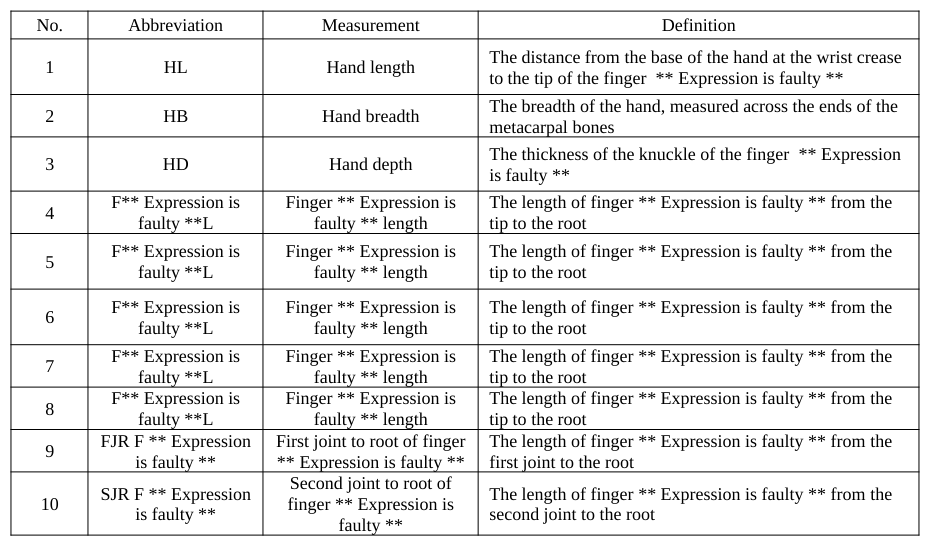
Human Systems Integration Both two-dimensional (2D) and three-dimensional (3D) methods were adopted to carry out the hand anthropometric survey. The detailed 2D method was present in another paper(Ran, Zhang, Chao, Liu, & Dong, 2009). In short, 2D color scanner was adopted, and the ratio of image size with the real hand size was 1:1 with a resolution of 150. To achieve a greater scientific uniformity, measurements were always carried out on the right hand. Every subject was scanned with two hand postures. The first was with four fingers closing together and the thumb naturally outreached, putting on the scanning plane lightly. The second was with the five fingers outreached as far as possible, putting on the scanning plane lightly. All the images were kept in BMP format. At the same time, a 3D method was also adopted. 3D scanner was used to record the 3D hand data, and dimension was extracted from 3D hand data without prior manual landmarking(Zheng et al., 2011). The professional hand dimension calculation softwares were used to extract the designed dimensions from the 2D or 3D data. The advantages of such system are that it would be much faster than Martin method of collecting hand data and it is applicable for a large-scale anthropometric survey. And it would provide a permanent record from which any measurement dimensions can be taken as needed. 25 anthropometric hand dimensions were collected in this survey. In this paper, only 10 important dimensions which can be compared with the results of other surveys were discussed, whose name, abbreviation and definition are illustrated in Table 1.
The Statistical Package for the Social Sciences (SPSS) for Windows version 16.0 was used in the following statistical analysis. The descriptive statistics, including arithmetic means (M), standard deviations (SD) of the measurements were calculated.
Table 1: Definition of the measurements No. Abbreviation Measurement Definition
RESULTS AND DISCUSSION
Native place distribution of samples The native places of the measured samples were also recorded during the anthropometric survey. This anthropometry sampled some people of every administrative region of Chinese mainland (which includes 22 provinces, 5 autonomous regions and 4 municipalities). According to GB10000-1988(Human Dimensions of Chinese Adult, 1988), these administrative zones were divided into seven anthropometry areas, which are Northeast, North China, Northwest, Southeast, Central China, South China and Southwest. From the statistical point of view, the people within each area have similar body shape and body size. Comparing with the results of the 6th population census of China, the distribution of native place of present samples nearly accords with that of the total people. Every administrative region was covered and the number of samples can meet with the need of statistical process.
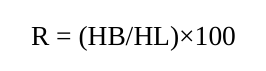
Hand index of young Chinese male To value the hand form quantitatively, many indexes are put forward. In the present study, hand type index R is adopted to value the hand shape. The equation to calculate R is as follows.
Equation reproduced from the original PDF.
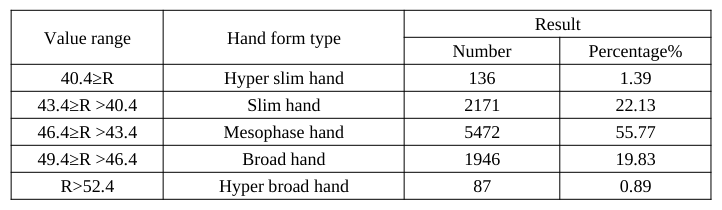
The definitions of HB and HL are shown in Table 1. According to the value of R, the hand form of young Chinese male can be divided into five types, which are Hyper slim hand, slim hand, Mesophase hand, Broad hand, and Hyper broad hand. With the increasing of R, the hand form type becomes broader. As Table 2 shown, the number of men with slim hand type in the samples is a little more than that with broad hand type. Comparing with old men, young men have less fat. As a result, the hand of young man may also be slimmer.
Table 2: The distribution of different hand form type Value range Hand form type Result Number Percentage% 40.4≥R Hyper slim hand 136 1.39 43.4≥R >40.4 Slim hand 2171 22.13 46.4≥R >43.4 Mesophase hand 5472 55.77 49.4≥R >46.4 Broad hand 1946 19.83 R>52.4 Hyper broad hand 87 0.89
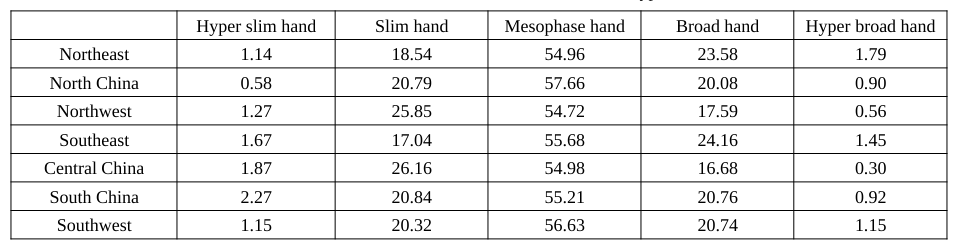
There are seven areas in China, and the people living in different areas differ between each other in many aspects because of the different environment, climate, economic level and living habit. As a result, the anthropometric data are also different. The population distribution of different hand form type in every area was calculated and displayed in Table 3. The distribution in different areas varies a little, which can be ranked into three groups. Northeast and Southeast are the same group, which has more broad hand forms. North China, South China and Southwest are the same group, whose number of slim hand forms and broad hand forms are equal. Northwest and Central China are the third group, which has more slim hand forms. There is a slight trend that the values of anthropometric dimensions become larger for the people in areas of higher latitude. The economy status may also be an important factor which affects the anthropometric dimensions. The economy status in east of China is better than that of west China. That may be one of the reasons why Northeast and Southeast areas have more broad hand forms than Northwest and Central China.
Table 3: The distribution of different hand form types Hyper slim hand Slim hand Mesophase hand Broad hand Hyper broad hand
The hand form difference between different populations Because of the importance of hand dimensions, many countries have carried out hand anthropometric surveys. Nabeel Mandahawi(Mandahawi, Imrhan, Al-Shobaki, & Sarder, 2008) reported the hand anthropometry survey for Jordanian in 2008. S.N. Imrhan reported the hand anthropometry survey for Mexicans(S.N. Imrhan & Conteras, 2005) and Vietnamese(Sheik N. Imrhan, Nguyen, & Nguyen, 1993) in 2005 and 1993. Most of their samples are from college students and industrial workers, whose mean age is 27.13, 25.8 and 32 years old, and should also be young men. Consequently, the anthropometric data of these surveys are camparable.
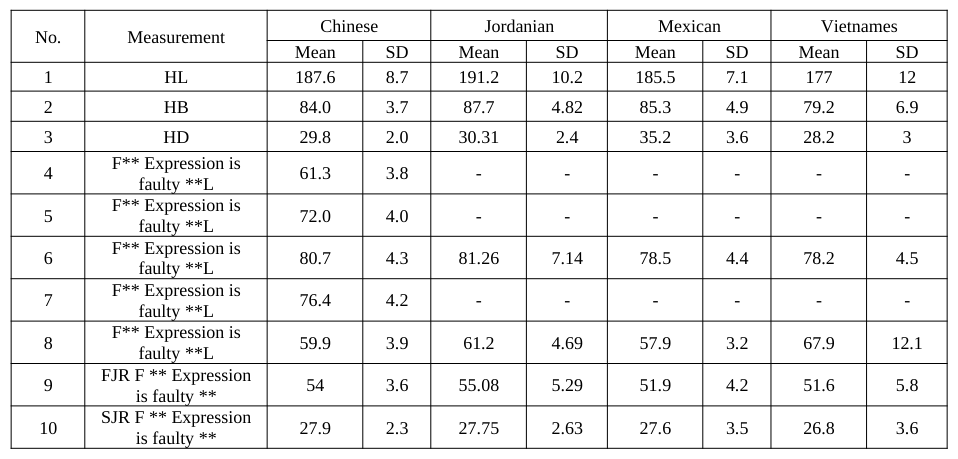
The means and standard deviation (SD) of the hand measurements of Jordanian, Mexican and Vietnames male are shown in Table 4. It is well known that nationality is an important factor which may affect the difference of anthropometric dimensions. The present results also reveal a significant distinction between racial groups found only in the first eigenvalue (p<0.05). Comparing with these data, a conclusion can be drawn that hand length of young Chinese male is a little smaller than that of Jordanian male, while bigger than that of Mexicans and Vietnamese. Meanwhile, the hand length of Mexican is smaller than Chinese, while the hand breadth and hand depth are larger. At the same time, the hand length, hand breadth and hand depth of young Chinese male are larger than Vietnames. A longer hand does not necessarily correspond to longer finger segments. Even though the finger length of Vietnamese is longer than Chinese, but the hand length is smaller. In a word, the hand proportions also differ in different nationalities, which may be consided
Table 4: Descriptive summary of craniofacial measurements of males from different nationalities (mm) No. Measurement Chinese Jordanian Mexican Vietnames Mean SD Mean SD Mean SD Mean SD 1 HL 187.6 8.7 191.2 10.2 185.5 7.1 177 12
CONCLUSION
Hand form is important for designing and sizing instrument, and many ergonomic scientists have paid attention to study on this issue. In this paper, new data for hand dimensions were present and the distributions of data were also illustrated. These anthropometric data was used to value the hand form of young Chinese male and the difference between Chinese male and Jordanian, Mexican, Vietnamese young male. The results show that the hand forms of different regions in China differ from each other, and young men from Northeast and Southeast have more broad hand types. The hand dimensions of the four nationalities shows that young Jordanian men have the longest hand and Vietnamese have the smallest hand. The differences of hand dimensions between different nationalities are distinct. Considering these differences in hand form, the instrument should be sized for the people different regions in China and different nationalities in the world to get better fitting and performance.
REFERENCES
Chandra, A., Chandna, P., & Deswal, S. (2011). "Hand anthropometric survey of male industrial workers of Haryana state (India)". International Journal of Industrial and Systems Engineering, 9(2), 163-182. Dizmen, C. (2012). Hand anthropometry analysis and construction of regression models for a hong kong sample,
Kowloon, Hong kong. Garrett, J. W. A. (1971). Anthropometry of the Air Force female hand (No. AD-710 202). Hughes, J. G., & Lomaev, O. (1972). "An Anthropometric Survey of Australian Male Facial Sizes". American Industrial Hygiene Association Journal, 33(2), 71-78. Human Dimensions of Chinese Adult. (1988). (No. GB 10000-1988): Chinese State Bureau of Technical
Supervision. Imrhan, S. N. (2000). Comparison of hand dimensions among various nationalities, San Diego, CA, United states. Imrhan, S. N., & Conteras, M. G. (2005). Hand anthropometry in a sample of Mexicans in the US Mexico border region. Paper presented at the Proceedings of the XIX annual occupational Ergonomics and saftey conference, Las Vegas, NE. Imrhan, S. N., Nguyen, M.-T., & Nguyen, N.-N. (1993). "Hand anthropometry of Americans of Vietnamese origin".
International Journal of Industrial Ergonomics, 12(4), 281-287. Mandahawi, N., Al-Shobaki, S., & Imrhan, S. (2006). Hand anthropometry on a sample of Jordanian females, Orlando, FL, United states. Mandahawi, N., Imrhan, S., Al-Shobaki, S., & Sarder, B. (2008). "Hand anthropometry survey for the Jordanian
population". International Journal of Industrial Ergonomics, 38(11), 966-976. Mokdad M., & Al-Ansari M. (2009). "Anthropometrics for the design of Bahraini school furniture". International Journal of Industrial Ergonomics, 39(5), 728-735. Porter, M. L. (2000). The anthropometry of the fingers of children, San Diego, CA, United states. Ran, L., Zhang, X., Chao, C., Liu, T., & Dong, T. (2009). Anthropometric measurement of the hands of Chinese
children. Paper presented at the Digital Human Modeling, HCII 2009. Yu, A., Yick, K. L., Ng, S. P., & Yip, J. (2012). "2D and 3D anatomical analyses of hand dimensions for custommade gloves". Applied Ergonomics, 44(3), 381-392. Zheng, X. H., Ding, S. T., Wu, Y. M., Xiao, H., Qi, J. C., & Niu, J. W. (2011). Dimension extraction from three
dimensional (3D) hand data without prior manual landmarking, Changchun, China.
LISTED IN THE AHFE DIGITAL BOOKSTORE CATALOGUE
Explore the complete digital volume
Advances in Physical Ergonomics and Human Factors: Part II
Read this individual research paper free through the original publisher, or explore the full digital proceedings book.
ISBN 978-1-4951-2105-0
Explore this ISBN in the AHFE Bookstore ↗Listed in the July 2026 bookstore catalogue; search by ISBN to confirm current availability · Digital book purchase optional