Dai Shi, Ai Zhang, Jing Ou, Haining Wang (2023). User Experience Design of Hand-Held Beauty Device. In: Ergonomics In Design. AHFE Open Access, vol. 77, pp. 233–242. https://doi.org/10.54941/ahfe1003381
With the development of the economy and the improvement of people's living standards, the use of beauty instrument demand gradually increased, the beauty instrument market is also booming on this basis. However, in the process of rapid development of beauty devices, there are obvious shortcomings in terms of functions and user experience, such as the inability to meet the holding experience of female users when matching with nail accessories. Therefore, this paper conducts a user experience study on hand-held beauty devices for home use in order to improve the awareness and experience of hand-held beauty devices. Based on the experience design theory, this paper analyzes the user's use process to find out the user's pain points through experience measurement. At the same time, the correlation between user hand size, beauty device shape and user experience is studied to provide a basis for the design of beauty device shape. Finally, based on the conclusion of the two experiments, the design of hand-held beauty device is proposed, which provides reference for the development of beauty device products and also provides reference for the application of product design and experience design methods.
In recent years, there has been a growing trend towards the use of handheld beauty devices among female users, as the demand for aesthetic enhance- ments continues to rise. The global home beauty device market is projected to grow significantly in the coming years, from $9,571.6 million in 2020 to an estimated $89,535.1 million in 2030, with a CAGR of 25.5% (Kim, T. W, 2022). However, with the increasing variety of beauty devices available, users are faced with inconveniences associated with their use, particularly in rela- tion to nail art hand decorations and the varying ways in which users hold their devices. In this context, the importance of ergonomic research in the design of handheld beauty devices cannot be overstated. (Kim, T. W. and Kim, H. W, 2022).
This paper employs ergonomic research methods to quantitatively analyze the user experience of holding a beauty device for home use, with a view to designing a device that meets the needs of contemporary female users. Through a systematic review of existing literature, we identify key ergono- mic considerations that must be taken into account in the design of handheld beauty devices, including grip, weight and balance. To test the usability of the
device, we conduct a user study involving a sample of female participants. The study assesses the ergonomic design features of the device, including its grip, ease of use, and overall user satisfaction. Based on the results of the study, we develop a prototype of the handheld beauty device that incorporates the key ergonomic features identified in our analysis. The proposed design is expe- cted to provide users with a more comfortable and efficient experience when using handheld beauty devices. By leveraging the principles of ergonomic design, our device has the potential to improve the overall user experience and satisfaction, while also contributing to the growth of the global home beauty device market.
EXPERIMENT 1: USER EXPERIMENT Participants and Equipment
For this study, three female participants aged between 18 and 20 years, who had prior experience using nail and beauty devices, were randomly sele- cted as subjects. Each participant was asked to use the same handheld home grooming device while wearing a 3cm long nail piece.
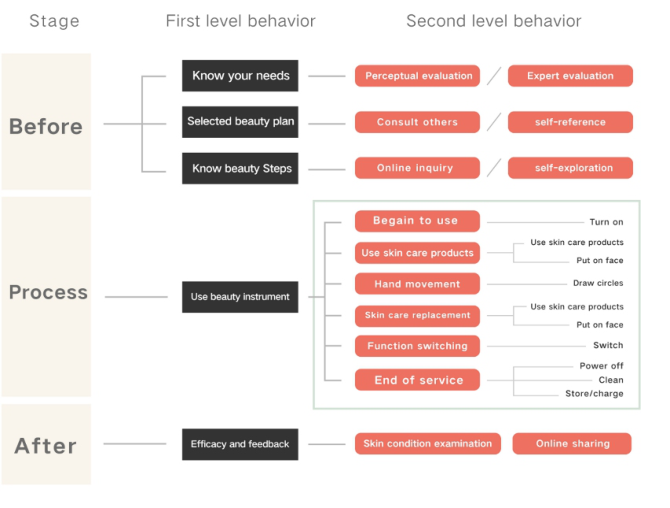
Experiment Methods From the user’s emotional concerns, we analyze the user’s behavioral levels in key aspects and visualize the user’s behavior. Behavior is composed of multiple levels, and the completion of an action is often the sequential per- formance of multiple “next-level behaviors” to the base behavior (Desmet, P, 2012). Based on the pause of behavior, connecting related things together can let things get timely processing, reduce the number of unfinished tasks, thus reducing the number of times things are started, and improve efficiency, there- fore, designers should consider the continuity of user behavior under certain environmental conditions when designing products, so that products bring better user experience. Based on the usage behavior of beauty instrument users, the user’s behavior level is analyzed.
The rough behavioral steps of beauty and skincare can be divided into before, during, and after beauty in chronological order. Through the analy- sis, the secondary behaviors under the primary behaviors of users using the importer are taken as the important stages of user experience conti- nuity measurement, and there are ten steps (start using, turn on the switch, use skin care products, hand action, change products, function switch- ing, hand action, end using, skin state, testing, online sharing), and the secondary behaviors of the ten steps are integrated into the user experie- nce test for quantified index testing to generate user experience continuity curves.
Three subjects were familiarized with the experimental introduction device and wore the same style of 3cm long nail art pieces while ensuring their comfort. Finally, the nail appliance was used in the ten behavioral steps described above and the user experience was scored by verbally informing the experimenter during use.
User Experience Design of Hand-Held Beauty Device 235
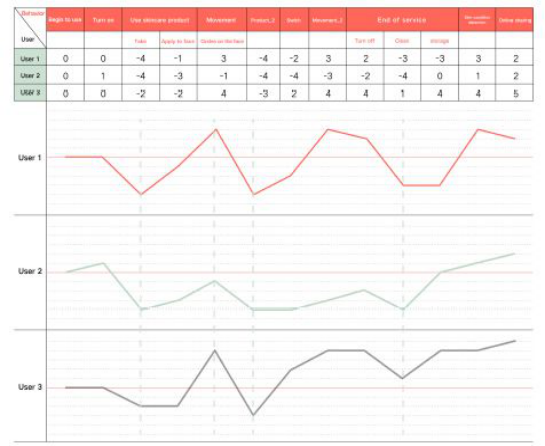
Data Collection and Analysis Three households were recruited to participate in a study examining the user experience of beauty devices across ten stages: starting use, turning on the switch, using skin care products, hand movements, changing products, swi- tching functions, hand movements, ending use, skin status, testing, and online sharing. User experiences were assessed on a scale ranging from −5 (negative) to +5 (positive), with 0 representing a neutral emotional state (Law, E.L.C., 2014). Following statistical analysis, the results of the experiment revealed the user experience scores for the three participants as follows: (Figure 2).
Through the analysis, it was found that the user experience index of 3 users in the use of the existing beauty device in the use of the switch and twice to take the skin care products in the stage of a significant decline, while in the rest of the stage of the overall show a relatively positive user experience.
Results
Based on the experimental data, it is evident that users had a negative expe- rience when using the switch to apply skincare products, but a positive experience during introductory massage. The cleanliness factor had a nega- tive impact on the user experience, while users exhibited satisfaction with the skincare effect and were eager to share it on social media. Furthermore, wearing nail accessories hindered the grip and use of the switch adjustment, leading to an unfavourable user experience. Thus, design practices should focus on simplifying the beauty device usage process and improving the button design of the device.
Figure 1: Analyse the usage behaviour of beauty device users.Figure 2: Behaviour of beauty device user experience score table.
EXPERIMENT 2: ERGONOMICS EXPERIMENT Kansei engineering research has demonstrated that the visual and physical characteristics of household beauty devices influence users’ perceptual and cognitive tendencies, as well as their overall user experience (Yang, H., 2021). In terms of product design, the human-machine interaction aspect of house- hold beauty devices affects users’ perception of use and design appeal. In Experiment 1, we conducted a study of user usage behavior and functio- nal attributes of beauty instruments, and combined the results with product semantics from a perceptual engineering study. Using common beauty instru- ment design sizes on the market, we developed different physical models to investigate the influence of product shape semantics and size on holding comfort, face/eye usage experience, and shape appeal.
The design of an all-in-one beauty device’s overall shape is determined by various factors, such as height, width, thickness, and roundness, which have multidimensional effects on the user’s grip experience. These dimensions may also interact with one another, necessitating a comprehensive evaluation of the comfort of the grip experience that takes multidimensional factors into account. The curvature, roundness, distortion, symmetry, and regularity of the contour curve of the beauty device product directly influence the user’s perceptual cognitive tendency. A rounded shape brings a friendly, warm emo- tional experience and a palm-fitting edge curve results in a better grip, while a flat shape represents a comfortable, safe, and stable beauty experience, as well as more efficient and detailed beauty care, in terms of semantics and function.
The comfort of using a beauty device also varies with the size of the pro- duct. Different parts of the hand have different tactile sensitivities, and when
User Experience Design of Hand-Held Beauty Device 237
changing the product size, the contact area between the hand and the product changes, thus affecting the hand’s perception of the product’s task (Schiffer- stein, H. N., 2011). The size of the user’s hand is also an important influence on the size of the product. Relevant handheld device studies have shown that greater width leads to an increase in required holding effort, which increa- ses discomfort in holding. Therefore, the size of the beauty device should be appropriately designed.
Based on the aforementioned analysis, it is suggested that the focus should be on user experience when designing beauty devices. To investigate the influ- ence of factors such as shape and size on the user’s holding experience, a 2*2 beauty device model comparison experiment with dual factors of shape (round/flat) and size (large/small) should be conducted.
Participants and Equipment For this study, a sample of five female participants between the ages of 18 and 20 with prior experience using beauty devices were randomly selected as participants. Four models of beauty devices (Figure 3) were created using lightweight clay in order to minimize the influence of differences in mass and to facilitate evaluation of the shape and size of the devices.
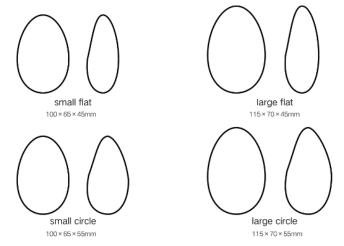
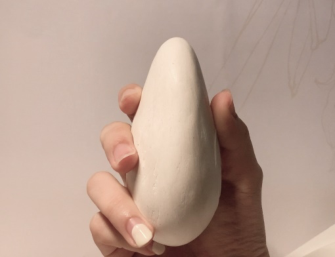
Experiment Methods The primary difference between the two modeling semantics (round/flat) was the thickness of the lower part of the product, while the rest of the product was of the same thickness by default. The thickest part of the rounded seman- tic beauty device was 55mm, with a fuller bottom to fit the hand, while the thickest part of the flat semantic beauty device was 45mm, with a flatter overall shape. The main difference between the two sizes (large/small) was the length and width of the product. The larger size was 115mm in length and 70mm in width, while the smaller size was 100mm in length and 65mm in width. The semantic and dimensional dimensions were arranged as 2*2 for “large round”, “large flat”, “small round”, and “small flat”. The four models were used to evaluate the experience of holding and using the devi- ces and design appeal. Each participant held the four models on the table with their right hand (Figure 4) and assumed the position of using the beauty
Figure 3: The four model used in Experiment 2 and the dimensional data.Figure 4: Participants held the beauty device models using their right hand.
device for over 30 seconds, holding and moving the models over their face to simulate the behavioral actions of cheek massage and eye massage.
Data Collection and Analysis The participants responded to four questions on a 10-point assessment scale, where 0 represented the lowest score and 10 represented the highest score. Whole numbers were chosen for scoring. The questions included (1) asses- sment of the comfort of holding the beauty device model, (2) satisfaction with the facial use experience during the beauty device simulation, (3) satisfaction with the eye use experience during the beauty device simulation, and (4) eva- luation of the overall aesthetics of the beauty device design. The comfort of holding question had a scale of (0 points) “very uncomfortable,” (5 points) “neutral,” and (10 points) “very comfortable.” The question on satisfaction with facial/eye experience had a scale of (0) “very dissatisfied,” (5) “neutral,” and (10) “very satisfied.” The evaluation scale for the question on liking the shape of the beauty device was (0) “very much disliked,” (5) “neutral,” and (10) “very much liked.”
The subjects’ hand data (thumb length and the distance from the root of the thumb to the root of the index finger, measuring the main part used for holding) were measured as independent variables for data analysis reference.
The experimental data were divided into set A: independent variable data indicators (Thumb length, Distance between the root of the thumb and the root of the index finger, Size, Round and flat) and set B: User experience data indicators (Comfort of holding, Facial contact experience, Eye contact expe- rience, Modeling evaluation) using typical correlation analysis. Comfort of holding, Facial contact experience, Eye contact experience, Modeling evalua- tion) were used to investigate whether there is a correlation between the two sets and to find the factors that have a greater influence on user experience.
From the results of Canonical Correlations (Loczi, J., 1993), it is clear that only the first pair of typical variables correlates significantly (P<0.05), while their confidence level is between 95% and 99%. From this, we can determine the number of typical correlation coefficients is 1, that is, the correlation
User Experience Design of Hand-Held Beauty Device 239
coefficient of the first pair of typical variables, and from the correlation coef- ficient (ρ(A1, B1)=0.860), we can see that the set A and set B show positive correlation, and the standardized first pair of typical variables obtained are.
Equation reproduced from the original PDF.
Results
Analysis of the data from Experiment 2 shows that:
Among the independent variable data indicators, the typical variables responding to the independent variable data indicators are mainly deter- mined by Size because x3 has the largest absolute value.
Among the user experience data indicators, the typical variables respon- ding to the independent variable data indicators are mainly determined by Comfort of holding because the absolute value of y1 is the largest.
Meanwhile, the coefficient of typical variables is heteroscedastic, which reflects the negative correlation between Size and Comfort of holding, the larger the size of the model the worse the user experience of holding
Table 1. Canonical correlations of independent variable data and user experience data.
Table available in the original PDF paper.
Canonical Correlations
Correlation Eigenvalue Wilks Statistic F Num D.F Denom D.F. Sig.
Thumb length(x1) .490 1.006 1.268 .722 Distance between the root of the thumb and the root of the index finger (x2) Size (x3) −.640 .524 −.396 .400 Circle and flat (x4) −.080 .565 .049 −.820
Table 3. Standardized canonical correlation coefficients of user experience data.
HOME HANDHELD BEAUTY DEVICE DESIGN In the current era of consumer upgrading, designing for the consumer expe- rience has become a focal point. This study approaches product design from the perspective of user experience, incorporating theories and methods rela- ted to ergonomics and conducting relevant research on target groups of home beauty devices. By integrating experience design methods into product design and conducting an in-depth study of user behavior and ergonomics, we aim to design more sensible and well-suited beauty devices. The goal is to incorpo- rate the objective science of design, rather than relying solely on aesthetics, and to enhance user-centered design development by utilizing data derived from experimental measurements. In the subsequent design practice phase, we will finalize the design output for beauty devices based on the needs iden- tified through emotional analysis of beauty device use and shape comparison experiments in our previous work, and achieve improved user experiences through innovative product design strategies that align with development trends.
Product Requirement Analysis and Functional Positioning Through the extension and insight of the beauty device consumer market, we observed that the female consumers of Generation Z are willing to “spend for beauty”, and got the high overlap between the consumer group using beauty devices and the nail care group (Łopaciuk, A., 2012), and found the design opportunities to improve the experience of using beauty devices–The beauty device was redesigned to address the inconvenience of long nails in the skincare process.
The aim of the beauty device is to enhance the skin’s absorption of ski- ncare products such as essential oils and creams. As compared to other types of beauty devices, the skincare product introduction device is used in com- bination with other skincare products, and thus its design process requires a combination of “skincare product - introduction device - human”interaction, imparting a greater innovative significance to the beauty device experience design.
Program Innovation Experiment 1, which evaluated the user experience of each aspect of beauty device use, revealed that individuals with longer nails reported lower satisfa- ction when using skin care products. Long nails also caused discomfort when holding the beauty device and activating the button switch, leading to nega- tive emotions. Furthermore, the need for users to frequently open and close multiple skin care products at different stages of the beauty process resulted in a cumbersome and inconvenient experience. These are design challenges that need to be addressed through innovation and improvement. Drawing upon market research and speculating on future trends in beauty instruments, we propose an innovative solution for beauty instrument products.
Our solution involves a modular configuration of the skin care system, which includes a beauty instrument that can inject skin care products into the base of the instrument. The base contains a customized skin care module that utilizes skin care components to achieve the full process of skin care with
User Experience Design of Hand-Held Beauty Device 241
the beauty instrument design, thereby improving the user experience. The beauty instrument encapsulates different functions such as extrusion, appli- cation, and introduction, reducing direct contact between hands and face, and catering to nail and long nail users, thereby making it more comfortable and convenient for users to hold the instrument and use skin care produ- cts. This functional innovation simplifies the use process at the root, thereby resolving the challenge of cumbersome skin care routines.
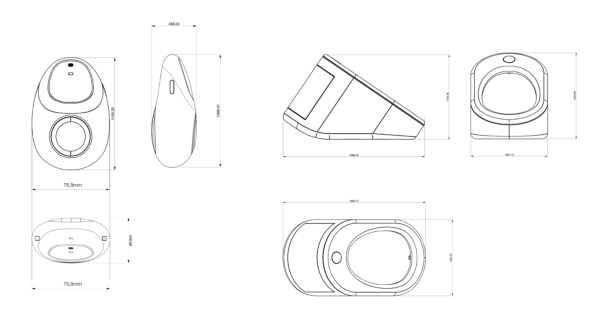
Design and Conclusion Referring to the findings of Experiment 2, which indicate that users prefer a rounded design for the beauty instrument, and taking into account the overall experience of using the device on the face/eyes and the comfort of holding the smaller-sized model, the final product shape and related ergonomic data were determined based on the principles of universal design. A product size diagram was then created to reflect these design considerations (Figure 5).
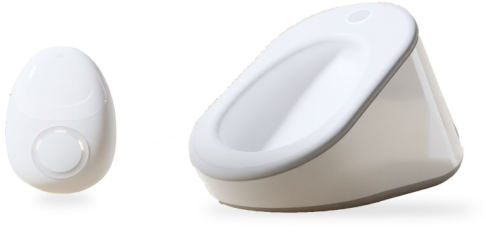
After 3D software modeling and rendering (Figure 6), the effect of the beauty device and skincare products into the base was created.
Figure 5: The length width height size of handheld beauty device and its base.Figure 6: Beauty device product modelling renderings.
REFERENCES
Desmet, P. and Schifferstein, H., 2012. Emotion research as input for product design. Product innovation toolbox: A field guide to consumer understanding and research, pp. 149–175. Kim, T. W., Kim, H. W., Lee, C. H., Min, H. J., Kim, D. D., Kim, D. H. and Park, S. Y.,
2022. A Study on the Development of Customized Home Care Beauty Device. The Journal of the Korea Contents Association, 22(1), pp. 23–34. Kim, T. W., Lee, C. H., Min, H. J., Kim, D. D., Kim, D. H., Park, S. Y. and Kim, H. W., 2022. Skincare Device Product Design Based on Factor Analysis of Korean Anthropometric Data. Cosmetics, 9 (2), p. 42. Law, E. L. C., Van Schaik, P. and Roto, V., 2014. Attitudes towards user experience
(UX) measurement. International Journal of Human-Computer Studies, 72 (6), pp. 526–541. Loczi, J., 1993, October. Ergonomic assessment of exiting automobiles. In Proceedings of the Human Factors and Ergonomics Society Annual Meeting (Vol. 37, No. 5, pp. 401–405). Sage CA: Los Angeles, CA: SAGE Publications. Łopaciuk, A. and Łoboda, M., 2013, June. Global beauty industry trends in the 21st
century. In Management, knowledge and learning international conference (pp. 19–21). Schifferstein, H. N. and Hekkert, P. eds., 2011. Product experience. Elsevier. Yang, H. and Jiang, Z., 2021, July. Appearance Design Method of Household Beauty Instrument Based on Kansei Engineering. In International Conference on Applied Human Factors and Ergonomics (pp. 1056–1063). Springer, Cham.
LISTED IN THE AHFE DIGITAL BOOKSTORE CATALOGUE
Explore the complete digital volume
Ergonomics In Design
Read this individual research paper free through the original publisher, or explore the full digital proceedings book.
ISBN 978-1-958651-53-7
Explore this ISBN in the AHFE Bookstore ↗Listed in the July 2026 bookstore catalogue; search by ISBN to confirm current availability · Digital book purchase optional