Yuang Li, Xiangcheng Qiu, Houqi Huang, Shi Lei Su, Haining Wang, Jing Ou (2026). Gender Sensitive Ergonomic Evaluation of a Disposable Ureteroscope Handle. In: Human Factors and Ergonomics In Design. AHFE Open Access, vol. 210, pp. 53–64. https://doi.org/10.54941/ahfe1007425
Disposable flexible ureteroscopy requires prolonged one handed holding, repeated thumb control, and frequent accessory changes. These demands may disadvantage users with smaller hands. This study developed a Human Factors Evaluation for Ureteroscopy system, named HFE-U, based on a User, Task, Environment, and Product model. The system contains five dimensions: grip comfort, interaction comfort, operational portability and efficiency, postural and whole body load, and perceived safety and innovation acceptance. Forty eight candidate indicators were generated from literature review, product analysis, clinician interviews, and questionnaires. Thirty eight core indicators were retained after item analysis and expert content validation. Guided by this system, a four stage iterative design produced a fully integrated handle prototype. In a simulated static holding experiment with 20 female and 20 male students, the prototype showed higher VAS grip comfort than the conventional handle. Female participants showed a larger descriptive improvement, although the sex by handle type interaction was not significant.
Flexible ureteroscopy places sustained physical demands on surgeons. During disposable flexible ureteroscope use, the handle is commonly held with one hand while the thumb repeatedly controls deflection and the fingers operate suction, imaging, and accessory related functions. Electromyography and posture based studies show that ureteroscopy can load the thenar region, wrist, elbow, and shoulder, and that ergonomic risks may persist during simulated and clinical tasks (Ludwig et al., 2017; Kim et al., 2024; Kobayashi et al., 2026).
Existing ergonomic studies on surgical instruments have mainly addressed laparoscopic devices, reusable endoscopes, and general endoscopic controllers. Recent ureteroscope evaluations have compared image quality, deflection, irrigation, maneuverability, and general ergonomic scores across device types (Bhojani et al., 2023; Tambo et al., 2020). Although a female gender flexible ureteroscope has been evaluated from a flow and deflection perspective (Karani et al., 2021), the grip interface of disposable ureteroscope
handles has received less systematic attention, particularly when the handle must integrate suction, imaging control, and accessory fixation within a lightweight disposable structure.
A key design issue is that medical instrument dimensions often reflect data and assumptions that fit larger hands more readily. Studies of minimally invasive surgical instruments and endoscopic controllers indicate that smaller hand size is associated with greater discomfort, lower proficiency, higher fatigue, or greater perceived difficulty (Green et al., 2023; Hislop et al., 2023; Miller et al., 2025; Yong et al., 2023). Since female clinicians generally have smaller hand dimensions and lower grip strength on average than male clinicians, a handle geometry that is acceptable for male users may still compromise stability, reach, and long term comfort for female users.
To address this gap, the study constructed a structured evaluation framework and used it to guide a four stage handle redesign. The objectives were to develop an HFE-U system that integrates subjective comfort, local fatigue, and operational performance, to translate female hand anthropometry and previously identified ergonomic problems into design changes, and to test whether the resulting fully integrated prototype improves static holding experience relative to a conventional handle while allowing sex related effects to be assessed.
METHODS
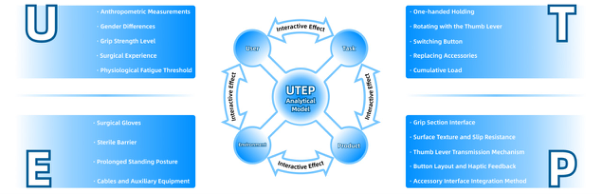
UTEP Analysis Model The User, Task, Environment, and Product model was adopted as the conceptual basis for the evaluation system. The model reflects a core human factors assumption: device performance is shaped by the interaction among user characteristics, task demands, environmental constraints, and product attributes rather than by a single design feature.
User refers to the clinicians who perform the procedure. Relevant characteristics include hand anthropometry, sex related differences, grip strength, surgical experience, and physiological fatigue thresholds during prolonged operation. This study focused on the fit problems that may arise when users with smaller hands operate a standard handle.
Task refers to typical ureteroscopy actions, including sustained one handed holding, thumb lever rotation, repeated switching between suction and image capture buttons, frequent accessory changes such as stone basket handling, and cumulative workload across long procedures.
Environment refers to constraints introduced by the operating room. These include attenuation of tactile feedback by surgical gloves, restrictions caused by sterile barriers, additional upper limb load from prolonged standing, and interference from cables and auxiliary equipment.
Product refers to handle geometry and interface design. Relevant attributes include grip section diameter and cross sectional shape, surface texture and slip resistance, thumb lever transmission and operating force, button layout and tactile feedback, and the integration of accessory interfaces such as a basket support or a three way valve.
Gender Sensitive Ergonomic Evaluation of a Disposable Ureteroscope Handle 55 The four factors interact in use. For example, a smaller hand may reduce grip stability when the handle circumference is excessive. Surgical gloves can further reduce tactile feedback and increase the risk of button misidentification. The UTEP model therefore served as a structured map for defining evaluation dimensions and screening indicators.
Figure 1: UTEP model framework.
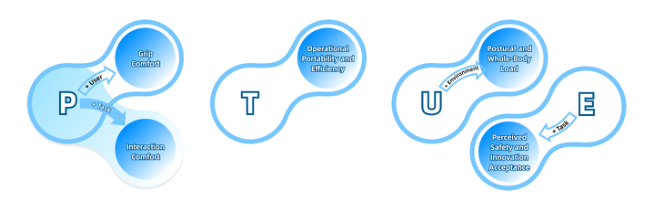
HFE-U Evaluation System Based on the UTEP model, a Human Factors Evaluation for Ureteroscopy system, named HFE-U, was developed. The construction process followed four steps.
First, the four UTEP factors were mapped to evaluation dimensions. User factors were linked to posture and whole body load. Task factors were linked to operational portability and efficiency. Environmental factors were linked to perceived safety and innovation acceptance. Product factors were linked to grip comfort and interaction comfort, because the handle geometry and control interface jointly determine contact quality and operation experience.
Second, an initial item pool was generated by combining four sources: a review of surgical instrument ergonomics literature, competitive analysis of disposable ureteroscope handles and comparable devices, interviews with urologists of different sexes, and a questionnaire based on the interview results. This process produced 48 candidate indicators grouped into five dimensions.
Third, item analysis, corrected item total correlation testing, and expert content validation were conducted. Three experts in ergonomics and urology evaluated content validity. Items with a content validity index above 0.80 were retained in principle, following common recommendations for CVI based instrument development (Polit et al., 2007). Ten items were removed because of semantic overlap, excessive generality, or redundancy. Item 38 had a CVI of 0.67 but was retained after group discussion because it assessed overall upper limb fatigue. The final HFE-U system contained 38 core indicators. The item level CVI ranged from 0.67 to 1.00, and the average scale level CVI was 0.93.
Fourth, measurement tools were operationalized. VAS was used for overall grip comfort, tailored 7 point Likert items were used for item level subjective
ratings, Borg CR-10 was used for local fatigue intensity, and objective indicators such as task completion time and accessory change success rate were included for future dynamic task assessment. The subsequent experiment focused on static holding comfort; therefore, objective performance indicators and several mechanically dependent items were not collected in this study.
Figure 2: Five dimensional HFE-U indicator system and its mapping to the UTEP model.Table 1: Summary of candidate indicators and screening results for the HFE-U system.
Table available in the original PDF paper.
Dimension Candidate Items
Retained Items
Examples of Retained Indicators
Main Reason for Removal Overlap or overly general wording
6 3 Perceived safety, professional trust, female hand adaptation
Duplicate or merged with related items Total 48 38 I-CVI range: 0.67 to 1.00; S-CVI/Ave: 0.93 10 items removed
Four Stage Iterative Design The design sequence followed a progression from the proximal grip interface to distal fingertip control. Grip geometry was treated as the physical basis of all later interaction. If the handle does not fit the palm, improvements to buttons, levers, or accessories cannot fully improve the user experience.
Gender Sensitive Ergonomic Evaluation of a Disposable Ureteroscope Handle 57 The four stages therefore addressed grip shape first, followed by one handed operating freedom, sustained thumb force, and fingertip control.
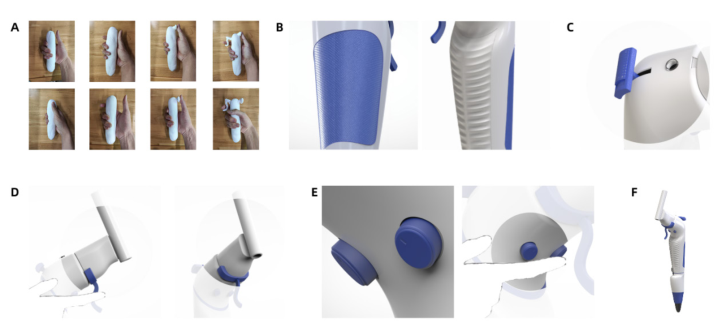
Stage 1 optimized the grip section. Many disposable ureteroscope handles use a cylindrical section that better matches larger hands. For users with smaller hands, insufficient fit can require compensatory grip force and accelerate fatigue. Based on female hand measurements, including palm width, thenar curvature, and the distance from index finger to palm center, the grip section was changed from a round to an oval cross section and the diameter was reduced. This stage produced Prototype 1.
Stage 2 introduced a clip support. During stone retrieval, clinicians frequently alternate between the handle and the stone basket. The prototype added a top clip support that allows the basket to be fixed above the handle after insertion into the working channel. The clip force was adjusted through repeated testing to balance fixation reliability and removal convenience. This stage produced Prototype 2.
Stage 3 integrated a gear drive thumb lever and sliding lock. Conventional friction based deflection control requires the thumb to maintain force to hold the target angle. The prototype used a gear drive to reduce transmission resistance and added a sliding lock so that users could fix the selected angle without continuous thumb loading. This stage produced Prototype 3.
Stage 4 optimized button layout and integrated all features. In the conventional handle, the suction and image capture buttons are separated by a relatively large distance, requiring wider index finger movement. Surgical gloves may further reduce tactile feedback. The two buttons were repositioned near the first phalanx of the naturally flexed index finger, the spacing was reduced, and slightly different raised surfaces were used to support tactile identification without visual confirmation. This stage produced Prototype 4, the fully integrated prototype.
Figure 3: Iterative design process: (A) design iterations, (B) optimized grip section, (C) gear drive thumb lever with sliding lock, (D) clip support, (E) optimized suction and image capture buttons, and (F) fully integrated prototype.Table 2: Summary of the four stage iterative design process.
Table available in the original PDF paper.
Stage Added Design Feature Related HFE-U
Dimension Output
Stage 1
Grip comfort Prototype 1
Oval grip cross section and reduced grip diameter Stage 2
Prototype 2
Top clip support for direct stone basket fixation
Operational portability and efficiency; postural and whole body load
Stage 3
Interaction comfort Prototype 3
Gear drive thumb lever with lateral sliding lock Stage 4
Prototype 4, integrated prototype
Button layout at natural index finger flexion position
Interaction comfort; perceived safety and innovation acceptance
Experimental Validation A controlled experiment was conducted in a simulated environment to compare the fully integrated prototype with the conventional handle and to test whether the HFE-U system could identify grip interface improvements. The experiment had two aims: to determine whether the prototype increased subjective grip comfort, and to examine whether sex and handle type interacted, with particular attention to whether female participants showed a larger improvement.
Forty participants were recruited, including 20 female and 20 male students from the design school. Inclusion criteria were completion of standardized training on the basic operation of a flexible ureteroscope and no history of upper limb musculoskeletal injury. All participants provided informed consent before the experiment.
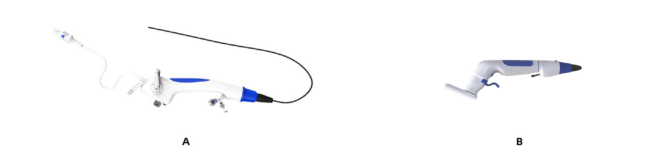
The equipment included a conventional handle and the fully integrated prototype. Under each handle condition, participants completed a simulated task set: one handed holding with thumb lever force to mimic scope rotation, repeated switching between suction and image capture buttons, and simulated stone basket handling. Because the fully integrated prototype included a top clip support, the other hand was not used to simulate manual basket holding in that condition. Each handle was operated for 10 min. The order of handle conditions was counterbalanced across participants.
Figure 4: Conventional handle (A) and fully integrated prototype (B).
Gender Sensitive Ergonomic Evaluation of a Disposable Ureteroscope Handle 59 Subjective ratings were collected immediately after each handle condition. A 100 mm visual analogue scale was used for overall grip comfort, with 0 indicating extremely uncomfortable and 100 indicating extremely comfortable. The Borg CR-10 scale was used to assess fatigue intensity in local regions and overall upper limb fatigue (Borg 1982). Tailored 7 point Likert items were used for item level subjective evaluation, from 1 indicating strongly disagree to 7 indicating strongly agree. Since many Likert items referred to prototype specific design features, they were completed only after the fully integrated prototype condition. Objective performance indicators were retained in the HFE-U system but were not collected in this static holding study.
To reduce redundancy and avoid unnecessary reproduction of standard scales, the VAS, Borg CR-10, and Likert instruments are described in text rather than shown as separate figures.
Table 3: Mapping between HFE-U dimensions and measurement tools.
Postural and whole body load 6 4, items 35 to 38 2, items 40 to 41 None
3 None 3 None
Perceived safety and innovation acceptance Overall comfort criterion VAS comfort score None None None
Note. The VAS comfort score was used as an overall subjective criterion rather than as a numbered item. For this static holding experiment, 23 Likert items were selected from the 38 core indicators. The selected items covered grip comfort, reachable button and tactile perception items, impression based operational efficiency items, posture related items, and perceived safety and innovation acceptance. Items requiring a fully functional mechanical transmission test, such as lever travel, operating force, gear feedback, and lock operation, were not included in this collection.
RESULTS
All statistical analyses were performed in R 4.3.0. The significance level was set at α = 0.05 for two sided tests. VAS comfort scores and Borg CR-10 fatigue scores were analyzed using repeated measures analysis of variance with sex as the between subject factor and handle type as the within subject factor. Partial η² was used as the effect size. Analyses used available cases for each outcome. Likert item scores for the prototype condition were analyzed using independent sample t tests to compare sex differences.
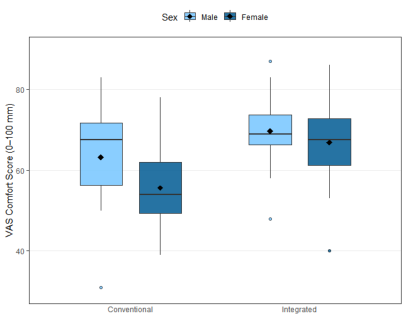
Overall Effect of Handle Type For VAS comfort, the 2 by 2 repeated measures analysis showed a significant main effect of handle type, F(1, 34) = 9.14, p = 0.005, partial η² = 0.21. The fully integrated prototype had a higher comfort score (70.4 ± 16.1) than the conventional handle (59.4 ± 12.0). The sex by handle type interaction was not significant, F(1, 34) = 0.80, p = 0.377. Simple effect analysis showed no significant sex difference under the conventional handle condition (male 63.2 ± 12.5; female 55.6 ± 10.5, p = 0.113) or the prototype condition (male 70.9 ± 18.4; female 69.8 ± 14.0, p = 1.000). Female participants nevertheless showed a larger descriptive improvement (Δ = 14.2) than male participants (Δ = 7.7).
Figure 5: Distribution of VAS comfort scores by sex under the conventional handle and fully integrated prototype conditions.
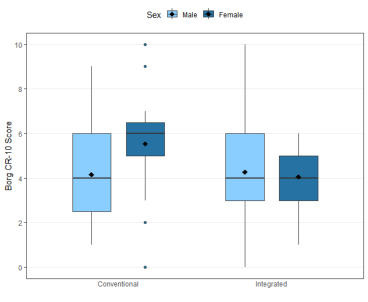
For overall upper limb fatigue measured by Borg CR-10 item 38, the main effect of handle type was not significant, F(1, 36) = 2.19, p = 0.148. The main effect of sex was also not significant, F(1, 36) = 1.38, p = 0.247. The sex by handle type interaction approached significance, F(1, 36) = 2.91, p = 0.096. Female fatigue under the conventional handle condition (5.53 ± 2.25) was higher than male fatigue (4.16 ± 2.14), but the difference was not significant (p = 0.125). Under the prototype condition, the sex difference was not significant (male 4.26 ± 2.40; female 4.05 ± 1.39, p = 1.000). Female participants showed decreased fatigue in the prototype condition (Δ = −1.47), whereas male fatigue was nearly unchanged (Δ = 0.11).
Figure 6: Distribution of Borg CR-10 fatigue scores by sex under the conventional handle and fully integrated prototype conditions, item 38.
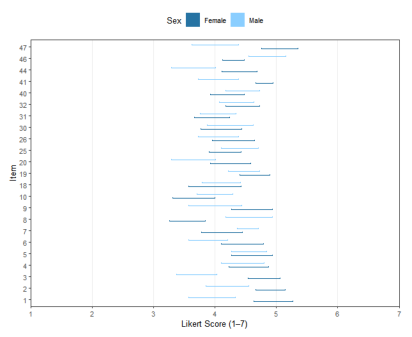
Supplementary Likert Item Analysis for the Prototype Independent sample t tests were conducted for the tailored Likert items collected after prototype operation. Female participants rated item 1, overall handle length suitable for female hand size, higher than male participants (4.95 ± 1.43 vs. 3.95 ± 1.70), with a near significant difference, t(36.5) = 1.98, p = 0.055, Cohen’s d = 0.63. Item 3, fit between the handle surface and the thenar region, was rated significantly higher by female participants (4.80 ± 1.15) than by male participants (3.70 ± 1.45), t(36.1) = 2.65, p = 0.012, Cohen’s d = 0.84. Item 47, satisfaction with adaptation to female hand size, was also rated significantly higher by female participants (5.05 ± 1.32) than by male participants (4.00 ± 1.69), t(35.9) = 2.20, p = 0.035, Cohen’s d = 0.69. Most other items showed no significant sex difference and substantial overlap between groups. Item 8 was rated higher by male participants (p = 0.045), whereas item 41 was rated higher by female participants (p = 0.045).
Figure 7: Mean Likert scores by sex for the fully integrated prototype condition. Bars show group means and error bars indicate ±1 standard error.
Overall, the prototype improved subjective grip comfort relative to the conventional handle. The larger descriptive improvement among female participants was consistent with the design aim, but the interaction effect was not statistically significant. Fatigue reduction showed a similar directional tendency for female participants, although the overall handle type effect was not significant and the interaction only approached significance.
DISCUSSION
This study developed a UTEP based HFE-U system and used it to guide the redesign of a disposable ureteroscope handle. The experiment provided preliminary evidence that the fully integrated prototype improved perceived grip comfort in a static holding task. The design changes were consistent with the evaluation framework: grip geometry improved palm fit, the clip support reduced the need for hand switching, the gear drive lever and lock were intended to reduce sustained thumb force, and the button layout brought index finger operation closer to a natural flexion posture.
The grip comfort result suggests that the HFE-U system can identify meaningful problems at the handle interface. The prototype outperformed the conventional handle on VAS comfort, with a moderate effect size. This effect is important because grip comfort is the foundation for later interaction. When the proximal handle surface fits the palm more closely, users can stabilize the device with less compensatory effort, which may make thumb and finger control easier in longer tasks.
The sex related results should be interpreted cautiously. The VAS interaction was not significant, and the Borg interaction only approached significance. Therefore, the study did not provide strong statistical evidence that the female improvement was significantly larger than the male improvement. However, the descriptive pattern was consistent with the design rationale. Female participants showed a larger increase in comfort and a larger reduction in fatigue. Likert items further indicated that female participants perceived stronger benefits in thenar fit and female hand adaptation. These findings align with previous evidence that smaller hand dimensions may increase difficulty, discomfort, or fatigue when medical instruments are designed around larger hand sizes (Green et al., 2023; Miller et al., 2025; Yong et al., 2023). The fatigue findings were weaker than the comfort findings. This may reflect the short static exposure, the student sample, and the absence of a full clinical workload. A 10 min simulated task may be sufficient to detect comfort differences in the grip interface, but it may not reproduce the cumulative fatigue patterns seen during longer ureteroscopic procedures. Future studies should therefore add longer dynamic tasks, validated performance indicators, and functional prototypes with complete mechanical transmission.
CONCLUSION
A UTEP based HFE-U evaluation system was constructed for disposable ureteroscope handle design. The final system retained 38 core indicators across five dimensions and combined VAS, Borg CR-10, tailored Likert items,
Gender Sensitive Ergonomic Evaluation of a Disposable Ureteroscope Handle 63 and objective performance indicators. Guided by this system, a four stage iterative process produced a fully integrated prototype with optimized grip geometry, a top clip support, a gear drive thumb lever with sliding lock, and an optimized button layout.
In a simulated static holding experiment, the prototype showed higher overall grip comfort than the conventional handle. Female participants showed a larger descriptive improvement in comfort and a greater reduction in overall upper limb fatigue, but the sex by handle type interaction was not significant for VAS and only approached significance for Borg fatigue. Likert results suggested that perceived benefits for female participants were concentrated in hand size adaptation and thenar region fit. These findings offer preliminary ergonomic evidence for gender sensitive handle design, while larger studies with clinical participants and longer dynamic tasks are needed before clinical generalization.
REFERENCES
Bhojani, N., Shalabi, N., Reicherz, A., Herout, R., Searles, K., Wong, K.F.V. and Chew, B.H. (2023). LithoVue Elite compared with single-use and reusable ureteroscopes: A bench and human cadaver study. JU Open Plus, 1(7), e00033. Borg, G.A.V. (1982). Psychophysical bases of perceived exertion. Medicine & Science
in Sports & Exercise, 14(5), 377–381. Green, S.V., Morris, D.E., Naumann, D.N., Rhodes, H.L., Burns, J.K., Roberts, R., Lang, A.R. and Morris, L. (2023). One size does not fit all: Impact of hand size on ease of use of instruments for minimally invasive surgery. The Surgeon, 21(5), 267–272. Hislop, J., Orth, D., Tirosh, O., Isaksson, M., Hensman, C. and McCormick,
J. (2023). Does surgeon sex and anthropometry matter for tool usability in traditional laparoscopic surgery? A systematic review and meta-analysis. Surgical Endoscopy, 37(9), 6640–6659. Karani, R., Arada, R.B., Ayad, M., Xie, L., Brevik, A., Peta, A., Jiang, P., Patel, R.M., Landman, J. and Clayman, R.V. (2021). Evaluation of a novel female gender flexible ureteroscope: Comparison of flow and deflection to a standard flexible ureteroscope. Journal of Endourology, 35(6), 840–846. Kim, E., Sun, A., Rodriguez-Alvarez, J.S., Ho, L., O’Laughlin, K. and De, S. (2024).
Gender differences in ergonomics during simulated ureteroscopy. The American Journal of Surgery, 235, 115691. Kobayashi, S., Tsukino, K., Koura, M., Tanegashi, T., Tsukahara, S., Matsumoto, T., Shiota, M. and Eto, M. (2026). Quantifying ergonomic challenges for urologists operating flexible ureteroscopes through artificial intelligence-based posture estimation. World Journal of Urology, 44, 347. Ludwig, W.W., Lee, G., Ziemba, J.B., Ko, J.S. and Matlaga, B.R. (2017). Evaluating the
ergonomics of flexible ureteroscopy. Journal of Endourology, 31(10), 1062–1066. Miller, C., Cavuoto, L., Berguer, R. and Lee, G. (2025). Surgeon hand size and grip strength for the design of surgical instruments. Human Factors in Healthcare, 7, 100106. Polit, D.F., Beck, C.T. and Owen, S.V. (2007). Is the CVI an acceptable indicator
of content validity? Appraisal and recommendations. Research in Nursing & Health, 30(4), 459–467.
Tambo, M., Inoue, T., Miura, H., Matsuzaki, J., Nutahara, K., Hamamoto, S., Okada, S., Fukuhara, H., Fujisawa, M. and Matsuda, T. (2020). A novel flexible ureteroscope with omnidirectional bending tip using joystick-type control unit (URF-Y0016): Initial validation study in bench models. Journal of Endourology, 34(6), 676–681. Yong, V., Kahler, D., Schlossberg, A., Gilmore, K., Zhao, H. and Philp, M.M. (2023).
Controller size matters: User proficiency is affected by endoscopic controller size. The American Journal of Surgery, 225(2), 378–382.
LISTED IN THE AHFE DIGITAL BOOKSTORE CATALOGUE
Explore the complete digital volume
Human Factors and Ergonomics In Design
Read this individual research paper free through the original publisher, or explore the full digital proceedings book.
ISBN 978-1-964867-86-1
Explore this ISBN in the AHFE Bookstore ↗Listed in the July 2026 bookstore catalogue; search by ISBN to confirm current availability · Digital book purchase optional