Dingfeng Zhou, Junjie Zhang, Junjie Hong (2026). A Kansei Engineering Study on the Effects of Camera Exterior Design Attributes on Nostalgic Perception. In: Human Factors and Ergonomics In Design. AHFE Open Access, vol. 210, pp. 130–139. https://doi.org/10.54941/ahfe1007433
Retro-style products have become increasingly prominent in contemporary design practice. This study uses retro-styled cameras as the research object and, from the perspectives of Kansei engineering and product semantics, examines how different appearance factors influence users’ nostalgic perception.The results show that colour has the strongest effect on nostalgic perception, followed by operation-related areas, while non-interactive regions have minimal influence. Leather materials consistently receive higher evaluations than metal, but the effect of material depends on the presence of key design elements. Moreover, the relative influence of design factors remains stable across material conditions. Individual experience and brand-related visual cues further shape nostalgic perception.These findings provide quantitative guidance for the appearance design of nostalgia-inspired products and extend product semantics into the study of emotional perception.
The retro aesthetics movement has rapidly expanded worldwide in recent years, gradually shifting from a niche preference to a cross-generational and cross-industry mainstream cultural phenomenon. Due to the strong visual recognizability of retro styles, such imagery spreads easily across social media platforms, turning retro into a recognizable symbol of online culture. In the physical consumer market, retro-style products have also shown sustained growth. An increasing number of brands intentionally incorporate nostalgic visual symbols, material languages, and interaction styles into product design to establish differentiation and strengthen emotional connections with users. For example, the Fujifilm X Series recreates the form of film cameras, integrates metal dials, and simulates shutter sounds to construct a “retro experience,” becoming a representative example of retro-styled cameras. Meanwhile, the Italian home appliance brand Smeg successfully evokes cultural associations with mid-century modern style through rounded forms and vintage colour schemes. Evidently, retro style has become a highly competitive value label in consumer markets with clear economic significance.
A Kansei Engineering Study on the Effects of Camera Exterior Design Attributes 131 Retro products also evoke nostalgic feelings among consumers (Vess, Arndt, 2012). Nostalgia, regarded as a positive emotional regulation resource (Sedikides & Wildschut, 2006), is commonly categorized into two types: personal nostalgia and social nostalgia (Stern, 1992). Personal nostalgia refers to nostalgia triggered by an individual’s real past experiences. In contrast, social nostalgia does not rely on personal memory but emerges from cultural transmission, media narratives, and brand storytelling. It describes a romanticized and idealized emotional longing for a past era that one has not personally experienced. This form of nostalgia is characterized by the idealization of the past, where the nostalgic object is not an actual memory but a vision of an era packaged and constructed through cultural imagination (Holbrook & Schindler. 1991).
In contemporary consumer contexts, nostalgia has become an important emotional driving force whose influence extends beyond functional needs (Weingarten, & Wei, 2023). Existing research shows that nostalgic consumption is not merely an emotional experience related to the past, but also a psychological mechanism with distinct social attributes. Its influence on consumption often operates through the mediating pathway of social connectedness, making individuals feel more supported, cared for, and a sense of belonging. Consumers’ preference for retro-style products often stems from the emotional connection and identity recognition evoked by the product, rather than from performance or price considerations (Arslan, & Oz, 2017). Retro factors can trigger emotional memories related to childhood, family, and the atmosphere of a particular era, imbuing purchasing behaviour with strong affective meaning. Moreover, nostalgic consumption is not limited to personal memories but also includes social nostalgia for an “idealized past.” Consumers often imagine a certain historical period in an idealized way, viewing it as purer, warmer, or more culturally appealing (Pir, 2019).
Within the framework of product semantics, the forms expressed through a product’s appearance, materials, and structure function as carriers of meaning, guiding users to form emotional, cultural, and symbolic interpretations of the product. Likewise, when users encounter nostalgia-inspired products with retro styles, they interpret the associated product semantics and develop nostalgic feelings. These semantic cues can evoke emotions related to the past and form a specific kind of “nostalgic product semantics.” At the design level, product semantics can trigger personal nostalgia through form, tactility, and modes of interaction. When facing a product’s appearance and interactive features, users not only develop visual preferences but also generate emotional experiences grounded in their own past memories. This indicates that product semantics serves as a crucial interface connecting material form and emotional experience, where the emotional cues conveyed by design can reinforce users’ memory structures and self-narratives (Schifferstein & Zwartkruis-Pelgrim. 2008).
Kansei Engineering, as a design methodology grounded in users’ affective needs, emphasizes eliciting emotional responses through the affective expression of design factors. It advocates a direct alignment between users’ emotional needs and design forms, ensuring that products not only fulfill functional requirements but also resonate with users on an emotional level.
In the design of nostalgic products, the core of Kansei Engineering lies in enhancing the emotional connection between product and user through carefully crafted affective cues. For instance, retro-style cameras evoke users’ memories through their appearance and tactile qualities—such as metallic textures and classic button layouts. Such design not only stimulates personal nostalgia but also strengthens emotional responses associated with social nostalgia. This emotional resonance is realized through the communicative mechanism of product semantics: the temporal information and cultural symbols conveyed by a product’s appearance, materials, and interaction styles can precisely trigger users’ nostalgic emotions (Karana. 2009).
Overall, the integration of product semantics and Kansei Engineering provides a dual driving mechanism for nostalgic design. Through symbolic design factors and precise alignment with affective needs, this approach actively facilitates the elicitation of nostalgic emotions. This study analyzes specific appearance factors of products and explores how they operate within the theoretical frameworks of product semantics and Kansei Engineering to evoke users’ nostalgic responses. The findings aim to offer deeper theoretical support for understanding the role of nostalgic aesthetics in contemporary design practice and to provide a more systematic practical foundation for the design of retro-inspired products.
EXPERIMENT In this study, retro products are defined as contemporary goods that deliberately recreate visual characteristics of a specific historical period in terms of appearance, materials, and colour schemes to evoke nostalgic emotions. Although functionally advanced, such products emphasize the visual language of a past era.
Among various product categories, cameras are particularly representative within the retro trend and have increasingly become fashion-oriented objects in the context of social media image sharing. Therefore, retro-style cameras were selected as the research object, and their appearance factors were analysed.
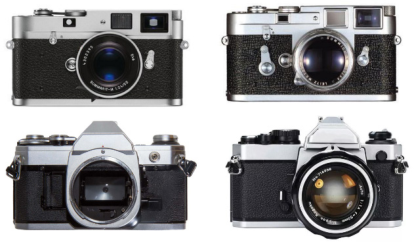
Through the collection of classic camera forms and interviews with photography enthusiasts and product design experts, the visual characteristics of vintage cameras were identified. These features can be summarized as a predominantly black-and-white colour scheme, metal decoration on the top and bottom of the body, and simple geometric forms.
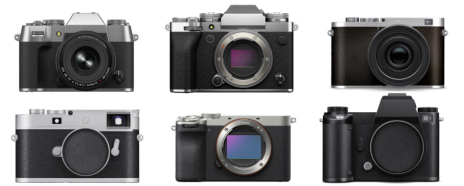
Based on the identified characteristics of vintage camera forms, current camera models across brands were screened, and six samples that met the criteria for retro appearance were selected. Brand logos and identifying marks were removed to minimize brand-related influence.
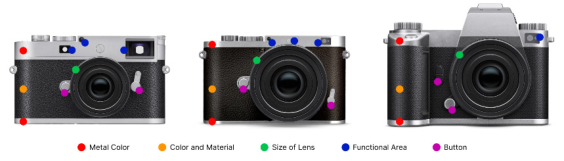
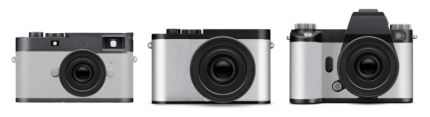
Through additional interviews, three representative cameras were chosen to construct the control-group appearances. These designs adopted a black- and-white colour scheme and a combination of metal and leather materials, representing a typical embodiment of retro style. Certain appearance factors were further adjusted to ensure consistency across samples.
Figure 1: Camera form styles from the 1970s to 1990s. (Compiled from online sources).Figure 2: Initially selected retro-style cameras. (Compiled from online sources).
Based on the control-group appearances, visually influential design factors were selected as experimental variables and systematically manipulated. The sample configurations and research variables are shown in Figure 3.
Figure 3: Control sample and experimental variables (illustration by the authors).
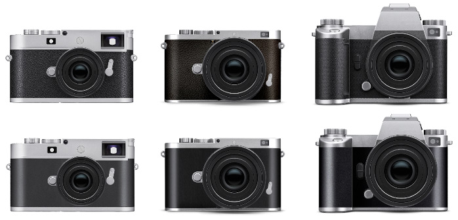
Colour scheme and CMF, as influential visual appearance factors, were selected for further subdivision of the experimental samples (Şener, & Pedgley, 2021). Comparative samples were constructed under two CMF conditions— leather and metal—combined with different colour schemes (Figure 4).
Figure 4: Control samples with different materials (illustrated by the authors).
A color configuration with black metal on the top and bottom and white in the middle was initially tested. Pretesting showed poor visual acceptance, and this scheme was therefore excluded from the final test stimuli (Figure 5).
Figure 5: Samples excluded after screening (illustrated by the authors).
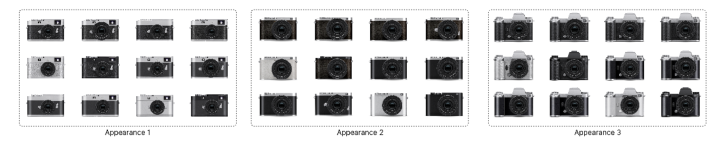
The complete set of sample options for the three appearance designs is presented below (Figure 6).
Figure 6: Complete set of experimental samples (illustrated by the authors).
A total of 52 participants were recruited through both online and offline channels to take part in the style imagery experiment, including 28 males and 24 females, aged between 20 and 40. Most participants were not photography enthusiasts and had limited prior knowledge of camera styles and appearances. This selection criterion was intended to reduce potential bias in evaluation caused by participants’ domain- specific knowledge.
Participants completed the study through a questionnaire-based evaluation. They were first asked to choose one preferred option from the three control samples. Based on the selected appearance, participants then rated all corresponding sample variants under that option. Nostalgic perception was measured using a 7-point Likert scale (1 = lowest, 7 = highest). After completing the ratings, participants were invited to describe their impressions in their own words, especially for the samples they rated the highest and the lowest. These open-ended responses provided original affective descriptions of the camera style imagery and were used as supplementary references during data analysis.
RESULT
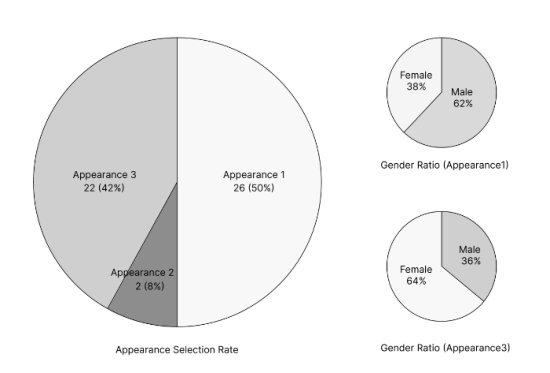
Among the three control appearances, appearances 1 and 3 showed similarly high and comparable selection rates. Appearance 1 was predominantly chosen by male participants, whereas Appearance 3 was more frequently selected by female participants. Due to the small number of selections for Appearance 2, both participants who chose it were male.
Figure 7: Appearance selection rate (illustrated by the authors).Table 1: Material effect (Paired Sample t-test).
Table available in the original PDF paper.
Condition 1 Condition 2 t df p Cohen’s d SE Cohen’s d Leather Condition Metal Condition 5.730 47 < .001 0.827 0.160
A paired t-test was conducted to compare overall perceptual evaluations between the leather and metal conditions. The results revealed a significant difference between the two materials, t(47) = 5.73, p < .001, with a large effect size (Cohen’s d = 0.83). The evaluation scores for the leather condition were significantly higher than those for the metal condition.
Table 2: Comparison between design factors and control condition (Paired Sample t-test).
Table available in the original PDF paper.
Condition - Control t df p Cohen’s d SE Cohen’s d Lens - Control -1.030 47 .308 -0.149 0.115 Functional Area - Control -5.608 47 < .001 -0.809 0.207
Button - Control -5.410 47 < .001 -0.781 0.163 Pure White - Control -7.551 47 < .001 -1.090 0.281 Pure Black - Control -9.802 47 < .001 -1.415 0.272
Paired-samples t-tests were performed to examine differences in perceptual evaluation between each design-factor condition and the control condition.
Significant differences were found for the functional area, button area, and colour schemes (pure white and pure black) (p < .001), all with large effect sizes (functional area: d = 0.81; button: d = 0.78; white: d = 1.09; black: d = 1.42). In contrast, no significant difference was observed between the lens condition and the control condition, p = .308.
For all conditions showing significant differences, the evaluation scores were lower than those of the control condition.
Table 3: Repeated measures ANOVA.
Table available in the original PDF paper.
Condition F df p η² Other Design Factors 35.310 2.691, 126.481 < .001 0.322
Material * Other Design Factors 0.862 4.123, 193.760 .491 0.002 Note. Greenhouse–Geisser correction was applied due to violation of sphericity (Mauchly’s test, p < .05). Type III sums of squares were used.
A repeated-measures ANOVA was conducted to examine the effects of material and other design factors on perceptual evaluation. The results showed a significant main effect of design factors, F(2.69, 126.48) = 35.31, p < .001, η² = .322.
No significant interaction effect was found between material and design factors, F(4.12, 193.76) = 0.862, p = .491, η² = .002.
Table 4: Material effect under different design factors (Paired samples t-test).
Table available in the original PDF paper.
Leather Condition - Metal Condition t df p 1 Leather Control - 7 Metal Control 4.514 47 < .001 2 Large Lens - 8 Large Lens 4.514 47 .004
3 No Functional Area - 9 No Functional Area 4.514 47 .068 4 No Buttons - 10 No Buttons 4.514 47 .020 5 Pure White - 11 Pure White 4.514 47 < .001
6 Pure Black - 12 Pure Black 4.514 47 < .001
Paired-samples t-tests were conducted to examine the effect of material (leather vs. metal) under different design conditions.
Significant differences between leather and metal were found in the control condition (p < .001), large lens condition (p = .004), no buttons condition (p = .020), and both color conditions (pure white and pure black, p < .001). In contrast, no significant difference was observed in the no functional area condition (p = .068).
Table 5: ANOVA: effect of gender on nostalgia ratings.
Table available in the original PDF paper.
Effect F df p Gender 1.337 1.46 .254
With gender treated as the independent variable, a one-way ANOVA was conducted on the nostalgic perception ratings. The results showed that the effect of gender did not reach a significant level, F(1,46) = 1.34, p = .254, indicating that no significant difference was found between male and female participants on this measure within the sample of this study.
CONCLUSION
In the initial appearance selection task, participants showed clear preferences among the three design options. Informal feedback revealed that some male participants associated nostalgia with relatively simple and restrained forms, suggesting that complex geometries conveyed a stronger sense of modernity and technological sophistication. In contrast, several female participants reported that more intricate forms were more likely to evoke nostalgic feelings.
In addition, participants who reported strong brand preferences in a preliminary question tended to exhibit brand-oriented tendencies in their selections. These observations, while not subjected to statistical testing, provide qualitative context that complements the quantitative findings by illustrating how personal experience and prior cognitive associations may shape nostalgic perception.
The data that users’ overall perceptual evaluation of retro-styled cameras is not uniformly influenced by all exterior factors, but instead follows a structured pattern of perceptual weighting across design factors.
First, the significant main effect of material indicates that leather consistently yields higher overall evaluations than metal. This confirms that material serves as an important perceptual cue in retro product appearance, contributing positively to users’ affective judgments.
Second, comparisons between design-factor conditions and the control condition show that alterations to colour schemes and operation-related areas (functional area and buttons) significantly reduce perceptual evaluation, whereas modifications to the lens area do not produce a comparable effect. This suggests that not all structural regions contribute equally to the formation of overall perception.
Third, the repeated-measures ANOVA demonstrates a strong main effect of design factors alongside a non-significant interaction between material and design factors. This indicates that the relative influence of different design factors remains stable across material conditions. In other words, while material changes the overall level of evaluation, it does not alter how users prioritize different exterior factors in perceptual formation.
Finally, the condition-specific material comparisons further reveal that the effect of material disappears when the functional area is removed. This finding suggests that the perceptual influence of material depends on the presence of certain key design factors, particularly those associated with operation and interaction.
Taken together, these findings suggest that users’ perception of retro product appearance follows a hierarchical structure. Colour and operation- related areas carry greater perceptual weight in shaping overall evaluation, while non-interactive structural regions play a relatively minor role. Material enhances overall perception but does not modify this underlying structure. Moreover, the absence of gender differences indicates that this perceptual pattern is consistent across male and female users.
From a product semantics perspective, the results imply that users’ perceptual judgments are driven more by the semantic significance of design factors than by material variation alone. Retro perception is therefore
constructed through a stable configuration of high-weight visual and operational cues rather than through isolated design features.
This study empirically reveals the underlying structure through which the perception of retro product appearance is formed, clarifying the differentiated roles of various design factors in shaping overall perception. The findings not only provide quantitative evidence for the application of retro aesthetics in product appearance design, but also offer new empirical support for the question in product semantics of how exterior factors collectively construct overall meaning.
For design practice, the results suggest that, in retro product design, priority should be given to the semantic expression of colour and operation- related areas rather than applying retro styling uniformly across all structural factors. The perceptual weighting structure identified in this study provides a verifiable theoretical framework for understanding how users form holistic perceptual judgments based on limited visual and interactive cues.
ACKNOWLEDGMENT
The author would like to express sincere gratitude to Prof. Zhang for invaluable guidance and continuous support throughout this research. Special thanks are extended to Mr. Hong for valuable assistance and guidance in statistical analysis. The author also sincerely appreciates all participants for their time and contribution to the experimental data collection.
REFERENCES
Arslan, B., & Oz, A. (2017). The effect of retro-looking products oriented consumer attitude on brand loyalty. PressAcademia Procedia, 4(1), 158-170. Batcho, K. I. (1995). Nostalgia: A psychological perspective. Perceptual and motor
skills, 80(1), 131-143. Georgiev, G. V., & Nagai, Y. (2011). A conceptual network analysis of user impressions and meanings of product materials in design. Materials & design, 32(8-9), 4230-4240. Holbrook, M. B., & Schindler, R. M. (1991). Echoes of the dear departed past: Some
work in progress on nostalgia. Advances in consumer research, 18(1). Karana, E., Hekkert, P., & Kandachar, P. (2009). Meanings of materials through sensorial properties and manufacturing processes. Materials & Design, 30(7), 2778-2784. Mugge, R., Schoormans, J. P., & Schifferstein, H. N. (2009). Emotional bonding with
personalised products. Journal of Engineering Design, 20(5), 467-476. Pir, E. Ö. (2019). Nostalgic evolution of marketing: retro marketing. The Journal of Social Science, 3(6), 613-624. Schifferstein, H. N., & Zwartkruis-Pelgrim, E. P. (2008). Consumer-product
attachment: Measurement and design implications. International journal of design, 2(3). Sedikides, C., Wildschut, T., & Baden, D. (2004). Conceptual issues and existential functions. Handbook of experimental existential psychology, 205(1), 200-214. Şener, B., & Pedgley, O. (2021). Surface texture as a designed material-product
attribute. Materials Experience 2, 67-88.
A Kansei Engineering Study on the Effects of Camera Exterior Design Attributes 139 Stern, B. B. (1992). Historical and personal nostalgia in advertising text: The fin de
siecle effect. Journal of advertising, 21(4), 11-22. Sunstrum, F. N., Demirbilek, O., Gardner, N., Viengkham, C., & Spehar, B. (2024).
Revealing the synergy between formal aesthetics and product semantics: Exploring the impact of visual form on product perception. International Journal of Industrial Ergonomics, 101, 103593. Vess, M., Arndt, J., Routledge, C., Sedikides, C., & Wildschut, T. (2012). Nostalgia as a resource for the self. Self and Identity, 11(3), 273-284. Folds, Dennis. Gardner, Douglas and Deal, Steve. (2008). Building Up to the Human Systems Integration Demonstration, INCOSE INSIGHT, Volume 11, No. 2. Weingarten, E., & Wei, Z. (2023). Nostalgia and consumer behavior. Current opinion
in psychology, 49, 101555. Wildschut, T., Sedikides, C., Arndt, J., & Routledge, C. (2006). Nostalgia: content, triggers, functions. Journal of personality and social psychology, 91(5), 975.
LISTED IN THE AHFE DIGITAL BOOKSTORE CATALOGUE
Explore the complete digital volume
Human Factors and Ergonomics In Design
Read this individual research paper free through the original publisher, or explore the full digital proceedings book.
ISBN 978-1-964867-86-1
Explore this ISBN in the AHFE Bookstore ↗Listed in the July 2026 bookstore catalogue; search by ISBN to confirm current availability · Digital book purchase optional