Tongyao Liu, Junjie Zhang, Zihao Wang (2023). Research on the Design of Short-Term Rest Cockpits Based on Light-Induced Sleep Technology. In: Ergonomics In Design. AHFE Open Access, vol. 77, pp. 593–604. https://doi.org/10.54941/ahfe1003419
The invention of artificial lighting makes people's work and rest gradually eliminate the constraints of natural light circadian rhythms. Sleep rhythm disorder and sleep loss are caused by the changing work schedule and long-term mental stress under the fast-paced life in modern society seriously, which affect people's health. With the development of technology in transportation, it is faster and more convenient to move between regions, people's living environments are changing, and the sleep scenario has become more complex. Studies have shown that the non-visual effects of light can induce sleep behavior by affecting melatonin secretion and the associated circadian rhythm system. Natural light is considered the most effective circadian rhythm synchronizer in humans. This study focuses on the short-term rest scene during travel and uses the induced effect of light to explore the instant effect of sound and light environment perception on promoting sleep. In the form of realization, the elements such as seats, interactive control systems, and semi-closed cabin bodies are integrated and reconstructed. The interior environment of the vehicle cabin is designed with somatosensory interaction and environment coordination. These vehicle cabins will be modularly combined to achieve an optimized combination of compact space layout and user privacy. In addition, these vehicle cabins will use photoelectric display technology to create a light environment with rhythmic changes in the cabin while meeting the differentiated needs of different users at the visual level. The design provides a new experience for resting during travel, making it possible for short-term and efficient rest in human living space and visual function. The research mainly focuses on the participatory experience of light-guided rest, explores the role of ambient light in improving sleep efficiency through quantitative methods, and explores public resting facilities for efficient rest with the consideration of the human body, sense, and control.
The two main features of modern industrial society: continuous light and reversal of life and rest, have destroyed the internal circadian rhythm that people have long evolved according to the sun’s rising and setting, increasing the incidence of sleep disorders such as circadian dysfunctional sleep disorder, which seriously affects the length of sleep and sleep quality. At the same time, with the improvement of economic level and technology, the development of mobile technology in the field of transportation, people’s business trip
frequency and willingness to travel increased, suitable for long-distance travel of public transportation such as airplanes, high-speed rail, Etc. has become the first choice for people to move between regions. The expansion of the scope of life scenes has led to a more variable sleep environment and more complex factors affecting sleep. People’s time on the go has increased, and the design of rest products applied to the travel scenario is essential in this trend.
LIGHT AFFECTS HUMAN SLEEP BEHAVIOR Light and Rhythm
Circadian Rhythm The cyclic state of human sleep-wake is generated by the interaction of circadian rhythms in the body and the steady state of sleep itself, which is influenced by external light conditions and rhythms. Natural light is the most effective circadian timer and can be used for phase shifts or re-timing of circadian rhythms. Biological circadian rhythms phenomenon: various phy- siological functions of living organisms to adapt to the external environment of circadian changes and establish a certain rule of operation, periodic life activity phenomenon, referred to as biological rhythms. Including such as sleep and wake cycle, body temperature cycle, and the circadian rhythm of the natural environment is consistent, with about 24 hours as a cycle. In mammals, the sleep-wake cycle and hormone levels are regulated by the suprachiasmatic nuclei (SCN) located in the hypothalamus(Buijs et al. 2006) so that the internal rhythm of the organism is compatible with the exter- nal rhythm of nature, waking up during the day and sleeping at night. This rhythm is very susceptible to disturbance by light factors. When the biologi- cal clock is dysfunctional, or the balance between the internal and external environment is disrupted, it will lead to sleep disturbance.
Non-Visual Efficiency The human eye performs its visual functions mainly through its retina, which contains photoreceptors, bipolar cells, and ganglion cells. The academic com- munity has always believed that rod and cone cells with photoreceptors are the only photoreceptor cells in the human eye. Until a basic research has shown that mice lacking photoreceptors can still maintain a normal circa- dian rhythm and adjust to changes in external light conditions (Foster et al. 1991). However, after eye removal, mice lost their circadian rhythm. In 2001, Brainard and Thapan published a paper suggesting the existence of other photoreceptor cells in the human retina. David Berson et al. (2002) discove- red a third type of photoreceptor cell in the mammalian retina, the retinal ganglion photoreceptor. The retinal ganglion photoreceptor cells (ipRGCs). ipRGCs directly perceive ambient light intensity and convert it into neu- ral impulses that project to the SCN via the retinal hypothalamic channel (RHT). This pathway differs from the conventional photoreceptor-involved autoreceptor visual information pathway and is referred to as the nonvisual pathway. The nonvisual pathway enters the brain after transferring to the
Research on the Design of Short-Term Rest Cockpits 595
cervical sympathetic ganglion and directly acts on the pineal gland to secrete MLT, which affects the body’s sleep rhythm. The Commission Internatio- nale de L’Eclairage (CIE) proposed that the nonvisual biological effects of light on the human body can affect the level of alertness, circadian rhythms, body temperature rhythms, and hormone secretion (Zeitzer et al. 2000). In 2005, Dr. Berman introduced three major trends in lighting development in the 21st century and listed the light-influenced nonvisual biological effects as one of the research topics (Hisense. 2005). In 2017, Jeffrey C. Hall, Michael Rosbash, and Michael W. Young were awarded the Nobel Prize in Physio- logy and Medicine for discovering the molecular mechanisms that control circadian rhythms.
Light and Mood Lisa Shives said that light mainly affects the biological rhythm biological rhy- thm through illumination and color temperature (Lerner. 1995). Different levels of illumination and color temperature induce different emotions, such as depression and excitement. Nonvisual effects are also used to affect mood, which in turn has an impact on sleep. High-color temperature light reduces subjective drowsiness and increases alertness (Liu. 2015). Izsó et al. (2009) compared low color temperature and low illumination (2700K, 100lx) with medium to high color temperature and high illumination (4000K, 1300lx). They showed that low color temperature and low illumination were more emotionally relaxing. Wan et al. (2012) investigated the effects of light color and dynamics lighting on the effect of ambiance perception and physiologi- cal relaxation. The results showed that the slowly changing orange lighting environment could create a relaxed and comfortable atmosphere. It has been explained that this phenomenon is mainly due to the ability of humans to adapt to the physical properties of sunlight and firelight developed over a long evolutionary period, making the human resting cycle fit with the exter- nal light environment. In addition, a long history of social activity has led to a certain subconscious response to the light environment: during labor, the need to keep the mind in a state of excitement, alertness, and calmness in order to ensure their safety and increase labor productivity has led to the formation of physical mechanisms capable of moving at high frequencies of breathing, pulse and heart rate under white and bright sunlight. By early morning, evening, and night rest time, people are always in a low color tem- perature and low illumination daylight environment or firelight environment, when people are reunited with their families, resting, and in a relaxed state of mind and body, and over time in a similar light environment is easy to produce affectionate, warm emotions, and more likely to sleep behavior.
Research Status of Light Introduction Sleep Technology Since Edison invented the white woven lamp in the 19th century, artificial electric light has played an irreplaceable role in human society’s progress. It has dramatically impacted the human perception of natural circadian light rhythms. The continuous illumination causes the sleep and wake cycles to no longer follow a 24-hour cycle, resulting in circadian rhythm disorders
such as delayed sleep phase disorder, early sleep phase disorder, and non- 24h sleep-wake syndrome. The experimental data of Brainard et al (2001), Thapan K. et al (2001) and Rea M. et al (2002) showed that with the incre- ase of illumination, the inhibitory effect of human melatonin secretion was significantly improved. Brain wave index tests at different illumination levels also showed that human arousal increased with illumination values, with a generally positive correlation (Yan et al. 2002). These studies suggest that the nonvisual effects of light can induce sleep behavior by affecting mela- tonin secretion and the physiological rhythm system associated with it, so researchers have proposed light therapy, mainly by changing light conditions to achieve: 1. synchronize the wake-sleep cycle with the primary circadian; 2. change the biological clock cycle to promote daytime or night-time sleep; 3. improve the biological clock cycle to indirectly affect mood effect, Etc. Numerous trials have also demonstrated that using light with aids can effe- ctively alleviate various sleep problems. For example, in 2013, Hao et al. (2013) completed an experimental study on “Nonvisual biological effects of LED lighting and its impact on human physiological rhythms” in Antarctica. Intending to improve circadian rhythm disorders and regulate emotions, an artificial health lighting intervention strategy was developed to mitigate the adverse effects of the special environment in Antarctica on the human physical and mental health of research personnel; in 2015, Young et al. (2015) conducted light stimulation experiments on 29 young male subjects using high color temperature and standard color temperature light sources at 13500K and 4000K, respectively. The results showed that high color tempe- rature lighting combined with rhythmic lighting to implement a 24-hour cycle submarine resting system, the submarine crew could obtain better operational performance and sleep quality, Etc.
THE SLEEP CHARACTERISTICS OF PEOPLE IN SHORT-DISTANCE TRAVEL This study conducted a questionnaire survey for people with travel needs. A total of 203 online questionnaires were distributed, with a gender ratio of 2:3, and 198 subjects were aged between 18 and 49 years old. By collating the data and summarizing the recovered questionnaires, the rest characteristics and needs of the travel group during the journey are as follows.
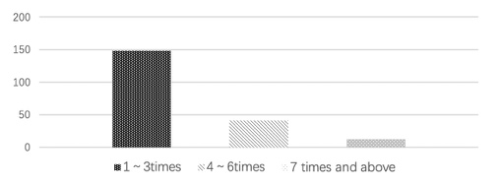
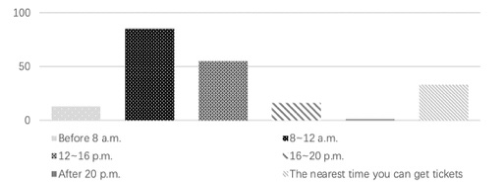
Travel Trip Damage to the Original Biological Rhythm The questionnaire showed that 73.27% of the subjects traveled by public transportation 1–3 times a month (Figure 1), choosing to depart between 8–12 and 12–16 o’clock, with another 16.26% choosing to depart at the nearest time they could get a ticket (Figure 2). However, when asked, “Have you ever left before 8 a.m. or after 8 p.m.?” 77.8% of the subjects chose yes, and about three-quarters of the subjects admitted that the trip’s departure time changed their daily routine.
It can be seen that people currently travel very frequently. Although they can choose travel time, they still damage the normal biological clock. In addi- tion to the trip scheduled in the rest period, in fact, the normal working hours
Research on the Design of Short-Term Rest Cockpits 597
Figure 1: How often did you travel (use public transportation) in a month? (Adapted from China.CAA.2022).Figure 2: When did your travel experience usually focus on (before COVID-19)? (Adapted from China.CAA.2022).
of travel still have a considerable “invisible length” is ignored - airplanes and high-speed rail stations are generally a certain distance from the residential area, in order to allow for unexpected situations Buffer, people will choose to arrive 1 to 4 hours earlier than the departure location to wait, which leads to a shortening of the normal sleep time, early or late. Sleep disorders caused by long-term frequent travel are likely to cause problems such as circadian rhythm disorders.
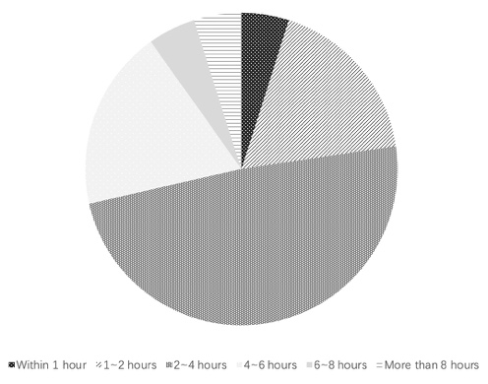
Sleep Environment During Travel Based on the data from the returned questionnaires, it is clear that the length of a single trip traveled by the subjects was mostly concentrated in the range of 2 to 4 hours (Figure 3). Among the activities that people will be performed during the journey, sleep accounts for about 77.34%, and sleep time accounts for nearly half of the total time of the travel and some more. It can be said that the comfort of sleep largely determines the comfort of the passenger journey experience. Optimizing the sleep environment is important to improve the quality of rest in the travel scenario.
The sleep environment in a broad sense, refers to the place and envi- ronment under any sleep behavior. Take a nap during the journey, the environment around the cabin can also be understood as a sleep environment. Environmental factors such as noise, light, thermal environment changes, and habitual sleep environment changes can impact sleep. More studies on sleep environments have focused on long-term fixed sleep sites, and fewer stu- dies have been conducted on short resting scenarios. Analysis of the subjects’
Figure 3: In general, what is the duration of your single trip? (Adapted from China.CAA.2022).
responses showed that flickering light and loud sounds on public transpor- tation had the greatest impact on sleep quality during travel. However, in public places, the composition of the sound transmission medium is complex and diverse, and it is not easy to control sound compared to light, so this study focuses on the study of light during travel. The results of the questi- onnaire showed that 41.38% of the subjects thought that light had a more serious impact on travel rest, and 19.7% were very serious. When asked if they would consider purchasing a product that could be used in a travel situ- ation to improve relaxation, only 4.93% of the respondents said they would not. The prospects and market for developing healthy sleep products focusing on the short rest scenario during travel are very broad.
Analysis of Behavioral Characteristics and Sleep Needs of Travel Groups According to the research, work, reading, eating, and social activities are also some of the activities they will do during the journey. Although sleep time accounts for a large proportion of the total journey time, the actual rest time is shorter.
The schedule determines that they prefer to get efficient rest in a short time. The passenger cabins of public transportation are not designed to be suitable for sleep and do not have good conditions for creating noise, light, and other sleep environments. Considering the convenience of travel, people often give up carrying large sleep aids and choose small products such as eye masks and earplugs. This also makes them less resistant to noisy environ- ments and unable to create a suitable micro-environment for resting through their efforts, resulting in low sleep comfort, shallow sleep, and easy wake-up. To sum up, people need a sound and light environment that can adapt to their biorhythms in mobile scenes and instantly promote sleep.
Research on the Design of Short-Term Rest Cockpits 599
EXPERIMENTAL STUDY BASED ON LIGHT INTRODUCTION SLEEP TECHNOLOGY Experimental Description
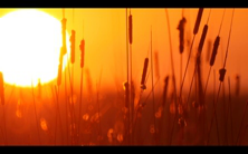
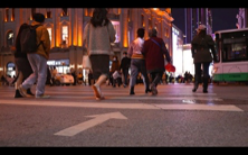
Light is one of the main factors affecting sleep. The rhythm of natural day and night affects the sleep and awakening of the human body through the light changes caused by the rise and fall of the sun. Light therapy is based on this basis. When using artificial electric light sources to create a light envi- ronment, the illuminance and color temperature are constant. Some studies have pointed out that people are prone to negative emotions when they are under a single light source for a long time, which is not conducive to sleep. In contrast, natural light has a rich rhythm of light and shadow, which can create a comfortable and dynamic light atmosphere in terms of illuminance, color temperature, and rhythm. In this paper, the influence of natural light on sleep is explored by simulating the content of natural light. The experimental video sets the experimental group (sunset) (Figure 4) and the control group (street view) (Figure 5) according to the different content of the picture and is divided into original speed, triple speed, high illumination, and low illumina- tion according to the different rhythms and illumination. The experimental and control groups were matched into four groups according to the corre- sponding rhythm of change and illumination level to simultaneously test the sleepiness caused by the light content, rhythm of change, and illumination level.
Subjects were randomly selected to a set of videos, watched them entirely, and then rated their level of sleepiness and need for sleep on a ten-point scale in real-time. Ten math questions were set in both videos to avoid subjects watching the second video with interference from the previous video. A total of 203 sample data were recovered from the experiment.
Figure 4: Experimental group.Figure 5: Control group.
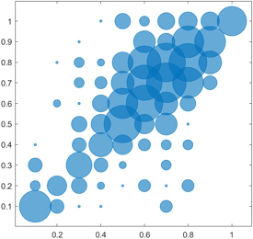
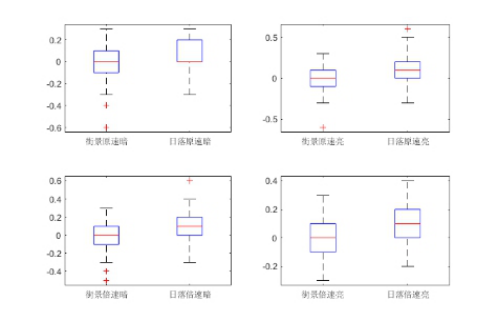
Effects of Different Light and Dark Rhythms and Illumination Levels of Natural Light on Sleep The results of the scores of sleepiness and sleep need level are shown in Figure 6, which shows a positive correlation distribution. Figure 7 shows the distribution of the difference between the sleepiness level before and after watching the video for the four experimental groups. The experimental group is overall higher than the control group, indicating that the sunset video is more likely to make people sleepy than the street view video.
The average score of the original speed of sunset video is about 0.57 higher than the average score of triple speed, which indicates that the slowly chan- ging orange light environment can create a light environment to help people sleep. The color temperature of the light at sunset is about 2000k, which is a low color temperature light source. Because the playback content reprodu- ces the dynamically changing light in nature, it makes people subconsciously associate being in the natural environment with “resting at sunset” which helps speed up the introduction of sleep. The mean high illumination score of the sunset video was about 0.5 higher than the mean low illumination score, which is not consistent with the finding that illumination is negatively correlated with fatigue in most studies. This may be related to the fact that
Figure 6: (Adapted from China.CAA.2022).Figure 7: (Adapted from China.CAA.2022).
Research on the Design of Short-Term Rest Cockpits 601
both illumination levels of the experimental videos were lower. In contrast, the high-illumination videos, which were more in line with the natural illumi- nation light environment, were more likely to make subjects sleepy by resting associations or were influenced by the spectrum of the lighting equipment.
Due to the small number of samples divided equally into each group of experiments and the relatively short duration of the experiments, the expe- rimental data obtained from the subjective sleepiness score only yielded qualitative analysis results and had limitations. The rhythm and illumina- tion of light changes need to be subdivided into more experiments before quantitative analysis can be performed.
PRODUCT DESIGN EXAMPLES Product Positioning
The core of sleep products is the human experience. Based on the sleep needs of passengers in public transportation, the correspondence between the system elements of sleep aid products and environmental elements can be deduced and translated into the corresponding product functions and design directions.
(1) Create a rhythmic light environment to resist interference from the external environment. Through the experiment, it can be seen that the orange light with certain rhythmic changes can create a light environment to help sleep by building a semi-enclosed cabin seat and opening up space to iso- late the outside light while using photoelectric display technology to create a cabin independent of the sleep-friendly light environment.
(2) Intelligent interaction center regulation. In addition to light, the sleep environment factors include sound, temperature, Etc. The intelligent envi- ronment control system accesses each device in the cabin, realizes intercon- nection and communication control, unifies the regulation of other factors affecting sleep, and meets the differentiated needs of different users at the visual level.
(3) Participation in the whole process of sleep scenario. As passengers have circadian rhythm disorders, falling asleep in unfamiliar environments may be difficult. It is necessary to simulate the natural light environment from light to dark or from dark to light in different stages of sleep and wakefulness to help passengers enter the resting state more efficiently.
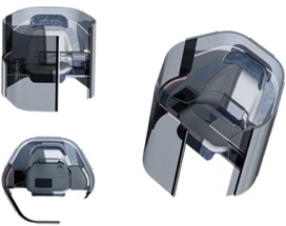
Product Elements (1) Semi-enclosed. The modular semi-enclosed cockpit is in the form of hexa- gonal unit. The common bulkhead of adjacent cockpits can be disassembled and assembled to achieve the optimal combination of compact space layout and meeting the privacy of users. The semi-enclosed form can ensure the maximum degree of openness of the seat while better isolating the noisy sound and light environment to meet the differentiated needs of different passengers using the environment.
(2) Light environment creation. The main use of light in transportation is lighting, illumination, and color temperature are high, and according to
the objective day and night for uniform regulation, can not match individual needs. In addition, the use of electronic equipment will also add additional light sources, resulting in a more complex light environment. The sleep- friendly light environment can use sound and light equipment to create a rhythmically changing light environment in the semi-enclosed cabin. Such as the use of OLED displays to play the sun’s daylight content, simulate natural color temperature and illumination, and control a certain rhythm of light and dark changes.
(3) control mode natural interactive senseless regulation. The intelligent environmental control system can adjust the seat state from sitting to recli- ning so that passengers can sleep in a reclining position. The in-cabin interaction is designed so that passengers can control most of the intelligent devices even in a reclining position - touch screen and knob control the con- tent of the wall display and the adjustment of other environmental factors. Since travelers are generally light sleepers and easily awakened, the natu- ral interaction reduces the impact of being in an unfamiliar mobile scene on falling back asleep when sleep is interrupted.
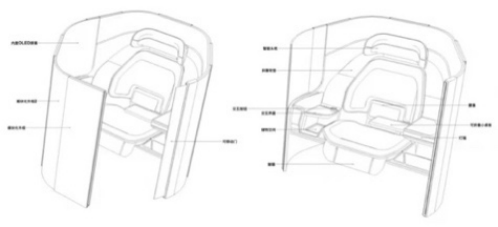
Product System The product consists of a light display screen and a seat to form a hardw- are system (Figure 8, 9). The seat, the interaction control system, and the semi-enclosed cabin are integrated and reconstructed to design the interior
Figure 8: (Adapted from China.CAA.2022).Figure 9: (Adapted from China.CAA.2022).
Research on the Design of Short-Term Rest Cockpits 603
environment of the vehicle cabin with physical interaction and environmental synergy.
The reclining seat expands the space for movement and provides a hardw- are basis for entering the sleep state in different positions. Compared with sitting, the reclining position can release body fatigue to a greater extent, which can better maintain the sleep state after waking up from light sleep. At the same time, the sitting and lying seat makes the visual range of the use of OLED display large area of light content and cabin ambient lighting, better effect on the eyes, affecting the body regulation; interactive control system by monitoring the passenger’s sleep state of sound, temperature and humidity and other equipment to unify the control, in different sleep stages to create a suitable sleep dynamic light environment.In terms of both habitat space and the visual physiological function of human eyes, it provides a new experie- nce for the resting environment of the journey people’s itinerary. It offers the possibility to realize short-time efficient rest.
CONCLUSION
As sleep problems become younger, people are paying more attention to managing their sleep health. As a non-pharmacological means to introduce sleep, light has a broad development space in the field of civil sleep products. At present, sleep health products in the market have serious homogenization, and are mostly applied to fixed sleep scenarios, and there are still large gaps in the design of sleep aid products for travel scenarios. This paper explores the instant promotion effect of simulated natural sound and light environment perception on sleep. It makes some reflections on the sleep aid design of traffic cabin public facilities. However, there is a conceptual deficiency because the sleep problem is a complex system that requires multidisciplinary knowledge integration and consideration of numerous factors in product design. This paper hopes to provide some possibilities for the exploration and practice of sleep health product design.
REFERENCES
Berson, D. M., Dunn, F. A. and Takao, M. (2002) ‘Phototransduction by retinal ganglion cells that set the circadian clock’, Science, 295(5557), pp. 1070–1073. Brainard, G. C., Hanifin, J. P., Greeson, J. M., Byrne, B., Glickman, G., Gerner, E.
and Rollag, M. D. (2001) ‘Action spectrum for melatonin regulation in humans: Evidence for a novel circadian photoreceptor’, Journal of Neuroscience, 21(16), pp. 6405–6412. Buijs, R. M., Scheer, F. A., Kreier, F., Yi, C., Bos, N., Goncharuk, V. D. and Kalsbeek, A. (2006) ‘Organization of circadian functions: Interaction with the body’, Progress in Brain Research, 153, pp. 341–360. Foster, R. G., Provencio, I., Hudson, D., Fiske, S., De Grip, W. and Menaker,
M. (1991) ‘Circadian photoreception in the retinally degenerate mouse (rd/rd)’, Journal of Comp-arative Physiology A, 169, pp. 39–50. Hao, L. X., Lin, Y., Xu, J. L., Zeng, K. and Cui, Z. (2014) ‘Antarctic and lighting tech-nology’, Journal of Lighting Engineering, (1), pp. 1–7.
Hisense (2005) ‘2005 CIE mid-term meeting and spain international lighting conference special report’, Light Source and Lighting, (2), pp. 35–37. Izso, L., Láng, E., Laufer, L., Suplicz, S. and Horváth, Á. (2009) ‘Psychophysiological,
performance and subjective correlates of different lighting conditions’, Lighting Research & Technology, 41(4), pp. 349–360. Lerner, A. (1995) ‘Comment administration of melanin in melatonin to human’, Frontiers of Pineal Physiology, 34(13), pp. 42–43. Liu, Y. Q. (2015) The effect of light on human physiological rhythm and its
application. PhD Thesis, Zhejiang University. Rea, M. S., Bullough, J. D. and Figueiro, M. G. (2002) ‘Phototransduction for human melatonin suppression’, Journal of Pineal Research, 32(4), pp. 209–213. Thapan, K., Arendt, J. and Skene, D. J. (2001) ‘An action spectrum for melatonin
supp-ression: Evidence for a novel non-rod, non-cone photoreceptor system in humans’, The Journal of Physiology, 535(1), pp. 261–267. Wan, S. H., Ham, J., Lakens, D., Weda, J. and Cuppen, R. (2012) ‘The influence of lighting color and dynamics on atmosphere perception and relaxation’, in: Proced-dings of experiencing light 2012, Y. A. W. de Kort, M. P. J. Aarts, F. Beute, A. Haans and W. A. Ijsselsteijn (Eds.). Eindhoven: Eindhoven University of Technology, pp. 1–4 Yan, Y. H., Yan, N., Guan, Y. and Zeng, H. Z. (2012) ‘Effects of light source color
temperature on brain wave rhythm and learning efficiency’, Civil Engineering and Environmental Engineering, (1), pp. 76–79. Young, C. R. Jones, G. E., Figueiro, M. G., Soutière, S. E., Keller, M. W., Richardson, A. M., Lehmann, B. J. and Rea, M. S. (2015) ‘At-sea trial of 24-h-based submarine watchstanding schedules with high and low correlated color temperature light sources’, Journal of Biological Rhythms, 30(2), pp. 144–154. Zeitzer, J. M., Dijk, D. J., Kronauer, R. E., Brown, E. N. and Czeisler, C. A. (2000)
‘Sensitivity of the human circadian pacemaker to nocturnal light: Melatonin phase resetting and suppression’, The Journal of Physiology, 526(3), pp. 695–702.
LISTED IN THE AHFE DIGITAL BOOKSTORE CATALOGUE
Explore the complete digital volume
Ergonomics In Design
Read this individual research paper free through the original publisher, or explore the full digital proceedings book.
ISBN 978-1-958651-53-7
Explore this ISBN in the AHFE Bookstore ↗Listed in the July 2026 bookstore catalogue; search by ISBN to confirm current availability · Digital book purchase optional