Yuwei Wu, Junjie Zhang (2023). User Interaction Decisions of Smart Home Products Under the Influence of Situational Differences - A Case Study of Home Lighting Products. In: Ergonomics In Design. AHFE Open Access, vol. 77, pp. 510–520. https://doi.org/10.54941/ahfe1003411
With the trend of intelligent systems, interaction between human beings and smart home products tends to be diversified with the development of technology. In this context, whether the selection of different interactive control forms of products will affect the user experience? Moreover, whether situational differences will affect users' interaction decisions? To solve the above problems, this article takes the interactive form of smart home products as the research object and takes the indispensable lighting products in the smart home system as an example. Based on literature research, the classification of interactive control methods of smart home products is clarified at first. The user interview method summarizes several typical daily home situations that are universally representative. In addition, based on questionnaire analysis method, user's interactive decision-making tendency, and decision dimension in several typical family living situations are researched. It is found that the current interactive control methods of smart home products can be roughly divided into touch-based physical interaction, non-touch motion sensing interaction, and third-party device-assisted control. It is also found that in several universal and representative family living situations, the decision-making tendencies and dimensions of interactive control behaviors of different situations are diverse. This study's significance is providing reference ideas and methods for the interaction design and research of smart home products. This study aims to call on designers to comprehensively analyze the diversified value demands of users in combination with the differences in situational demands and then design a corresponding interactive control form, achieving the goal of more humanized interaction between users and smart home products.
The form of interaction control between human and smart products is continually evolving as science and technology advance. Various product’s interactive control form such as voice control, gesture recognition, and human induction are applied to various intelligent products. In many circum- stances in life, we often operate and use intelligent products. The interaction
User Interaction Decisions of Smart Home Products 511
between people and products has a direct impact on the product’s user expe- rience. When combined with Norman’s (1986) user-centered design theory, we believe that when designers build a smart product, they must consider not only the product’s look and software and hardware technologies, but also the user’s usage circumstances. Meanwhile, it is vital to consider the user’s usage situation and configure its interactive control form. As a result, the focus of this study will be on the interactive control form of smart home produ- cts, as well as the influence of situational differences on human-computer interaction behavior decision-making.
RESEARCH STATUS Current research on home automation interactive control focuses primarily on smart home system architecture, interface design optimization, and system control automation technologies. Peine (2008), for example, utilized smart home systems as an example to develop a theoretical framework for com- prehending the dynamics of technical architecture. Through experimental studies, Jeong et al.,(2012) investigated the cognitive differences in interface layout organization and information distribution of users from various cul- tural backgrounds and genders. To increase the capability of smart home monitoring and automation, Reddy et al.,(2016) created a smart home moni- toring system using the Intel Galileo Gen2 development board. Smart home is an interdisciplinary field; when intervening in research, designers should pay more attention to the relationship between people, things, objects, and places, focusing on human life situations and designing the corresponding lifestyles in the context of intelligence, rather than simply staying at the level of technology and vision.
On the other hand, situational differences research focuses on the appli- cation of pertinent theories in psychology and education, as well as the development of situational perception techniques. For instance, Brdiczka et al.,(2008)proposed a framework for smart home information technology based on human-centered computing and machine learning to identify and predict the needs of user situations. From the perspective of context-based design, there are also studies that investigate how designers can complete design practices for different needs in different contexts. Sato (2004), for instance, has investigated the manner of situational interaction and proposed a design method related to situational perception. Clancey (1997) summari- zes the methods for rapidly discovering design requirements through users’ cognition and description of situations and proposes the design methodology of situation cognition and situation analogy to assist designers in executing innovative design. The majority of studies present differentiated thinking from a macro perspective, i.e., specific analysis of specific problems.
According to the above summary of the current state of research on smart home interaction control and contextual differences, research that fully considers the relationship between contextual differences and user inte- raction behaviors, micro-quantifies user interaction behaviors in multiple contexts with the same dimensions, and systematically summarizes them for interaction decisions can enrich the related fields to some extent.
512 Wu and Zhang
RESEARCH ON INTERACTIVE CONTROL FORM OF SMART HOME PRODUCTS The creation of interactive control forms has contributed significantly to the continuing advancement of the intelligence of smart home gadgets. We may witness a range of intelligent interactive control forms in today’s world. To comprehend the user’s interactive decision-making in various contexts, we must first sift through and describe the current interactive control forms.
The type of interaction control covered in this article mostly pertains to the product’s user control technique. Extensive study is being conducted on the interactive control forms of popular and representative smart home items on the market, with a particular emphasis on the interactive control mode of smart bulb categories. According to the results of the survey, the most frequ- ent types of interactive control in smart home devices include button control, touch control, remote control, mobile phone application control, human body sensing, voice control, gesture recognition, and so on. The interactive control classification methods of smart home goods are re-summarized in conjunction with the classification criteria developed by Tian et al. (2021) on the common interactive control techniques of smart homes based on the degree of contact between users and devices.
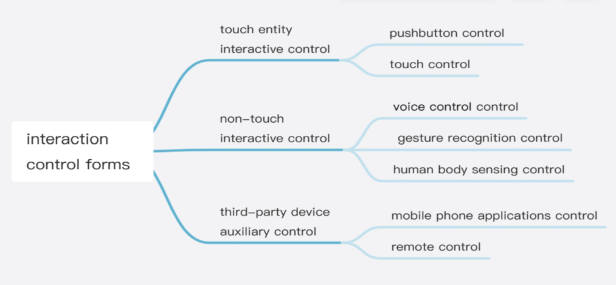
The interactive control forms of reasonably mature smart home goods on the market may be loosely split into three groups, as indicated show in Fig. 1 touch entity interactive control, non-touch interactive control, and third- party device auxiliary control. The user’s direct contact with the physical button on the product’s body, the explicit functional area (touch screen), or the implicit functional area(the appearance of the operable functional area and the non-functional area is not much different) is referred to as touch-based physical interaction control. In the lamp products, it mainly includes pushbutton switches and touch switches.Non-touch interactive con- trol implies that the user does not need to directly contact the product body when controlling the product and instead sends control instructions to the product via other more natural interactive forms such as voice control, gesture recognition, human body sensing, and so on. Third-party device auxi- liary control is the use of objects other than the product that have physical
Figure 1: Classification of interaction control methods of smart home products.
User Interaction Decisions of Smart Home Products 513
hardware to control the product itself. Control and remote control of smart bulbs are mostly accomplished using mobile phone applications. It should be emphasized that this study only picks the more prevalent and reasonably mature interactive control forms in smart lighting products for future inve- stigation as examples of particular control techniques of subordinates of the three categories of control forms, including but not limited to Fig. 1.
RESEARCH ON THE DECISION-MAKING DIMENSION OF USER INTERACTION CONTROL BEHAVIOR Interactive decision-making primarily refers to the control behavior decisions made by users, and researching the decision-making dimension of interactive behavior is useful for comprehending the process behind user interaction beh- avior decision-making variations. Individual conduct is the manifestation of values, and behavioral decisions are impacted by the individual’s perceived values and needs, according to some research in psychology (Zeithaml et al., 1996). Therefore, there is a link between the behavioral decision- making dimension and the user’s perceived value and demands. In economics, there are several hypotheses about the classification dimension of customers’ perceived value, with the majority of research including functional value, emotional value, and social value as classification criteria (Sheth, et al., 1991). With reference, the user’s decision-making dimension for product interaction may also be split.
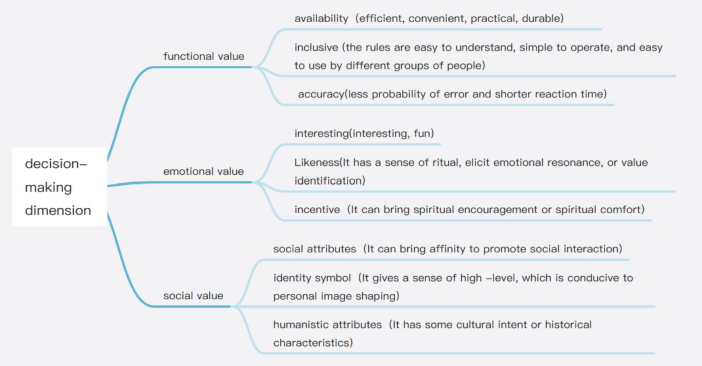
The user’s decision-making dimension on interactive control form is fur- ther summarized and divided according to the dimensions of functional value, emotional value, and social value, based on the user perception value dimen- sion and the description content of Sweeney & Soutar (2001), Petrick (2002), and others on the specific measurement scale of each dimension, and combi- ned with the characteristics of intelligent product interaction (See Fig. 2). The user’s functional value demand for interaction refers to the user’s expectation that the interaction mode will meet the product’s basic control requirements,
Figure 2: User interaction controls behavioral decision dimensions.
514 Wu and Zhang
which primarily include the need for the interaction form to have a cer- tain degree of usability, inclusiveness, and accuracy, such as low difficulty of operation, allowing users to control intelligent products efficiently and conveniently. Emotional value demand is concerned with the spiritual and emotional input provided to users through interactive techniques, such as pla- yability, feeling of ritual, and spiritual comfort during the interaction process, and includes three perspectives: fun, love, and motivation. The social value is primarily determined by the interaction mode’s social qualities, identification symbols, and humanistic features, and it takes into account the influence of the interaction mode on fostering the interaction of the interactive subject with others or cultural communication.
EXPERIMENT ON THE IMPACT OF SITUATIONAL DIFFERENCES ON USER INTERACTION DECISIONS Experimental Description
The purpose of this experiment is to investigate the impact of situational diffe- rences on user interaction decisions, specifically the degree of user preference for different types of interaction control methods, the degree of decision- making tendency of interaction behaviors, and whether the decision-making dimensions of interaction behaviors will differ as a result of situational differences.
Some studies place the main consumer group for smart home products between the ages of 20 and 45 (Yu, 2018). But according to the “2020 China Smart Home Ecological Development White Paper” published by China Smart Home Industry Alliance (CSHIA) about the characteristics of smart home users, although the current stage Smart home users are primarily post- 80s and post-90s user groups, but the penetration of smart home goods in the lives of consumers born after 1995 and after 2000 is greater based on the gro- wth pattern. Therefore, all of the research volunteers recruited for this study are between the ages of 18 and 45 and have utilized smart home goods.
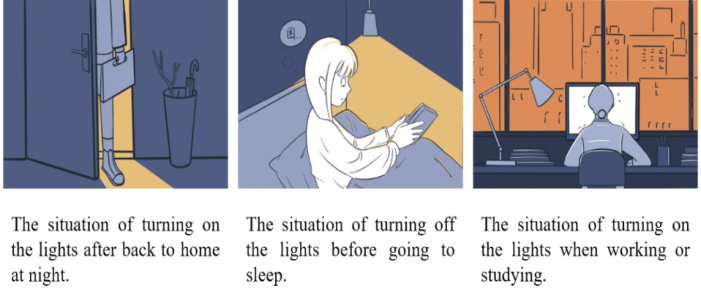
Due to the vast selection of smart home goods, the function, form, and control mode across various categories are highly distinct; thus, it is crucial to choose the appropriate category as the study carrier throughout the expe- riment. Literature review reveals that the intelligent lighting system, as one of the fundamental systems inside the smart home system (Xu, 2013), and its subordinate lighting goods have broad market penetration and high popu- larity, making it simple for people to comprehend the experimental issue. Secondly, the function and form of lights are more controllable than those of other smart home products, it is simpler to configure them. Consequ- ently, this study will focus on house lighting items as its primary research subject. In addition, user interviews revealed that the three primary home life circumstances of this study include turning on the lights after back to home at night, utilizing the lights for work or study, and shutting off the lights before going to sleep. The interactive decision-making tendency of users regarding the interactive control mode of lighting products is studied based on different contexts using the questionnaire research method, and it is anticipated that
User Interaction Decisions of Smart Home Products 515
the research results can be mapped to the interactive decision-making ten- dency of users regarding the interactive control mode of other smart home products.
Through experimental quantitative research, this study assesses the decision-making propensity and interaction behavior of consumers for smart home goods. In addition to providing designers with a certain selection basis and research path reference when designing the interaction control forms of smart home products, it also aids in understanding users’ preferences for vari- ous forms of interaction control, decision tendency, and decision dimensions of interaction behavior in various contexts.
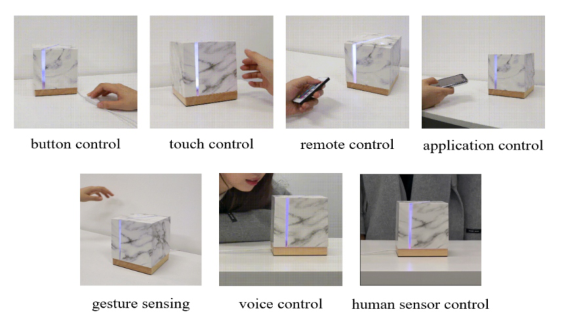
Experimental Process In the form of online surveys, the experiment was disseminated and gathered via various social media channels. A total of 250 valid questionnaires were obtained in the end. In the questionnaire, a basic example of three types of seven interactive control ways was provided initially. This procedure was carried out by displaying the same modeling function, but the interactive control mode was carried out in the form of distinct dynamic images, as shown in Fig. 3.
At the conclusion of the demonstration, a picture of one of the seven swi- tch control methods was selected at random, and the subject was asked to select its corresponding name and category. This was done to ensure that the subject understood the specific content of each option, and it could also be used to eliminate invalid questionnaires during later data screening. The main portion of the experiment will randomly display three typical home life situations, accompanied by a graphic form describing the situation, so that users can more effectively evoke the situation’s feeling when filling out the questionnaire; the situation illustration is depicted in Fig. 4.
The subjects are asked to rate each interactive control form or con- trol mode feature using a matrix scale. Each scenario corresponds to the same questions and options about the degree of preference, decision-making
Figure 4: Three typical home life scenario diagrams.
tendency, and decision-making dimension. The sorting questions are reset to allow the subjects to choose the circumstances that arose during the study procedure in order, which is also used to weed out incomplete questionnaires, after they have completed three random situation tests.
ANALYSIS AND FINDINGS User Decision Propensity is Positively Correlated With the Degree of Preference
Spearman’s correlation analysis of the degree of preference and decision pro- pensity in the three contexts was performed by SPSS software, and it was found that the correlation coefficients were all at the significance level of 0.01 (Two-sided Test), and the correlations were very significant, thus inferring that there was a positive and high significant positive correlation between the degree of user preference and the degree of decision propensity for the three interaction control methods of the luminaire in each context. This indicates that users’ decision propensity for interactive control is greatly influenced by preference, and the mean of the two can be calculated to describe users’ “attitude” toward interactive control.
In addition, slight differences were found in the specific scores and the magnitude of mean change between preference and decision propensity. In the situations of turning on the lights at home at night and turning off the lights at bedtime, the preference scores of touch physical interaction and third-party device assisted control were higher than the preference scores, while the prefe- rence scores of non-touch interaction control were lower than the preference scores. Combined with the content of the preliminary user interviews, we beli- eve that this is mainly due to the fact that the subjects’ decision propensity is influenced by their subjective preferences, but in the actual operation pro- cess, other factors, such as the stability of the non-touch interaction control during the actual operation, other factors are also taken into consideration, resulting in local differences between the actual interaction decision and the preference level.
User Interaction Decisions of Smart Home Products 517
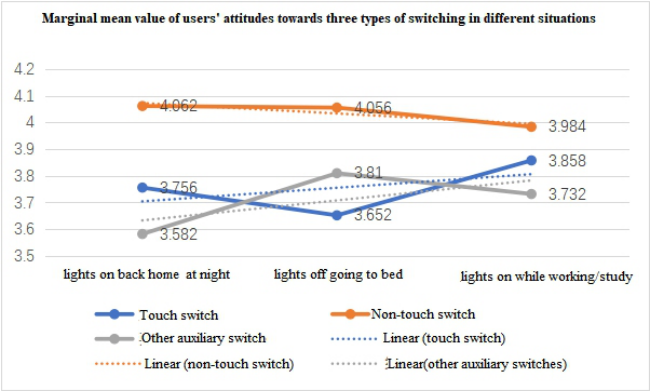
Contextual Differences Affect Users’ Attitudes Towards Interaction Control Forms The mean value of both preference and decision propensity was further used as the “attitude” indicator, and the user’s attitude was analyzed by repea- ted ANOVAs to form a graph of the marginal mean of the user’s attitude toward the three types of switches in different contexts (as shown in Fig. 6), with higher scores indicating a greater preference for the interaction control method in the corresponding contexts. The higher the score, the more the subjects prefer the interaction control method in the corresponding context. As can be seen from the figure, there are differences in the attitudes of users in different contexts, and they appear to intersect, which shows that there are differences in the attitudes of users towards the same form of interaction control in different contexts, thus judging that the contextual differences will have an impact on users’ interaction decisions.
For the interactive control method of home lighting, the preferred intera- ctive control method of the subjects was non-touch interactive control. It is speculated that this phenomenon is due to the increasing demand of users for automation of smart home products, and the interactive control methods of smart home products are constantly developing in the direction of naturaliza- tion and proactiveness (Tan et al., 2019). Under the premise of guaranteeing the basic functions, users are more inclined to the interactive control method with fewer or no operation steps. However, users’ willingness to use non- touch interaction in work or study situations decreases, which is presumed to be due to the fact that in work or study situations requiring high concen- tration, subjects do not want their concentration to be affected by external factors, and the current non-touch interaction control technology is more accurate and sensitive than the physical contact methods such as touch and other devices. The current non-touch interaction control technology lacks accuracy and sensitivity compared to the physical contact interaction meth- ods such as touch and other device assistance, and occasionally requires repeated user actions.
In addition, in the context of turning off the lights at bedtime, subjects were less willing to use touch-based interactions and more willing to use other devices to assist with interactions, which may be related to their personal habits, taking into account the decision dimensions and information obtained from user interviews. When they feel sleepy and need to turn off the lights, they are more likely to turn off the lights through their cell phones or remote control devices that are readily available. Compared with the touch switch fixed on the wall, it is obvious that other devices assist in interacting with less movement and more convenient operation.
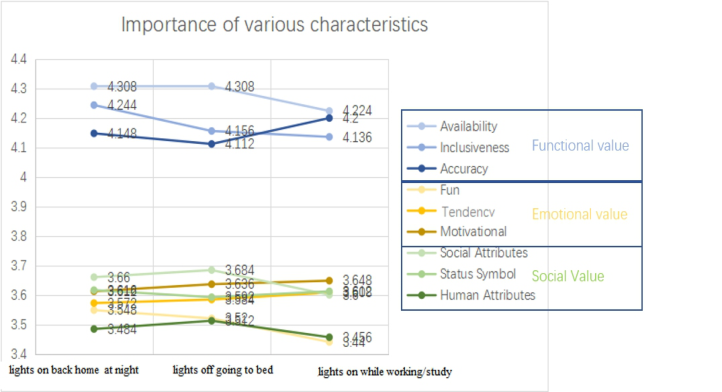
User’s Decision Dimension for Luminaire Product Interaction is Dominated by Functional Value in Different Situations A further study was conducted to investigate the dimensions and characte- ristics of the user’s attitude towards the interaction control of the luminaire products in each situations. In the same way, the dimensions considered by the users when making interaction decisions in the three home life situations
518 Wu and Zhang
Figure 5: Marginal mean value of users’ attitudes towards three types of switching in different situations.Figure 6: Decision dimensions of users’ interaction behavior in different situations.
were compared (Fig. 7). By comparing the mean values of user decision dimensions in each situation, it was found that functional value was the primary consideration of the participants. The reason for this is that, on the one hand, the users’ core demand for the lamps and lanterns is to be able to provide lighting, and the user’s perception of the lamps and lanterns is less involved, and the interaction with the lamps and lanterns is mainly during the two time periods of turning on and off the lights. The emotio- nal and social values of the luminaire interaction are relatively small. On the other hand, users’ functional needs for product interaction are higher than
User Interaction Decisions of Smart Home Products 519
humanistic needs, and the usability of interaction control methods is the most basic requirement for smart home products.
In addition, the subjects’ emotional value needs such as motivation and love for the interaction method in work or study light situations have incre- ased. This indicates that when users are likely to face stress, the proportion of emotional needs increases, and they expect the interaction to bring some spiritual comfort. In the situation of turning on the lights at home at night, in addition to the basic requirement of functional value, the subjects also pay more attention to social value, indicating that in places like entrance hall and porch where social interaction is possible, users also have a demand for social attributes of interaction methods, and pay attention to the role of interaction methods in shaping their personal image. In the relatively relaxed and leisu- rely situations of bedtime lounging, users’ demand for social and humanistic attributes of interaction methods also increases.
CONCLUSION
Users have obvious preferences for interaction control modes, and diffe- rent situations have different degree of preference, decision propensity and decision dimension of interaction behaviors. Based on the experimental results, we can consider more non-touch interaction control methods and combine multiple methods as one to design products with multimodal inte- raction when designing smart home products. And in the design process, the characteristics of the target situations, and integrate the multi-dimensional functions, emotions, social and other multi-dimensional values, user habits and user psychology, should be fully analyzed to enhance the user experience in the process of product use.
REFERENCES
Brdiczka, O., Crowley, J. L. and Reignier, P. (2008) “Learning situation models in a smart home,” IEEE Transactions on Systems, Man, and Cybernetics, Part B (Cybernetics), 39(1), pp. 56–63. Available at: https://doi.org/10.1109/tsmcb. 2008.923526. Clancey, W. J. (1997) Situated cognition: On human knowledge and computer
representations. New York: Cambridge. Jeong, K.-A., Proctor, R. W. and Salvendy, G. (2012) “Smart-Home Interface Design: Layout organization adapted to Americans’ and Koreans’ cognitive sty- les,” Human Factors and Ergonomics in Manufacturing & Service Industries, 23(4), pp. 322–335. Available at: https://doi.org/10.1002/hfm.20299. Norman, D. A. (1986) User Centered System Design: New perspectives on human-
computer interaction. Hillsdale, NJ: Erlbaum. Petrick, J. F. (2002) “Development of a multi-dimensional scale for measuring the perceived value of a service,” Journal of Leisure Research, 34(2), pp. 119–134. Available at: https://doi.org/10.1080/00222216.2002.11949965. Reddy, S. R. N. et al. (2016) “Shome: A smart home environment with GEN2,”
2016 International Conference on Computational Techniques in Information and Communication Technologies (ICCTICT) [Preprint]. Available at: https://doi.org/ 10.1109/icctict.2016.7514627.
520 Wu and Zhang
Sato, K. (2004) “Context-sensitive approach for interactive systems design: Modular scenario-based methods for context representation,” Journal of PHYSIOLO- GICAL ANTHROPOLOGY and Applied Human Science, 23(6), pp. 277–281. Available at: https://doi.org/10.2114/jpa.23.277. Sheth, J. N., Newman, B. I. and Gross, B. L. (1991) “Why we buy what we buy: A
theory of consumption values,” Journal of Business Research, 22(2), pp. 159–170. Available at: https://doi.org/10.1016/0148-2963(91)90050-8. Sweeney, J. C. and Soutar, G. N. (2001) “Consumer perceived value: The development of a multiple item scale,” Journal of Retailing, 77(2), pp. 203–220. Available at: https://doi.org/10.1016/s0022-4359(01)00041-0. Tan, J. Y., Chen, Z. B., Zhang, W. H., Hao Z. Y., Guan, D. S., Wu, Z. & Zhao,
M. (2019). Active Interaction Design of Family Intelligent Products. Packaging Engineering, (20), 67-73. doi:10.19554/j.cnki.1001–3563.2019.20.011. (Chi- nese) Tian, Y. B., Zhu, J. G., & Wang, G. K. (2021). Discussion on the Experience Design Method of Voice Interaction in Smart Home. Furniture, 042(003), P.23–27, 38. (Chinese) “Understanding the dynamics of technological configurations: A conceptual fra-
mework and the case of Smart Homes” (2008) Technological Forecasting and Social Change, 76(3), pp. 396–409. Available at: https://doi.org/10.1016/j.techfo re.2008.04.002. Xu, H. (2013). Analysis of the Front-end Information Acquisition and Transmission Media and Product Cateaorv of Smart Home System. Intelligent Buliding, (10), 75-80. (Chinese) Yu, J. T. (2018). Research on User Experience Evaluation Model of Smart
Home Application Product Based on Situation Theory (Chinese Master’s The- ses, Tianjin University). https://kns.cnki.net/KCMS/detail/detail.aspx?dbname= CMFD201902&filename=1019833428.nh (Chinese) Zeithaml, V. A., Berry, L. L. and Parasuraman, A. (1996) “The behavioral consequences of service quality,” Journal of Marketing, 60(2), p. 31. Available at: https://doi.org/10.2307/1251929.
LISTED IN THE AHFE DIGITAL BOOKSTORE CATALOGUE
Explore the complete digital volume
Ergonomics In Design
Read this individual research paper free through the original publisher, or explore the full digital proceedings book.
ISBN 978-1-958651-53-7
Explore this ISBN in the AHFE Bookstore ↗Listed in the July 2026 bookstore catalogue; search by ISBN to confirm current availability · Digital book purchase optional