Lu Wei, Xiaotong Zhao, Xiaomo Ye, Xin Chen (2023). Application of innovative design of transformable baby stroller based on TRIZ. In: Usability and User Experience. AHFE Open Access, vol. 110, pp. 571–580. https://doi.org/10.54941/ahfe1003233
In the context of traditional stroller design, people tend to focus on its lightness, stability, comfort and material safety aspects, however, the current strollers are single-functional and do not fully meet the needs of users in complex spaces, while there are safety hazards. Based on the safety requirements of the escalator scene, this paper proposes a solution for a stroller with liftable rear wheels to solve the problems of easy tipping and unstable user force when the front and rear wheels of the stroller are not at the same level. The solution discusses how strollers can dynamically change to meet users' needs for product safety and ease of use in an escalator scenario. First, user research was conducted through observations and interviews. After that, a TRIZ-based functional model was developed to describe the application scenario and identify the specific problem. Using the standard solution method, the innovative invention principle was used to design a self-adjusting structure applied to baby carriages through the analysis of the su-field model. In addition, based on the ergonomic design principles of standing posture, we have improved the sense of the experience of using the product. This study guarantees the safety of infant travel while also enhancing the comfort of use, satisfying the needs of users and providing a new solution for the use of strollers in escalator scenarios.
In recent decades, rising birth rates in Asian countries such as India, Bangladesh and China have driven up the demand for baby carriages. Stroller market to grow at a rate of 5.8% in the last five years and reach USD 3.88 billion by 2029 (GrandViewResearch, 2022). With the rapid economic de- velopment, people pay less attention to the proportion of the price, more attention to product safety, ornamental and cost performance, etc.. Although the stroller in recent years has received attention and attention, but most of the design remains in the appearance and seat comfort, without chang- ing the original frame mechanical structure, so it can not meet the needs of the stroller used in some more complex environmental occasions (Bao, Y., Cheng, W., Chai, H., Lv, J., & Chai, G., 2016). In addition, many designs
only consider whether the baby is comfortable, ignoring the connection be- tween the user and the stroller, failing to make full use of ergonomics to solve the problem, thus creating a contradiction(Sehat, A. R., & Nirmal, U., 2017).
This paper explores the optimal design of a stroller in the case of an es- calator. “Escalators are widely considered to be an alternative to stairs or elevators.” The most common accidents are falls on stairs and getting body parts stuck in various areas of the mechanism (Ayres, T., & Schmidt, R., 2008). Statistical analysis showed that escalator-related injuries were mainly caused by passengers failing to stand still and passengers performing other tasks at the same time (Xing, Y., Dissanayake, S., Lu, J., Long, S., & Lou, Y., 2019). And for parents with children, the use of strollers to travel with children is unavoidable. In the context of public transportation (e.g., shop- ping malls, subway stations, etc.), escalators are one of the policy measures to alleviate barriers to parenting (Ohmori, N., 2015). China’s subway system, for example, serves an average of 12,411,000 passengers per day in the con- text of public transportation, and daily ridership surges during peak hours. (Xing, Y., Chen, S., Zhu, S., & Lu, J., 2020). Of concern is the serious rip- ple effect of the subway escalator accident, as other injuries that could result from a falling passenger. (Xing, Y., Chen, S., Zhu, S., & Lu, J., 2020).
Nowadays there are also some relevant studies on adapting staircase struc- tures. For example, Joen proposed a 6-degree-of-freedom bipedal robot consisting of seven links in the sagittal plane to ensure stability while min- imizing energy consumption when going up and down stairs. (Jeon, K. S., Kwon, O., & Park, J. H., 2006). Dim Sensitivity analysis of design pa- rameters using Taguchi’s method to eliminate confounding factors. (Kim, D., Hong, H., Kim, H. S., & Kim, J., 2012). A more optimized rocker- steering structure was then deduced through dynamics studies to provide greater stability when climbing buildings. Byung studied the application of the human flip structure to the building climbing function, and improved the stability of the structure by optimizing the platform length and height of the caterpillar structure and the track speed. (Seo, B., Hong, S. Y., Lee, J. W., & Seo, T., 2013).
This paper will address the improvement of the stroller frame structure in the escalator scenario. On escalators the stroller seat plane can form an inclination with the ground or fail to stop the rear wheels on the escalator, causing structural instability. Based on TRIZ theory, the author conducted conflict analysis, su-field model analysis and demand function analysis on the problem. According to the conflict matrix, the problem was further deepened by identifying the corresponding invention and innovation principles in the 40 invention and innovation principles. Extracting one aspect of the stability problem, the connection between the rear wheel and the front wheel, the triangular structure on the flat ground is not conducive to smoothness on the escalator, and the crawler structure on the escalator is not conducive to smoothness on the flat ground. (Seo, B., Hong, S. Y., Lee, J. W., & Seo, T., 2013), combining the general case with the special case, using the laser displacement sensor to sense the height difference of the escalator, the worm gear of the stroller will automatically adjust to stabilize the standing on the escalator, turning harm into benefit while improving the front wheel structure
Application of Innovative Design of Transformable Baby Stroller Based on TRIZ 573
of the stroller and improving the stability of the stroller in different occasions. In addition, the user is under the steps of the stroller on the escalator, in accordance with the general plane of holding posture will cause shoulder and neck stress fatigue, not in line with ergonomic principles. Therefore, we have adopted the telescopic structure of the grip to improve the comfort of the user.
USER ANALYSIS Observation
The observation method reveals that modern parents lack awareness of their children’s safety and they often ignore the warning signs on escalators that do not allow strollers on the escalator. A suitable mechanism that can be used to carry a stroller is an elevator. Most parents with strollers will use the escalator with the excuse that it is a hassle to use the elevator because it is so far away from them. (binti Parman, N. E., 2015). In the context of escalator riding, stroller users choose to ride the escalator by picking up the child and folding the stroller with one hand, lifting the front wheels of the stroller to place it on the previous step, applying force to the handle so that the rear wheels are parallel to the front wheels, or holding the stroller with both hands to balance it. The posture of the baby is generally lying down or sitting in the stroller, the stroller is in a tilted state, the center of gravity shifted, easy to make the baby in the car discomfort, and in the user’s operation process will be subject to bumps, while the user not only effort and can not ensure the safety of the baby, the above positions are safety hazards.The wheels of the stroller do not fully bite with the escalator steps, so they cannot be fixed on the escalator and there is a risk of falling.
User Interview Users with infants of different ages and their families (24 different families, 80 people in total) were interviewed to find out their feelings and suggestions about using strollers in shopping malls or other public places equipped with escalators. Below are some of the frequently asked questions collected. First, most of the respondents would choose elevators or escalators to go up and down the stairs. Respondents responded to whether it is convenient to use elevators in shopping malls as follows: 65% of the respondents thought it was not convenient to use elevators in public places such as shopping malls when there are too many people, especially straight elevators, because of the limited space in the elevator compartment, long waiting time, and the need to consider safety issues such as carrying baby strollers. Secondly, for the choice of escalator and straight elevator, more than half of the respondents will use the escalator because they carry a baby carriage, because the location of the straight elevator in public places such as shopping malls is too far away or remote and not easy to find, while the location of the escalator is more conspicuous. Finally, for the respondents’ feeling of using on the escalator, they think it is difficult to use the stroller on the escalator because of the
inclination angle of the escalator and the weight of the stroller, which is not easy to fix, low stability, and safety hazards.
DESIGN PROCESS BASED ON TRIZ THEORY About TRIZ
The Russian spelling of TRIZ is теоpии решения изобрет-ательских задач, with the Russian abbreviation “TРИЗ”, which translates as “Theory of In- ventive Problem Solving” (Rantanen, K., Domb, E., 2008). It is a group of researchers led by Archishuler and his team in the former Soviet Union, in or- der to find a way to eliminate contradictions, they spent a lot of manpower and resources, and on the basis of analyzing and studying 2.5 million patents from all over the world, they came up with the corresponding laws and put forward the theory of invention problem solving.
Compared with traditional innovation methods such as brainstorming and trial-and-error, TRIZ theory has distinctive features and advantages. It can quickly and efficiently find ways to improve and achieve conflict resolution. It aims to discover the inner laws of creation and invention, emphasizing the existence of contradictions and their complete resolution, rather than considering multiple solutions and compromising on inadequacies; it is based on the evolutionary laws of technology development to study the entire design and development process, rather than random acts. In the process of using TRIZ to solve a problem, the product to be designed is first expressed as a TRIZ problem, and the inventive principles, technical trends and standard solutions provided by TRIZ (Gadd, K., 2011). Then, we analyze the nature of the actual problem and match it with the solution, then we find the universal solution or the simulation solution of this TRIZ problem, and finally we transform the solution into a solution or a special solution in this field. The author will elaborate on this below.
Application of TRIZ Theory In the process of using the stroller on the escalator, the stroller is easy to topple over and get stuck due to the change of escalator level height, people often ease this problem by lifting their arms up, but it cannot be completely solved.
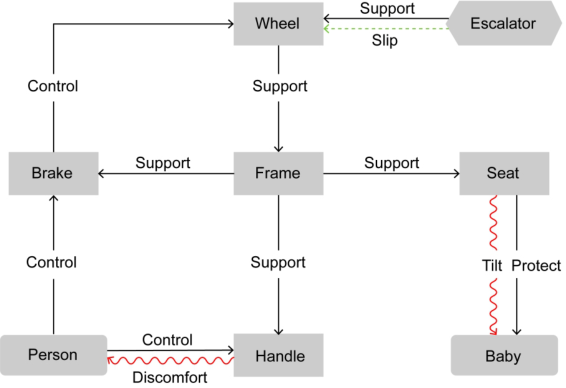
The author performed a functional model analysis (Figure 1) of the stroller, listing the components of a common stroller as well as the supersystem and clarifying the relationship between the parts. Where useful relationships are represented by black straight arrows, deficient relationships are represented by green dashed arrows, and harmful relationships are represented by red wavy arrows. The purpose of creating this functional model is to be able to understand the useful, harmful, and insufficient functional relationships between the various components and systems of the stroller.
The analysis of the above components shows that in the current system, the seat can have a harmful effect on the baby, the escalator can have an insuffi- cient effect on the stroller wheels, and the handle can have a harmful effect on the stroller person. Therefore, in order to solve these phenomena, first of
Application of Innovative Design of Transformable Baby Stroller Based on TRIZ 575
all, the stroller seat angle and even the frame should be adjusted to overcome the obstruction caused by large angle tilt. Secondly, should be returned to the handle height adjustment, suitable for pushing the stroller people use to avoid using excess force. At the same time, the tires should be improved so that they can be better adapted to the surface of the escalator steps.
Combine the basic terms in TRIZ theory to dig deeper into the proposed problem. The problem of substantial tilting of seats as well as car frames on escalators is solved by the object field analysis model.
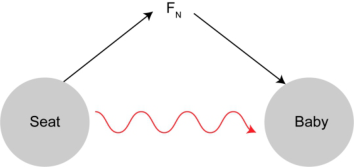
By constructing this model object field analysis (Figure 2), it is concluded that the harmful effect of the stroller on the baby is to make the baby tilt at a large angle or even tumble and fall. Therefore, we need to adopt the standard solution of “introducing the deformed third substance S” to deform the original fixed stroller frame into a frame structure with a high front and a short back, so that the stroller can stand on the escalator stably without the seat tilting at a large angle.
After solving the above problems, a secondary analysis of the system was conducted based on the subsystem unbalanced evolution method, from which it was found that any single structure could not be adapted to use in three environments simultaneously: flat ground, up stairs and down stairs, and
Table 1. Principles.
Table available in the original PDF paper.
#2 Taking out #22 “Blessing in Disguise” or “Turn Lemons into Lemonade” #17 Another dimension #19 Periodic action
the deformed structure could only be adapted to one of the up and down escalator environments.
The contradictions in the innovation problem include technical and phys- ical contradictions (Altshuller, G., 1999). Stroller frame at the same time can adapt to the up escalator, down escalator and flat three environmen- tal use belongs to the same parameter between the contradiction, belongs to the physical contradiction, using the principle of separation. The user wants to use the stroller at different moments and in different environments, so the time separation solution principle is used. According to the recommended invention principle #19-periodic action given by time separation, a slider is set at the front and rear frame connection, while the lower part of the frame is changed into a worm gear structure, and the structure is deformed by this way. Different periods can be slid in different directions depending on the terrain. When the stroller rides up the escalator, the frame architecture is in the high front and short rear; when the stroller returns to the flat ground, the stroller frame will be the same height in front and rear; when the stroller rides down the escalator, the frame will be in the short front and high rear.
When the stroller frame changes up and down at different times, additional structures are needed to assist this change, thus increasing the complexity of the stroller system and also deteriorating the stability of the components. Ac- cording to TRIZ 39 characteristics, the parameter to be optimized is No. 36 - Device complexity, and the parameter to be deteriorated is No. 13 - Stabil- ity of the object. Based on the parameters to be optimized and deteriorated against the contradiction matrix, the four inventive principles that can help to improve can be derived as #2, #22, #17 and #19 (Table 1) (Altshuller, G., 1998). After screening, it was decided that the #22 invention principle - “Blessing in Disguise” or “Turn Lemons into Lemonade” (Convert Harm into Bene- fit) could help solve this problem. Escalator in the operation process, will be in the buffer zone from the flat ground to produce escalator step height difference, which is also to make the stroller produce a large angle tilt harm- ful causes. The process of using escalator steps to gradually change in the buffer zone helps the stroller frame to make height changes. A laser displace- ment sensor is added to sense the height difference between the front and rear wheels on the escalator, and the worm gear structure is used to enable the frame to be adjusted correspondingly according to the front and rear height difference. When the stroller is in the buffer zone of the upward esca- lator and the sensors sense that the height of the front wheels is higher than the rear wheels, the rear frame will move down in the direction of the front frame until the height difference reaches stability;When the stroller is in the buffer zone of the downward escalator, the rear frame will move upward in
Application of Innovative Design of Transformable Baby Stroller Based on TRIZ 577
the direction of the rear frame until the height difference reaches stability. This approach can help the stroller to be relatively stable for structural de- formation and adapt to different escalator changes. Control frame structure deformation can be operated through the handle end, before the stroller en- ters the buffer zone, unlocked and opened by the buttons on the left and right sides, and automatically locked after returning to the flat ground.
Ordinary stroller wheels are prone to movement due to the slippery surface material of the escalator, so the wheels need to be improved to help make the stroller more stable on the escalator. This contradiction is a technical contradiction. Increasing the friction can be done by increasing the pressure, which represents the optimized parameter No. 11-Stress or pressure. While increasing the friction, it will increase the loss of the wheel, therefore, the deteriorated one is the parameter No. 15-Durability of moving object. Based on the parameters to be optimized and worsened against the contradiction matrix, it can be concluded that the inventive principles that can help to improve are #19, #3 and #27.Among them, using the principle of invention No. 3, the outer side of the baby stroller wheel is improved according to the gap on the surface of the escalator steps, and the outer radius of the wheel is increased so that the outer side of the wheel can fit with the gap on the surface of the steps, and in this way, friction is increased and stability is enhanced.
After these problematic improvements, users were less comfortable using strollers in the escalator environment. The user cannot always be in a com- fortable position at different locations on the escalator. Therefore, the handle was designed as an adjustable structure according to the principle of temporal separation in physical contradiction. In the upward and downward escalator environment, the front wheels and the human standing position differ by 2 rung heights respectively, so the adjustment structure is divided into 3 stages of adjustment. When in the up escalator, stretch the handle to the shortest position; when on level ground, in the middle position; when in the down escalator, stretch the handle to the longest position. According to the data (Yulan, 2017), the 95th percentile elbow height was 1096 mm for men and 1023 mm for women. When the object is at a height of 1100mm to 1650mm above the ground, most people can reach a comfortable range in an upright position, therefore, the overall height of the stroller is 1160mm. At the same time, the height of each escalator step was found to be within 240mm by mea- surement, so the three-stage telescopic height difference of the baby stroller handle was set to 240mm.
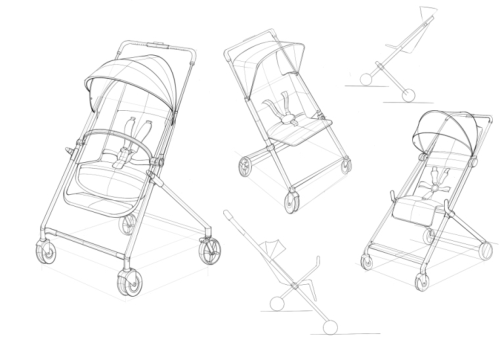
Final Concept According to the above solution and product structure function, preliminary sketching was carried out. (Figure 3)
In terms of material selection, the weight of the stroller itself increases due to the worm gear and motor structure, and a material with high density, high strength and light weight should be selected, so carbon steel is chosen as the base material for the stroller frame. Considering the comfort and safety of the baby, the seat part is made of breathable linen fabric combined with carbon steel, which not only ensures the comfort of the baby when sitting, but also
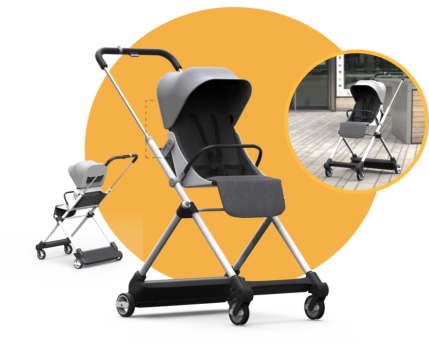
Figure 3: Conceptual sketch.Figure 4: The final rendered product.
ensures the safety and stability of the baby seat. The stroller wheels are made of rubber to slow down the wear and tear of the stroller while providing shock absorption. The final rendered product is shown in the Figure 4.
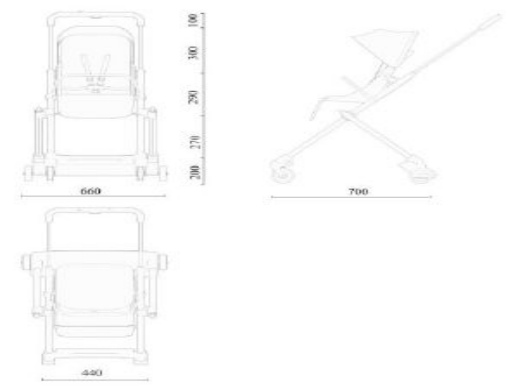
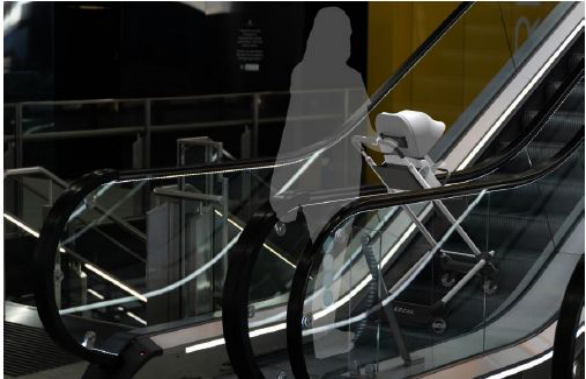
In terms of dimensions, the product has a height of 1160 mm, a length of 700 mm, and a width of 660 mm. The specific sizes are in Figure 5. The stroller will be transformed in going up the escalator, and the Figure 6 shows its effects in the escalator environment.
CONCLUSION
This study discusses transformable strollers that can be used on escalators to reduce the probability of accidents when strollers are used on escalators and help strollers to be used safely on escalators. According to the user survey, there is a real demand for the design. The project discussed a way to improve the structure of the stroller through TRIZ and proposed a final solution with
Application of Innovative Design of Transformable Baby Stroller Based on TRIZ 579
Figure 5: Size.Figure 6: Scene diagram.
ergonomic data. This project can help babies ride comfortably and safely, and the people who take care of them can travel more conveniently, providing a new idea for the related research field.
References
Altshuller, G. (1998). 40 Principles - TRIZ Keys to Technical Innovation, TRIZ Tools, Vol. 1, 1st Ed, Technical Innovation Center, Inc. Altshuller, G., (1999). The Innovation Algorithm, TRIZ, Systematic Innovation and
Technical Creativity, Technical Innovation Center, Inc. Ayres, T., & Schmidt, R. (2008). Age-related risk patterns for escalators. In CybErg 2008: Fifth International Cyberspace Conference on Ergonomics.
Bao, Y., Cheng, W., Chai, H., Lv, J., & Chai, G. (2016, September). The Mechanical Design of an Adjustable Baby Carriage/Walker Based on Human Factors Engineer- ing. In 6th International Conference on Mechatronics, Materials, Biotechnology and Environment (ICMMBE 2016) (pp. 357–360). Atlantis Press. binti Parman, N. E. (2015). Security for Baby Stroller. Gadd, K., 2011. TRIZ for Engineers. John Wiley & Sons, West Sussex, UK. Litvin,
S., Petrov, V., Rubin, M., Fey, V., 2005. TRIZ body of Knowledge. Avail- able from: /http://www.aitriz.org/articles/TRIZ_Body_of_Knowledge.pdfS (ac- cessed30.11.11). GrandViewResearch (2022). Retrieved From the Internet. Available online at: https://www.grandviewresearch.com/industry-analysis/baby-stroller-market (ac- cessed July 22, 2022). Jeon, K. S., Kwon, O., & Park, J. H. (2006). Trajectory optimization for biped robots
walking up-and-down stairs based on genetic algorithms. Journal of the Korean Society for Precision Engineering, 23(4), 75–82. Kim, D., Hong, H., Kim, H. S., & Kim, J. (2012). Optimal design and kinetic analysis of a stair-climbing mobile robot with rocker-bogie mechanism. Mechanism and machine theory, 50, 90–108. Ohmori, N. (2015). Mitigating barriers against accessible cities and transportation,
for child-rearing households. IATSS research, 38(2), 116-124. Rantanen, K., Domb, E., 2008. Simplified TRIZ—new problem solving applications for engineers and manufacturing professionals. Auerbach Publications, New York. Sehat, A. R., & Nirmal, U. (2017). State of the art baby strollers: Design review and
the innovations of an ergonomic baby stroller. Cogent engineering, 4(1), 1333273. Seo, B., Hong, S. Y., Lee, J. W., & Seo, T. (2013). Kinematic optimal design on a new robotic platform for stair climbing. Journal of the Korean Society for Precision Engineering, 30(4), 427–433. Xing, Y., Chen, S., Zhu, S., & Lu, J. (2020). Analysis Factors That Influence
Escalator-Related Injuries in Metro Stations Based on Bayesian Networks: A Case Study in China. International journal of environmental research and public health, 17(2), 481. https://doi.org/10.3390/ijerph17020481 Xing, Y., Chen, S., Zhu, S., & Lu, J. (2020). Analysis factors that influence escalatorrelated injuries in metro stations based on bayesian networks: A case study in China. International journal of environmental research and public health, 17(2), 481. Xing, Y., Dissanayake, S., Lu, J., Long, S., & Lou, Y. (2019). An analysis of escalator-
related injuries in metro stations in China, 2013–2015. Accident Analysis & Prevention, 122, 332–341. Yulan, D.: Ergonomics. Beijing Institute of Technology, Beijing (2017).
LISTED IN THE AHFE DIGITAL BOOKSTORE CATALOGUE
Explore the complete digital volume
Usability and User Experience
Read this individual research paper free through the original publisher, or explore the full digital proceedings book.
ISBN 978-1-958651-86-5
Explore this ISBN in the AHFE Bookstore ↗Listed in the July 2026 bookstore catalogue; search by ISBN to confirm current availability · Digital book purchase optional