Jonathan Max Kiessling, Thomas Maier, Simon Wiesenfarth, Stephan Mayer (2023). User-centered design of an adaptively morphing human-machine interface. In: Usability and User Experience. AHFE Open Access, vol. 110, pp. 102–112. https://doi.org/10.54941/ahfe1003182
Adaptively morphing (shape changing) human hand-machine interfaces aim at increasing usability for various users, especially older walking-aid users with impaired hands. This paper introduces such an interface design for a five-finger hand-handle contact consisting of machined and additive manufactured components. Functionality is achieved via a granulate-filled flexible shell and pneumatic-actuated jamming. The interface is tested in a realistic use context experiment. The results contain positive subjective comfort evaluation and a digital workflow for design parameter analysis. Further design iterations considering these parameters are proposed.
Self-reliant mobility is a crucial factor for social participation, especially for aging users. Walking aids – such as rollators – support users in doing so. Most of those aids are hand-held and manually driven. However, with age motoric and sensory capabilities of the hands decrease (Fisk et al. 2009), further limiting user experience and users’ ability to move independently. This work contributes to solving this problem at the hand-product interface. For this, it focusses on three points represented by the following chapters:
Introduction of an adaptively morphing hand-product interface design based on previous work and identified requirements.
Conducting of a user study, based on grip evaluation and mobility test stand research.
Analysis and discussion of further design parameters from the study’s results.
Methods and the relevant scientific background are described in each cha- pter respectively. The main research question of this work is: How can design parameters for further iterations be derived from the current adaptively mor- phing interface design? Further questions cover the difference in subjective evaluation between a standard rollator handle and the adaptively morphing
User-Centered Design of an Adaptively Morphing Human-Machine Interface 103
interface as well as the comparison of one-time and use case specific form ada- ption. The research questions are considered in the user study methodology and discussed in the results and final chapter of this work.
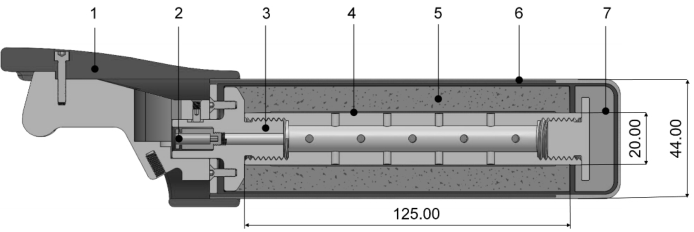
ADAPTIVELY MORPHING INTERFACE DESIGN The adaptively morphing interface design in this paper builds on previous work by Lassmann et al. (2019) describing an adaptive handle for older users in a rollator use context. Due to their hands’ properties described in the introduction, these users potentially benefit significantly from an ada- ptive hand-product interface. Janny and Morkoc (2017) propose a convex shaped handle adapting its diameter as specified by Bullinger (1994) via a stepper motor, an attached spindle, and cam discs. However, Lassmann et al. (2019) propose a granulate filled flexible shell due its capability to mirror the anthropometric geometry of individual hands in more detail. This functi- onality is based on Follmer and Leithinger’s (2012) utilizing coarse coffee granulate, following Cheng et al. (2012), inside a silicone shell. A first pro- totype demonstrated potential while lacking structural stability and sizing definition. Therefore, the following adaptively morphing handle was desi- gned and built to withstand realistic use and enable further research. The design follows a user-centered design and combines addititve manufactured soft-robotics (Lee et al., 2017) functionality with conventionally machined parts. The morphing area has a fixed length of 125.00 mm, 44.00 mm in diameter, and allows for a deformation of 12.00 mm. It therefore fits 5 to 95 percentile hand sizes (DIN 33402-2, 2020) universally, while providing a larger, deformable diameter for smaller hands (Lassmann et al., 2019).
Figure 1 shows a cross-section of the adaptive handle with its key hardw- are components. It is connected to the rollator, via an aluminum interface (1). The handle softens by transporting air into the shell and allows for mirroring the user’s hand form. Extracting the air from the system stiffens handle by “jamming” (Follmer and Leithinger, 2012) the coarse granulate. An Arduino Nano, a small 12 V pump, and three 3/2-way solenoid valves control airflow into and from the flexible shell via the sealed connector (2). The machined aluminum structure (3) transfers loads of up to 93.00 kg with a factor of
Figure 1: Adaptively morphing handle cross-section with components and dimensions [mm].
safety of 1.5 from the user to the rollator. Thus, it supports a 95 percentile male user (DIN 33402-2, 2020). A paper based filter (4) shields the pneu- matic sub-system from coffee granulate (5) particles. The coffee granulate is sustainably sourced from used coffee grounds. The core component for the adaptively morphing functionality is the granulate-filled flexible shell (6). A TekScan 9830 pressure mapping sensor can be attached to the shell via a fle- xible textile sleeve. Multiple versions with latex and silicone were tested. A 1.00 mm, 33 ShA silicone shell provides adequate flexibility, hand feel, and in-house manufacturability. A silicone bumper (7) cushions the aluminum tip.
USER STUDY Second, the adaptively morphing handle was used in a user study with reali- stic use cases to evaluate the form morphing functionality, compare it to the standard rollator handle, and to identify typical handle forms for different users. The test stand design builds on user interviews and literature review.
Handle Usability and Ergonomics Evaluation in Literature Multiple national standards provide guidelines for usability and ergonomics evaluations. According to the FDA (2016), subjects representing the actual users of a product should perform all critical tasks in a realistic simulated environment for human factors validation testing. The MHRA (2016) dif- fers in wording and proposes “formative” testing for the identification of design improvements with 5 to 8 participants in a realistic use context as well. ISO 9241–11 (2018) describes examples of usability testing in human factors engineering during field tests or in controlled experiments. This includes eva- luation of users’ satisfaction and the identification of users’ requirements for further product iterations.
Fellows and Freivald (1991) as well as Chao et al. (2000) propose force measurements via force sensitive resistor (FSR) sensors placed on the handle surface in different use contexts. Kong and Lowe (2005) apply FSR sensors placed on a glove for hand-handle contact force measurements. Kiessling et al. (2022) use a similar glove with higher sensor cell count for compa- ring different handles. Kuijit-Evers (2007) identifies several factors for hand tools’ comfort. Amongst these, “good fit in hand” and “no peak pressures on hand” are especially relevant for the work presented here. Besides mea- suring hand-handle contact surface pressure, indicating high-pressure areas on a hand map (Kadefors et al., 1993, Bonfim et al. 2017) is a valid subje- ctive addition. To conduct these evaluations in an appropriate setting, field research or specific test stand designs can be applied. In the domain of per- sonal mobility, wheelchair test stands provide transferable methods. Kirby et al. (2004) include real-life use cases into a subsequent parkour for testing users’ mobility. Sol et al. (2017) transfer this to children and adolescent users. Askari et al. (2013) propose another wheelchair propulsion test for mobility evaluation of real-life use cases. These tests all focus on the evaluation of users’ skills in realistic use contexts. Weston et al. (2017) examine forces on the hand-arm system and spine when pushing a wheelchair straight and
User-Centered Design of an Adaptively Morphing Human-Machine Interface 105
through curves. They use a dedicated test stand with linear and rotational degrees of freedom for movements.
Similarly, test stands for handle evaluations are proposed in the litera- ture. Kluth et al. (2007) and Janny (2018) utilize test stands for torque measurements in screwdriver and adaptive rotary control elements use con- texts respectively. Lin et al. (2012) and La Delfa et al. (2019) propose test stands for multiple handle orientation variants and load measurements. Kiessling et al. (2022) also propose a universally applicable test stand design to isolate load directions from individual use cases. This is exemplarily applied to the rollator use context as in this work. However, this work focus- ses on the evaluation in a closer to real-life use context while still enabling objective comparability amongst subjects.
Experiment Method For relevant use case identification, a user interview with an everyday rollator user was conducted. Typical use cases in which the rollator is handled are represented and concatenated in the user study’s parkour. Thus achieving high realism, the parkour enables measurements and equal conditions for multiple subjects.
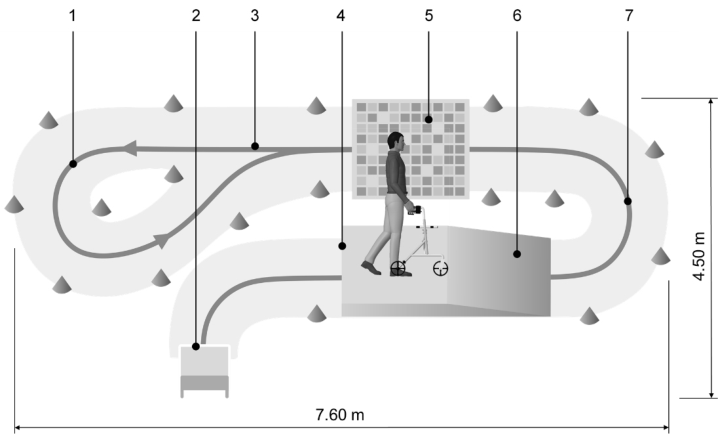
Figure 2 shows the parkour walked by the subjects – marked with small traffic cones – and the examined use cases. The rollator’s handle height is adapted to each subject individually to ensure comparable and comfortable hand-arm postures. The experiment is performed four times, first with the rollator’s standard handle and then with the adaptively morphing handle at the right hand side respectively. Latter is first adapted to the subject’s hand once at the start of the experiment. For the third and fourth walkthrough, a sleeve with a TekScan 9830 pressure mapping sensor is attached to the
Figure 2: User study parkour overview with path, use cases, and subject with rollator.
handle. In both walkthroughs, the pressure distribution in the hand-handle contact surface is measured. Analogous to the second walkthrough, the ada- ptive handle is morphed into a user-specific form once at the beginning of the third walkthrough. In the fourth walkthrough, the handle form is softened and re-adjusted to the subject’s hand at each of the indicated use cases.
The order of these use cases stays the same for each walkthrough: First, the subjects position the rollator while sitting on a chair and stands up with its support (2). After, they step over a 140.00 mm curb (4) and walk down the ramp (6). The parkour includes several curves (1, 7). A cobblestone patch (5) represents a rough and uneven underground. The subjects subsequently walk straight (3) and loop back (1) through the course in the opposite direction.
After sitting back down in the chair, the adaptively morphing handle form is scanned using an Artec Eva structured light 3D scanner and a fixture for positioning the adaptively morphed handle. Simultaneously, the subje- cts answer the survey by marking peak pressure areas on a hand map and rating how the handle fits their hand on a five-point Likert scale (0=“not at all” to 4=“very well”).
Sample The survey’s sample size is n = 34 subjects, plus 1 pre-test participant. The subjects can be grouped into younger adults (20-30 years), adults (40 years), and older adults (80+ years), with an overall mean age of 40.1 ± 20.9 years. Sixteen female, nineteen male subjects participated in the experiment. Three subjects are daily users of rollators and other walking aids. With hand wid- ths (including thumb) of 79–128 mm and hand lengths of 157–207 mm, the sample represents 5-percentile female to 95-percentile male hand sizes (see DIN 33402-2, 2020). Therefore, it represents the variation in hand sizes adequately. Two subjects are left-handed. Since left-handed users show no significant difference in using their right or left hand for load-intensive use cases (Schmauder and Solf, 1998), focusing on the right handle is sufficient.
SURVEY RESULTS AND DESIGN PARAMETERS In the following, subjective evaluations and pressure distribution hand maps are used to compare the standard rollator handle and the adaptively mor- phing handle. One-time individual form adaption and use case specific form adaption are briefly described. Both these results are analyzed descriptively. Finally, contact zone and distance variations are methodologically identified from the 3D scan data to describe form parameters for further adaptively morphing handle design iterations.
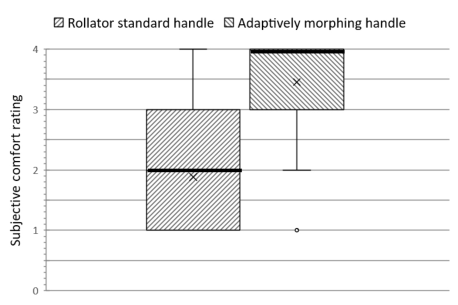
Subjective Evaluation The subjective rating of the standard rollator handle and the adaptively mor- phing handle (walkthrough 1 and 2) indicate a more positive evaluation of the individually adapted handle, as shown in figure 3.
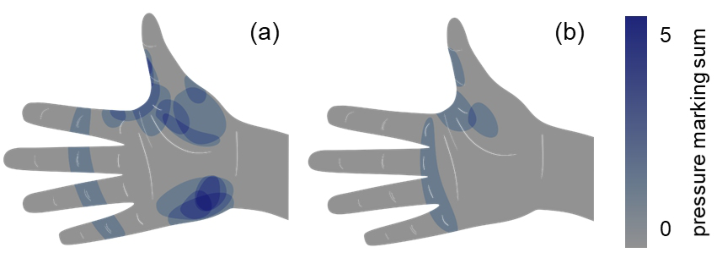
Figure 4 shows the subjective comfort rating of peak pressures on hand maps comparing the standard rollator handle (a) to the adaptively morphed
User-Centered Design of an Adaptively Morphing Human-Machine Interface 107
Figure 3: Subjective rating on the standard rollator and adaptively morphing handle’s fit to the subjects’ hands (0=“not at all” to 4=“very well”).
handle form (b). This visualizes lower pressure loads on the metacarpo- phalangeal finger joints, the radial palm edge, and the ball of the thumb. The adaptively morphing handle is therefore subjectively evaluated as more comfortable in the rollator use context.
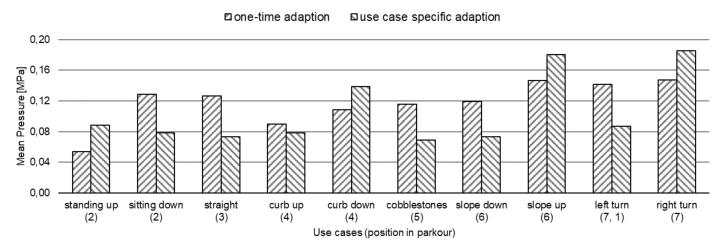
Individual and Use-Case Specific Adaption In walkthrough 3 and 4 individual adaption and use case specific adaption are considered by comparing their pressure distribution by use case, as seen in figure 5. The overall tendencies are similar, while the intra-measurement variance is higher for the use case specific adaption. The subjective ratings show no clear tendencies as well. The pressure indicate on the hand maps is similar to the one shown in figure 4. However, several subjects remarked the sensor sleeve as interfering with the form adaptive morphing functionality.
Figure 4: Subjective comfort rating with pressure marking heat maps on hand maps for the standard (a) and the adaptively morphing handle (b).Figure 5: Mean pressure on one-time and use-case specifically adapted handle in N/mm2.
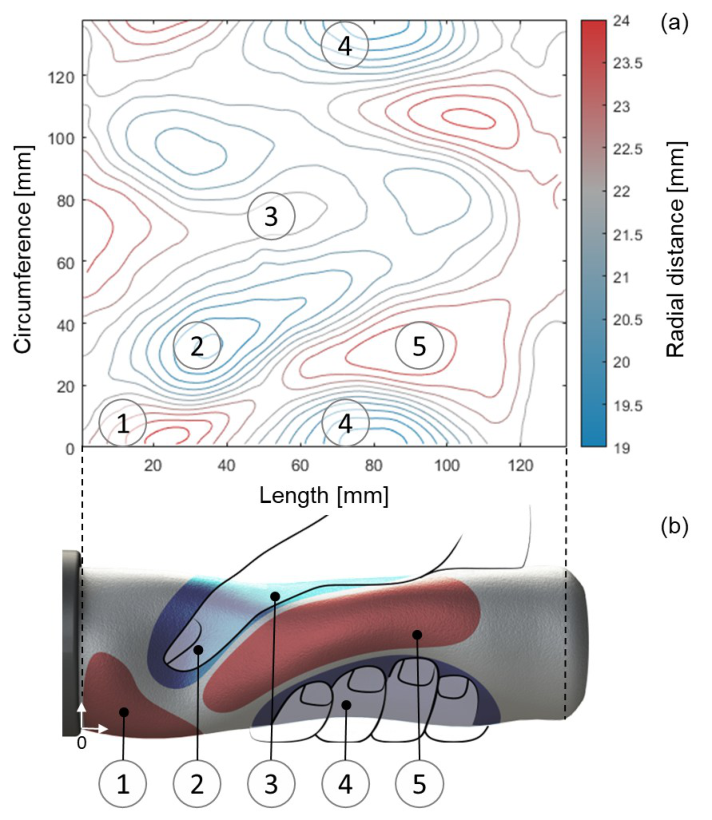
Topologies and Form Parameters To iterate and improve the adaptively morphing handle’s design, the scanned forms are analyzed using CloudCompare (Girardeau-Montaut, 2022) and MATLAB R2021B software. The scans are prepared via automated outlier removal and Laplacian smoothing (n = 20, a = 0.5). The smoothened scans are then overlaid using point-pair picking and trimmed to only the handle sur- faces. These are then finely registered automatically and the distance to the un-morphed handle is calculated. The handle surface is subsequently rasteri- zed into a 1.00x1.00 mm resolution grid with the size of 139 (approx. handle circumference from 44.00 mm diameter) by 133 (trimmed handle length) cells. For each individually adapted handle form, this grid contains the mean distance to the un-morphed handle form. The mean radial deformation for all 35 scans results in the topology shown in Figure 6 (a). Here, contours of the hand-handle contact and no-contact zones are identified and described quantitatively. A radius of 22.00 mm defines the approximate border betw- een compressed hand-handle contact zones and un-morphed or protruded zones. These zones are used as form parameters for further adaptively mor- phing interface design iterations. The distance variation within these zones defines form morphing requirements within these parameters.
Figure 6 (b) shows a CAD model of the mean topology with (non-) contact zones overlaid. Distinct contact zones for the thumb (distance variation: 10.1 mm), fingers (distance variation: 6.2 mm), and palm (distance variation: 3.00 mm) can be identified (blue). Red areas protrude from the mean topology as a result of deformed granulate. The mean topology shows similarity to typi- cal five-finger grips with a palm support wing, e.g. ergonomic bicycle grips, while the contact zones are more distinct. The identified zones and distance variation should – among other results – be discussed in the following.
DISCUSSION AND OUTLOOK Considering the initially defined research questions, this work proposes an adequate 3D scan based method for quantifying the adaptively morphed forms for individual users of a broad spectrum of hand sizes. The process is
User-Centered Design of an Adaptively Morphing Human-Machine Interface 109
Figure 6: Mean topology of radial form morphing (a) and deducted contact zones (b).
scalable and transferable to e.g. clay-formed interfaces or varying load tran- sfer directions. The identified zones and distance variations therein should be used to further iterate adaptively morphing interface designs. Simultaneously, the form topology should be used as a basis to creatively synthesize handle structures with a formal styling. The mentioned CAD model and subsequent prototype implementation can serve as a basis for expanding the functiona- lity to different (e.g. less load intensive) use contexts. Here, multi-component additive manufacturing (Watschke, 2019) com-bined with airtight silicone manufacturing could prove useful.
Use case specific forms should be further researched following the method proposed by Kiessling et al. (2022) to further analyze the form (variation)
parameters. To measure pressure distribution on the hand-handle contact sur- face a sensor glove, as used by Bonfim et al. (2005) and Kiessling et al. (2022) improves flexibility and comparability of different handle forms compared to the sensor sleeve utilized here. Considering Watschke et al. (2020), integra- tion of sensory layers into the flexible shell is a potential mean for functional integration through additive manufacturing.
The differences in pressure distribution from individual form adaption and use-case specific morphing should also be further examined and analyzed. Analogously, the subjective evaluation questionnaire applied here should be extended, considering e.g. specific design parameters of handles.
Finally, the parkour utilized in this work trumps static test stands with its realistic use context representation. However, this needs to be balanced with measurement infrastructure and the spatial requirements. While the parkour provides a good evaluation environment not only for rollators but potenti- ally other daily use walking aids and wheelchairs as well, the test context always needs to be chosen appropriately. The design of an adaptively mor- phing hand-product interface in this work shows great potential for further iterations and in the chosen use context of rollators and walking aids.
ACKNOWLEDGMENT
This research is funded by German Research Foundation (DFG, Deutsche Forschungsgemeinschaft): Universal Design for adaptive handles for adju- stment to specific operating scenarios - New effective principles enabled by additive manufacturing; project no.: 452009430.
REFERENCES
Askari, S., Kirby, R. L., Parker, K., Thompson, K., & O’Neill, J. (2013). Wheelchair propulsion test: development and measurement properties of a new test for manual wheelchair users. Archives of Physical Medicine and Rehabilitation, 94(9), 1690–1698. Bonfim, G., Silva, D., Neves, E., Plácido, J., Mantova, A., Medola, F., & Paschoa-
relli, L. (2017). Palmar pressure and perception of discomfort in the use of axillary crutches. In Proceedings of the AHFE 2016 International Conference on Ergono- mics Modeling, Usability & Special Populations, July 27-31, 2016, Walt Disney World®, Florida, USA (pp. 437-449). Springer International Publishing. Bullinger, H. J. (1994). Ergonomie: Produkt-und Arbeitsplatzgestaltung. Springer- Verlag. Chao, A., Kumar, A. J., Nagarajarao, K., & You, H. (2000). An ergonomic evaluation
of cleco pliers. In Proceedings of the Human Factors and Ergonomics Society... Annual Meeting (Vol. 4, p. 441). Sage Publications Ltd. Cheng, N. G., Lobovsky, M. B., Keating, S. J., Setapen, A. M., Gero, K. I., Hosoi, A.
E., & Iagnemma, K. D. (2012). Design and analysis of a robust, low-cost, highly articulated manipulator enabled by jamming of granular media. In 2012 IEEE international conference on robotics and automation (pp.4328–4333). IEEE. DIN 33402–2 (2020): Ergonomics – Human body dimensions – Part 2: Values, Deutsches Institut für Normung, December 2020.
User-Centered Design of an Adaptively Morphing Human-Machine Interface 111
FDA U. S. Department of Health and Human Services Food and Drug Administration (2016): Applying Human Factors and Usability Engineering to Medical Devices - Guidance for Industry and Food and Drug Administration Staff, February 2016. Fellows, G. L., & Freivalds, A. (1991). Ergonomics evaluation of a foam rubber grip
for tool handles. Applied Ergonomics, 22(4), 225–230. Fisk, A. D., Rogers, W. A., Charness, N. (2009): Designing for older adults. Principles and creative human factors approaches. 2. Aufl. Boca Raton, Fla: CRC Press/Taylor & Francis (Human factors & aging series). Follmer, S., Leithinger, D., Olwal, A., Cheng, N., & Ishii, H. (2012). Jamming user
interfaces: programmable particle stiffness and sensing for malleable and shape- changing devices. In Proceedings of the 25th annual ACM symposium on User interface software and technology (pp.519–528). Girardeau-Montaut, D. (2022): CloudCompare. https://www.danielgm.net/cc/~--~l astchecked:08.02.2023 ISO 9241–11 (2018): Ergonomics of human-system interaction - Part 11: Usability:
Definitions and concepts, November 2018. Janny, B. (2018). Entwicklung von gestaltvariablen Bedienelementen zur Überwindung von Nutzungsbarrieren am Beispiel alternsgerechter Drehstellteile. Stuttgart: Institute for Engineering Design and Industrial Design. Doctoral dissertation. Janny, B. & Morkoc, H. (2017): Device for adaptable manual operation of a device
and method for operating the device, University of Stuttgart, patent application E201610101121, publication number DE102016101121A1, disclosure 2017. Kadefors, R., Areskoug, A., Dahlman, S., Kilbom, Å., Sperling, L., Wikström, L., & Öster, J. (1993). An approach to ergonomics evaluation of hand tools. Applied ergonomics, 24(3), 203–211. Kiessling, J. M., Hilbig, K., Dinkel, J., Schmid, M., Maier, T., & Vietor, T. (2022).
Exploratory Analysis of Adaptively Morphing Handle Forms for Load Transfer Use Cases. Proceedings of the Design Society, 2, 2117-2126. Kirby, R. L., Dupuis, D. J., MacPhee, A. H., Coolen, A. L., Smith, C., Best, K. L.,...
& Bonaparte, J. P. (2004). The wheelchair skills test (version 2.4): measurement properties. Archives of physical medicine and rehabilitation, 85(5), 794–804. Kluth, K., Chung, H. C., & Strasser, H. (2007). Ergonomic quality and design criteria of professional-grade screwdrivers. Assessment of the Ergonomic Quality of Hand-Held Tools and Computer Input Devices, 10(1), 153-172. Kong, Y. K., & Lowe, B. D. (2005). Optimal cylindrical handle diameter for grip
force tasks. International Journal of Industrial Ergonomics, 35(6), 495–507. Kuijt-Evers, L. F. M. (2007). Comfort in using hand tools: theory, design and evaluation. Doctoral dissertation, proefschrift. La Delfa, N. J., Evans, Z. C., & Potvin, J. R. (2019). The influence of hand location
and handle orientation on female manual arm strength. Applied Ergonomics, 81, 102896. Lassmann, P., Kiessling, J., Mayer, S., Janny, B., & Maier, T. (2019). aHa–Der adaptive Handgriff der Zukunft. Lee, C., Kim, M., Kim, Y. J., Hong, N., Ryu, S., Kim, H. J., & Kim, S. (2017).
Soft robot review. International Journal of Control, Automation and Systems, 15, 3–15. Lin, J.-H.; McGorry, R. W. (2012): Effects of handle orientation and between-handle distance on bi-manual isometric push strength. In: Applied ergonomics 43, No. 4, S. 664–670.
MHRA Medicines and Healthcare products Regulatory Agency (2016): Human Factors and Usability Engineering – Guidance for Medical Devices Including Drug-device Combination Products, June 2016. Schmauder, M.; Solf, J. J. (1998): Händigkeitsgerechte Gestaltung von Arbeitsmit-
teln, S. 1–16. Sol, M. E., Verschuren, O., de Groot, L., & de Groot, J. F. (2017). Development of a wheelchair mobility skills test for children and adolescents: combining evidence with clinical expertise. BMC pediatrics, 17(1), 1–18. Watschke, H. (2019). Methodisches Konstruieren fur Multi-Material-Bauweisen
hergestellt mittels Materialextrusion (Doctoral dissertation, Dissertation, Braun- schweig, Technische Universität Braunschweig, 2019). Watschke, H., Goutier, M., Heubach, J., Vietor, T., Leichsenring, K., & Böl, M.
(2020). Novel resistive sensor design utilizing the geometric freedom of additive manufacturing. Applied Sciences, 11(1), 113. Weston, E. B., Khan, S. N., & Marras, W. S. (2017). Wheelchair pushing and turning: lumbar spine and shoulder loads and recommended limits. Ergonomics, 60(12), 1754–1765.
LISTED IN THE AHFE DIGITAL BOOKSTORE CATALOGUE
Explore the complete digital volume
Usability and User Experience
Read this individual research paper free through the original publisher, or explore the full digital proceedings book.
ISBN 978-1-958651-86-5
Explore this ISBN in the AHFE Bookstore ↗Listed in the July 2026 bookstore catalogue; search by ISBN to confirm current availability · Digital book purchase optional