Hannah Biermann, Sophia Otten, Martina Ziefle (2023). Understanding Trust in Automation: A Consideration of Human Factors Context. In: Usability and User Experience. AHFE Open Access, vol. 110, pp. 9–20. https://doi.org/10.54941/ahfe1003173
People interact with modern technology in various areas of life, both private and professional. One major advantage is the relief provided to users by technical devices that progressively take over tasks and perform them autonomously. Increasing system automation is often accompanied by uncertainties among users, expressed in concerns about paternalism through technology and loss of control. Trust can help to overcome perceived uncertainties and is thus a key driver for the acceptance and successful implementation of innovative technology. The study aim is to understand how trust formation “works”, what technology trust means in different contexts, which perceived uncertainties exist, and how individual usage decisions are made.We designed a two-step empirical research approach. Our aim was to explore what trust and distrust mean to different individuals and groups – in general (e.g., interpersonal trust) and in the context of technology (e.g., trust in automation) – and what influence different dimensions of trust and distrust may have on the acceptance of technology in different application fields. In a preliminary qualitative study, guided interviews (language: German) were conducted to identify conceptual facets of trust and distrust. In sum, 21 adults of different age groups (21 to 86 years) participated. The interviews were transcribed verbatim and analyzed using content analysis. Results were operationalized and measured in an online questionnaire survey (data collection is ongoing). To investigate influences of human factors on perceptions of trust and distrust, demographic data, personality traits, and attitudes were measured (e.g., risk perception, trust disposition, openness to innovation). To evaluate how differences in context might influence trust perceptions, the fields of autonomous driving and ambient assisted living were considered.Interviews: Trust was described as a positive gut feeling, difficult to put into words, and associated with affection, love, and friendship. Distrust was described as a negative, acrid feeling and associated with doubt, uncertainty, and deception. Experience (good/bad) and knowledge were identified as key factors that influence (dis)trust in general. Regarding technology, technical reliability and functionality as well as the perception of service operators influence the perceived trustworthiness. Trust and distrust seem to influence behavior in terms of reliability and control and depend on general risk perception and attitude (open/skeptical) toward others and things, respectively.Questionnaire: Factor and regression analyses will be conducted to form distinct dimensions for trust and distrust and to model their influence on technology acceptance in different contexts (mobility vs. health care). Cluster analysis will be conducted to examine the extent to which trust and distrust are perceived the same or differently among diverse study participants. Our results contribute to a deeper understanding of trust in automation across contexts and help scientific research measure (dis)trust constructs more precisely, taking into account individual associations and context-specific predictors. This also strengthens the knowledge of trust as a prerequisite for technology acceptance. The practical relevance of our study lies in the possibility to derive design and action recommendations for the user-centred development of technology innovations considering different target groups and application fields.
People are increasingly interacting with modern technology in different areas of their lives, both personally and professionally. A great advantage can be the relief of the user through technical devices that gradually take over tasks and perform them independently. However, increasing system automation is often accompanied by uncertainty among users, expressed for example in concerns about loss of control (Jaschinski and Allouch 2015, Schmidt et al. 2015). Trust can help overcome perceived uncertainties and is seen as a key driver for the acceptance and successful implementation of novel technologies (Ghazizadeh and Lee 2012).
In the research literature, there are numerous descriptions and classificati- ons of trust that vary depending on the setting (organisational, interpersonal, etc.) in which trust decisions are made (Söderström 2009). With regard to human-automation interaction, trust is defined as “the attitude that an agent
will help achieve an individual’s goals in a situation characterized by uncer- tainty and vulnerability” (Lee and See 2004). It is assumed that trust as an attitude is related to reliance on someone or something and thus has beha- vioral implications (Lee and See 2004). In real life, misconceptions, such as trusting a technical system that acts faulty or unforeseen (i.e., overreliance), or distrusting a technical system that functions flawlessly (i.e., underre- liance), can have dramatic consequences, as past aviation and maritime accidents have shown (Parasuraman and Riley 1997). By understanding how trust and distrust are formed, strategies can be derived for managing tech- nology innovation and developing trustworthy applications for successful human-automation interaction.
Characteristics of the trust giver, such as disposition and knowledge, and characteristics of the trust receiver, such as performance, are important for the evaluation of trust and for trust decisions; a detailed description and classifi- cation of influencing factors for trust in automation can be found in Hoff and Bashir (2015). The perception of trust also seems to be influenced by the type of trust receiver (human or machine), which is reflected in the scientific tools used to measure trust. A recent textual analysis of trust measures showed that in the context of automation technology, system- and task-related attri- butes are often used (e.g., “reliable”, “function”), whereas in the context of interpersonal trust (i.e., person-to-person), emotional aspects are more often asked about (e.g., “feeling”, “honesty”) (Alsaid et al. 2022). We would like to follow this up with an empirical study to better understand what trust and distrust actually mean to different people, and how these fundamental ideas and understandings are related to trust in automation. We distinguish conceptually between trust and distrust, assuming that they are related but individual attitudes. This assumption is supported by theoretical considerati- ons (Muir 1994; Lewicki et al. 1998) and empirical research (Biermann et al. 2022). We designed a two-step empirical, exploratory research approach using qualitative and quantitative methods. First, we explored the narratives underlying trust and distrust, i.e., how they are perceived and described, what associations and attributions exist, etc. (method: interview). In a second step, the obtained facets of trust and distrust were operationalised and measured in an online questionnaire survey to identify distinct dimensions and to assess relationships with human factors and trust in automation. As trust varies depending on the technical system and application field (Brell et al. 2019), we considered two different scenarios to identify context-independent and specific evaluation patterns. The areas chosen were mobility (autonomous driving) and medicine (ambient assisted living, short AAL), as in both cases risk perception, trust in technology, and the perceived value of an innovation play an important role in the willingness to use it.
METHOD
The procedure and methods used, as well as the samples of the two studies are described below.
Understanding Trust in Automation: A Consideration of Human Factors and Context 11
Interview study: In a preliminary qualitative study, guided interviews (language: German) were conducted to identify conceptual facets of trust and distrust. Participants were asked what trust and distrust mean to them, what they associate with these terms, and to what extent their conception of trust and distrust changes when they think specifically about the use of techno- logy. In sum, 21 adults of different age groups (21 to 86 years) participated, thereof 12 women and 9 men. The average age of the participants was 49.9 years (SD = 20.1). The interviews were transcribed verbatim and analyzed using content analysis.
Questionnaire survey: Interview results were operationalized and mea- sured in an online questionnaire survey. Initially, participants were asked about demographic information (age, gender, education), their trust dispo- sition (Beierlein et al. 2014, Otten and Ziefle 2022), innovativeness, and risk perception (Beierlein et al. 2015). Subsequently, participants evaluated items describing trust (e.g., “Trust is a gut feeling or instinct”) and distrust (e.g., “Distrust is something negative”). A semantic differential was used to assess associations with trust and distrust in the form of counterword pairs (e.g., “affection” vs. “aversion”). All itmes used for the evaluation of general trust and distrust perceptions were self-developed based on the interview findings. Then, two scenario descriptions were presented to the participants in ran- domized order. One scenario pertained to medical video-based AAL (VAAL) technology, focusing on movement recognition and fall detection. The other scenario pertained to autonomous driving, focusing on a self-driving shuttle service. Following the scenarios, participants were asked to rate the extent to which they would trust and intend to use the technologies described (e.g., “I would only use this technology if I felt I could trust it”). The items were developed on the basis of the results of preliminary qualitative studies.
We used 6-point Likert scales ranging from “totally disagree” to “totally agree”. Cronbach’s alpha (α) was checked for scale reliability which was good (>.7), except for the self-developed scale measuring distrust perception (.660) which was included for analysis, though, due to the exploratory nature of the overall research design. Descriptive and inferential statistical methods were used for data analysis. A significance level of.05 was used.
In total, N = 90 data sets were included in the analysis. There were sli- ghtly more male (55.6%) than female participants (44.4%). The sample was highly educated with 61.2% university graduates. The mean age was 36.37 (SD= 11.25) with an age range from 20 to 73 years. The mean score on risk perception was M = 3.99 (SD = 1.24) and the mean score on dispositional trust was M = 4.04 (SD =.31). The mean score on innovation readiness was 3.89 (SD = .44). The mean score for trust in autonomous mobility was 4.81 (SD = .81), while the mean score for trust in VAAL technology was 4.66 (SD = .73).
RESULTS
First, interview results are presented. Second, results of the questionnaire survey are outlined.
Interview Study: Understanding the Narratives of Trust and Distrust The aim of the interview study was to understand individual perceptions of trust and distrust in general and with regard to technology use. The obtained results are presented below regarding descriptions of and associations with trust and distrust, as well as contextual differences. Verbatim quotes from the interview transcripts are in quotation marks and marked in italics.
(Dis)trust descriptions: Trust and distrust were described as a personality trait, as an instinct, and a gut feeling that participants said was difficult to put into words. Trust was paraphrased with positive and distrust with nega- tive attributions, such as “warm” and “vital” versus “discomfortable” and “corrosive”. Descriptions of trust and distrust related to aspects of control, reliability, and safety. The participants stated that trust for them meant being able to give up control and rely on something or someone, keeping one’s word, and not being hurt. In contrast, distrust was interpreted as the oppo- site of trust, expressed as having no control, not being able to rely on others, and being hurt.
(Dis)trust associations: Trust and distrust were generally associated with other people and social interaction. Table 1 shows an overview of all asso- ciations with the two terms mentioned by the participants and assigned categories. Associations with trust were predominantly positive and asso- ciations with distrust were negative. Besides, associations with trust and distrust often formed pairs of opposites. Values were associated only with trust, whereas distrust aroused attitude-related associations.
Interpersonal vs. technology trust: Asked to what extent their perception of trust and distrust changes when they think about technology, some of the
Table 1. Mentioned associations with trust and distrust and assigned categories (N = 21).
Table available in the original PDF paper.
Category Trust associations Distrust associations Disappointment Fear Discomfort Feeling Affection Wellbeing Love Comfort
State and condition Safety Reliability Intimacy Familiarity Breach of trust
Uncertainty Doubt Panic Danger Fraud Dispute War Relationship Family Friendship
Enmity Job / Business Value Fidelity Loyalty Honesty Attitude Prejudice Pessimism
Understanding Trust in Automation: A Consideration of Human Factors and Context 13
participants stated no considerable differences and indicated that trustwor- thiness was determined by similar factors, such as experience and reliability. Not everyone saw it the same way. For others, trust generally involved emo- tional aspects, while trust in technology was related to functional aspects. One participant (female, age 54) stated: “I mentioned the word love ear- lier, I don’t love technology. There’s a big difference. Technology has to work reliably for me.” Also, technology-related trust was described less as a gut fee- ling and more a predictable risk. Another participant (male, age 73) stated: “Well, you can be more objective about whether technology is really trustw- orthy. Whether a person is trustworthy cannot be determined objectively. [...] I rather know that I cannot believe a technology. So it’s not about distrust, it’s about having knowledge about a technology.”
Questionnaire Survey: Quantifying Trust and Distrust Perceptions The aim of the questionnaire survey was to measure the obtained narratives of trust and distrust to identify dimensions that can be used to describe them and to evaluate to what extent these are related to human factors and trust in automation.
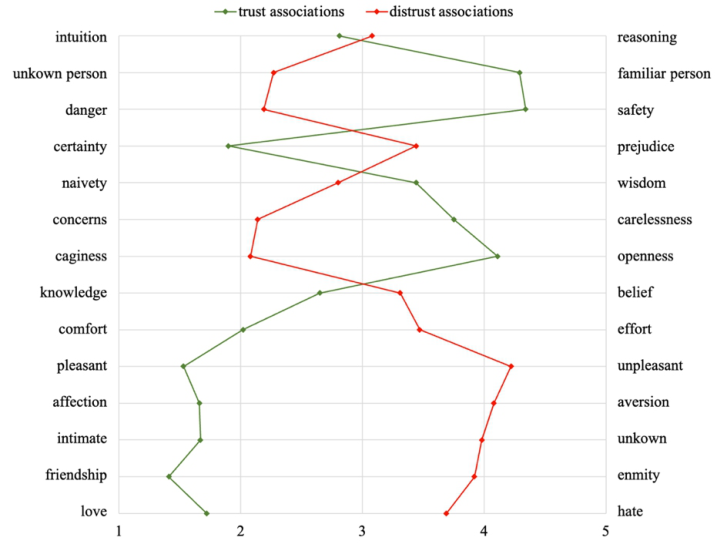
Figure 1 shows associations with trust and distrust measured on a seman- tic differential. Associations with trust were positive, while associations with distrust tended to be negative. There were major differences in the evaluation of associated feelings. Distrust was also more strongly associated with percei- ved risk and the unknown, whereas trust was more strongly associated with familiarity and security. Social relationships also seem to influence percepti- ons, e.g., with trust being more associated with friendship and distrust with enmity. Smaller evaluation differences occurred in the association of trust and distrust with intuition and reasoning, knowledge and belief, and naivety and wisdom, which were near the middle of the scale (i.e., half/half).
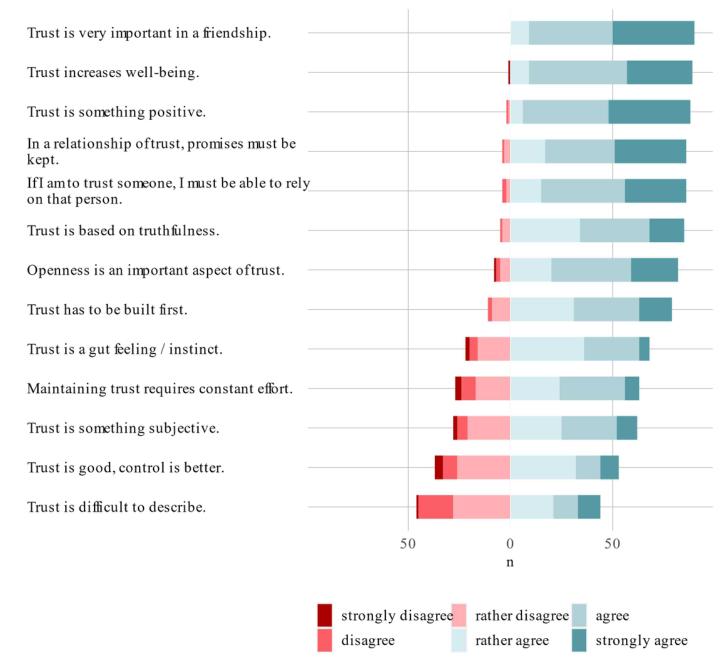
Figure 2 visualizes response behaviors for items describing trust. There was unanimous agreement that trust is important for friendship. There was also a relatively high level of agreement with the idea of trust being associated with wellbeing, something positive, and reliability. There was a striking diversity of responses to the claim that trust is difficult to describe, suggesting the existence of individual perspectives on the issue of trust.
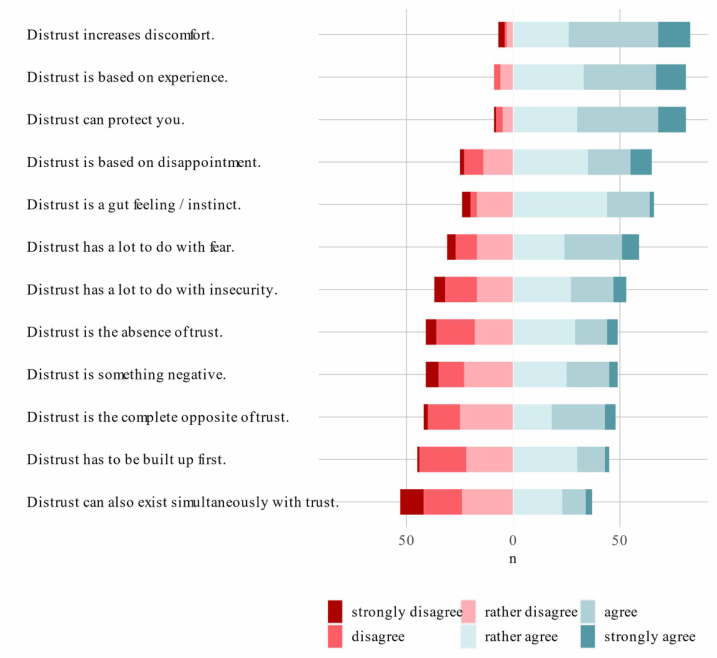
Figure 3 illustrates the response behaviour for items describing distrust, which was more diverse overall. While there was still a comparatively high level of agreement on the association of distrust with an uncomfortable fee- ling and a (bad) experience, participants were divided on the assumption that distrust is related to fear or insecurity or is something negative. There was also disagreement about whether distrust is the opposite of trust, and disagreement about the possibility that feelings of distrust and trust can exist in the same thing at the same time.
(Dis)trust dimensions: To further investigate dimensions of trust and distrust, exploratory factor analyses (EFA) using principal axis factoring and oblique rotation (direct oblimin) were conducted. Due to the sample size, only factor loadings above. 4 were considered.
Figure 1: Associations with trust and distrust measured on a semantic differential (N = 90).
The EFA on the trust instrument revealed two distinct dimensions based on the factor loadings and examination of the scree plot. The Kaiser- Mayer Olkin score was.767 and Barthlett’s test of sphericity was significant (p<.001). Factor one consisted of 8 items (α = .794) and factor two of 3 items (α = .556), see Table 2.1 The two identified trust factors explained 44.05% of the variance (extraction sum of squared loadings). After careful examination, the first factor was named conditional trust and the second factor was called affective trust.
The EFA on the distrust instrument revealed three distinct dimensions based on the factor loadings and examination of the scree plot. The Kaiser- Mayer Olkin score was.635 and Barthlett’s test of sphericity was significant (p < .001). The first factor consisted of 4 items (α = .649), while factor two (α = .547) and factor three (α = .652) consisted of 3 items.2 The three iden- tified distrust factors explained 39.83% of the variance (extraction sum of squared loadings). After careful examination, the first factor was named affe- ctive distrust, the second factor was named cognitive distrust, and the third factor was named semantic distrust.
1A third proposed factor consisted of only one item and was discarded whereas another item did not load on any of the factors and was discarded, too. 2Two items were excluded from the analysis due to insufficient factor loading.
Understanding Trust in Automation: A Consideration of Human Factors and Context 15
Figure 2: Trust perceptions (N = 90).
Relations between (dis)trust, human factors, and context: Correlation analyses were carried out to evaluate relations between the identified trust and distrust dimensions, human factors, and trust in automation (mobility vs. medicine). We found a moderate correlation between conditional trust and trust in autonomous mobility (ρ = .331, p = .001). Also, cognitive distrust and semantic distrust showed significant correlations with trust in autonomous mobility (ρ = .474, p<.001; ρ = .254, p = .016). The more likely respondents were to say that trust (in general) is something positive and important, conditioned by reliability, the greater their reported trust in autonomous mobility. Also, the more they were to say, for example, that distrust is based on disappointment and experience and needs to be built up, the greater their reported trust in autonomous mobility. No significant cor- relations were found between (dis)trust factors and medical trust in VAAL technology.
All identified (dis)trust factors were related to human factors: Condi- tional trust correlated with risk perception (ρ = -.227, p = .031), trust disposition (ρ = .265, p = .012), innovativeness (ρ = .346, p<.001), and gender (r = −.265, p = .011). Affective trust correlated with risk perception
Figure 3: Distrust perceptions (N = 90).Table 2. Pattern matrix for the trust instrument.
Table available in the original PDF paper.
Factor 2 “affective trust”
Items Factor 1 “conditional trust”
.786
If I am to trust someone, I must be able to rely on that person.
.61
Trust increases well-being. .731 Trust is something positive. .684 Trust is very important in a friendship. .625 In a relationship of trust, promises must be kept.
.427
Trust is based on truthfulness. .501 Trust has to be built up first. .466 Maintaining trust requires constant commitment.
Trust is a gut feeling/instinct. .574 Trust is difficult to describe. .52 Trust is something subjective. .438
Understanding Trust in Automation: A Consideration of Human Factors and Context 17
Table 3. Pattern matrix for the distrust instrument.
Table available in the original PDF paper.
Items Factor 1 “affective distrust”
Factor 2 “cognitive distrust”
Factor 3 “semantic distrust”
.437
Distrust has a lot to do with fear. .917 Distrust has a lot to do with insecurity. .568 Distrust is something negative. .432 Distrust is a gut feeling/instinct. .404 Distrust increases discomfort. .771 Distrust is based on experience. .553 Distrust is based on disappointment. .448 Distrust has to be built up first. .813 Distrust is the complete opposite of trust. .647 Distrust can exist simultaneously with trust.
(ρ = −.254, p = .016) and gender (r = −.248, p=.018). Affective distrust correlated with gender (r = −.208, p = .049), cognitive distrust correlated with innovativeness (ρ = .336, p = .001), and semantic distrust correlated with age (r = .242, p = .021).
DISCUSSION
The aim of our research was threefold: First, we identified narratives underl- ying trust and distrust. Second, we quantified different dimensions (i.e., trust and distrust factors). Third, we assessed relationships with human and con- textual factors. The obtained results contribute to a more detailed description and explanation of trust and distrust in general and in automation, and help scientific research to measure corresponding constructs more precisely.
With regard to the obtained qualitative data, the basic descriptions of trust and distrust were similar, e.g., both were seen as personality traits and rela- ted to aspects of control, reliability, and safety. Semantic differences were found: trust had a positive connotation and distrust a negative connotation, expressed for example in opposite attributions. There were further differe- nces in individual associations; values were exclusively associated with trust, whereas distrust implied attitudinal associations. Contextual differences were found: Technology trust was more associated with functional aspects, whe- reas interpersonal trust was more emotional. This is in line with the findings of Alsaid et al. (2022). The descriptive evaluation of trust and distrust showed different response behaviour: There was a high level of agreement, i.e., broad consensus, regarding the description of trust, whereas responses regarding the description of distrust were more diverse, indicating different opinions. The following conclusions can be drawn: First, trust and distrust are partly opposing concepts, but they also have conceptual similarities and overlaps, as well as unique features in terms of concrete associations and attributions. In other words, we can confirm the assumption that they are distinct but clo- sely related concepts. Second, there seems to be a greater consensus on what
constitutes trust, while narratives of distrust are more divergent. This con- firms previous studies (Biermann et al. 2022) and calls for follow-up studies to better understand, in particular, the formation of distrust.
The difficulty of finding a specific definition of what distrust actually means is illustrated by the allusion to the underlying semantics. Overall, five different dimensions of trust and distrust were found. The different facets reflected in them illustrate the complexity of how trust and distrust are perceived and how they arise. Correlation analyses revealed intriguing results. While there were significant correlations between (dis)trust factors and trust in autonomous mobility, there were no significant relations in the medical context. This is interesting since there are several studies showing that trust is an important predictor for perceptions of medical technology (e.g., Otten and Ziefle 2022; Wilkowska and Ziefle 2018). This, however, is often speci- fied to conditional trust of specific technologies and less often about general trust perceptions and how these are related to the overall evaluation of medi- cal technology. Thus, it is important to further investigate whether general (dis)trust perceptions influence trust in medical technology, like it influe- nces trust in autonomous mobility, or whether the medical context is more context-dependent than initially thought.
Correlations between (dis)trust factors and trust in autonomous mobility showed that the conditional, cognitive, and semantic domains of (dis)trust are relevant whereas the affective domain shows no relationship. Thus, rational considerations and situational conditions seem to be more strongly related to trust in autonomous mobility than affective evaluations, which is in line with our pre-study findings, suggesting that trust in technology is driven by cognition rather than emotion, and reinforcing the two-stage research process of this study.
(Dis)trust factors were related to human factors. This confirms previous studies (e.g., Biermann et al. 2022) and adds to the literature. However, as not all dimensions of (dis)trust correlated with all human factors, it is crucial to deepen the understanding of these correlations. This would also clarify which dimensions of (dis)trust are more or less relevant for the relationships between trust and human factors. Future studies should extend and further validate these initial findings.
We continue to draw the following conclusions: Trust and distrust are based on different facets, which in this study could be mapped into five dimensions in affection, cognition, condition, and semantics. These distinct dimensions correlate with human factors, suggesting that perceptions and evaluations of trust and distrust are individual and may be determined by people’s general attitude of trust (or scepticism) towards others, how risk- averse or risk-seeking they are, how willing they are to embrace innovation, and also their socio-demographic background. Secondly, there is a correlation between the identified (dis)trust dimensions with trust regarding autonomous mobility, but not with trust regarding VAAL technology. Therefore, a further conclusion is that the evaluation of trust or distrust in the case of technology use is context-dependent, which is also supported by the observation that trust in autonomous mobility is generally higher than trust in VAAL techno- logy. It is assumed that trust does not always follow the same pattern, but
Understanding Trust in Automation: A Consideration of Human Factors and Context 19
is determined by personal and situation-specific characteristics. This makes it necessary to carefully investigate trust in automation, taking into account user diversity and different application contexts. Our findings provide an empirical basis for future research projects.
The critical reflection of the study addresses both methodological and con- tent issues. Firstly, the sample of our quantitative study (questionnaire) was rather small. Besides, the participants were relatively young and well educa- ted. Follow-up studies should validate the results obtained in a larger and broader (i.e., more diverse) sample. Another point relates to the data col- lection, which took place in Germany or in German-speaking countries. As perceptions and attitudes may be conditioned by cultural influences, it would be both exciting and indispensable to mirror our results in a cross-national study in order to identify any cultural differences in the perception and eva- luation of trust and distrust, which would then have to be incorporated into the management and design of technical innovation. A third point relates to the automation contexts considered in our study. With the knowledge gained in this study that there are context-specific evaluation patterns with regard to trust and distrust, it remains essential to consider further applica- tion scenarios (e.g., home automation, production contexts) and to describe the formation of trust and distrust regarding the scenarios considered here in more detail in follow-up studies, for example in a comparative study of factors influencing trust and distrust. Besides, the reliability of some of the identified (dis)trust factors was only sufficient, not adequate, which may be due to the comparatively small number of items per factor. Due to the explo- ratory research approach of this study, they were nevertheless included in the analyses. Nevertheless, further narratives of trust and distrust should be identified and measured in follow-up studies to complement and sharpen the identified factors.
ACKNOWLEDGMENT
The authors thank all participants for their openness to share opinions on trust in automation. Special thanks to Constantin Zeller for research assista- nce. This project has received funding from the European Union’s Horizon 2020 research and innovation programme under the Marie Skłodowska- Curie grant agreement No. 861091.
REFERENCES
Alsaid, A., Li, M., Chiou, E. K., & Lee, J. (2022). Measuring trust: A text analysis approach to compare, contrast, and select trust questionnaires. Beierlein, C., Kemper, C., Kovaleva, A. J. & Rammstedt, B. ‘Interpersonales Ver-
trauen (KUSIV3). Zusammenstellung sozialwissenschaftlicher Items und Skalen (ZIS). ZIS - GESIS Leibniz Institute for the Social Sciences, 2014. Beierlein, C., Kovaleva, A., Kemper, C. J., & Rammstedt, B. (2015). Kurzskala zur Erfassung der Risikobereitschaft (R-1). Zusammenstellung sozialwissenschaftli- cher Items und Skalen (ZIS).
Biermann, H., Philipsen, R., & Ziefle, M. (2022). Crazy Little Thing Called Trust–User-Specific Attitudes and Conditions to Trust an On-Demand Autono- mous Shuttle Service. In Human-Automation Interaction (pp. 235–252). Springer, Cham. Brell, T., Biermann, H., Philipsen, R., & Ziefle, M. (2019, July). Trust in autono-
mous technologies. In International Conference on Human-Computer Interaction (pp. 371–384). Springer, Cham. Choi, J. K., & Ji, Y. G. (2015). Investigating the importance of trust on adopting an autonomous vehicle. International Journal of Human-Computer Inte- raction, 31(10), 692–702. Ghazizadeh, M., Lee, J. D., & Boyle, L. N. (2012). Extending the Technology
Acceptance Model to assess automation. Cognition, Technology & Work, 14(1), 39–49. Hoff, K. A., & Bashir, M. (2015). Trust in automation: Integrating empirical evidence on factors that influence trust. Human factors, 57(3), 407–434. Jaschinski, C., & Allouch, S. B. (2015). An extended view on benefits and barriers
of ambient assisted living solutions. Int. J. Adv. Life Sci, 7(2). Lee, J. D., & See, K. A. (2004). Trust in automation: Designing for appropriate reliance. Human factors, 46(1), 50–80. Lewicki R, McAllister D, Bies R (1998) Trust and distrust: new relationships and
realities. Acad Manage Rev 23(3):438–458. Muir, BM (1994). Trust in automation: Part I. Theoretical issues in the study of trust and human intervention in automated systems. Ergonomics 37(11):1905–1922. Otten, S. and Ziefle, M. (2022). Exploring Trust Perceptions in the Medical
Context: A Qualitative Approach to Outlining Determinants of Trust in AAL Technology. In Proceedings of the 8th International Conference on Infor- mation and Communication Technologies for Ageing Well and e-Health - ICT4AWE,ISBN 978-989-758-566-1; ISSN 2184-4984, pages 244–253. DOI: 10.5220/0011058300003188. Parasuraman, R., & Riley, V. (1997). Humans and automation: Use, misuse, disuse, abuse. Human factors, 39(2), 230–253. Schmidt, T., Philipsen, R., & Ziefle, M. (2015). Safety First?-V2X–Perceived Bene-
fits, Barriers and Trade-offs of Automated Driving. In International Conference on Vehicle Technology and Intelligent Transport Systems (Vol. 2, pp. 39–46). SCITEPRESS. Söderström, E. (2009). Trust types: an overview. Discourses in Security Assurance & Privacy, 15, 16, 1–12. Wilkowska, W. & Ziefle, M. (2018). Understanding Trust in Medical Technologies.
In Proceedings of the 4th International Conference on Information and Commu- nication Technologies for Ageing Well and e-Health - ICT4AWE, ISBN 978-989- 758-299-8; ISSN 2184-4984, pages 62–73. DOI: 10.5220/0006734500620073.
LISTED IN THE AHFE DIGITAL BOOKSTORE CATALOGUE
Explore the complete digital volume
Usability and User Experience
Read this individual research paper free through the original publisher, or explore the full digital proceedings book.
ISBN 978-1-958651-86-5
Explore this ISBN in the AHFE Bookstore ↗Listed in the July 2026 bookstore catalogue; search by ISBN to confirm current availability · Digital book purchase optional