Ralf Philipsen, Hannah Biermann, Martina Ziefle (2022). New Cars on the Block - The Impact of Public Charging Infrastructure on BEV Ownership. In: Human Factors in Transportation. AHFE Open Access, vol. 60, pp. 208–218. https://doi.org/10.54941/ahfe1002451
To slow climate change down, a reduction in greenhouse gas emissions is crucial. Part of the solution could be the electrification of cars, but market penetration is progressing slowly so far. It is still unclear to what extent specific user groups, e.g., without private parking/charging space, are willing to buy BEV in the long term. The present study is a first step to holistically measure the existing findings on perceived barriers in terms of their importance and to transfer them into a vehicle ownership model. In a two-stage approach, potential factors influencing the purchase decision were first ranked (MaxDiff), followed by a focus on some of the most relevant factors and a more precise measurement in decision simulations (ACBC). Even though this study is only an intermediate step towards a holistic model, the results show that building charging infrastructure is important for the purchase decision but not a panacea, as vehicle parameters such as range or acquisition costs are equally or more important. Furthermore, it becomes evident that a dependence on public charging infrastructure alone is seen more negatively for the purchase of an e-vehicle than the use of gas stations for vehicles with combustion engines, which leads to the conclusion that market penetration among users without the possibility of charging at home or at work will be slow or even non-existent given the current state of technology.
The decarbonization of private transport for climate protection reasons is an ongoing challenge for states and municipalities. Battery-electric cars could be part of the solution, as they can be operated in a CO2-neutral manner if rene- wable energy sources are used (Europäische Kommission, 2011). Registration figures for such electric vehicles are on the rise, but there is still no real market penetration yet. In Germany, for example, registered conventional passenger cars with internal combustion engines (ICEV) still outnumber battery-electric vehicles (BEV) by a factor greater than 100 (Kraftfahrt-Bundesamt, 2021).
The reasons for this are many, varied, and can be found in the barri- ers perceived by users (Biresselioglu, Demirbag Kaplan and Yilmaz, 2018; Kumar and Alok, 2020). First, these include vehicle-related factors, such as
New Cars on the Block - The Impact of Public Charging Infrastructure on BEV Ownership 209
higher acquisition costs (Abotalebi, Scott and Ferguson, 2019), lower ran- ges (Degirmenci and Breitner, 2017), or lower model diversity (Gómez et al., 2017) compared to conventional vehicles. In addition to the vehicle factors, the expansion state of the charging infrastructure is seen as a barrier by poten- tial users or buyers (Gómez et al., 2017). The perception of the availability of public charging infrastructure is positively related to the willingness to buy (Giansoldati, Danielis, Rotaris and Scorrano, 2018; Schulz and Rode, 2022). The expansion of the charging infrastructure can therefore potentially open up further user groups (Globisch, Plötz, Dütschke, and Wietschel, 2018), as it reduces purchasing barriers and enables further market penetration.
Addressing additional user groups is necessary for the further spread of electromobility, as current BEV users have very homogeneous characteristics (Simsekoglu and Nayum, 2019), while other groups only rarely appear in the registration figures. In particular, users without private parking space, often living in rental properties in apartment blocks, have so far been hesi- tant to buy. Regarding this user group, it is currently still completely unclear to what extent, for example, an availability of public charging options is suf- ficient to reduce the purchase barrier or whether a private charging option, e.g., in a shared parking garage, is mandatory to achieve an effect on market penetration.
To better assess and predict the adoption potential of different prospective user groups, a comprehensive and explanatory model of e-vehicle owner- ship would be needed that considers vehicle and infrastructure parameters as well as user factors in proportion to their respective influence. The challenge here is that while there exists currently a large corpus of literature on purch- ase barriers and drivers in the context of electromobility, the sources usually only consider a few of these in relation to each other (cf. Kumar and Alok, 2020). For example, it was shown that the environmental friendliness of the means of transport is more important for the purchase decision than range or acquisition costs (Degirmenci and Breitner, 2017). Range, in turn, is more important than acquisition costs, which in turn are more important than the expansion of the charging infrastructure (Egbue and Long, 2012). Other sou- rces cannot confirm the latter significant difference (Philipsen et al., 2018). The heterogeneous, patchwork data situation results, among other things, from different survey periods and method use and underlines the fact that a holistic model of e-vehicle purchasing is still lacking, which is the motivation for the present paper.
ARISING QUESTIONS In the long term, this study aims to develop a vehicle ownership model, which depicts the decision to buy and own e-vehicles as realistically as possible and allows statements to be made about future developments. This should help to map the purchase decision of specific user groups, e.g., people who do not have a private parking space for their car and thus do not have the possibility to charge at home, in infrastructure planning and market simulations. Based on the current state of research and existing knowledge gaps, the following challenges arise for the development of a model of this kind.
How do the many known perceived barriers and perceived benefits affect the purchase decision? - Many of the studies presented analyzed only a small number of influencing factors regarding willingness to buy, which means that no complete measurement of the relative importance of as many relevant factors as possible exists to date; instead, it is often only possible to make statements on rankings of importance without numerical quantification. Here, an attempt must first be made to holistically measure the numerous influencing factors - both with respect to the vehicle and the infrastructure - identified so far.
What role do user factors play in the purchase decision? - In addition to vehicle technology and charging infrastructure parameters, a better under- standing of how user factors work in the purchase of e-vehicles is par- ticularly important. Currently, present e-vehicle users are well known in terms of their socio-demographic characteristics (Simsekoglu and Nayum, 2019), but it is unclear to what extent future user groups can be distin- guished and possibly predicted. Therefore, user profiling beyond existing findings on influencing user factors (cf. Ziefle, Beul-Leusmann, Kasugai and Schwalm, 2014) is another essential part of the vehicle ownership model to be developed.
What are the tipping points for purchase intention? - It would be impor- tant to know under which conditions which specific user group would be willing to purchase e-vehicles, e.g., at which point in the development of technology, price, and infrastructure there is a willingness to buy, to fore- cast market penetration and to plan and promote charging infrastructure in a way that is appropriate for the user. Ideally, these tipping points should be identifiable out of the vehicle ownership model. The question of whe- ther such a tipping point exists for every potential user group, including, for example, people without private charging facilities, is of particular importance.
The present paper cannot yet fully address these questions but is intended to be the first step in a model development. The aim was therefore first to bring together the existing knowledge on factors influencing vehicle purch- ase, to measure them in terms of importance, and then to decide in advance which factors should be integrated into the vehicle ownership model and which can be neglected due to their low importance to reduce complexity in the model. At the same time, however, an initial focus should already be on the importance of refilling options for vehicle ownership. Since a bet- ter understanding of BEV purchase intentions also requires considering the distinction from the purchase of conventional cars with internal combustion engines, especially to understand when one type of motorization is preferred and when the other, all studies must address both vehicle technologies and therefore include not only charging processes and infrastructure, but also refueling in terms of general refilling and corresponding infrastructure.
METHODOLOGY
Due to the complexity of the methods used and the amount of response time required in each case, two smaller quantitative surveys with different
New Cars on the Block - The Impact of Public Charging Infrastructure on BEV Ownership 211
measurement instruments were conducted instead of one large study. On the one hand, this had the advantage that the processing time could be kept short in each case and thus the acquisition of test subjects was more practicable. On the other hand, findings from the first study could be incorporated into the design of the second study. In the following, the two studies are described in conjunction, with differentiation only where necessary.
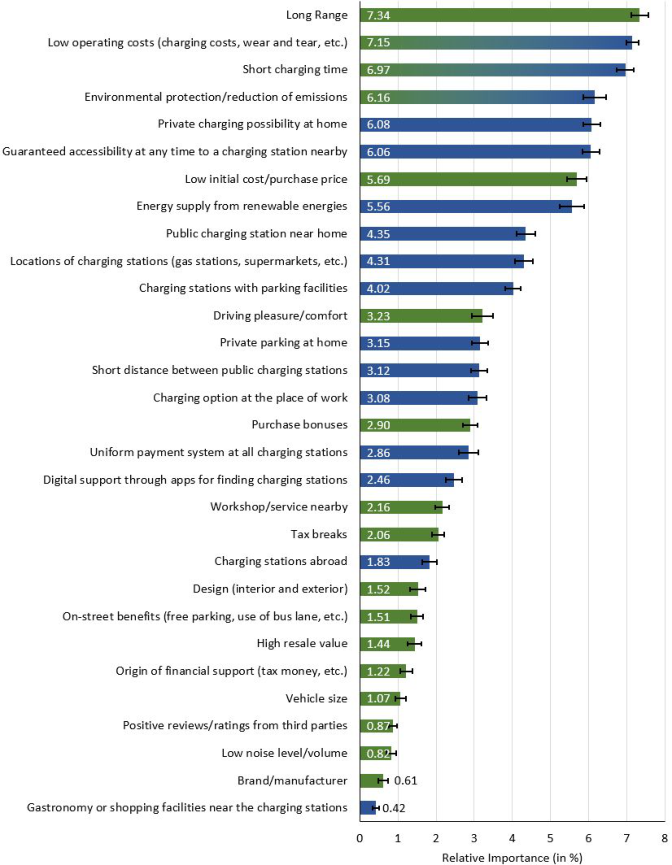
Questionaire Designs The first study (I) aimed to integrate the factors influencing vehicle owner- ship identified in the state of the art into a holistic picture by measuring the relative importance of these factors for a purchase decision. For this purpose, a best-worst scaling (“MaxDiff”) was used for ranking. A set of four ran- dom factors was repeatedly presented to the participants, from which they had to select the most important and the least important for their purchase decision. A total of 29 sets were presented to the respondents. The underl- ying factors or purchase criteria were all derived from existing knowledge about influencing factors in e-vehicle purchase or use. In addition to vehicle- related factors, such as acquisition costs, operating costs, driving comfort or range, infrastructure-related factors, such as charging speed, charging locati- ons, private charging options or uniform payment systems, were also queried. A complete overview of all factors can be found in Figure 1.
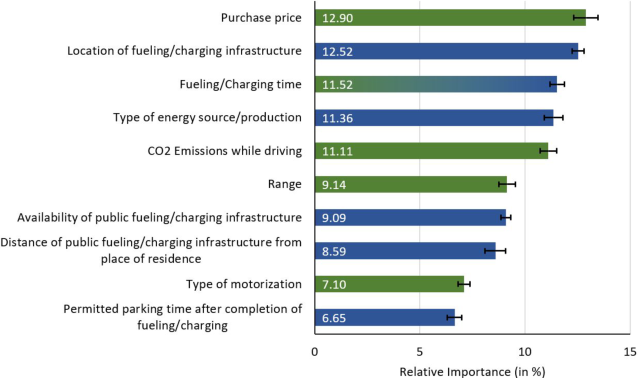
Based on Study II, some of the most important factors were transferred to a decision simulation and differentiated by deriving levels of the respe- ctive factors. This was done because in the first study the factors were only considered on a generic level, but real world purchase or usage decisions are made depending on specific levels and gradations of a product or scenario. For this reason, ten factors were transferred to the second study, adjusted if necessary (see Figure 2), and then corresponding levels were defined for them. Among other things, concrete purchase costs between 10,000€ and 100,000€, concrete charging times between 5 minutes and 4 hours, concrete ranges between 200km and over 800km, concrete CO2 emissions between emission-free and 270g/km, as well as different types of energy generation (fossil, renewable, mixed) and different types of motorization (BEV and ICEV) were used. Based on these defined factors and levels, an adaptive choice-based conjoint (ACBC) was designed. In this, possible must-haves or unacceptables with regard to the levels were first identified in eight screening tasks, which were then kept constant in the subsequent decision simulations to reduce complexity. In each of these ten following decision-making tasks, the respondents were presented with three possible scenarios for a vehicle purchase based on the defined factors and levels, from which they had to select the one most suitable for them and most likely to lead to a purchase. The aim was thus to measure again the relative importance of the factors, but also to identify the influence of the respective specific levels on the purchase decision.
In both studies, additional user factors, such as socio-demographic cha- racteristics (e.g., age, gender, education, or income) and mobility behavior, were assessed to help classify the samples.
Data Collection, Processing, and Analysis Both studies were conducted online. Participant acquisition took place in the social environment of the university, as well as in thematic forums on conventional and electromobile vehicle ownership. The survey language was German, and the surveys accordingly addressed only German-speaking countries. Participation was voluntary, anonymous, and no form of reimbur- sement for expenses was provided. After completion of each data collection, the data were subjected to a quality check in which speeding, unserious responses, as well as dropouts were excluded from further analysis. The data prepared in this way were then analyzed descriptively and inferentially. Both the MaxDiff analysis and the conjoint analysis were estimated with hiera- rchical Bayes (HB). While the model fit (Root-likelihood) in Study I equaled RLH = .548, it equaled RLH = .927 in Study II.
Samples The sample of the first study (Study I) consisted of N = 115 participants. 53% (n = 61) were male and 48% (n = 54) were female. The mean age was M = 31.9 years (SD = 11.7) with a range of 18 to 74 years. With 56% (n = 64), the majority reported a college degree as their highest level of edu- cation. The median net household income level was €2,000 to €3,000. The sample of the second sample consisted of N = 95 responses. As in Study I, the majority of these were also male, with 68% male (n = 65), 31% female (n = 29), and one person of diverse gender (1%, n = 1). The average age was slightly higher at M = 39.1 years (SD = 13.8) and with a range between 19 and 81 years. Again, college degree was the most frequently reported educa- tional attainment (46%, n = 44). The median household net income was one defined level higher, ranging from €3,000 to €4,000. Due to screening criteria used in participant acquisition, the driver’s license ownership rate was 100% in both studies.
RESULTS
The results of the studies are presented below. First, with the results of best- worst scaling, the focus is on a holistic view of the factors influencing the purchase decision (Study I). In the second step, the focus becomes narrower with the presentation of the influence of concrete characteristics of selected influencing factors (Study II).
What are Important Factors for the Purchase Decision?
As can be seen in Figure 1, with a high maximum range, a vehicle attribute was the most important influencing factor in the participants’ purchase deci- sion. In second, third and fourth place were factors that, at least in part, also relate to the charging infrastructure or the charging services. Thus, low ope- rating costs, which include both vehicle repairs and energy costs, were the second most important factor in the purchase decision, while a short char- ging time, which depends on both the technical capabilities of the vehicle and those of the charging infrastructure, was the third most important factor. Environmental friendliness, the fourth most important factor when buying a
New Cars on the Block - The Impact of Public Charging Infrastructure on BEV Ownership 213
Figure 1: Relative importance (mean and standard Errors) of different factors for the purchase decision differentiated by factors relating to the vehicle (green), the charging infrastructure (blue) or both (color gradient green/blue) – Study I (MaxDiff).
car, also relates to both the car and the way it is propelled, as well as the charging process through the way energy is generated.
Starting in fifth place, some exclusively infrastructure-related factors fol- low. The most important of these is the availability of a private charging facility, followed by guaranteed access to a charging station nearby. Only then, in decreasing order of importance, comes the purchase price of the vehicle, followed by, among other things, the source of energy generation, the proximity of the charging facility to the place of residence, and the surroundings of the charging facility.
Figure 2: Relative importance (mean and standard errors) of different factors for the purchase decision differentiated by factors relating to the vehicle (green), the charging infrastructure (blue) or both (color gradient green/blue) – Study II (Adaptive Choice- based Conjoint).
In summary, most of the factors from the charging context are in the top half of the order of importance, while classic vehicle factors such as vehicle size, brand, design, or workshop availability are among the comparatively unimportant factors, as are government subsidies such as on-street benefits or tax breaks. Furthermore, it is evident that there were no outliers among the factors, in the sense that one or more factors stand out that would be several times more important than all the others. The opposite is true: there is an almost linear decrease in importance in Study I from the most important factor (Range, 7.3%) to the least important (Gastronomy/shopping facilities near charging station, 0.4%).
The measurement of relative importance of factors was replicated in Study II, but with a focus on a few that had emerged as relevant in the first pass and with a special emphasis on refill infrastructure. As can be seen from Figure 2, there is again an approximately linear decrease in relative importa- nce without the presence of identifiable outliers. In the results of the second study, the acquisition costs have the greatest influence on the decision for or against a specific car. In terms of importance, this is followed by the que- stion of the extent to which charging is possible in public, private or at the workplace. This time, the vehicle range is only in the midfield of the factors examined. The question of the extent to which a charging space must be vaca- ted after charging or how long parking is permitted afterwards has the least influence on the purchase decision.
Is Public-only Charging an Option?
To better understand the importance of public charging, a look into the indi- vidual characteristics of the Location of fueling/charging infrastructure and Availability of public fueling/charging infrastructure attributes is necessary.
New Cars on the Block - The Impact of Public Charging Infrastructure on BEV Ownership 215
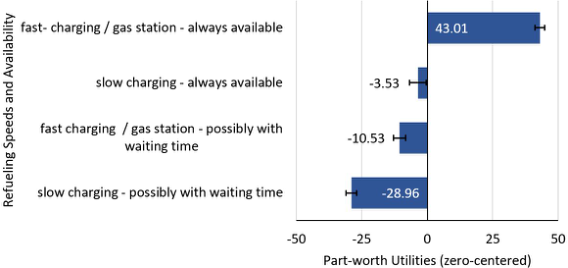
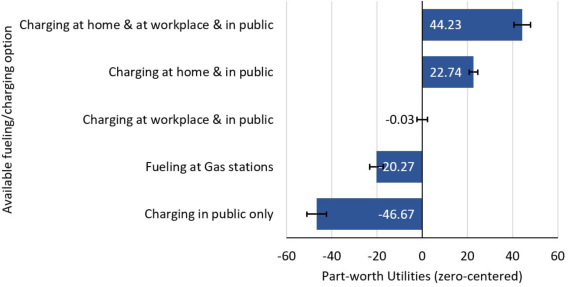
Figure 3: Part-worth utilities (mean and standard errors) of different available public charging speeds – Study II (adaptive choice-based conjoint).Figure 4: Part-worth utilities (mean and standard errors) of different available charging options – Study II (adaptive choice-based conjoint).
Figure 3 indicates that fast refilling is preferred over slow refilling for public refilling. However, availability is more important for the user’s purch- ase decision than pure refill speed, so that even a slow, always-available refill option can have a more positive influence on the purchase decision than a fast refill option, where waiting times are possible. This already hints that refill options at home or at work might have a more positive influence on the willingness to buy than public refill options due to their more predictable availability.
Consequently, the availability of both private, workplace, and public refill options has the greatest positive influence on the car purchase decision (see Figure 4). In the absence of one of these options, if public refilling is availa- ble, private refilling at home is clearly preferred over refilling at work. The more positive influence on the purchase decision makes it evident that com- binations of different charging options, even if only two of the three possible charging locations are available, are seen as an advantage over refueling at gas stations. However, if only public charging options are available, this is seen as more critical than refueling at gas stations, which is also purely public, as evidenced by the lower positive contribution to the purchase decision.
DISCUSSION & OUTLOOK The results of the present studies partly confirmed the state of research, but partly go beyond it. In particular, the high importance of the purchase price, range, environmental friendliness and charging infrastructure for the purch- ase decision was again evident (cf. Degirmenci and Breitner, 2017; Egbue and Long, 2012; Philipsen et al., 2018). What is new is the holistic ranking of the relevant influencing factors that is now available, which shows that the expansion of the charging infrastructure is important for market pene- tration but is no more a panacea than the technological further development of the vehicles. In particular, the high importance of private charging opti- ons for the purchase intention and the low positive influence of scenarios in which the user is purely dependent on public charging infrastructure suggest that a market penetration of user groups that do not have private parking spa- ces and thus cannot have private charging options will be difficult and may only be possible through technological advances on the vehicle side. Future research must therefore once again focus on scenarios of technological pro- gress and investigate user acceptance under conditions in which charging and refueling converge in terms of charging times and resulting ranges. It is pos- sible that the tipping point for some user groups will not be reached until there is equality between the technologies (electromobility vs. internal com- bustion engines) in terms of the aforementioned properties and these groups may therefore not tend toward BEV ownership in the short term.
It is noticeable that the order of importance of the surveyed factors for the willingness to buy is not identical in both studies. For example, vehi- cle range was once the most important factor and once only in sixth place, while conversely purchase price was once the most important and once only in seventh place. This may, of course, be due to the different samples, but it is more likely that this is also due to the method. While in best-worst scaling the influencing factors are only examined on a generic level without concrete cha- racteristics, in ACBC analysis the respondents’ decision is based on specific scenarios built on concrete characteristics of a factor (e.g., concrete ranges instead of the abstract construct “range”). The latter method is therefore more closely oriented to real purchase decisions and is therefore likely to give the more realistic picture. However, it also appeared that factors were not very important in the results of one method and not important at all in the results of the other. In practice, there were only shifts in the importance hierarchy between factors that were of comparable magnitude in terms of importance values in both methods.
The major limitation of the available data, and thus the results, comes from the present sample line sizes. Although the data allow a first insight into the relative importance of different vehicle- and infrastructure-related factors for the purchase decision, evaluations depending on user profiles are not yet possible. Thus, two of the three previously posed questions could not yet be addressed and are the subject of future research. The extent to which user factors, such as socio-demographics, personality traits, cultural back- ground, or characteristics related to place of residence or mobility, influence the willingness to buy (electric) cars has so far been researched only in part.
New Cars on the Block - The Impact of Public Charging Infrastructure on BEV Ownership 217
Especially the derivation of different user profiles should be a future research focus to identify tipping points in the willingness to buy for these profiles. To make this possible, the next step is to conduct a larger, census-representative survey based on an ACBC, so that the resulting vehicle ownership model can be used in market simulations and infrastructure planning as a function of user profiles, to predict, as far as possible, when and under what conditions new cars are to be expected in which block.
ACKNOWLEDGMENT
This work was partly funded by the projects “Cities in Charge” (reference no. 01 MZ 18005C) and “eMIND (reference no. 01 MZ 18015B), funded by the German Federal Ministry for Economic Affairs and Energy. The authors would like to thank all participants for their willingness to share their opi- nions on a novel and innovative technology. Thanks are also due to Vanessa Halle for research support and to Nynuk for inspiring the paper title.
REFERENCES
Abotalebi, E., Scott, D. and Ferguson, M. (2019) Why is electric vehicle uptake low in Atlantic Canada? A comparison to leading adoption provinces. Journal of Transport Geography, 74, pp. 289–298. doi: 10.1016/j.jtrangeo.2018.12.001 Biresselioglu, M., Demirbag Kaplan, M. and Yilmaz, B. (2018) Electric mobility in
Europe: A comprehensive review of motivators and barriers in decision making processes. Transportation Research Part A: Policy and Practice, 109, pp. 1–13. doi: 10.1016/j.tra.2018.01.017 Degirmenci, K. and Breitner, M. (2017) Consumer purchase intentions for electric vehicles: Is green more important than price and range?. Transporta- tion Research Part D: Transport and Environment, 51, pp. 250–260. doi: 10.1016/j.trd.2017.01.001 Egbue, O. and Long, S. (2012) Barriers to widespread adoption of electric veh-
icles: An analysis of consumer attitudes and perceptions. Energy Policy, 48, pp. 717–729. doi: 10.1016/j.enpol.2012.06.009 Europäische Kommission (2011) Fahrplan für den Übergang zu einer wettbewerbsfähigen CO2-armen Wirtschaft bis 2050. Available 21. December 2021 at https: //eur-lex.europa.eu/legal-content/DE/TXT/PDF/?uri=CELEX:52011DC0112 Globisch, J., Plötz, P., Dütschke, E., & Wietschel, M. (2018) Consumer evaluation of
public charging infrastructure for electric vehicles (No. S13/2018). Working Paper Sustainability and Innovation. Giansoldati, M., Danielis, R., Rotaris, L. and Scorrano, M. (2018) The role of driving range in consumers’ purchasing decision for electric cars in Italy. Energy, 165, pp. 267–274. doi: 10.1016/j.energy.2018.09.095 Gómez Vilchez, J., Harrison, G., Kelleher, L., Smyth, A. and Thiel, C. (2017) Quan-
tifying the factors influencing people’s car type choices in Europe: Results of a stated preference survey, EUR 28975 EN, Publications Office of the European Union, Luxembourg. doi:10.2760/695017 Kraftfahrt-Bundesamt (2021) Fahrzeugzulassungen (FZ) - Bestand an Kraftfahrzeugen nach Umwelt-Merkmalen. Available 21. December 2021 at https://www.kba.de/SharedDocs/Downloads/DE/Statistik/Fahrzeuge/FZ13/fz13 2021.pdf? blob=publicationFile&v=4
Kumar, R. and Alok, K. (2020) Adoption of electric vehicle: A literature review and prospects for sustainability. Journal of Cleaner Production, 253, p.119911. doi: 10.1016/j.jclepro.2019.119911 Philipsen, R., Brell, T., Funke, T., Brost, W. and Ziefle, M. (2018) With a Little Help
from My Government – A User Perspective on State Support for Electric Vehicles. Advances in Intelligent Systems and Computing, pp. 386–397. doi: 10.1007/978- 3-319-93885-1_35 Schulz, F. and Rode, J. (2022) Public charging infrastructure and electric vehicles in Norway. Energy Policy, 160, p.112660. doi: 10.1016/j.enpol.2021.112660 Simsekoglu, Ö. and Nayum, A., 2019. Predictors of intention to buy a battery electric
vehicle among conventional car drivers. Transportation Research Part F: Traffic Psychology and Behaviour, 60, pp. 1–10. doi: 10.1016/j.trf.2018.10.001 Ziefle, M., Beul-Leusmann, S., Kasugai, K. and Schwalm, M. (2014) Public Perception and Acceptance of Electric Vehicles: Exploring Users’ Perceived Benefits and Drawbacks. Design, User Experience, and Usability. User Experience Design for Everyday Life Applications and Services, pp. 628–639. doi: 10.1007/978-3-319- 07635-5_60
LISTED IN THE AHFE DIGITAL BOOKSTORE CATALOGUE
Explore the complete digital volume
Human Factors in Transportation
Read this individual research paper free through the original publisher, or explore the full digital proceedings book.
ISBN 978-1-958651-36-0
Explore this ISBN in the AHFE Bookstore ↗Listed in the July 2026 bookstore catalogue; search by ISBN to confirm current availability · Digital book purchase optional