Manuel Kipp, Caroline Guo, Klaus Bengler (2022). Evaluation of the Seating Environment of an Autonomous Taxi on User Needs – An Online Survey Investigation. In: Human Factors in Transportation. AHFE Open Access, vol. 60, pp. 100–108. https://doi.org/10.54941/ahfe1002439
In the UNICARagil project, funded by the German Federal Ministry of Education and Research, four modular autonomous vehicle concepts are de-veloped. The paper deals with an autonomous taxi designed for ride sharing and non-driving tasks and activities. An online-based survey is conducted to evaluate integrated components and features of the seating environment under different conditions of use. The expectations, preferences and wishes of 181 survey par-ticipants are compared with the aspects and features to be offered in the auto-TAXI. The results show that using the equipment elements of the seating envi-ronment depends on various influencing factors such as trip duration, type of trip, privacy and activity. In general, users' expectations of the autoTAXI's equipment elements are met.
The requirements for mobility in the future are changing continuously. Urba- nization leads to increased traffic and environmental pollution. To meet these challenges, autonomous vehicles can positively impact future mobility, safety, better time management for people, and the environment (Cyganski et al., 2014). Within the project UNICARagil, funded by the German Federal Mini- stry of Education and Research, four autonomous prototypes are developed and tested. The autoTAXI is one of these concept vehicles, which is prima- rily designed to meet the needs of business people and non-driving related activities. The Chair of Automotive Engineering and the Chair of Ergono- mics at the Technical University of Munich are responsible for the design and development of the entire interior of the autoTAXI. Autonomous veh- icles enable new interior concepts that must meet new requirements. One of the main challenges in the development of the interior is to convey a sense of security and ensure comfort (Schlott, 2016). The repositioning of occupants in autonomous vehicles leads to new types of seating configura- tions for different activities such as working. In the context of autonomous driving, technological advances are leading to more degrees of freedom in driver-vehicle interaction. A challenge is to ensure confidence in autonomous driving by optimally designing the interior space and functional integration
Evaluation of the Seating Environment of an Autonomous Taxi on User Needs 101
at the human-machine interface. (Köhler et al., 2019, Golowko et al., 2017, Östling and Larsson, 2019).
Requirements for the fully automated driverless taxi and a resulting inte- rior concept are described in Kipp et al. (2020). The focus of the presented paper is on the evaluation of an innovative seating environment in the autoTAXI.
METHOD
In the following, the design of the seating environment of the autoTAXI and the method of the online survey are described. The research questions of the survey to assess the requirements and characteristics of the seating environment are:
What are passengers’ expectations regarding the seating environment in an autonomous autoTAXI?
Which features do passengers use in the seating environment during different driving situation?
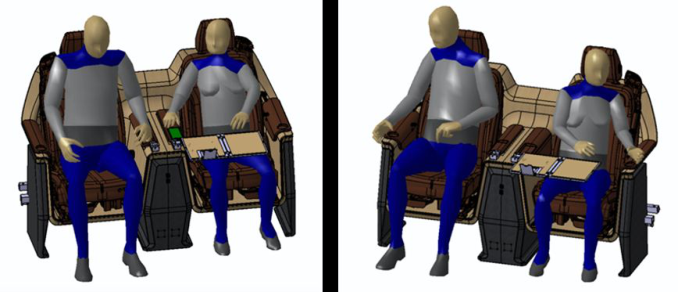
Interior Design of the autoTAXI The interior design of the autoTAXI adapts primarily the needs of business people who use the taxi mainly for short trips to work. In addition, it is assumed that the user can order the taxi at any time as needed, and the inte- rior should be further designed for different situations. The basic topology of the interior is a 2+2 seater with vis-à-vis arrangement. Two main seats are provided in the preferred direction and two folding seats are positioned on the opposite side. A seat shell concept is developed for flexible arrange- ment of main and folding seats to allow individual positioning of seats. The seats facing the direction of travel are designed as main seats and the oppo- site side as folding seats, which promise additional space when they are not in use. Furthermore, the seats have an adjustment clearance of 400 mm and are accordingly adaptable to human body proportions and sizes (Kipp et al., 2020). Iterative to the design development, ergonomic simulations are car- ried out using the digital human model software RAMSISTH for reachability verification and visibility analysis of the designed elements. Here, various sea- ting positions are taken into account. In this way, an ergonomic design for anthropometric sizes from 5th percentile woman to 95th percentile man can be ensured during design development. The seating environment is virtually analyzed and the accessibility of the integrated technical features in the arm- rest and center console is checked. Figure 1 shows the manikins in an upright sitting position during different tasks.
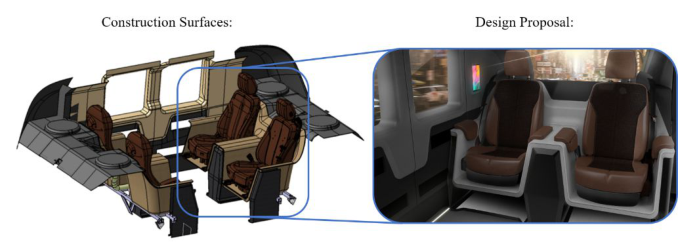
The HMI (Human-Machine-Interface) screen, providing information about the ride, entertainment programs and control of some features of the seating environment, is located on the side wall next to the main seats. Further equipment and electronic elements will be positioned in the middle console. On the main seat side a folding table is integrated that allows desk work and eating facilities. In addition, the seating environment will be equipped with charging options and storage areas. The interior design is worked out by the
Figure 1: Ergonomic analysis of the seating environment with RAMSISTH.Figure 2: Construction surfaces and design proposal of the autoTAXI’s seating envi- ronment (DERESA, 2020).
University of Applied Sciences, Salzburg, which is shown in Figure 2. The elaboration of the design is ensured under specifications of manufacturabi- lity, accessibility and applicability. Components of the seat shell will be made of a biogenic wood material that conveys the requirements for sustainable mobility of the future.
Compared to the conventional vehicle from the middle class, the auto- TAXI has modern equipment elements adapted to the motto of a working taxi for future mobility. This allows passengers to work and pursue other activities during the ride. Table 1 compares the equipment elements between the conventional vehicle and the autoTAXI. In addition, Table 1 contains sug- gestions for the autoTAXI that were not implemented due to a requirements analysis of the taxi use case.
Online Survey In this paper, a quantitative online survey is used to evaluate the require- ments and seat environment equipment of the autoTAXI concept. A survey by Hwang and Cho (2018) regarding reliability, utility, and convenience conclu- ded that 55.9 % of respondents had an intention to purchase autonomous vehicles. For this reason, a scenario is presented for the participants to help them empathize with the situation and also address distractions, overwh- elm, and bias. Hertberg et al. (2019) conducted a survey to inquire about
Evaluation of the Seating Environment of an Autonomous Taxi on User Needs 103
Table 1. Comparison of equipment elements between conventional vehicles and autoTAXI.
Table available in the original PDF paper.
Equipment elements Conventional Vehicle autoTAXI Power socket - Yes USB ports Yes Yes Inductive charging Yes Yes Cup holder Yes Yes WIFI - Yes Heated seats Yes Yes Folding table - Yes Waste garbage can - - LED lamp for each seat - - Storage net/storage space Yes Yes Snack fridge - - Cigarette lighter Yes - Private area - -
user needs and expectations in various UNICARagil use cases. They show that occupants expect different employment opportunities while riding in an autoTAXI such as reading, relaxing, sightseeing, using cell phones or tablets, talking with other passengers, sleeping, or working. Different activities intend requirements and expectations for the seating environment in the taxi. The- refore, the interior design is closely related to the choice of workplace. The autoTAXI’s needs are primarily focused on activities such as relaxing, sle- eping, or looking out the window, but desk work and meetings are also included.
Influencing factors such as socio-demographic influences, personal well- being, trip duration and purpose are taken into account and used to obtain a complete overview of the usability of the vehicle users’ functions and perceptions. For the investigation of the influence parameters, same questi- ons are used for different predefined scenarios with an evaluation scale by Bortz and Döring (2006). The usability of equipment elements was measu- red using a 5-point Likert scale from “by no means” to “quite definitely”. During the evaluation, the scenarios are compared with each other and the sociodemographic influencing factors within a scenario are analyzed. The statistical analysis is performed using t-tests for dependent samples and repeated measures, Cohen’s d and p-value (for t-test) is given for effect size.
RESULTS
Within 3 weeks, 214 people participated in the online survey, of which 33 submitted incomplete answers. Therefore, the sample size of the survey is N = 181. The average age of 181 participants is 33.52 years with a stan- dard deviation of 14.64. With 71 %, the majority of the participants can be assigned to the age group of 18 - 40.
Table 2. Desired equipment elements in an autonomous vehicle divided for overall, female, male, less than and more than 40 years.
Furthermore, the survey shows that 50 % of the participants are currently students while 43 % of them are employed. The remaining 7 % are limited to pupils, trainees, pensioners, housewives and unemployed individuals.
Results on Passengers’ Expectations in an Autonomous Vehicle In order to determine passenger’s wishes and expectations towards an auto- nomous vehicle, the participants were asked to indicate the importance of equipment elements that can be offered in the vehicle with a multiple-choice selection. The sociodemographic influencing factors, such as gender and age of the participants, are particularly considered. Table 2 illustrates that the results from different groups are similar. The interest levels towards having a snack fridge and a cigarette lighter are especially low. In comparison, the majority would like to have a wireless internet connection and charging opti- ons via a power socket. Conventional features like cup holders, heated seats and cigarette lighter are in low demand. The most frequently mentioned equipment elements (50 % and more) are available in the autoTAXI.
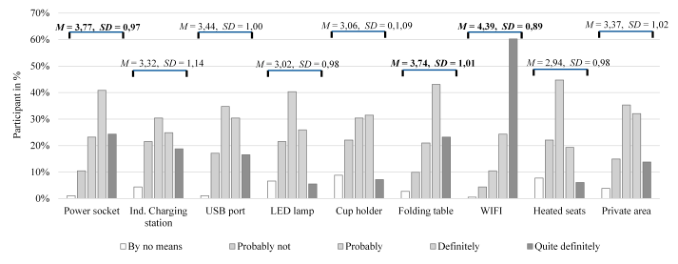
Results on Passengers’ Expectations in the autoTAXI To get an overview of the necessity of the equipment provided in the seating environment of the autoTAXI, the participants were put into different sce- narios and asked about the probability to use the features. For quantitative analysis, a five-point scale is introduced in the survey, in which five points cor- responds to the highest probability level and one point to the lowest. In this way, the mean value and the corresponding standard deviation can be calcula- ted for the probability. Figure 3 shows a typical situation where the autoTAXI is used to travel to work in one hour. The probability of using the WIFI is the highest level with a mean value of M = 4.39. It is followed by the use of power socket (M = 3.77) and folding table (M = 3.74). The remaining functions like heated seats and LED lamps were in casual use with average values of M ≈3.
Evaluation of the Seating Environment of an Autonomous Taxi on User Needs 105
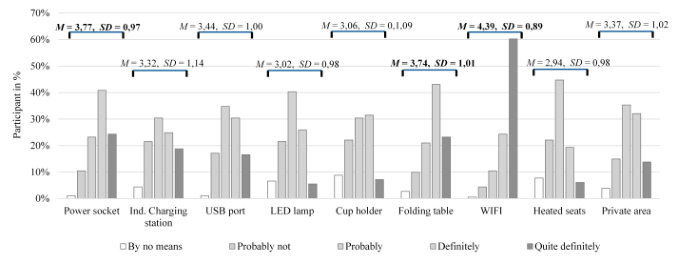
Figure 3: Probability of equipment use according to the situation: going to work in one hour.Figure 4: Probability of equipment use in autoTAXI according to the driving time.
Passengers’ Expectations According to the Trip Duration Furthermore, the usage probabilities of the equipment in the three scena- rios are compared with a travel time of 4 hours, 1 hour, and 15 minutes. The significant differences can be seen in Figure 4. It is noticeable that the probability of using all the features increases significantly with increasing duration. When comparing the one-hour trip with a shorter and longer trip respectively, the probability of using the features differs. It means that the influence on the using of the equipment functions and the effect strength are decreased with the increase of trip duration. This is most obvious when using the power socket. Both comparisons between 1 hour and 15 minutes (t(180) = 38.22; p < 0.001; d = 2.84) and between 1 hour and 4 hours (t(180) = −16.89; p < 0.001; d = −1.26) show large effect sizes, i.e. the result is strongly dependent on the trip duration. Depending on the duration, participants also choose different features to use while travelling. During a short trip, i.e.15 minutes, a cup holder is more likely to be used than a folding table, which is preferred for a longer trip.
Preferences for charging options are also different. In contrast to a short trip, where inductive charging stations and USB ports are more likely to be used, a trip of more than 1 hours, power socket is chosen to charge larger devices.
Figure 5: Probability of equipment use in autoTAXI according to the trip purpose.Figure 6: Probability of equipment use in autoTAXI according to the personal well- being.
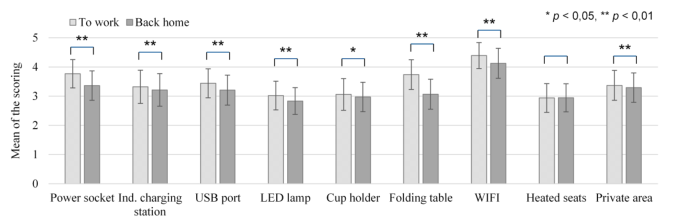
Passengers’ Expectations According to the Trip Purpose For the analysis of the purpose, the responses of the survey participants in two scenarios are compared, in which the autoTAXI passenger is on the way to work and on the way back from work respectively. There is a significant influence of the purpose of the trip and the time of day on the use of all features, except for heated seats (see Figure 5). The tendency to use these features during the outward trip is greater than on the way back. Using the power socket (t(180) = 11.03; p < 0.001; d = 0.82) and the folding table (t(180) = 19.29; p < 0.001; d = 1.43) show a strong influence on the pur- pose of the trip. On the way to work, the probability of using the features is significantly higher.
Passengers’ Expectations According to the Personal Well-Being
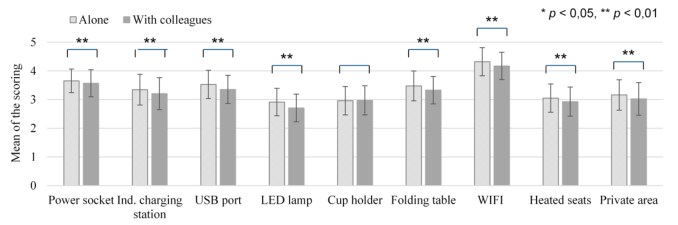
Figure 6 shows the comparison of the scenarios of riding alone and on a trip with three other occupants. It is apparent that the given privacy has a statistically significant influence on the use of all functions except the cup holder (t(180) = −0.63; p = 0.53; d = −0.05). Nevertheless, in both cases, using functions of WIFI (M1 = 4.32; M2 = 4.17) and power socket (M1 =3.65; M2 = 3.57) are most likely to be used. The effect according to Cohen is small for all equipment functions, except for the cup holder and LED lamp (t(180) = 6.80; p < 0.001; d = −0.45), i.e. personal well-being weakly influences the probability of use.
Evaluation of the Seating Environment of an Autonomous Taxi on User Needs 107
DISCUSSION AND CONCLUSION The selection and integration of equipment elements in the autoTAXI were adapted by the current features of today’s automobiles and public transport. Charging options such as USB ports and inductive charging stations, as well as other seat functions such as seat heating, are adapted from conventional cars. The integration of cup holders on the armrests resembles the tables in trains. Inspirations for the folding table were taken from the business class and first class of the aircrafts. To create a working environment in the auto- TAXI, WIFI is also provided, which is the most desired features in the survey, followed by the power socket, USB ports, and folding table. The results con- firm the selection of the equipment functions integrated in the autoTAXI. On the other hand, conventional features such as a cigarette lighters are not very popular, and are therefore not implemented in the autoTAXI.
In addition, the study is focused on the factors influencing the use of the integrated elements, which are related to non-driving related activities. In the autoTAXI, also known as “Working Taxi” to business people, the possibility to work should be prioritized. The factors of travel duration and purpose have a recognizable influence on the use of the equipment. All equipment elements would be used appropriately in a trip with a duration of 1 hour. In particular, the use of the power socket and folding table increases signi- ficantly with increasing travel time, both on the way to work and on the way back from work. The autoTAXI is therefore suitable for longer busi- ness trips. Concerning the influence of privacy, it shows that the use of all features enhancing a working atmosphere decrease when sharing the vehicle with occupants. Concentration can be reduced when there are several passen- gers in the autoTAXI. Another reason is the privacy of sensitive data, which prevents working in public.
In summary, work environment equipment elements such as charging opti- ons and folding table are consistently popular among survey participants. Other features such as heated seats and cup holders are less preferred and rated “maybe”. The likelihood of using a private area is 60% that guaran- tees more privacy for a one-hour trip. Hence, integrating a private area into the autoTAXI, e.g. in the form of headrests that fold down to the side, should be considered.
As mentioned in Kipp et al. (2020), further physical tests will be conducted with a user group in the assembled vehicle to compare the results with the real vehicle. The online study was used to verify the ideas for the seating environ- ment in an autonomous taxi. Participants were able to visualize the interior space when asked familiar features also found on an airplane or train. The role of the user changes as the driving function is taken over by the vehicle. Due to the new interior concept of the vehicle, the user experience need to be evaluated regards to comfort and usability for the driving experience, motion sickness, and interior space.
ACKNOWLEDGMENT
The research work was carried out within the framework of the project “UNI- CARagil” (FKZ 16EMO0288). We gratefully acknowledge the financial
support of the project by the German Federal Ministry of Education and Research (BMBF). We are particularly grateful to the Chair of Automotive Engineering, TU Munich, and the FH Salzburg for their contribution to this publication. The author is solely responsible for the content.
REFERENCES
Bortz, J. & Döring, N. (2006), Forschungsmethoden und Evaluation. 5. Auflage Springer Medizin. Heidelberg. Cyganski, R., Fraedrich, E. & Lenz, B. (2014), Travel-Time Valuation for Auto-
mated Driving: A Use-Case Driven Study, Annual Meeting of the Transportation Research Board. DERESA. (2020), Design Research Salzburg, Salzburg University of Applied Sciences, Campus Kuchl. Golowko, K., Mugele, P.; Zimmer, D. (2017), Neue Möglichkeiten der Innenraum-
gestaltung. ATZ Extra, Bd. 22, S. 42–45. Herzberger, N., Schwalm, M., Reske, M., Woopen, T. & Eckstein, L. (2019), Mobilitätskonzepte der Zukunft - Ergebnisse einer Befragung von 619 Personen in Deutschland im Rahmen des Projekts UNICARagil. Institut für Kraftfahrzeuge – RWTH Aachen University. Kipp, M., Bubb, I., Schwiebacher, J., Schockenhoff, F., Koenig, A. & Bengler, K.
(2020), Requirements for an Autonomous Taxi and a Resulting Interior Concept. HCI International 2020-Posters. 22nd International Conforence. 374–381. Köhler, A.; P., Wang, L., Becker, J., Voß, G., Ladwig, S., Eckstein, L., Schulte, T. & Depner, N. (2019), How Will We Travel Autonomously? User Need for Interior Con-cepts and Requirements towards Occupant Safety. 28th Aachen Colloquium Auto-mobile and Engine Technology. Lee, J., Chang H. & Park, Y. (2018), Influencing Factors on Social Acceptance
of Autonomous Vehicle and Policy Implications. Technology Management for Interconnected World. Östling, M. & Larsson, A. (2019), Occupant Activities and Sitting Positions in Automated Vehicles in China and Sweden. Schlott, S. (2016), Fahrzeuginnenräume für automatisierte Mobilitätsstrategien.
ATZ-Automobiltechnische Zeitschrift, 118(3). S. 8–13.
LISTED IN THE AHFE DIGITAL BOOKSTORE CATALOGUE
Explore the complete digital volume
Human Factors in Transportation
Read this individual research paper free through the original publisher, or explore the full digital proceedings book.
ISBN 978-1-958651-36-0
Explore this ISBN in the AHFE Bookstore ↗Listed in the July 2026 bookstore catalogue; search by ISBN to confirm current availability · Digital book purchase optional