Frank Flemisch, Tassilo Ianniello, Paul M. Weiser, Justin Osmanov, Tianyu Tang, Kai Storms, Can Kemmler, Marvin V. Baumann, Bettina Abendroth, Klaus Bengler, Steven Peters, Peter Vortisch (2026). From Human Systems Integration to Human Systems Migration: First sketch from the automated driving system project MiRoVA. In: Intelligent Human Systems Integration (IHSI 2026): Disruptive and Innovative Technologies. AHFE Open Access, vol. 200, pp. 412–422. https://doi.org/10.54941/ahfe1007100
With the advancement of artificial intelligence (AI), machines are gaining unprecedented autonomous capabilities. This progress presents a significant challenge in how to seamlessly integrate humans, machines, organizations, and the environment into meaningful socio-technical systems. This process is called Human System Integration (HSI) and a prime example is vehicle automation in the transportation sector. In this sector AI enables a spectrum of automation levels, culminating in highly and fully automated systems. In the center of this integration challenge lies the concept of control. Traditional control theory, which focuses on a single entity’s command and execution, is no longer sufficient to address this growing complexity. The rise of automated systems makes new control paradigms necessary. Shared control, where humans and machines collaboratively operate the vehicle, and traded control, where authority is passed back and forth; both provide more dynamic and flexible solutions. The synthesis of these approaches, cooperative control, represents a new frontier for integrating people with intelligent technologies. As these paradigms become increasingly relevant, they demand novel methodologies that extend beyond traditional engineering and human-in-the-loop experiments. To bridge the gap from initial theoretical concepts to practical design patterns and implementations, a deeper and more systematic investigation into the human-system relationship is required, moving toward a holistic understanding of human adaptation, trust, and collaboration with vehicle automation. Challenges for human adaptation introduced by the rapid evolution of intelligent technologies cannot be neglected, as failures in human-system coordination can have direct implications for public safety and societal acceptance. This gives rise to the crucial concept of Human Systems Migration (HSM), which is now scientifically defined and investigated. It describes the dynamic process of humans and technologies moving together through new system configurations. In this context, the DFG-funded research group MiRoVA (Migration of Road Vehicle Automation) was established to investigate and exemplify Human Systems Migration in the domain of automated vehicle systems.In this paper, we present Human Systems Migration as key paradigm for understanding the integration of people and intelligent technologies. We illustrate these paradigms with the MiRoVA project, where we explore migration paths through different automation levels and analyze the resulting processes of adaptation and collaboration. We view the migration challenge on various levels, including a technological, game theoretical, as well as micro and macro perspective. These considerations not only address the integration of people and automation, but also extend to broader concerns such as social development, autonomy, safety and sustainability. Our interdisciplinary approach provides a foundation for bridging theoretical models with design patterns and practical implementations, addressing critical questions of trust, safety, and societal acceptance of vehicle automation.
FROM TECHNICAL CONTROL TO SHARED AND COOPERATIVE CONTROL AND VEHICLE AUTOMATION In a wider and historic perspective on humans, technology, nature and planet Earth, technology originally evolved in close relationship with its use by humans and their environment. Anthropologists even describe a co-evo lution, where human evolution is increasingly coupled with technological developments (Harari, 2015). An example for this is the human hand, which is likely to have coevolved to accommodate human tools (see e.g. Marzke and Marzke, 2000).
With improvements of technology, the paradigm of automation evolved, which puts the autonomous capabilities of a machine into the center of think ing and acting (e.g. Billings, 1996). As a direct response to this, control of these capabilities came into focus (e.g. Wiener, 1961). The concept of shared control was originally defined as when both a human operator and a com puter are active at the same time, while working jointly on a task (Sheridan et al., 1978). Later, scientists like Hoc (2001) go beyond shared control and describe human-machine cooperation as a desirable goal, creating not only an internal, but also an external perspective on the cooperation of automated systems and humans. Immense research on shared and cooperative control has been conducted since then. For an overview see e.g. Abbink et al. (2018). These concepts were fused into a framework of joint action, human-ma chine cooperation, shared, traded and supervisory control by Flemisch et al. (2019).
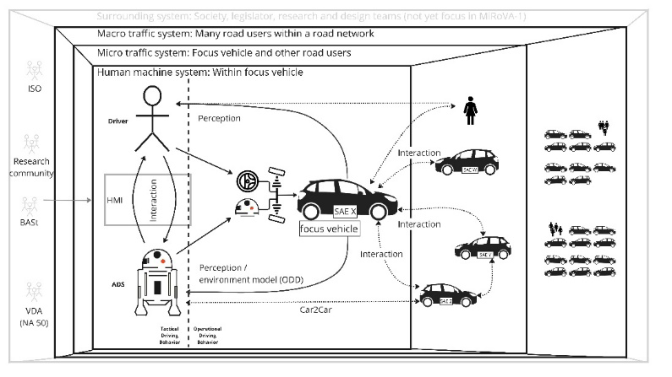
Figure 1: Holistic bowtie-model of vehicle automation with the inner human-machine system, the micro and macro traffic system.
Applied to vehicle automation, Abbink, Flemisch, Winner, Bubb, Bengler and many others also connect the paradigms of shared and cooperative con trol with the automation of road vehicles. An example for this, are the SAE levels of vehicle automation, which originated as general levels of automa tion (Endsley and Kaber, 1999), transferred from rider-horse relationship to
the vehicle domain (Flemsich et al., 2004 to Altendorf et al., 2016), and gradually translated via BASt working groups to an SAE-standard (On-Road Automated Driving committee, 2021). The connection between levels and modes of automation is sketched by (Flemisch et al., 2024). The automa tion levels between manual and fully automated are often implemented with shared and cooperative control schemes.
In the context of MiRoVA (Migration of Road Vehicle Automation), we are analyzing shared and cooperative control with different cooperation partners in mind. Figure 1 shows a holistic system model of driving automa tion, with the driver, automation, other single road users and larger traffic systems as cooperation partners.
HUMAN SYSTEMS INTEGRATION WITH DESIGN AND INTERACTION PATTERNS In a general, domain-overarching perspective, the integration of humans into systems can be explained with interaction patterns, especially focusing on cooperative control. Patterns were originally described for architecture by Alexander (1977). Inspired by the software patterns (e.g. Gamma et al. 1995), and their use in human-computer interaction (e.g. Borchers, 2001; Flemisch, 2001), the concept was generalized and extended by Flemisch et al. (2022b). Oversimplified, patterns are an abstraction of repeating parts of reality into models. These models are re-used for observation, identification and/or to re-compose, design and create new, similar but not the same instances in another part of reality.
Applied to automation, patterns can be used to model interaction and cooperation between human and automation on the level of the general design (e.g. Baltzer, 2020). Such patterns can be categorized as interaction design patterns. They can also be used to observe, identify and design inter actions on a finer level of interaction events, (e.g. Usai et al., 2024). An exam ple for these interaction event patterns are maneuvers like driving in a lane or changing the lanes.
Patterns can also be used to describe the behavior at system boundaries or failures of traffic systems, where the automation needs to decide between giving back control to the human or executing a minimum risk maneuver. Maneuvers, as defined e.g. by Habenicht et al. (2011), can also be seen as special patterns, which bind together the interaction and cooperation of humans, automation and environment. These patterns can be modelled including eye gaze behavior, e.g. to find out whether drivers can indeed take over control (Herzberger, 2023).
HUMAN SYSTEMS MIGRATION NEEDS CLASSICAL ENGINEERING, EXPERIMENTS AND HUMAN SYSTEMS EXPLORATION In a general, domain-overarching perspective, the ability for humans and tech nology to migrate side by side requires a dynamic human-system integration. To achieve this, methods of Human Systems Integration (HSI) beyond exper iments become necessary. One effective set of tools are exploratory methods
From Human Systems Integration to Human Systems Migration 415 that combine theoretical foundations with the involvement of stakehold ers, such as users, and empirical validation (Flemisch et al., 2013; 2022a). Approaches from domains such as systems and human factors engineering, as well as design research and human systems integration are combined into a concept of Human Systems Exploration (HSE), and utilized for explorative design processes (Preutenborbeck et al., 2024).
Applied to MiRoVA, systems engineering and experiments still play a cru cial role in design validation by testing hypotheses regarding system attri butes such as performance, safety, and user experience in controlled envi ronments, whether in driving simulators or real-world settings. Human Systems Exploration extends this approach by systematically investigating the “unknown unknowns” within the problem and solution space of auto mated traffic systems. This enables the identification of emergent migration effects and interaction patterns that may not yet be fully understood, but are essential for further development of these systems.
THE TIME DYNAMIC CHANGE OF HUMAN-TECHNOLOGY CONFIGURATIONS: HUMAN SYSTEMS MIGRATION In a historic and general perspective, even the earliest human technologies changed over time, for instance in the materials used. This is already evident in the rough categorization of human civilizations into stone, bronze, and iron ages. Even if this rate of change was slower than today, it is an early example of the migration of human systems. While the migration of tech nology and that of humans with it usually means an improvement, there are costs and risks to be considered as well. These are especially critical in the early time of adoption, as this period is most often characterized by both the old and new technology coexisting. Based on this insight, the idea of Human Systems Migration (HSM) applied to train systems is initially described in Obrenovic et al. (2006), an application to air traffic control is introduced by Ohneiser and Gürlük (2013). Based on this positive experience with the con cept, a first generalization towards Human Systems Migration is described by Flemisch et al. (2017a).
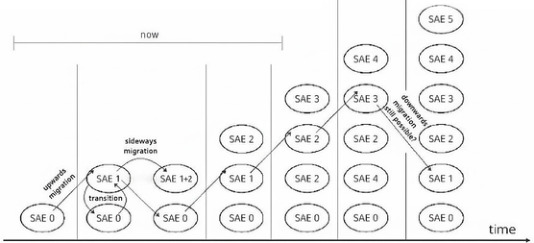
Figure 2: Possible migration paths with the example of vehicle automation levels.
Applied to MiRoVA, the concept of Human Systems Migration means a process of migrating not only technology, but also people, organizations and environments, from manual over low to high stages of automation and back. This might take at least two decades, probably even considerably lon ger (Flemisch et al., 2017a). During this time, vehicles with different automa tion capabilities will coexist in traffic. This might be even more challenging with the two migration aspects: Driver-vehicle systems can transition and migrate between different automation levels – e.g. by activating lane assis tance and/ or adaptive cruise control – and manufacturers might implement the same automation features differently, which may result in them reacting differently depending on the situation. In the context of vehicle automation, we structure migration into three directions: Upwards migration from one automation level to a higher one, sideways migration within vehicles of the same automation level, but with different implementations, and downwards migration from one level of automation to a lower level. These directions define migration paths. Examples for migration paths are given in Figure 2, though there are many other possibilities.
MIGRATION OF INTERNAL HUMAN-MACHINE INTERACTION, COOPERATION AND THEIR PATTERNS In general, internal human-machine interaction, i.e. of a human and a machine within a sociotechnical system, is an essential part of automation. In our context, internal means the interaction between an operator and a machine, in contrast to external interaction with a third party in the environment. Human Systems Migration of internal human-machine interaction is char acterized by a change in interaction, but is often triggered by a change in the machine and its capabilities. Examples of this are transitions between lower and higher automation levels, which make changes in the Human Machine Interface (HMI) and in the interaction pattern necessary.
In the context of MiRoVA, Weiser et al. (2025) give examples for concrete risk situations from the perspective of human-machine interaction in auto mated cars. One risk factor for upwards migration is an over-reliance on and overconfidence in the automation, described by Flemisch et al. (2017b) as the uncanny and unsafe valley of automation. For sideways migration, a change of system components may create confusion regarding its use or change the parameters that are necessary for it to function properly. An example is the switch from a radar-based, to a vision-based adaptive cruise control system, which may have unforeseen side effects in certain situations like heavy rain. Downwards migration bears the risk of losing a relied-upon support system, such as a braking assistant, in the new vehicle. This can be described as an over-familiarization with higher automation levels.
To analyze such migration risks of the internal human-machine interac tion, patterns will be employed in multiple ways. First, to analyze migration, we will need HMI and automation designs that represent possible current or future implementations of automation levels. After exploring possible designs, they will be defined and created using design and event patterns.
From Human Systems Integration to Human Systems Migration 417 MIGRATION OF EXTERNAL HUMAN-MACHINE INTERACTION IN AUTOMATED VEHICLES
In general, human-machine interaction is characterized by the behavior of at least two parties that might occupy the same space at the same time in the near future (Markkula et al., 2020). For a successful interaction in a cooperative relationship, the parties need to act cooperatively, which means facilitating each other’s goal achievement in order to avoid misunderstand ings, accidents or collisions (Kraft et al., 2019), (Imbsweiler et al. 2018). Communication as a means of information exchange is an essential ele ment for successful interaction and cooperation in sociotechnical systems and directly contributes to increased safety and efficiency (Bengler et al., 2020), (Imbsweiler et al., 2018), (Joisten et al., 2020). Applied to the vehicle domain, when driving responsibility shifts from the human driver to the auto mated system, the responsibility for communicating and interacting with the external environment might also shift (Joisten et al., 2020) The interaction between an automated vehicle (AV) and non-automated road users is crucial for a safe coexistence. As AV technology advances, the upcoming integration of AVs into mixed traffic - comprising manually driven vehicles, automated vehicles, and vulnerable road users (e.g. pedestrians) - raises important ques tions about how this migration process influences the interaction between AVs and non-automated participants but also the communication between non automated traffic participants in general.
In the context of MiRoVA, the objective is to analyze and model the bidirectional interaction and cooperation between automated vehicles and non-automated road users, with a focus on the dynamics of automation migration. Drawing on existing patterns of influencing factors and proce dural structures, qualitative UML2 models are developed to represent these interactions. These models will be progressively expanded to incorporate the impact of automation migration. To support this, data will be gath ered through observational studies, surveys, and experiments. The resulting insights will enable the enhancement of the UML2 models with quantitative elements. Scenarios such as road crossing or lane merging will be examined in virtual reality, driving simulators, and naturalistic settings. Continuous validation by experts in human factors, psychology, and vehicle automation will ensure the practical relevance and applicability of the models to real- world traffic contexts.
HUMAN SYSTEMS MIGRATION AND GAME THEORETICAL MODELING OF COOPERATION PARTNERS In general, the Human Systems Migration extends the concept of Human Systems Integration and the relationship between one human and one machine, beyond single automated systems to dynamically evolving, mixed environments. In these environments, several entities compete, cooperate and exert influence on one another. Applied to automated vehicles, as they become new participants in the traffic system, they will inevitably interact with existing road users such as human drivers, cyclists, and pedestrians. In other words, various traffic participants will jointly and cooperatively influ ence or control a future traffic system. Mathematical models using game theory (GT) to analyze human behavior in interactions or cooperation have
been extensively studied in this context. GT provides a structured approach to understanding decision-making among rational agents in interactive set tings, including traffic systems. It identifies players, defines strategies, and evaluates outcomes through payoff functions. In traffic research, GT has been applied to adaptive cruise control, lane merging, and autonomous vehi cle cooperation (Kesting et al., 2007), (Kim and Langari, 2014), (Altendorf, 2018), (Zimmermann et al., 2018). Applied to MiRoVA, the focus is on modelling and analyzing interactions and cooperation among heterogeneously automated road users using GT to assess migration effects. The research begins with analyzing existing driver behavior patterns, distinguishing fundamental patterns from those affected by technical and human migration. A qualitative model—a systematized ontology for studying cooperation among automated road users—is at first developed using UML2 or the Functional Resonance Analysis Method (FRAM). This model is validated through expert workshops and a field observation (Wizard-of-Oz study), ensuring its applicability to real-world traffic scenarios. Following validation, the qualitative model is transitioned into a quantitative, mathematical model using GT, focusing on cooperative behavior between traffic participants with different automation levels. These models aim to provide a deeper understanding of mixed traffic dynamics and predict cooperative interactions under varying migration conditions.
MIGRATION OF SHARED AND COOPERATIVE CONTROL FROM A TECHNOLOGICAL PERSPECTIVE In general, the integration of a human into a technical system not only depends on the human, or the HMI, but also on technology, which has to be prepared to share control or even cooperate. Multiple technologies interconnected can collectively create new capabilities, enhancing overall system functionality. The migration of capabilities across automation levels demands the devel opment and integration of novel technologies and their application. These technologies and their interconnection can best be described and realized using design patterns, originally derived from software engineering practices (Gamma et al., 1995). Such patterns can be categorized into creational, struc tural, and behavioral patterns. In the context of HSI, examples of important aspects are communication technologies and protocols. However, the state- of-the-art for these technologies and protocols remains at an early develop mental stage. Goal-oriented research and development are essential to evolve from initial concepts to mature, reliable implementations.
Applied to MiRoVA, the models of automation technology used must also explicitly incorporate creational, structural, and behavioral design patterns, ensuring that the resulting capabilities are systematically structured and their interactions effectively anticipated. Particularly in cooperative driving sce narios such as merging, design patterns can specify how technologies should interconnect and interact during migration, ensuring consistent and pre dictable cooperative behavior among vehicles at varying automation states. MiRoVA contributes to this by providing models for the technologies used in Automated Driving Systems, creating these models with design patterns
From Human Systems Integration to Human Systems Migration 419 in mind to ensure their suitability and adaptability for migration across dif ferent automation levels. This approach enables the exploration of shared and cooperative control systems in the context of migration both vertically over varying levels of automation and horizontally over changing degrees of capabilities.
INTEGRATION AND MIGRATION FROM MICRO TO MACRO SYSTEMS: LARGE SYSTEMS SIMULATION In general, simulation provides a scalable and systematic method for analyz ing the behavior of complex sociotechnical systems. It enables researchers to model individual agents, their interactions, and emergent system dynamics across multiple layers of abstraction—from low-level control to high-level coordination. Building on the general notion of patterns as reusable models of interaction and cooperation, simulation allows us to instantiate and test these patterns within dynamic traffic scenarios. In this context, patterns serve as repeatable and parameterizable structures of agent behavior that describe how agents negotiate tasks, resolve conflicts, and adapt to varying contexts over time. These patterns bridge individual behavior models to system-level performance indicators.
Applied to MiRoVA, we implement interaction and cooperation patterns in a microscopic traffic flow simulation. Tactical driving behavior is mod elled as finite state machines and extended to represent varying automation levels and cooperation styles. The simulation integrates behavioral models of external interaction, internal driver-automation interfaces, and multi-agent cooperation to explore how migration-related changes impact the traffic sys tem. We simulate a range of scenarios based on a migration tree that struc tures different pathways of technological and behavioral transitions. The goal is to identify critical migration paths that may degrade traffic perfor mance or increase risk, and to support the development of mitigating strate gies through cooperative system design.
OUTLOOK: GENERAL WAY FORWARD AND CONCRETE STEPS IN MIROVA MiRoVA is just one of many examples for an interdisciplinary research project to investigate shared control designs and automation in the automo tive domain. However, it is the first project to systematically investigate the migration of technology and humans through different configurations and levels of automation. Using findings of previous projects (e.g. DFG focus group CoInCar) and increasing real-world examples of automated vehicle systems, MiRoVA will model the human-system interaction, migration and cooperation inside and outside of vehicles and model the impact on mac roscopic traffic flow. Besides the solid theoretical foundation of MiRoVA sketched in this publication, the project has just started. Feedback, also crit ical, is explicitly invited.
Generalizing beyond MiRoVA, the research and development of dynamic control distribution, often described as shared and cooperative control of automation, is now, after thirty years of increasing research, sophisticated enough that we can design and implement successful versions of this histor ically new paradigm, but only if we understand also the migration of peo ple, technology, organization and the environment through different system configurations.
Based on this positive experience, we should now proceed similar to MiRoVA for other domains, investigating dynamic situations where humans interact with systems of various automation levels and possibly the involve ment of AI, to migrate jointly. This should always be done with respect to known unknowns, but even more to unknown unknowns, potentially dan gerous or positive effects of those systems. Understanding, automated and cooperatively controlled systems and their changes over time will also sup port us humans in understanding the nature of technology, our nature, and developing both towards a good balance of humans, technical systems and nature on this precious, unique spaceship Earth.
ACKNOWLEDGMENT
The authors thank the critical friends and the reviewers of DFG-Research Group FOR 5702 for their extremely valuable contributions.
REFERENCES
Abbink, D. A. Carlson, T. Mulder, M. de Winter, J. C. F. Aminravan, F. Gibo, T. L. and Boer, E. R. (2018). A topology of shared control systems—finding com mon ground in diversity. IEEE Transactions on Human-Machine Systems, vol. 48, no. 5, pp. 509–525. Alexander, C. (1977). A Pattern Language: Towns, Buildings, Construction. Oxford
University Press USA - OSO. Altendorf, E. Baltzer, M. Heesen, M. Kienle, M. Weißgerber, T. and Flemisch, F. (2016) “H-mode” in Handbook of Driver Assistance Systems, Springer International Publishing, pp. 1499–1518. Altendorf, E. E. O. (2018) “Cooperative driver-vehicle systems in automated driv
ing with game theory and deep learning”. Ph.D. dissertation, RWTH Aachen Ujniversity. Baltzer, M. C. (2020) “Interaktionsmuster der kooperativen Bewegungsführung von Fahrzeugen - interaction patterns for cooperative guidance and control of vehi cles”. Ph.D. dissertation, RWTH Aachen University. Bengler, K. Rettenmaier, M. Fritz, N. and Feierle, A. (2020) “From HMI to HMIs:
Towards an HMI framework for automated driving”. Information, vol. 11, no. 2, p. 61. Billings, C. E. (1996). Aviation automation: The search for a human-centered approach. Lawrence Erlbaum Associates Publishers. Borchers, J. O. (2001) “A pattern approach to interaction design”. AI & Society. Endsley M. R. and Kaber, D. B. (1999) “Level of automation effects on performance,
situation awareness and workload in a dynamic control task”. Ergonomics.
From Human Systems Integration to Human Systems Migration 421 Flemisch, F. (2001) “Pointillistische Analyse der visuellen und nicht-visuellen
Interaktionsressourcen am Beispiel Pilot-Assistenzsystem Berichte aus der Ergonomie“ Shaker Verlag, Aachen. ISBN: 9783826583650 Flemisch, F. Abbink, D. A. Itoh, M. Pacaux-Lemoine, M.-P. and Weßel, G. (2019).
Joining the blunt and the pointy end of the spear: Towards a common framework of joint action, human–machine cooperation, cooperative guidance and control, shared, traded and supervisory control. Cognition, Technology & Work, vol. 21, no. 4, pp. 555–568. Flemisch, F. Altendorf, E. Canpolat, Y. Weßel, G. Baltzer, M. Lopez, D. Herzberger, N.
D. Voß, G. M. I. Schwalm, M. and Schutte, P. (2017b) “Uncanny and unsafe valley of assistance and automation: First sketch and application to vehicle automation” in Advances in Ergonomic Design of Systems, Products and Processes, Springer Berlin Heidelberg, pp. 319–334. Flemisch, F. Bengler, K. Bubb, H. Winner, H. and Bruder, R. (2014) “Towards coop erative guidance and control of highly automated vehicles: H-mode and conduct- by-wire”, Ergonomics, https://doi.org/10.1080/00140139.2013.869355. Flemisch, F. Herzberger, N. D. Usai, M. Wasser, J. (2024) “Beyond levels of auto
mation: Human system modes, levels, functions and patterns for an intelligent human systems integration of humans and co-systems” in Intelligent Human Systems Integration (IHSI 2024): Integrating People and Intelligent Systems, AHFE International. Flemisch, F. O., Winner, H. Bengler, K. and Bruder, R. (2017a) “Vom autonomen fahren zur migrationsfähigen, kooperativen Assistenz und Automation” in (Wie) wollen wir automatisiert Fahren?, pp. 103–113. Flemisch, F. O. Preutenborbeck, M. Baltzer, M. Wasser, J. Kehl, C. Grünwald, R.
Pastuszka, H.-M. and Dahlmann, A. (2022a) “Human systems exploration for ideation and innovation in potentially disruptive defense and security sys tems” in Disruption, Ideation and Innovation for Defence and Security, Springer International Publishing. Flemisch, F. Semling, C. Heesen, M. Meier, S. Baltzer, M. Krasni, A. and Schieben, A.
(2013) “Towards a balanced human systems integration beyond time and space: Exploroscopes for a structured exploration of human–machine design spaces,” in HFM-231 SYMPOSIUM. NATO-STO Human Factors and Medicine Panel. Flemisch, F. Usai, M. Herzberger, N. D. Baltzer, M. C. A. Hernandez, and D. L. Pacaux- Lemoine (2022b) “Human-machine patterns for system design, cooperation and interaction in socio-cyber-physical systems: Introduction and general overview” in 2022 IEEE International Conference on Systems, Man, and Cybernetics (SMC). Gamma, E. Helm, R. Johnson, R. and Vlissides, J. M. (1995). Design patterns:
Elements of reusable object-oriented software. Addison-Wesley. Habenicht, S. Winner, H. Bone, S. Sasse, F. and Korzenietz, P. (2011) “A maneu ver-based lane change assistance system” in 2011 IEEE Intelligent Vehicles Symposium (IV). Harari, Y. N. (2015) Sapiens: A brief history of humankind, First U.S. edition. Harper
Collins Publishers. Hartmann, M. Motamedidehkordi, N. Krause, S. Hoffmann, S. Vortisch, P. and Busch, F. (Oct. 2017) “Impact of automated vehicles on capacity of the german freeway network”, in Proceedings of the 24th ITS World Congress, vol. 29, Montreal, Canada. Herzberger, N. D. (2023) Erfassung der Übernahmefähigkeit von Fahrpersonen im
Kontext des automatisierten Fahrens. Shaker Verlag. Hoc, J.-M. (2001) “Towards a cognitive approach to human–machine cooperation in dynamic situations”. International Journal of Human-Computer Studies.
Imbsweiler, J. Ruesch, M. Weinreuter, H. Puente León, F., Deml, B. (2018) “Cooperation behaviour of road users in t-intersections during deadlock situa tions. Transportation Research Part F: Traffic Psychology and Behaviour”, vol. 58, pp. 665–677. Joisten, P. Freund, A. and Abendroth, B. (2020) “Gestaltungsdimensionen der Kom-
munikation von automatisierten Fahrzeugen und anderen Verkehrsteilnehmenden”. Zeitschrift für Arbeitswissenschaft, vol. 74, no. 2, pp. 132–145. Kesting, A. Treiber, M. and Helbing, D. (2007) “General lane-changing model mobil for car-following models”. Journal of the Transportation Research Board. Kim, C. and Langari, R. (2014) “Game theory based autonomous vehicles opera
tion”. International Journal of Vehicle Design, vol. 65, no. 4, p. 360. Kraft, A.-K. Maag, C. Baumann, M. (2019) “How to support cooperative driving by HMI design?” Transportation Research Interdisciplinary Perspectives, vol. 3, p. 100 064. Markkula, G. Madigan, R. Nathanael, D. Portouli, E. Lee, Y. M. Dietrich, A. Billington,
J. Schieben, A. and Merat, N. (2020) “Defining interactions: A conceptual frame work for understanding interactive behaviour in human and automated road traf fic”, Theoretical Issues in Ergonomics Science, vol. 21, no. 6, pp. 728–752. Marzke M. W. and Marzke, R. F. (2000) “Evolution of the human hand: Approaches to acquiring, analysing and interpreting the anatomical evidence” Journal of anatomy. Obrenovic, M. Jäger, B. Lemmer, K. (2006) “Migration of the european train con
trol system (etcs) and the impacts on the international transport market”, ETC Proceedings. Ohneiser, O. and Gürlük, H. (2013) “Migration tolerant human computer inter action for air traffic controllers” in Human Interface and the Management of Information. Information and Interaction for Health, Safety, Mobility and Complex Environments, vol. 8017, Springer Berlin Heidelberg, pp. 143–152. On-Road Automated Driving (ORAD) committee. (2021) “Taxonomy and defini
tions for terms related to driving automation systems for on-road motor vehicles”. Preutenborbeck, M. Wolf-Monheim, F. Carey, E. Canu, P. Herzberger, N. Usai, M.
and Flemisch, F, (2024) “Stakeholder-driven design and exploration of sociotech nical systems using virtual-reality”. Procedia CIRP, vol. 128, pp. 274–279. Sheridan, T.B. Verplank, W. L. Brooks, T.L. (1978) “Human/computer control of undersea teleoperators” in NASA. Ames Res. Center The 14th Ann. Conf. on Manual Control. Usai, M. Herzberger, N. Yu, Y. and Flemisch, F. (2024) “Confidence horizons: Dynamic
balance of human and automation control ability in cooperative automated driv ing” in Cooperatively Interacting Vehicles: Methods and Effects of Automated Cooperation in Traffic, Springer International Publishing, pp. 525–543. Weiser, P. Preutenborbeck, M. Usai, M. and Flemisch, F. (2025) “Towards under standing human-technology migration: Internal interaction in automated road vehicles” in Intelligent Human Systems Integration, AHFE International. Wiener, N. (1961). Cybernetics: Or control and communication in the animal and
the machine. Second edition. M.I.T. Press. Zimmermann, M. Schopf, D. Lütteken, N. Liu, Z. Storost, K. Baumann, M. Happee, R. and Bengler, K. J. (2018) “Carrot and stick: A game-theoretic approach to moti vate cooperative driving through social interaction”. Transportation Research Part C: Emerging Technologies, vol. 88, pp. 159–175.
LISTED IN THE AHFE DIGITAL BOOKSTORE CATALOGUE
Explore the complete digital volume
Intelligent Human Systems Integration (IHSI 2026): Disruptive and Innovative Technologies
Read this individual research paper free through the original publisher, or explore the full digital proceedings book.
ISBN 978-1-964867-76-2
Explore this ISBN in the AHFE Bookstore ↗Listed in the July 2026 bookstore catalogue; search by ISBN to confirm current availability · Digital book purchase optional