Taiki Matsunaga, Ryunosuke Fukada, Kimi Ueda, Hirotake Ishii, Hiroshi Shimoda (2026). Designing an Experimental Method for Evaluating Divergent Thinking with a Color Queue under Time Constraints. In: Intelligent Human Systems Integration (IHSI 2026): Disruptive and Innovative Technologies. AHFE Open Access, vol. 200, pp. 111–118. https://doi.org/10.54941/ahfe1007070
The Alternative Uses Test (AUT) is a common method for evaluating divergent thinking. In the AUT, users are asked to generate as many alternative uses as possible for a given object. Divergent thinking is then assessed based on the quantity and quality of these responses. However, the AUT has its drawbacks: the difficulty of the task can vary depending on the object presented, and differences in native language can also affect the difficulty level. To address these issues, we developed a Color Queue Creation Task (CQCT) where users create a queue of colors, and their divergent thinking is evaluated based on the pattern of this color queue. In this study, we conducted a preliminary experiment to verify that the task and evaluation index of the CQCT are effective for assessing divergent thinking.This task requires users to generate a one-dimensional color queue consisting of 100 elements. It is supposed that the higher the randomness and lack of regularity in the generated color queue, the higher the score for divergent thinking. We hypothesize that individuals with high flexibility—a key aspect of divergent thinking—can recall ideas randomly from a given set of options, leading to less biased thinking. Therefore, they should be able to generate a more random and less structured color sequence.Our evaluation metric for flexibility is based on the idea that even when consciously trying to make random choices, individuals with low flexibility tend to repeatedly select the same options due to inherent cognitive biases or personal preferences. The index assesses the regularity of the color sequence by focusing on the combinations of adjacent colors. A greater bias in these combinations indicates a more regular, and thus less flexible, sequence.We conducted a preliminary experiment in which participants performed the CQCT under two conditions: with and without a time constraint, in addition to completing the traditional AUT. The two primary goals were to verify that the CQCT's flexibility score is affected by the presence of a time constraint and to examine the relationship between the flexibility scores of our new task and the traditional AUT. We hypothesized that adding a time constraint would limit a person's ability to make random choices, thereby revealing their underlying cognitive biases and lowering their flexibility scores. Eight participants with no color vision deficiency joined the experiment and conducted the CQCT under the conditions both with and without a time constraint.The results showed that six out of the eight participants demonstrated higher flexibility scores on the CQCT without a time constraint compared to the condition with a time constraint. This finding suggests that our CQCT has the potential to be a valid tool for measuring the effects of environmental or conditional changes on cognitive flexibility. A significant relationship with the AUT could not be confirmed because of the limited sample size. Future work will involve a larger sample size to further validate these findings and the use of post-task surveys to better understand the participants' thought processes during the task.
In recent years, creative thinking that cannot be replaced by AI has been attracting attention. Creative thinking is broadly divided into divergent thinking and convergent thinking, with divergent thinking being particularly important for generating new ideas (Guilford, 1967). Various evaluation tasks have been developed to quantitatively measure divergent thinking (Runco, 2011). Among these, the Alternative Uses Test (AUT) is the most used. In this evaluation task, respondents are presented with a familiar object and asked to use it in as many ways as possible, alternative to its original purpose. Divergent thinking of respondents is evaluated based on the quantity and quality of their responses. However, the AUT has several problems, including varying difficulty depending on the object presented and, because it uses language, varying difficulty depending on the native language.
Therefore, a new evaluation task that overcomes these problems is needed. Flexibility is one of the indicators of divergent thinking, which corresponds to the quality of ideas (John, 2016). We focused on flexibility and developed a Color Queue Creation Task (CQCT) to evaluate respondents’ flexibility based on the regularity of the color sequence in the one-dimensional color queue they generated.
Based on the above background, in this study, we proposed a flexibility evaluation index of CQCT and conducted an experiment to verify the effectiveness of the task content of the CQCT and the evaluation indicator.
COLOR QUEUE CREATION TASK AND ITS METRICS In this chapter, we explain the task content of the CQCT and the newly proposed flexibility evaluation index.
Task Content of the Color Queue Creation Task
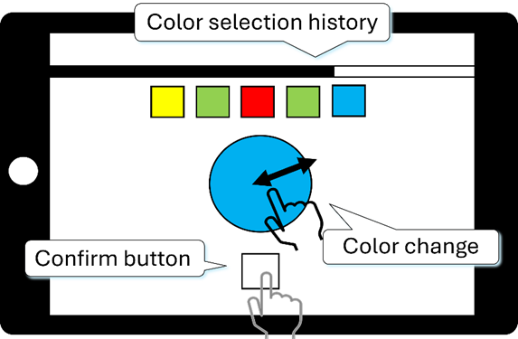
Figure 1 shows interface for the CQCT as measuring divergent thinking task. In this task, users are asked to generate a one-dimensional color queue consisting of 100 elements.
This task was designed and implemented with tablet devices in mind. Up to five previously selected colors are displayed in the “color selection history”. Users were instructed to avoid generating a color sequence like the one displayed in the color selection history. In the color selection history, users can change the color displayed on the screen by swiping their finger. The currently displayed color can be selected by tapping the “confirm button”. The users were asked to repeat these steps until the color queue was complete. The more randomly the colors were selected, without any apparent pattern, the greater the inferred flexibility.
Figure 1: Interface for the Color Queue Creation Task.
Designing an Experimental Method for Evaluating Divergent Thinking 113 Creativity is the process of coming up with new combinations of existing thoughts and ideas, and the act of combining ideas unconsciously is important (Young, 2003). Therefore, highly flexible people are thought to be able to randomly generate a variety of ideas without biased thinking. On the other hand, less flexible people are thought to repeatedly recall the same ideas due to their own unique thinking habits and preferences, even when attempting to randomly generate a variety of ideas. It is also believed that randomness within people influences divergent thinking, and it has been suggested that randomness is important for generating novel ideas (Sonia, 2001). Based on the above, we devised this task based on the idea that the more regularity there is in the color queue generated by the user, the more that person’s cognitive biases and fixed thinking patterns are reflected, and the less flexible they can be evaluated.
Proposal of an Evaluation Index for Flexibility The regularity of the color queue defines the flexibility in CQCT. In this study, the regularity of the color queue is defined as the combination of preceding and following colors in the color queue. People with high flexibility can intentionally come up with ideas randomly without bias in their thinking, so when intentionally generating a color queue with a random color sequence, it is thought that the combinations of preceding and following colors will be diverse. On the other hand, people with low flexibility have habits and preferences in their thinking and tend to recall ideas that they have once come up with multiple times, so it is thought that when intentionally generating a color queue with a random color sequence, similar color combinations will appear multiple times.
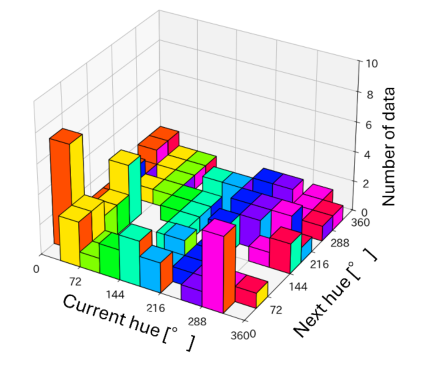
Based on the above, we consider an index for evaluating flexibility. First, we calculate the 𝑖th (1 ≤ 𝑖 ≤ 100) hue from the beginning. Hue is defined as the angle on the circumference of a circle. Next, we construct 2D histogram in 3D space. The x- and y-axes are each set to angles ranging from 0 to 360 degrees, divided into 10 equal 36-degree intervals. The z-axis is assigned the number of data points in each interval, with the x-axis representing the 𝑖-th hue and the y-axis representing the 𝑖 + 1-th hue. The horizontal plane of each bin represents the current hue and the next hue. The more biased the bins in this histogram, the more biased the color sequence of the respondent’s color queue, which can be assessed as lower flexibility. Figure 2 shows the example of 2D histogram generated from color queue in 3D space. In this example, a tendency to select yellow after red is seen. In this study, the index of flexibility in the CQCT was defined as the histogram bin standard deviation (HBSD). When expressing HBSD using a mathematical formula, we obtain where is number of bins, is amount of data in each bin and is mean of bin counts. The smaller this HBSD, the less bias there is in the histogram bins, and the more flexible the respondents are, with no bias in their thinking habits or preferences.
( )
Figure 2: 2D histogram generated from color queue in 3D space.
PRELIMINARY EXPERIMENT Overview
We conducted an experiment to verify the effectiveness of the CQCT. The experiment was conducted between July 23, 2025, and July 26, 2025, targeting undergraduate and graduate students at Kyoto University. Eight participants were involved: six men and two women, with an average age of 21.1 and a standard deviation of 1.9. Because this experiment involved color, participants were required to complete a pre-test questionnaire to confirm that they did not have color vision deficiencies, given that color perception varies. Hereafter, the eight participants will be referred to as ID1001, 1002, ... 1008 in the order in which the experiment was conducted. This experiment was conducted with the approval of the Graduate School of Energy Science, Kyoto University.
In this experiment, participants completed two evaluation tasks: the CQCT and the AUT. For the CQCT, participants were asked to complete the task with time constraint (time constraint condition) and without time constraint (control condition). By comparing the results, we verified the effectiveness of measuring the impact of changes in the environment and conditions on flexibility. For the AUT, participants were asked to identify as many alternatives uses for a familiar object as possible within a four-minute period. By comparing the flexibility results in the AUT with those in the CQCT under a control condition, we verified the validity of the CQCT for assessing human flexibility characteristics.
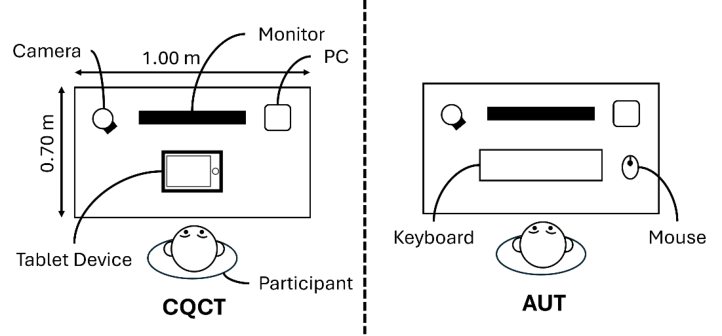
Figure 3 shows the experimental environment for the CQCT and AUT. When performing the CQCT, participants used an Apple 10.2-inch iPad (Wi- Fi, 64GB) Space Gray. When performing the AUT, participants used a display (EX-LDH271DB-B 27-inch) and keyboard. The experiment supervisor also monitored participants via camera to ensure they were concentrating on the evaluation task and not falling asleep.
Figure 3: Experimental environment for each evaluation task.
Purpose The purpose of this study was to verify two aspects of the CQCT. The first was to assess the influence of environmental and conditions on divergent thinking. The second was to assess the characteristics of individual divergent thinking. To verify item 1, we conducted a CQCT with and without a time constraint. It is believed that when time constraints become stricter, respondents are required to make decisions more quickly, limiting exploratory thinking (Amabile, 1983). This is also related to divergent thinking, and it is believed that under time constraints, existing thought patterns are more likely to be adopted (Chrysikou et al, 2016). As a result, color sequence that reflect the respondent’s habits and preferences are likely to emerge. Based on the above, we think that item 1 can be verified by confirming that the CQCT under control condition is more flexible than the CQCT under time constraint condition. To verify item 2, we examined the correlation between the flexibility of AUT, an existing evaluation task, and the HBSD of CQCT. Item 2 can be verified by confirming a significant correlation between the two results.
Procedure
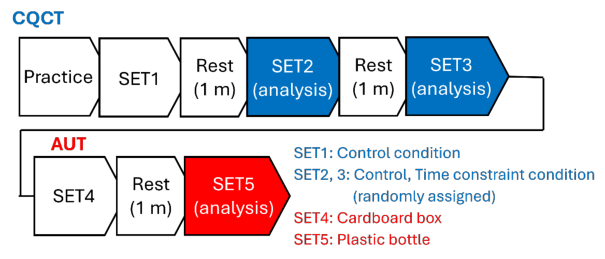
Figure 4 shows the experimental condition sequence for the CQCT and AUT. After explaining the experiment to participants about the CQCT, they were given a practice task to familiarize themselves with the interface, followed by the main task. For this task, a one-minute break was allowed between each set, with the setting set to automatically transition to the next set after the break. For SET2 and SET3, we randomly assigned participants to either the control condition or the time constraint condition to counterbalance the order effect.
After completing the CQCT, an explanation of the AUT experiment was given, and participants were then asked to complete the task. In SET4, a cardboard box was presented as the topic, and in SET5, a plastic bottle. Participants were asked to identify as many alternatives uses for each as possible. Four minutes was allowed for idea generation for each set. As with the CQCT, automatic transition to the next set was allowed after a one-minute break.
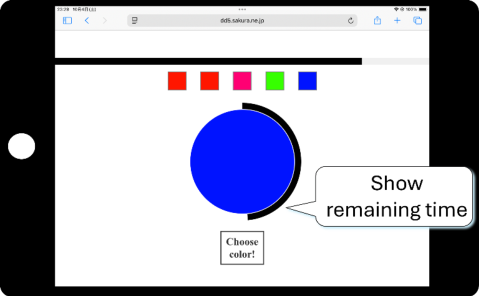
Figure 4: Experimental condition order.Figure 5: Interface for Color Queue Creation Task under time constraint condition.
Evaluation Tasks In the CQCT under control condition, the interface shown in Figure 1 was used. Participants changed colors by swiping “Color change” and selected the color by pressing “Confirm button”. They continued this process until the color queue was complete, taking care not to overlap the color sequences.
Figure 5 shows interface for CQCT under time constraint condition. Under the time constraint condition, participants were given a time limit for selecting a color. A line indicating the remaining time was displayed around the “Color change”; as time decreased, the line shortened counterclockwise. The time allowed to select a color varied depending on the participant; the time allowed was set to 0.5 times the average time required to select a color in SET 1 of the CQCT shown in Figure 4. To ensure a minimum time allowed for color changes, participants whose time was less than 1.5 seconds were set to 1.5 seconds. Under these constraints, participants were asked to complete the color queue, taking care not to overlap the color sequences, as in the control condition.
Results and Discussion
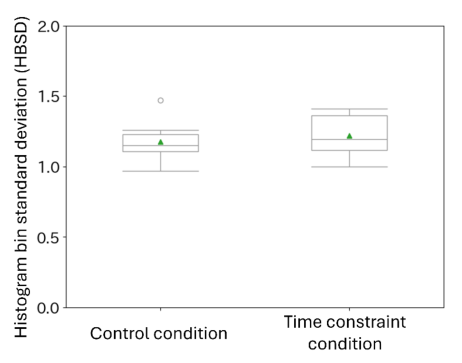
Figure 6 show the results of the CQCT under each condition. The vertical axis represents the HBSD, with smaller values indicating greater flexibility. The mean value in the control condition was 1.18, and in the time constraint condition
Designing an Experimental Method for Evaluating Divergent Thinking 117 it was 1.22, resulting in an effect size of 0.296. The mean value was lower in the control condition. Table 1 shows each participant’s HBSD values under both conditions. The values represent the HBSD, with smaller values indicating greater flexibility. Six out of eight participants had smaller HBSD in the control condition, indicating greater flexibility. These results suggest that item 1 may be possible. However, the effect size was small, likely due to the small variance of the proposed flexibility value, HBSD. In this study, the 360-degree range was divided into 10 sections, resulting in many sections compared to the amount of data. Therefore, future improvements will be necessary to create an index that is not dependent on the width of the histogram bins.
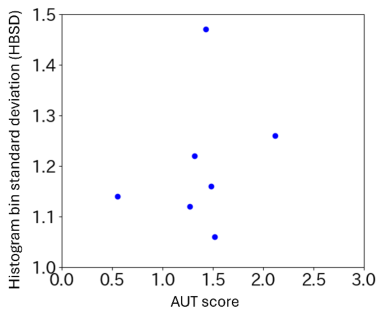
Figure 7 shows a scatter plot of the results of the HBSD under the control condition and the AUT score. The vertical axis represents the HBSD, with smaller values indicating greater flexibility. The horizontal axis represents the AUT score, with larger values indicating greater flexibility. Therefore, item 2 can be demonstrated by confirming a negative correlation. However, the results of this study did not confirm a negative correlation. This may be since respondents used different strategies for selecting colors, which may have resulted in different conditions for each respondent when engaging in the CQCT. Therefore, it is considered necessary to introduce a questionnaire aimed at investigating strategies used during task execution and analyse the relationship with AUT for each strategy.
Figure 6: Boxplot results of the HBSD under control condition and time constraint condition.Table 1: Results of the HBSD for each participant in each condition.
Table available in the original PDF paper.
Id Control Condition Time Constraint Condition
1001 1.06 1.41
1002 1.47 1.13
1003 0.97 1.00
1004 1.12 1.15
Continued
Table 1: Continued.
Table available in the original PDF paper.
1005 1.16 1.24
1006 1.26 1.35
1007 1.14 1.40
1008 1.22 1.08
Figure 7: Scatter plot of the HBSD and AUT scores.
CONCLUSION
In this study, we verified the effectiveness of a new divergent thinking assessment task, the CQCT. The results suggested its effectiveness in measuring the effects of changes in the environment and conditions, but we were unable to confirm its effectiveness in assessing the characteristics of individual divergent thinking. In the future study, we plan to revise the HBSD, the current evaluating indicator for the CQCT, introduce an experimental questionnaire aimed at investigating respondents’ color selection strategies and increase the sample size to statistically verify the effectiveness of the CQCT.
REFERENCES
Amabile, T.M. (1983). The social psychology of creativity. New York: Springer-Verlag. Baer, J. (2016). Domain specificity of creativity. Academic Press. Chrysikou, E.G., Motyka, K., Nigro, C., Yang, S.I., Thompson-Schill, S.L. (2016).
“Functional fixedness in creative thinking tasks”, Psychology of Aesthetics, Creativity, and the Arts, Volume 10, No. 4, pp. 425–435. Guilford, J.P. (1967). The nature of human intelligence. New York: McGraw-Hill. Runco, M.A. (2011). “Divergent Thinking”, in: Encyclopedia of Creativity (Second Edition). Sequeira, S. (2001). “Randomness and creativity”, Trends in Neuroscience,
Volume 24, No. 12. Torrance, E.P. (1962). Guiding creative talent. Englewood Cliffs, NJ: Prentice-Hall, Inc. Young, J.W. (2003). A technique for producing ideas. New York: McGraw-Hill.
LISTED IN THE AHFE DIGITAL BOOKSTORE CATALOGUE
Explore the complete digital volume
Intelligent Human Systems Integration (IHSI 2026): Disruptive and Innovative Technologies
Read this individual research paper free through the original publisher, or explore the full digital proceedings book.
ISBN 978-1-964867-76-2
Explore this ISBN in the AHFE Bookstore ↗Listed in the July 2026 bookstore catalogue; search by ISBN to confirm current availability · Digital book purchase optional