Shunya Tanaka, Wataru Ogomori, Kimi Ueda, Hirotake Ishii, Hiroshi Shimoda (2026). Promoting Pro-Environmental Behavior through Destructive Experiences in Virtual Reality: Design and Implementation of the VR Experience. In: Intelligent Human Systems Integration (IHSI 2026): Disruptive and Innovative Technologies. AHFE Open Access, vol. 200, pp. 598–603. https://doi.org/10.54941/ahfe1007118
In recent years, the worsening of environmental issues such as global warming and resource depletion has highlighted the growing importance of individual pro-environmental behavior (PEB). However, everyday actions such as waste sorting, energy saving, and water conservation often fail to translate into consistent practice. Therefore, new external approaches are required to motivate such behaviors. Recent studies suggest that positive emotions such as enjoyment and a sense of achievement can encourage PEB. This study focused on positive emotions such as exhilaration and achievement.In this research, we attempted to promote PEB by providing an exhilarating and rewarding experience through destructive actions in virtual reality (VR). Destructive behavior is often characterized by strong physical and sensory stimulation and has the potential to evoke feelings of exhilaration and satisfaction. However, in real-world contexts it is often avoided because it involves danger and is socially inappropriate. In contrast, VR makes it possible to safely engage in such experiences without inducing guilt, allowing for the design of interactions that effectively elicit only positive emotions. By leveraging these characteristics, VR-based destruction experiences can offer new opportunities for behavioral change. Specifically, we developed a destruction-based task using two-choice quiz questions related to environmental issues. In this task, they answer by destroying with a handheld stick the panel corresponding to the option they believe to be correct, which is presented in the VR environment. When the correct option is chosen, the panel shatter dramatically with visual effects, accompanied by exhilarating sound effects. This design is intended to reinforce the sense of exhilaration and achievement through both visual and auditory stimulation.The experiment was conducted with 10 university students, divided into a test group with the destruction experience (n = 5) and a control group without the destruction experience (n = 5). Although both groups answered the same questions, the method of responding differed, which served as the basis for comparison. The measurement items included the Pro-Environmental Behavior Test (PEBT) to evaluate pro-environmental behavioral implementation, the Multiple Mood Scale (MMS) to assess emotional states, and a post-experience questionnaire. The questionnaire focused on key factors contributing to a sense of exhilaration, and participants’ overall impressions of the experience were also collected through free descriptions.As a result of the experiment, the test group scored higher on the PEBT compared to the control group, indicating that pro-environmental behavior was more strongly promoted. In addition, an increase in “active pleasure” was observed in the MMS, suggesting that the destruction experience significantly induced positive emotions. Free responses also included several positive comments such as “I felt refreshed” and “The destruction was fun.” These results suggest that VR-based destruction experiences can serve as an effective method for promoting pro-environmental behavior through positive emotions. Although this study was limited by the small number of participants, the clear emotional effects and changes in behavior observed even in a small-scale experiment are noteworthy. Future research should increase the sample size to examine statistical validity and further clarify the semantic relationship between destruction experiences and pro-environmental behavior.
In recent years, environmental and energy issues have become increasingly serious. To address and mitigate these challenges, promoting individuals’ pro-environmental behavior (PEB) has become crucial. PEB includes actions such as saving electricity, conserving water, and sorting waste; however, it remains a challenge to translate awareness into actual behavior. Therefore, additional motivational strategies beyond mere awareness are required to encourage PEB.
Although numerous studies have examined PEB, a high level of concern about environmental issues does not necessarily lead to the actual imple mentation of PEB (Bamberg, 2007). This finding suggests that enhancing awareness and concern alone is insufficient, and other forms of intervention are needed. Recent studies have highlighted the critical role of psychological states in PEB, particularly the induction of positive emotions, which has been highlighted as a key factor influencing behavioral engagement.
Promoting Pro-Environmental Behavior through Destructive Experiences 599 For example, presenting environmental messages designed to evoke posi tive emotions increased participants’ intentions to engage in PEB (Chatelain, 2018). Similarly, in a donation game, positive emotions tended to increase the amount donated to environmental organizations, suggesting that emo tional states can influence voluntary pro-environmental actions (Ibanez, 2017). These findings imply that positive emotions serve as a psychological mechanism not only for enhancing awareness but also for facilitating sus tainable behavioral change.
The aim of this study is to design and implement a positively framed destruction experience in virtual reality through a preliminary experiment, in order to explore its potential to evoke positive emotions and consequently promote pro-environmental behavior. This paper reports on the design of the VR destruction task and presents preliminary experimental results examin ing its effects on participants’ emotions, moods, and PEB.
Destruction Experience in Virtual Reality VR experiences are known to have a strong influence on users’ psychology and behavior due to their high levels of immersion and sense of agency. For example, participants who experienced flying like a superhero in a VR envi ronment were found to exhibit more altruistic behaviors in the real world, suggesting that active experiences can induce positive behavioral change (Rosenberg, 2013). Thus, active experiences in environments with a strong sense of agency are effective in promoting psychological and behavioral transformation.
Among various active experiences, destruction-based activities involve intense physical and sensory stimulation, and those intense stimuli are hypothesized to trigger excitement and pleasure.
For instance, it has been reported that participants who engaged in smashing ceramic or glass objects in VR expressed positive feedback such as “fun” and “refreshing” (Persson, 2021). On the other hand, while destructive acts can function as a form of catharsis for releasing anger, they have also been associated with increased aggression and hostility (Bushman, 2002 and Kjærvik, 2024).
Development of the VR Destruction Task
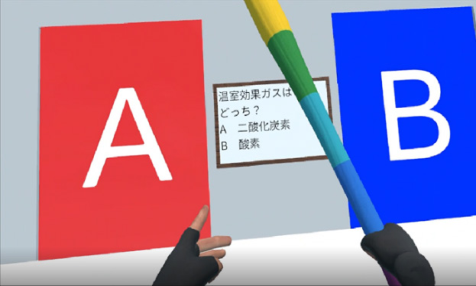
Figure 1 shows the scene during the VR destruction experience developed in this study. As a VR destruction task, a two-choice quiz format related to environmental issues was adopted. In the task, participants were presented with 10 multiple-choice questions in the VR environment (e.g., “Which is a greenhouse gas?” A: Carbon dioxide, B: Oxygen). Participants answered by destroying the panel corresponding to the option they believed to be correct using a handheld stick.
Since the purpose of this task is not knowledge acquisition but the destruc tion experience itself, the quiz questions were intentionally designed to be simple and focus on basic environmental knowledge. When a correct answer was selected, visual and auditory feedback was implemented to enhance the
sense of exhilaration and achievement. The task was developed using Unity, and the VR device used for the experience was Meta Quest 2.
Figure 1: VR environment during the experience.
Experimental Method An experiment was conducted to evaluate whether the developed VR destruc tion task could evoke feelings of exhilaration and achievement and thereby contribute to the promotion of PEB. The experiment involved ten students from Kyoto University, divided into two groups: 5 participants in the test group, who performed the VR destruction task, and 5 participants in the con trol group, who experienced a non-destruction version of the task in which they simply passed through the panels without breaking them. The partici pants were aged between 18 and 24 years, consisting of 4 males and 6 females.
To assess participants’ mood and emotional states, the Multiple Mood Scale (MMS) (Terasaki, 1992) was used. The MMS is a questionnaire designed to evaluate affective and mood states, consisting of ten items per subscale and measuring multiple emotional factors. In this study, six factors—Active Pleasure, Passive Pleasure, Fatigue, Anxiety/Depression, Astonishment, and Hostility—were selected to examine the reduction of psychological burden and the induction of positive emotions through the VR destruction task. For each factor, the five items with the highest factor loadings were used, and participants rated them on a five-point Likert scale. Additionally, a post-ex perience questionnaire was administered to evaluate subjective impressions such as pleasure and a sense of accomplishment. The questionnaire consisted of six items: “Did you feel refreshed?”, “Were you absorbed in the VR expe rience?”, “Were you satisfied with the VR experience?”, “Did you feel a sense of accomplishment?”, “Did the experience relieve tension or stress?”, and “Did you feel fatigue?” Responses were obtained on a five-point Likert scale.
To measure the promotion of PEB, the Pro-Environmental Behavior Task (PEBT) (Lange, 2018) was employed. In the PEBT, participants choose between two transportation options on each trial: one with low environmen tal impact but longer waiting time, and another with high environmental impact but shorter waiting time. The task consists of 24 trials with varying combinations of waiting times. In this study, participants completed PEBT
Promoting Pro-Environmental Behavior through Destructive Experiences 601 both before and after the VR task, and the change in the number of environ mentally friendly choices was used as a behavioral indicator of PEB promo tion. Since the PEBT was administered twice in a single session, a shortened version of 24 trials was used to reduce participant burden while maintaining task validity.
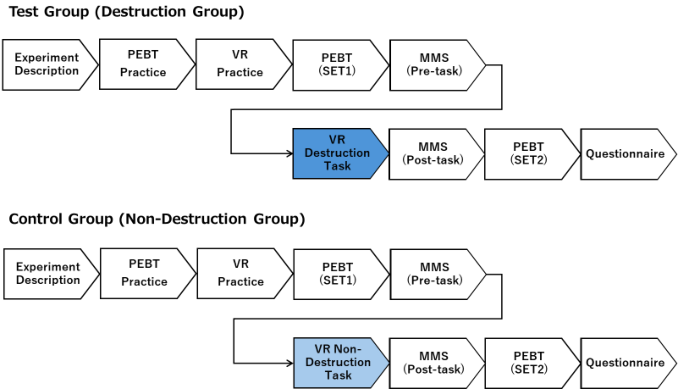
The overall procedure of the experiment is illustrated in Figure 2. Prior to the start of the experiment, participants were briefed on the study’s aims and procedures. After the briefing, participants completed a short prac tice session to familiarize themselves with the controls of the VR device. In addition, participants were given a practice session of PEBT to ensure that they understood the structure and decision-making process of the task. After completing the practice sessions, the experimental sequence proceeded as follows: MMS (pre-task), PEBT (pre-task), VR destruction task, MMS (post-task), PEBT (post-task), and finally the post-experience questionnaire.
Figure 2: Experimental procedure.
Results
Table 1 shows the results of the PEBT, displaying the mean scores for both the test and control groups. The results indicate that the test group showed an increase in scores, while the control group exhibited little change. This suggests that the developed VR destruction task may have the potential to promote PEB.
Table 1: The result of PEBT.
Table available in the original PDF paper.
Equation reproduced from the original PDF.
Post-task 15.2 14.4 Change +1.2 –0.2
Subsequently, Table 2 presents the results of the MMS, which was con ducted to evaluate changes in mood and emotional states. The total scores for each factor were calculated, and the average changes before and after the experience were compared. As a result, the test group showed an increase in Active Pleasure and a decrease in Inactive Pleasure.
Hostility +0.8 ±0.0 Finally, Table 3 shows the results of the post-experience questionnaire. The mean scores for all items were high in the test group, confirming that the designed task might elicited feelings of exhilaration and satisfaction.
Table 3: The results of the post-experience questionnaire.
Table available in the original PDF paper.
Equation reproduced from the original PDF.
Absorbed 4.4 3.0 Satisfied 4.6 3.4
Accomplished 4.2 3.2 Relieve tension 4.0 2.2
Fatigue 1.6 3.6
DISCUSSION
The results of this study indicate that the developed VR destruction task effectively elicited positive emotions such as exhilaration and a sense of achievement. The observed increase in Active Pleasure and decrease in Passive Pleasure suggest that participants experienced physically and actively induced positive emotions rather than calm or passive pleasantness. Moreover, the minimal change in the Hostility factor demonstrates that, despite involving destructive actions, the task was designed to avoid eliciting aggression or negative effects.
However, several limitations must be acknowledged. The most significant is the small sample size (n = 10), which restricts the statistical generalizability of the findings. Additionally, since the study focused on short-term effects, the long-term influence of positive emotional experiences on sustained PEB remains unclear. Future research should employ a larger sample and longitu dinal design to validate the robustness and persistence of these effects.
CONCLUSION
This study proposed and tested a VR destruction task designed to evoke positive emotions such as exhilaration and a sense of achievement as a novel approach to promoting PEB. The findings demonstrate that such an expe rience can induce active and enjoyable emotional states without triggering aggression, and that these emotions may contribute to enhancing pro-envi ronmental decision-making.
Future work will involve a larger-scale experiment to statistically verify the effects of the task.
REFERENCES
Bamberg, S., & Moser, G. (2007). Twenty years after Hines, Hungerford, and Tomera: A new meta-analysis of psycho-social determinants of pro-environmen tal behaviour. Journal of Environmental Psychology, 27, 14–25. Bushman, B. J. (2002). Does venting anger feed or extinguish the flame? Personality
and Social Psychology Bulletin, 28(6), 724–731. Chatelain, G., & Hille, S. L. (2018). Feel good, stay green: Positive affect promotes pro-environmental behaviors and mitigates compensatory “mental bookkeeping” effects. Journal of Environmental Psychology, 56, 3–11. Ibanez, L., & Moureau, N. (2017). How do incidental emotions impact pro-envi
ronmental behavior? Evidence from the dictator game. Journal of Behavioral and Experimental Economics, 66, 150–155. Kjærvik, S. L., & Bushman, B. J. (2024). A meta-analytic review of anger manage ment activities that increase or decrease arousal. Clinical Psychology Review, 109, 102414. Lange, F., Steinke, A., & Dewitte, A. (2018). The Pro-Environmental Behavior
Task: A laboratory measure of actual pro-environmental behavior. Journal of Environmental Psychology, 56, 46–54. Persson, J., & Clifford, D. (2021). A virtual smash room for venting frustration or just having fun: Participatory design of virtual environments in digitally reinforced cancer rehabilitation. JMIR Rehabilitation and Assistive Technologies, 8(4). Rosenberg, R. S., Baughman, S. L., & Bailenson, J. N. (2013). Virtual superheroes:
Using superpowers in virtual reality to encourage prosocial behavior. PLOS ONE, 8(1). Seinfeld, S., & Arroyo-Palacios, J. (2018). Offenders become the victim in virtual reality: Impact of changing perspective in domestic violence. Scientific Reports, 8, 2692. Terasaki, Kishimoto, Koga (1992). Refreshing Feeling of Physical Exercises and Its
Factors (1). Journal of health science, 62(6), 350–356, in Japanese.
LISTED IN THE AHFE DIGITAL BOOKSTORE CATALOGUE
Explore the complete digital volume
Intelligent Human Systems Integration (IHSI 2026): Disruptive and Innovative Technologies
Read this individual research paper free through the original publisher, or explore the full digital proceedings book.
ISBN 978-1-964867-76-2
Explore this ISBN in the AHFE Bookstore ↗Listed in the July 2026 bookstore catalogue; search by ISBN to confirm current availability · Digital book purchase optional