Langsong Sun, Kimi Ueda, Hirotake Ishii, Hiroshi Shimoda (2025). Mitigating VR Motion Sickness in Visual Sharing Based on Observer-Observed Coupled Movements. In: Metaverse, Virtual Environments and Game Design. AHFE Open Access, vol. 178, pp. 66–75. https://doi.org/10.54941/ahfe1006346
Visual sharing via Virtual Reality (VR) significantly enhances skill transfer within complex industrial domains. However, sharing another's viewpoint can lead to severe motion sickness. Although many researchers have proposed numerous solutions to address VR sickness, few are specifically tailored for visual-sharing experiences. This study aims to propose the VR sickness mitigation method for VR visual-sharing experiences introducing Observer-Observed (Observer and Operator) Coupled Movements. This method can reduce the disparity between the body's movements and the visuals by field of view restriction and motion-compensated point rendering with observer-observed coupled movements in the visual-sharing system. Furthermore, this study experimented to verify the effects of the proposed method. The results indicate that using this method during shared viewpoints can reduce the sickness caused by perceptual and visual discrepancies to some extent without significantly impacting the observer's understanding of the content in the VR experience.
Visual sharing technology is being applied in various fields. Many researchers and companies are also implementing techniques based on visual synchronization for technical skill transfer (Kurosaki et al., 2011), like facilitating the transfer of maintenance techniques in complex nuclear power plants. For instance, by sharing viewpoints, a novice can grasp the overall workflow from the perspective of a veteran. This method can be expected to have a higher learning effect than traditional face-to- face learning, where a novice observes a veteran’s work from different perspectives. Kodama et al. have confirmed that when the movements of beginners and veterans are synchronized within a Virtual Reality (VR) space, the short-term learning effects are very high (Kodama et al., 2023). However, there are still many challenges to introducing visual-sharing technology. Sharing the viewpoint of a veteran, the sensory information obtained through observation can significantly deviate from one’s intentional movements, potentially causing severe VR sickness. To mitigate these symptoms, techniques such as temporarily disconnecting screen sharing
Mitigating VR Motion Sickness in Visual Sharing 67
during sudden changes in viewpoint, sharing only the position of avatars controlled by both parties instead of the entire view (Kodama et al., 2023), or avoiding visual sharing and observing work from other perspectives have been tried (Tserenchimed et al., 2024). However, these methods can make it challenging to understand the actions of others. Although many studies proposed methods to reduce VR sickness for individual users (Wienrich et al., 2018) (Park et al., 2023) (Park et al., 2022) (Kim et al., 2023), there are few studies specifically focused on VR sickness related to visual sharing experiences.
Therefore, this study aims to explore methods that reduce VR sickness in VR visual sharing experiences without compromising the ease of understanding others’ actions.
VR VISUAL SHARING AND MOTION SICKNESS MITIGATION VR Visual Sharing
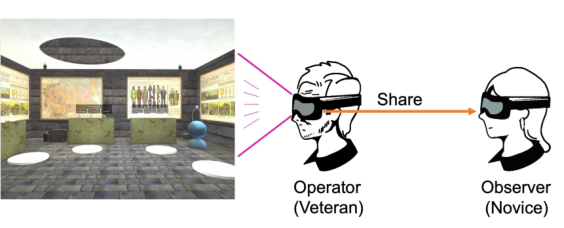
In an essential VR visual sharing experience, as shown in Figure 1, multiple users in the same virtual space sharing a single viewpoint can enable joint experiences that are impossible in the real world (Hoppe et al., 2021). Chenechal et al. proposed the MR system ‘Vishnu’, where a veteran skilled in VR tasks can control the viewpoint with a VR device and provide real-time support to users sharing the viewpoint through AR (Chenechal et al., 2016). In industrial applications, multiple veterans use VR visual sharing to provide real-time guidance and advice (Josef et al., 2020).
Figure 1: Example of VR visual sharing.
Thus, VR visual sharing technology enables natural interactions as if one is performing the tasks themselves by observing from another’s perspective, and it allows for a deeper understanding of others’ actions compared to regular VR experiences. However, the VR sickness that arises when using VR visual sharing systems has not yet been resolved, which has limited its widespread adoption.
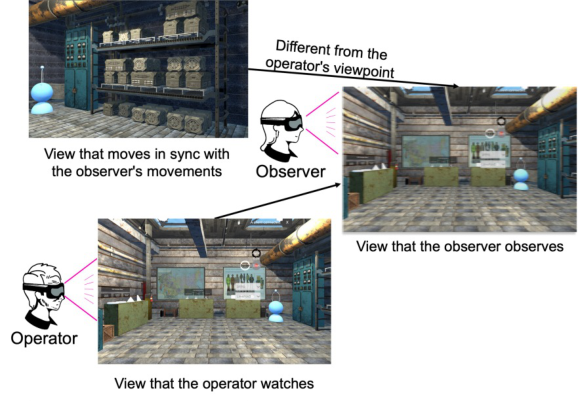
Sickness Caused by VR Visual Sharing In VR visual sharing, as shown in Figure 2, observing another person’s viewpoint results in receiving visual information that differs from one’s body
movements. This makes it more likely to induce VR sickness, especially when the other person makes sudden movements, causing the observer to experience these intense movements visually.
Figure 2: Example of sickness caused by VR visual sharing.
In VR visual sharing, the following two main factors contribute to this:
Sensory mismatch: The difference between bodily movements and visual inputs leads to discrepancies between vision and vestibular senses.
Difficulty in predicting viewpoint changes: Observers cannot anticipate changes in their viewpoints, which places a strain on the brain (Tserenchimed et al., 2024).
In these respects, VR visual sharing requires more complex processing than typical VR experiences. According to research by Le Chenechal et al. (2016), the complexity of operations in visual sharing systems can increase, potentially leading to a greater degree of experienced sickness.
Thus, VR sickness is more likely to occur in VR visual sharing than in typical VR experiences.
PROPOSAL FOR VR SICKNESS MITIGATION METHOD IN VISUAL SHARING VR Sickness Mitigation Method in Visual Sharing Based on Observer-Observed Coupled Movements
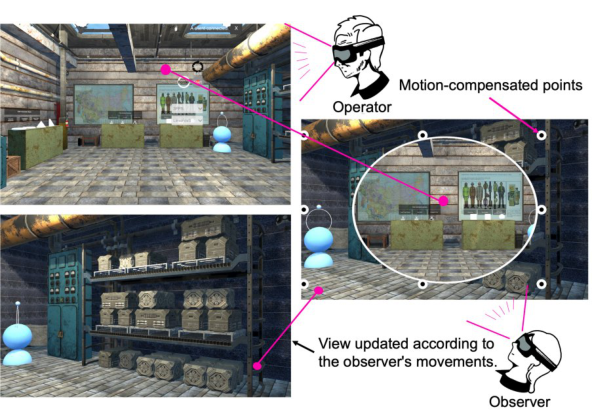
The methodology of this study is summarized as shown in Figure 3. Expanding existing VR sickness mitigation methods (Chang et al., 2020) (Ishio et al., 2015) (Martijn et al., 2011) (Mazloumi et al., 2017), we restricted the field of view reflecting the operator’s action perspective watching by the observer, an observe-window is placed within the observer’s field of view to observe the operator’s perspective, and the size of this window
Mitigating VR Motion Sickness in Visual Sharing 69
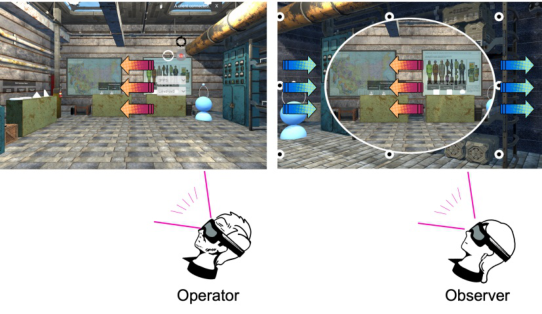
changes based on the movements of both the observer and the operator. The observe-window is set to ensure that the observer can fully understand the shared scene. Then, images obtained from the observer’s movements are added to the periphery of the field of view. Furthermore, circular points related to the differences in movements between both parties also overlaid the observer’s view. For example, Figure 3 shows the operator’s viewpoint moves left while the observer’s viewpoint moves right. In that case, a view moving in the opposite direction to the right and circular points moving left are displayed on the periphery of the observe-window. By adding view and points opposite to the discrepancies between the observer and the operator’s movements to the observer’s field of view, we attempt to reduce the disparity between the visual information received and the bodily information, thereby realizing a more effective VR sickness mitigation method in VR visual sharing experiences.
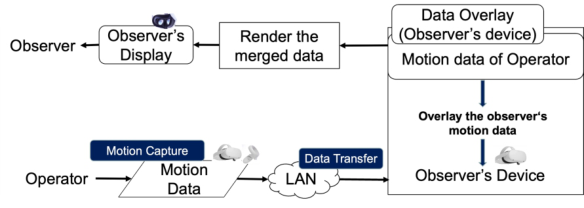
Figure 3: VR sickness mitigation method in visual-sharing.Figure 4: Data transfer of visual sharing.
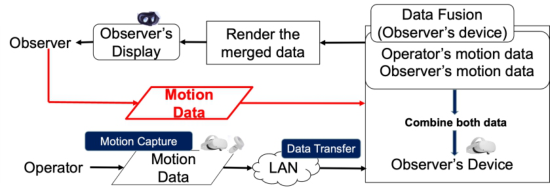
Implementation of the Proposed VR Sickness Mitigation Method in Visual Sharing As shown in Figure 4, in this experimental system, to minimize latency as much as possible for optimal performance, a method was adopted that uses the KCP protocol over a LAN (Local Area Network) to send the current position and orientation of the operator’s viewpoint directly to the observer’s HMD.
Figure 5: Data transfer of proposed method.
Unlike a visual sharing system, as shown in Figure 5, this mitigation method utilizes the observer’s device’s rotation to control the images presented.
Figure 6: Data fusion in the observer’s device.
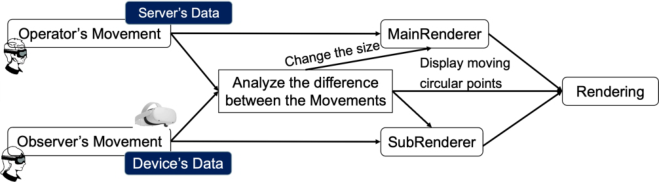
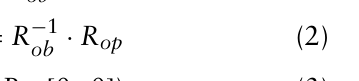
Figure 6 illustrates the process flow of this study’s VR sickness mitigation method. To realize this method, generating two types of images is necessary: one according to the observer’s movements and the other according to the operator’s movements. To achieve this, the study uses two renderers, a main- renderer and a sub-renderer, as functions to generate the images. After the observer’s device receives data from the operator, the operator’s movements are then transmitted to the main-renderer, and the sub-renderer reads the observer’s movements. Then, we use the two sets of motion data (Quaternion of the observer (Qob) and Quaternion of the operator (Qop)) to calculate the Rotation matrix of observer Rob and the Rotation matrix of operator Rop. By these two parameters (Rob&Rop), we can get the Difference Quaternion
Mitigating VR Motion Sickness in Visual Sharing 71
Rdr. Finally, the difference angle θ is analyzed and calculated below, Difference Quaternion Qdq = Q−1 ob · Qop (1)
Equation reproduced from the original PDF.Equation reproduced from the original PDF.
and the rendering range of the main-renderer will be confined to a window and scaled according to the differences. The speed and direction of circular points displayed based on these differences and Qdp will overlap on both renderers as visual stimuli, indicating the tendencies opposite the difference. Figure 7 shows an example of the screen of the implemented system.
Figure 7: The example of the proposed method.
This system was developed using the Unity Engine 2022.3.16f1 and implemented device communication via the Mirror Package (JesusLuvsYooh, 2023). The HMD used was the Meta Quest 3.
EXPERIMENT FOR VALIDATION Purpose
This study’s proposed method explicitly targets VR motion sickness under visual sharing conditions. To verify the proposed method’s effectiveness, this study makes the following hypothesis and has conducted a corresponding experiment. We obtained approval from the Institutional Ethics Committee of Graduate School of Energy Sciences, Kyoto University.
Hypothesis: Compared to VR visual sharing experience without the proposed method, experience with the proposed method resulted in milder VR sickness without affecting the observer’s understanding of the content in the space.
Suppose the experiment using the proposed method proves this hypothesis. In that case, it suggests that the proposed method is helpful as a VR sickness mitigation method in visual sharing and has a certain practicality.
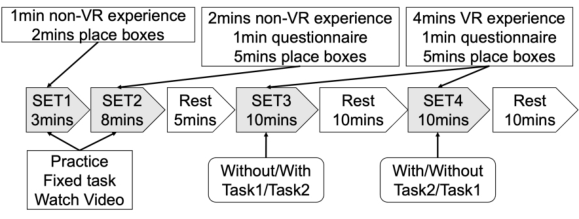
Figure 8: Experimental procedure.
Method
Figure 8 shows the experimental procedure. Each participant must experience four sets (two practice and two formal sets). In the practice sets, they were asked to watch the video to memorize two tasks described later. Two sets of trials were conducted in the formal sets, both using pre-designed tasks that might induce VR motion sickness. One set was performed without the proposed method, and the other was performed with the proposed method. This experiment used within-subject comparison, requiring each participant to experience both sets of trials. To balance the results, different participants experienced the experiments in various orders. After completing each set of trials, participants were required to immediately fill out the SSQ questionnaire to record the severity of motion sickness felt during the experience (Robert et al., 1993) (Hirayanagi, 2006). Additionally, at least ten minutes of rest time was scheduled after each set of trials until participants reported full recovery from the symptoms of the previous group.
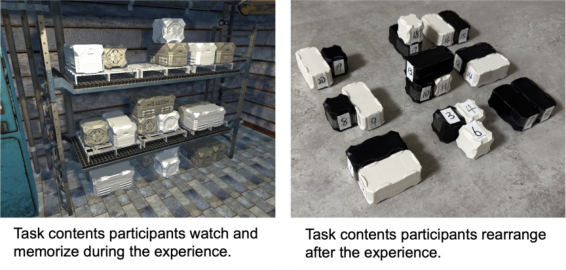
Figure 9: Example of the task content.
Figure 9 shows the contents of one of the tasks. The tasks involve participants experiencing the observer’s perspective and watching the operator place boxes on shelves in a specific sequence. The boxes come in two colors, and each color has two sizes. Observers need to note the operator’s placement order and, after filling out the questionnaire, place the
Mitigating VR Motion Sickness in Visual Sharing 73
correct boxes in the proper order themselves on the table. This task has two sequences; participants must memorize different sequences in the two sets of formal experiments. Participants also experience the two placement sequences in various orders to ensure experimental balance. This task ensures that participants remain focused on the experimental content and allows for an assessment of their understanding of the spatial content. Task results will be scored based on whether the boxes are placed in the correct positions in the proper order.
In this experiment, we recruited 34 Kyoto University students, all over 18, as experimental participants (observers).
Result and Discussion
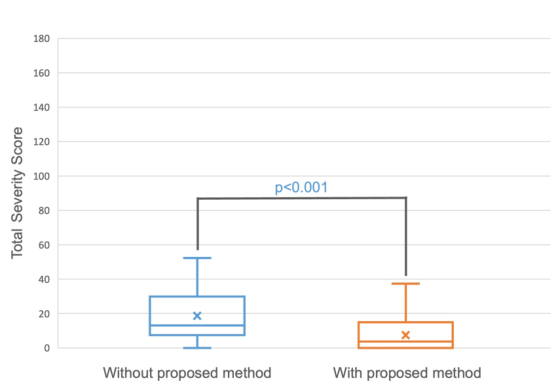
The experiment yielded 34 sets of valid data. Figure 10 shows the sickness results for each formal experimental condition as a boxplot. The sickness data for the group that did not use the proposed method (control group) and the group that used the proposed method (experimental group) were each tested for normal distribution using the Shapiro-Wilk test. The results showed that neither group’s data followed a normal distribution. The Wilcoxon signed-rank test was used to determine if there was a significant difference between the two groups. A Wilcoxon signed-rank test showed a significant difference between the control group (Mdn = 13.09) and the experimental group (Mdn = 3.74), Z = 4.3, p <0.001, r = −0.52. This indicates that the method proposed can alleviate the sickness experienced by observers in the visual sharing system.
Figure 10: Boxplot of sickness results across experimental conditions.
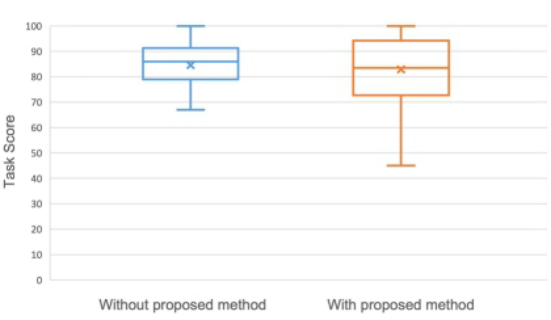
Figure 11 shows the task score results for each formal experimental condition as a boxplot. The score results showed that the control group had a mean of 84.56, and the experimental group had a mean of 82.88. The gap between the two sets of data is minimal.
Figure 11: Boxplot of task scores across experimental conditions.
The experimental results validate the hypothesis proposed earlier: the proposed method effectively reduces the sickness felt by observers during the visual sharing process without impacting their understanding of the content within the space.
Participants had varying opinions on the method’s use of motion data to restrict the field of view while displaying a view on the periphery that aligns with the observer’s movement tendencies and moving points. Some participants felt that limiting the field of view was more effective in mitigating motion sickness. In contrast, others believed the moving dots, which inform the observer of unseen viewpoint movements, helped reduce motion sickness. A significant number of participants also found both methods effective or ineffective. Based on participants’ opinions, there are very different views regarding the motion sickness they experienced, the causes of the motion sickness, and the ways to alleviate it. Further experimental investigation is needed to determine which factors impact most participants more.
CONCLUSION
This study has successfully demonstrated a VR sickness mitigation method tailored for visual sharing systems. This method leverages Observer-Observed Coupled Movements to reduce the sensory mismatch often responsible for VR sickness. The experiments validate the proposed method’s efficacy in significantly reducing the discomfort associated with VR visual sharing without compromising the observer’s understanding of spatial content. The innovative method dynamically adjusts the observer’s field of view, displaying a view on the periphery corresponding to the observer’s movements and showing motion-compensated points across the merged view. Both features are implemented based on Observer-Observed Coupled Movements, effectively enhancing the user experience in immersive environments.
However, this study specifically focuses on how to mitigate the sickness they experience through Observer-Observed Coupled Movements. Future research will require further refinement of the experiments based on
Mitigating VR Motion Sickness in Visual Sharing 75
participants’ insights, and separate trials will be conducted using only restricting the field of view or displaying the moving circular points to compare results.
REFERENCES
Chang, E., Kim, H. T., Yoo, B. (2020). Virtual Reality Sickness: A Review of Causes and Measurements, International Journal of Human-Computer Interaction, Volume 36, No. 17. pp. 1658–1682. Chenechal, M. L. J., Duval, T., et al. (2016). Vishnu: Virtual immersive support for
HelpiNg users an interaction paradigm for collaborative remote guiding in mixed reality, 3DCVE. pp. 9–12. Hirayanagi, K. (2006). A present state and perspective of studies on motion sickness, The Japanese Journal of Ergonomics, Volume 42, No. 3, pp. 200–211. Hoppe, A. H., et al. (2021). ShiSha: Enabling Shared Perspective With Face-to-
Face Collaboration Using Redirected Avatars in Virtual Reality, Proceedings of the ACM on Human-Computer Interaction, Volume 4 No. CSCW3. Ishio, H., Yamakawa, T., et al. (2015). A Study on Within-Subject Factors for Visually Induced Motion Sickness by Using 8K Display, Universal Access in Human-Computer Interaction. Access to Interaction. pp. 196–204. JesusLuvsYooh. (2023). ExampleVR, MirrorNetworking. Website: https:// github.com/MirrorNetworking/ExamplesVR Josef, W., Jan, Z., Nobert, W. (2020). Supporting Teamwork in Industrial Virtual
Reality Applications, Procedia Manufacturing, Volume 43, pp. 2–7. Kim, S., Kim, G. J. (2023). Dynamically Adjusted and Peripheral Visualization of Reverse Optical Flow for VR Sickness Reduction, Electronics, Volume 12, No. 4. Kodama, D., Mizuho, T., Hatada, Y. (2023). Effects of collaborative training using
virtual co-embodiment on motor skill learning, Volume 29, No. 5. pp. 2304–2314. Kurosaki, K., Kawasaki, H., et al. (2011). Skill transmission for hand positioning task through view-sharing system. Augmented Human International Conference. Martijn, L., Sjoerd, C., Jelte, E. B. (2011). Internal and external fields of view affect
cybersickness, Displays, Volume 32, No. 4. pp. 169–174. Mazloumi, G. A., Hodgson, D. M., Nalivaiko, E. (2017). Effects of visual flow direction on signs and symptoms of cybersickness, PLoS One, Volume 12, No. 8, pp. 1–14. Park, M., Yun, K., Kim, G. J. (2023). Reducing VR Sickness by Directing User
Gaze to Motion Singularity Point/Region as Effective Rest Frame, IEEE Access, Volume 11. pp. 34227–34237. Park, S. H., Han, B., Kim, G. J. (2022). Mixing in Reverse Optical Flow to Mitigate Vection and Simulation Sickness in Virtual Reality. Conference on Human Factors in Computing Systems. Robert, S. K., Norman, E. L., et al. (1993). Simulator Sickness Questionnaire: An
Enhanced Method for Quantifying Simulator Sickness, The International Journal of Aviation Psychology, Volume 3, No. 3. pp. 203–220. Tserenchimed, T., Kim, H. (2024). Viewpoint sharing method with reduced motion sickness in object based VR/AR collaborative virtual environment, Virtual Reality, Volume 28, No. 3. Wienrich, C., Weidner, C. K., et al. (2018). A Virtual Nose as a Rest Frame. The
Impact on Simulator Sickness and Game Experience. International Conference on Virtual Worlds and Games for Serious Applications (VS-Games). pp. 1–8.
LISTED IN THE AHFE DIGITAL BOOKSTORE CATALOGUE
Explore the complete digital volume
Metaverse, Virtual Environments and Game Design
Read this individual research paper free through the original publisher, or explore the full digital proceedings book.
ISBN 978-1-964867-54-0
Explore this ISBN in the AHFE Bookstore ↗Listed in the July 2026 bookstore catalogue; search by ISBN to confirm current availability · Digital book purchase optional