Yaqin Ping, Men Han Li, En Guo Cao (2025). G-LLE System Design: Gamified Rehabilitation for Children’s Lower Limb Therapy Based on Natural Mapping. In: Metaverse, Virtual Environments and Game Design. AHFE Open Access, vol. 178, pp. 130–139. https://doi.org/10.54941/ahfe1006352
It is widely recognized that gamification can potentially improve users' performance in rehabilitation tasks. However, limited research has addressed mitigating additional cognitive load from gamification in pediatric rehabilitation. This study examined a natural mapping-based gamified rehabilitation system to improve children's rehabilitation performance and minimize cognitive load from a user-centered perspective. Eighteen participants were enrolled in a controlled trial, providing questionnaire feedback and interviews after each situation. The results showed that G-LLE improved children's rehabilitation performance and maintained a low cognitive load. On the other hand, it revealed the importance of personalised game elements and immersive interactions in enhancing the rehabilitation experience. This study demonstrates the potential of a user-centered design approach to innovating pediatric rehabilitation, offering valuable insights for developing scalable and personalised gamified rehabilitation systems.
The application of gamification has become a research trend in rehabilitation training (Alfieri et al., 2022). Gamification can be defined as a method for applying game design elements in non-game environments to enhance user engagement and performance (Huotari and Hamari, 2017). In the pediatric field, some studies have been conducted to enhance children’straining performance (Sardi et al., 2017) by incorporating engaging game elements into functional training. Some studies have shown that the therapeutic use of gamification in rehabilitation training can enhance patients’pleasure (Gabele et al., 2021), motivation, (Pan et al., 2019) and therapeutic adherence (Pimentel-Ponce et al., 2023).
Although gamified rehabilitation training has been explored in many research studies, existing gamified rehabilitation systems face a series of limitations in user experience that affect their development. For example, compared with ordinary rehabilitation training, there is a higher cognitive load (Wang et al., 2024). Some new technologies may cause problems such
G-LLE System Design: Gamified Rehabilitation for Children’s Lower Limb Therapy 131
as dizziness or insufficient safety considerations. Limited prior research has explored strategies to minimize cognitive load in gamification approaches while simultaneously enhancing user experience. Therefore, it is very important to explore how to improve children’s performance and experience in rehabilitation training and reduce mental demand through gamification. This study investigates the design of a gamified rehabilitation system based on natural mapping to improve the experience and reduce cognitive load.
In games, natural mapping is often used to match real-world actions with game operations. Natural mapping theory refers to the simulation of behavioral patterns in a natural state by aligning the user’s actual movements with the system’s feedback (Clausen et al., 2020). It allows the user’s actual actions to be directly mapped to the virtual task, thereby reducing the learning cost and cognitive load. Building on evidence that natural mapping can enhance gamification, this study explores its effectiveness in optimizing rehabilitation experience for children. We independently designed G-LLE system and through controlled experiments we evaluated task performance and user experience, finding that a natural mapping-based gamified approach can improve user experience while maintaining low cognitive load.
RELATED WORK
Children’s Motor Rehabilitation Pediatric motor rehabilitation is complicated by children’s unique physical and psychological traits, with lower-limb recovery being a key concern. Traditional physical therapy methods like electrical stimulation and weight- bearing focus on physical function but often neglect psychological and social factors, leading to limited long-term effectiveness and low adherence (Franki et al., 2012). Moreover, these therapies demand extensive therapist input and are costly (Jesus et al., 2017). To address this, home-based remote rehabilitation approaches have emerged. For example, Molinaro et al. (2022) explored Action Observation Therapy (AOT) remotely, though its usability and impact on social-emotional development remain underexplored. Nuara et al. (2019) extended AOT with child-to-child interaction, yet lacked long-term outcome data.
Functional gait training, both active and passive, is widely applied in pediatric rehab, with robot-assisted technologies like Lokomat improving movement accuracy and reducing therapist burden (Weinberger et al., 2019). Still, monotonous tasks reduce children’s engagement and motivation, limiting efficacy (Meyns et al., 2018). New active methods have emerged, such as EEG-based brain-computer interface neurofeedback for ankle control (Behboodi et al., 2024), and motor imagery training with robotic aids (Souto et al., 2020). However, these technologies often face limitations in usability, cost, and general applicability. Thus, pediatric motor rehabilitation continues to grapple with issues of high cost and low child engagement.
Gamification in Rehabilitation Task With ongoing technological advancements, digital-integrated rehabilitation approaches are increasingly applied in home-based settings and demonstrate
notable benefits (Matamala-Gomez et al., 2020). Gamification, defined as the application of game elements in non-game contexts, leverages interactivity, enjoyment, and reward systems to enhance user motivation and engagement, potentially improving therapeutic outcomes and quality of life (Alfieri et al., 2022). ‘Pirate therapy’ exemplifies successful gamified rehabilitation, highlighting its potential to boost pediatric participation (Aarts et al., 2012). Commercial somatosensory platforms such as Kinect and Wii have also been utilized in motor rehabilitation. For instance, Wii- based therapy has shown superior outcomes compared to conventional approaches (Gatica-Rojas et al., 2017), and Kinect-based systems have demonstrated enhanced immersion (Chiu and Chang, 2017). However, these studies largely focus on upper-limb disorders. Although gamification can increase motivation, its clinical efficacy remains inconsistent. This may be due to mismatches between game mechanics—often designed for unimpaired users—and patients’ motor capabilities, or to increased cognitive demands imposed by such systems. To improve rehabilitation efficacy, some researchers have proposed immersive environments using VR, AR, and motion capture technologies. Examples include a VR-based exergaming program for patients with SAIS and Leap Motion interventions for hand function improvement (Wu et al., 2019). Nevertheless, concerns persist regarding the risk of vertigo in children and safety during prolonged AR/VR use. While gamified rehabilitation enhances engagement, its adaptability to children’s varied cognitive and motor abilities remains limited, and issues of safety and cost persist. This study explores the potential of natural mapping theory to address these challenges.
METHOD AND MATERIAL Gamification Adaptability Design
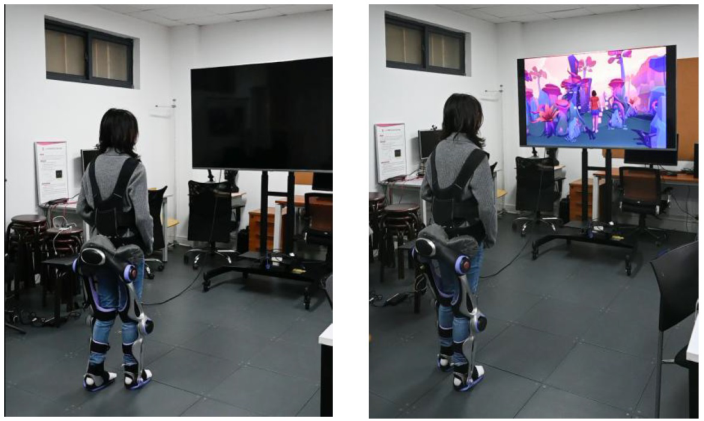
The gamified rehabilitation tool ‘Walking in Dreams’ used in this study is based on natural mapping theory, integrating exoskeleton hardware G-LLE and virtual reality technology. The patient’s movements are real-time transmitted to the virtual character within the environment via MPU sensors, thereby increasing immersion and interest during gait training.
In ‘Walking in Dreams’, we follow the ‘Hook Model’ and design virtual elements according to the design principles that conform to children’s mental needs. Different themes are used as triggers to continuously attract children to participate at different levels. Each theme contains several obtainable props that can be gradually obtained during the user’s training process to encourage users to continuously complete the level. When users pass these diverse and challenging levels, they will obtain different rewards. In this way, we try to make our game effectively attract users.
During the task, users perform walking training within a virtual environment. Participants may be required to help a virtual character navigate obstacles, cross bridges, or follow the character’s footsteps to complete walk training. Every movement the patient makes is synchronised with the exoskeleton hardware and the virtual reality system. The virtual environment provides real-time feedback that adjusts according to the
G-LLE System Design: Gamified Rehabilitation for Children’s Lower Limb Therapy 133
accuracy and progress of the patient’s actions, including the forward movement of the character and the progress of task completion. Each time a task or action is completed, users may unlock virtual items or accessories, further motivating them. Animated visual effects and sound cues are integrated into the system. Upon successful task completion, the system provides positive reinforcement through visual effects and pleasant sounds. Additionally, after each task, ‘Walking in Dreams’ provides parents with visualized feedback on the rehabilitation progress, allowing them to manage and monitor their child’s rehabilitation journey and view related data within the program.
Experiment Design The study recruited 18 participants (7 males and 11 females) with no history of severe lower limb injuries or neurological conditions. All participants were pre-screened to ensure their eligibility for gait training. They were accompanied by a guardian during the study. Recruitment was conducted through schools. Consent was obtained from both participants and their guardians before the experiment. The experiment consisted of three main parts: basic information collection, training tasks (traditional and gamified), and interviews. The total duration of the experiment was 28 minutes. All participants signed the informed consent forms and were explained the experimental procedure prior to the study onset.
To evaluate rehabilitation performance, participants completed both traditional and gamified 5-minute walking tasks using the G-LLE exoskeleton. After a pre-study questionnaire and baseline heart rate measurement, they first performed a standard task without interactive elements, followed by a rest period. They then completed the gamified task in a virtual environment with real-time feedback and rewards. The gamified system ‘Walking in Dreams’, displayed on a 2D computer connected to a 75-inch 4K AOC mobile TV 10 m away. Task load questionnaires were administered after each session, and a final semi-structured interview captured insights on usability, engagement, and system potential.
RESULTS AND DATA ANALYSIS Questionnaire Results
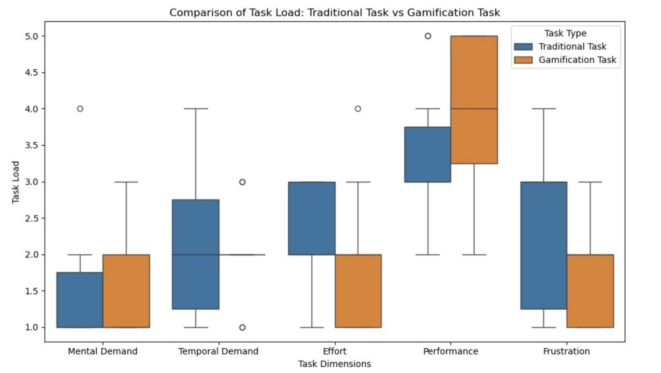
After completing both traditional and gamified tasks, we collected task load questionnaire data from 18 participants. The questionnaire compared the differences between the two task types across 4 key dimensions: temporal demand, effort, task performance, and frustration, as shown in Figure 1 and Table 1. All the following data were processed by Python.
As can be seen in the chart, the mean value difference between traditional and gamified tasks in terms of mental demand is very small. This finding suggests that participants’ cognitive load in gamified tasks using G-LLE remained comparable across both conditions, with no significant additional burden introduced by the gamified system.
Figure 1: Experiment group.Table 1: Questionnaire results (based on NASA-TLX).
Table available in the original PDF paper.
Dimensions Mean Value Std.Dev.
T G T G Mental demand 1.429 1.500 0.852 0.650 Temporal demand 2.071 2.000 0.917 0.555 Effort 2.286 1.929 0.726 0.917 Performance 3.214 4.000 0.975 0.961 Frustration 2.571 1.786 1.158 0.802
T: Traditional task, G: Gamification task.
Regarding temporal demand, the standard deviation for the traditional task was higher than for the gamified task, meaning that participants experienced more variation in their perception of time during the traditional task. In contrast, the gamified task resulted in more consistent time perceptions, likely due to its engaging nature, which made the task feel more straightforward to manage.
indicating that participants felt the gamified task required less effort than the traditional task, which can be interpreted as the game elements helping reduce the perceived effort, making the task more straightforward to complete.
A significant improvement was observed in gamified task performance. The mean, maximum, and range of scores were all higher for the gamified task, showing that participants felt they performed better. The engaging design likely motivated them to focus and feel more confident in their performance. A paired t-test showed a statistically significant improvement in task performance for the gamified task compared to the traditional task
G-LLE System Design: Gamified Rehabilitation for Children’s Lower Limb Therapy 135
(p = 0.041 < 0.05). This improvement can be attributed to the immersive and engaging nature of the gamified environment, which likely enhanced participants’ focus and motivation, enabling them to perform tasks with greater confidence and ease.
Figure 2: Rating of the task load questionnaire.
Another notable finding is that frustration levels were significantly lower in the gamified task. The t-test results confirmed significantly reduced frustration levels for the gamified task (p = 0.047 < 0.05). This reduction can be explained by the enjoyable and interactive nature of the gamified system, which provides positive reinforcement through visual and auditory feedback. The immediate rewards and progress indicators likely helped reduce negative emotions, creating a more supportive and less stressful rehabilitation environment.
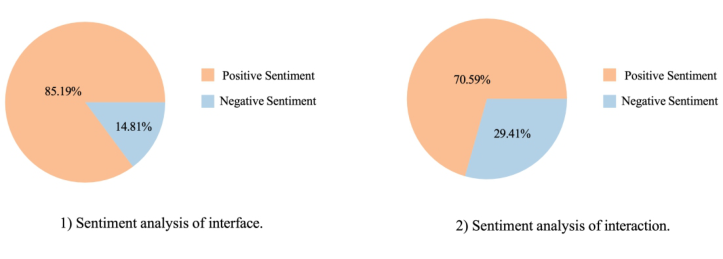
Semi-Structured Interviews Results Sentiment analysis was performed on the interview content using the Tsinghua University Sentiment Lexicon for data computation, as shown in Figure 3, to further enrich our conclusions. As illustrated in Figures 3-1, participants predominantly expressed positive sentiment (85.19%) toward the visual design. However, critical feedback (14.81%) highlighted opportunities for refinement, particularly in enhancing visual richness and personalisation. As depicted in Figures 3-2, a majority of participants expressed strong enthusiasm for expanding interactive features, with 70.59% of responses highlighting the potential of enhanced engagement to increase rehabilitation adherence.
These insights highlight a user-centered need: design interaction paradigms balancing functional richness, personalised expression, and social connectivity to turn rehabilitation from a routine into an engaging journey.
Figure 3: Sentiment analysis results.
DISCUSSION
This study developed a gamified rehabilitation system (G-LLE) grounded in natural mapping and examined its effectiveness by comparing it with a non- gamified training condition. Drawing on prior research in gamification and pediatric motor rehabilitation, G-LLE is proposed to address several existing gaps in the field.
Gamified Strategies in Children’s Rehabilitation The results demonstrate that the gamified rehabilitation system G-LLE significantly enhances children’s task performance during training. Reductions in perceived effort, frustration, and time demand, alongside improved performance metrics, underscore the efficacy of gamification in optimizing user experience—consistent with prior evidence supporting gamified approaches in rehabilitation. Unlike many adult-focused studies that employ singular actions or game mechanisms, often yielding limited or inconsistent outcomes, our system incorporates design strategies grounded in the Hook Model. Features such as real-time rewards, end-of-level scoring, and varied scene themes across multiple levels sustain children’s engagement throughout the intervention. Furthermore, findings suggest that as children become increasingly familiar with commercial gaming paradigms, their expectations for game mechanics, interface design, and interaction fidelity rise accordingly. A growing demand for personalized virtual avatars was also observed. These insights may help explain the limited success of earlier efforts and highlight the need for child-centered personalization in future gamified rehabilitation research.
Interaction of Children’s Gamified Training Based on Natural Mapping While natural mapping theory has primarily been applied in commercial motion-sensing games (Chen et al., 2024), this study extends its application to gamified pediatric rehabilitation, indicating its potential effectiveness. Preliminary results suggest that the natural mapping-based G-LLE system may alleviate task load in children, possibly by reducing cognitive demands during task execution. Although gamification has shown promise in pediatric
G-LLE System Design: Gamified Rehabilitation for Children’s Lower Limb Therapy 137
rehabilitation (Alfieri et al., 2022), its effectiveness remains inconclusive (Marley et al., 2021), with variability potentially stemming from the added cognitive load imposed by complex game mechanics (Tuah et al., 2021). Such demands may increase learning costs and diminish gamification benefits. To mitigate this, we propose interaction mechanisms grounded in natural mapping. Initial findings indicate improved task intuitiveness, reduced learning effort, and enhanced control over virtual characters. The combination with gamified elements appears to offer a more immersive experience. Experimental data also show no significant increase in mental demand compared to baseline tasks, preliminarily supporting our hypothesis.
Additionally, natural mapping may produce positive psychological effects by visually reinforcing a rehabilitated self-image through virtual characters, offering motivational cues during therapy. In conclusion, integrating natural mapping and child-centered design into gamified rehabilitation may address cognitive load challenges, enhance user motivation, and improve training outcomes. The G-LLE system also shows potential for cost-effective implementation, supporting broader accessibility and laying a foundation for future personalized rehabilitation solutions.
CONCLUSION
In this study, we aim to examine whether the gamified lower-limb exoskeleton system (G-LLE) based on natural mapping can improve children’s performance in rehabilitation training. The results show that G-LLE reduces the effort of participants, improves task performance, reduces frustration, and controls the cognitive load brought by gamified tasks within a relatively low level. Additionally, it is noteworthy that participants have diverse needs for the richness of game themes, virtual characters, and interaction modes. In view of this, we call on the research community to explore innovative, adaptive, and inclusive approaches to advance rehabilitation technologies that meet the diverse needs of children and improve their rehabilitation outcomes.
ACKNOWLEDGMENT
This study was supported by National Social Science Foundation of China (23FYSB051), National Natural Science Foundation of China (51505191), Jiangsu Province Natural Science Foundation of China (BK20150161), Jiangsu Province Social Science Foundation of China (22HQB55), Research Funds for the Central Universities of China (JUSRP51729A), ‘Six Talent Peaks’ high level talent project of Jiangsu Province of China (RJFW-007), The Key Project of Philosophy and Social Science Research in Colleges and Universities in Jiangsu Province (2021SJZDA113).
REFERENCES
Aarts, P. B., van Hartingsveldt, M., Anderson, P. G., van den Tillaar, I., van der Burg, J., and Geurts, A. C. (2012). The pirate group intervention protocol: Description and a case report of a modified constraint-induced movement therapy combined with bimanual training for young children with unilateral spastic cerebral palsy. Occupational therapy international, 19(2):76–87.
Alfieri, F. M., da Silva Dias, C., de Oliveira, N. C., and Battistella, L. R.
(2022). Gamification in musculoskeletal rehabilitation. Current Reviews in Musculoskeletal Medicine, 15(6):629–636. Behboodi, A., Kline, J., Gravunder, A., Phillips, C., Parker, S. M., and Damiano, D. L.
(2024). Development and evaluation of a BCI-neurofeedback system with real- time EEG detection and electrical stimulation assistance during motor attempt for neurorehabilitation of children with cerebral palsy. Frontiers in Human Neuroscience, 18:1346050. Chen, J., Wang, Y., and Luximon, Y. (2024). Camtroller: An auxiliary tool for controlling your avatar in PC games using natural motion mapping. In Proceedings of the 2024 CHI Conference on Human Factors in Computing Systems, CHI ‘24, New York, NY, USA. Association for Computing Machinery. Chiu, M.-C. and Chang, Y.-J. (2017). A service recovery method to enhance
customer satisfaction with a case study of motion sport game. Human Factors and Ergonomics in Manufacturing & Service Industries, 27(5):233–242. Clausen, J.-D., Nahen, N., Horstmann, H., Lasch, F., Krutsch, W., Krettek, C., Weber-Spickschen, T. S., et al. (2020). Improving maximal strength in the initial postoperative phase after anterior cruciate ligament reconstruction surgery: Randomized controlled trial of an app-based serious gaming approach. JMIR Serious Games, 8(1): e14282. Franki, I., Desloovere, K., De Cat, J., Feys, H., Molenaers, G., Calders,
P., Vanderstraeten, G., Himpens, E., and Van den Broeck, C. (2012). The evidence-base for basic physical therapy techniques targeting lower limb function in children with cerebral palsy: A systematic review using the international classification of functioning, disability and health as a conceptual framework. Journal of rehabilitation medicine, 44(5):385–395. Gatica-Rojas, V., Cartes-Velásquez, R., Guzmán-Munoz, E., Méndez-Rebolledo, G., Soto-Poblete, A., Pacheco-Espinoza, A. C., Amigo-Mendoza, C., Albornoz- Verdugo, M. E., and Elgueta-Cancino, E. (2017). Effectiveness of a nintendo wii balance board exercise programme on standing balance of children with cerebral palsy: A randomised clinical trial protocol. Contemporary clinical trials communications, 6:17–21. Huotari, K. and Hamari, J. (2017). A definition for gamification: Anchoring
gamification in the service marketing literature. Electronic markets, 27(1):21–31. Jesus, T. S., Landry, M. D., Dussault, G., and Fronteira, I. (2017). Human resources for health (and rehabilitation): Six rehab-workforce challenges for the century. Human resources for health, 15:1–12. Marley, W., Barratt, A., Pigott, T., Granat, M., Wilson, J., and Roy, B. (2021).
A multi-center randomized control trial, comparing gamification with remote monitoring against standard rehabilitation for patients after arthroscopic shoulder surgery. Journal of shoulder and elbow surgery. Matamala-Gomez, M., Maisto, M., Montana, J. I., Mavrodiev, P. A., Baglio, F., Rossetto, F., Mantovani, F., Riva, G., and Realdon, O. (2020). The role of engagement in teleneurorehabilitation: a systematic review. Frontiers in Neurology, 11:354. Meyns, P., Roman de Mettelinge, T., van der Spank, J., Coussens, M., and
Van Waelvelde, H. (2018). Motivation in pediatric motor rehabilitation: A systematic search of the literature using the self-determination theory as a conceptual framework. Developmental neurorehabilitation, 21(6):371–390. Molinaro, A., Micheletti, S., Pagani, F., Garofalo, G., Galli, J., Rossi, A., Fazzi, E., and Buccino, G. (2022). Action observation treatment in a tele-rehabilitation setting: A pilot study in children with cerebral palsy. Disability and Rehabilitation, 44(7):1107–1112.
G-LLE System Design: Gamified Rehabilitation for Children’s Lower Limb Therapy 139
Nuara, A., Avanzini, P., Rizzolatti, G., and Fabbri-Destro, M. (2019). Efficacy of a home-based platform for child-to-child interaction on hand motor function in unilateral cerebral palsy. Developmental Medicine & Child Neurology, 61(11):1314–1322. Pan, L., Zhao, L., Song, A., Yin, Z., and She, S. (2019). A novel robot-aided upper
limb rehabilitation training system based on multimodal feedback. Frontiers in Robotics and AI, 6. Pimentel-Ponce, M., Romero-Galisteo, R., Palomo-Carrión, R., Pinero-Pinto, E., Merchán-Baeza, J. A., Ruiz-Muñoz, M., Oliver-Pece, J., and González-Sánchez, Sardi, L., Idri, A., and Luis Fernández-Alemán, J. (2017). A systematic review of gamification in e-health. Journal of Biomedical Informatics, page 31. Souto, D. O., Cruz, T. K. F., Coutinho, K., Julio-Costa, A., Fontes, P. L. B.,
and Haase, V. G. (2020). Effect of motor imagery combined with physical practice on upper limb rehabilitation in children with hemiplegic cerebral palsy. NeuroRehabilitation, 46(1):53–63. Tuah, N. M., Ahmedy, F., Gani, A., and Yong, L. N. (2021). A survey on gamification for health rehabilitation care: Applications, opportunities, and open challenges. Inf., 12:91. Weinberger, R., Warken, B., König, H., Vill, K., Gerstl, L., Borggraefe, I., Heinen, F.,
von Kries, R., and Schroeder, A. (2019). Three by three weeks of robot- enhanced repetitive gait therapy within a global rehabilitation plan improves gross motor development in children with cerebral palsy–a retrospective cohort study. European Journal of Paediatric Neurology, 23(4):581–588. Wu, Y.-T., Chen, K.-H., Ban, S.-L., Tung, K.-Y., and Chen, L.-R. (2019). Evaluation of leap motion control for hand rehabilitation in burn patients: An experience in the dust explosion disaster in formosa fun coast. Burns, 45(1):157–164. Z. Wang, J. Lv, Y. Hou, D. Song, Enhancing experience: Investigatingthe impact
of different personal perspectives in virtual reality with lowerlimb rehabilitation robots on participants’ motivation, experience, andengagement, International Journal of Industrial Ergonomics 99 (2024)103496.
LISTED IN THE AHFE DIGITAL BOOKSTORE CATALOGUE
Explore the complete digital volume
Metaverse, Virtual Environments and Game Design
Read this individual research paper free through the original publisher, or explore the full digital proceedings book.
ISBN 978-1-964867-54-0
Explore this ISBN in the AHFE Bookstore ↗Listed in the July 2026 bookstore catalogue; search by ISBN to confirm current availability · Digital book purchase optional