Shuyao Liu, Yun Wang (2026). A Design Framework Based on Endogenous Priority Construction. In: Human Systems Engineering and Design (IHSED2026): Future Trends and Applications. AHFE Open Access, vol. 237, pp. 178–187. https://doi.org/10.54941/ahfe1008158
The reduction of independent peer interaction is likely to negatively impact on children’s cognitive, emotional, and social development.Therefore, this study aims to establish a design framework to enhance children's willingness for face-to-face social engagement. The mixed-method approach, including literature review and semi-structured interview, was adopted. Firstly, through literature review, the main reasons why children dislike social activity are peer exclusion, lack of social skills, social anxiety, excessive screen time, over-protection by family, and social time compression. To further explore children’s social experiences and psychological need, the semi-structured interview was conducted. The interview themes covered basic situation, factors influencing social participation, prioritization of barriers. Through the research above, the six core psychological needs were identified. To validate this framework, we developed a companion robot prototype through co-design method to encourage children’s social engagement. Based on the gamification theory, the robot offers rewards after daily social interaction task supports with suggesting engaging topics to enhancing the social motivation of children. We validate this framework by integrating companion robot, which shows a positive influence of encouraging children interact with others face to face, and the potential for expanding applications with integrating existing frameworks and theories. This framework provides a reference to the designers who conduct studies in the field of child offline social development, with clear priority considerations. The framework address and understands the challenges of children’s social barriers.
According to Organisation for Economic Co-operation and Development (OECD, 2024), the report Social and Emotional Skills for Better Lives highlights that the “engaging with others skills” dimension of social-emotional competence, encompassing traits like assertiveness and sociability, is strongly associated with positive outcomes such as academic achievement, life satisfaction, and self-worth. Over the past fifteen years, children have experienced reduced face-to-face interaction time with friends while spending more time on digital screens. The reduction of independent peer interaction is likely to negatively impact on all children’s cognitive, emotional, and social development (Cameron & Tenenbaum, 2021).
Received May 15, 2026 Revised June 26, 2026 Accepted July 17, 2026 Available online September 25, 2026
A Design Framework Based on Endogenous Priority Construction 179 In recent years, children’s offline social interactions have gradually decreased (Misirli et al., 2025), accompanied by declining independent exploration abilities in physical environments (Hand et al., 2018; Marquet et al., 2021) and increasing online social engagement (Misirli et al., 2025). Research indicates a significant negative correlation between children’s digital technology usage duration and overall psychosocial well-being, particularly manifested in three sub-dimensions: social functioning, behavioral functioning, and parent-child relationship quality (Harverson et al., 2025). This phenomenon is further associated with elevated depression levels, behavioral problems, self-harm tendencies, and substance abuse risks, while correlating with lower academic achievement and diminished self-perception (Teague et al., 2026).
To address the issues present in existing researches, the mixed-method, including literature review and semi-structured interview was employed. This study aims to establish a design framework to enhance children’s willingness for face-to-face social engagement. This study pioneers a design framework focused on children’s offline social interactions, prioritizing the factors influencing such interactions and providing theoretical guidance for designs related to authentic children’s social engagement. Meanwhile, this study developed a prototype, which not only demonstrated the framework’s ability to guide design processes but also validated the effectiveness of the proposed design framework.
RELATED WORK
Through literature review, we listed the main reasons why children dislike social activity below. (1) Peer exclusion: being deliberately left out or ignored by peers in social situations; (2) Lack of social skills: difficulty in starting, maintaining, or responding appropriately to social interactions; (3) Social anxiety: intense fear or discomfort in social settings due to worry about negative evaluation; (4) Excessive screen time: overuse of digital devices, which reduces opportunities for face-to-face social practice; (5) Over-protection by family: parents or caregivers excessively restricting a child’s independent social experiences; (6) Social time compression: reduced unstructured free time for spontaneous peer interaction due to busy schedules (Gazelle, 2022; McIver, 2025; Salari et al., 2024; Van Petegem et al., 2022; Illingworth et al., 2025; Malti et al., 2017). Current research and practice exhibit a pronounced bias toward “clinical treatment,” thereby neglecting the social needs of the broader general pediatric population (Mitchell et al., 2025). Regarding efficacy, despite theoretical frameworks targeting general children, the actual outcomes of such interventions remain highly controversial and challenging, contrasting sharply with established clinical intervention protocols (Birrell et al., 2025). While existing design paradigms have addressed multifactor analysis and priority sequencing individually, no studies have integrated these approaches to address the critical question of “how to enhance children’s offline social interactions” (Sadrkhanlou et al., 2023; Joyce & Loebach, 2026). Moreover, current design paradigms lack effective instructional guidance and rarely prioritize incorporating children’s perspectives (Jansens et al., 2023).
180 Liu and Wang To address children’s reluctance to engage in offline social interactions, current designs predominantly employ gamification theory and social robots. Gamification transforms “passive social interaction” into active exploratory engagement, using low-stress, high-engagement scenarios to reduce social barriers for children prone to exclusion or anxiety (Kapp, 2012). Social robots significantly enhance children’s offline social initiation, peer collaboration, shared attention, prosocial behaviors, conflict resolution, and friendship- building skills (Salma et al., 2025; Shrestha et al., 2025; Yi et al., 2025).
FRAMEWORK ESTABLISHMENT Participant and Procedure
We recruited 12 participants (age 8–12, 6F, 6M) to conduct the semi-structured interview. Before the interview, each participant was required to fill out the Social Anxiety Scale for Children questionnaire to divide them into two user segments, social anxiety group (greater than 7 points) and normal group (less than 7 points). The two groups had equal sample sizes of 6 children, with the survey covering both anxious and non-anxious populations to ensure representative results.
The interview focus on 3 themes: basic social interaction status of children, analysis of factors influencing children’s social interactions, and ranking of social interaction factors. The purpose of the interview was to determine whether the factors influencing children’s social interactions were consistent with the results of prior literature review and to prioritize the factors. The detailed questions are following.
Table 1: The detailed questions of the interview.
Table available in the original PDF paper.
No. Theme Question Social objects 1 Basic situation of children’s social interaction
Social scenarios Social frequency
2 Factors influencing children’s social participation
A description of a successful and enjoyable social experience A description of a failed and upset social experience
3 Ranking of factors influencing social interaction in children
Perceived priority ranking of the listed factors (from highest to lowest)
Interview Result Based on the interview, both anxiety group and normal group can maintain daily social engagement. Children in the anxiety group have relatively fixed social circles and limited exposure to social settings; they are reluctant to proactively engage in social interactions in unfamiliar environments or with strangers. In contrast, children in the normal group possess extensive social networks, broad social circles, numerous potential social partners, and demonstrate a proactive willingness to expand their social connections.
Table 2: The interview result of factors promoting positive social interactions.
Table available in the original PDF paper.
Typical Quote
Theme Factors Promoting Positive Social Interactions
Number of People Mentioned
Peer influence The invitation from peers 9/12 During physical education class they invited me to join in the game.
The Interpersonal compatibility of social peers
6/12 She was very humorous, and I really enjoyed chatting with her.
The help from peers 4/12 During handicraft class, my deskmate offered to teach me without thinking I was stupid.
Personal achievement
The sense of achievement from helping peers
2/12 I helped the new student adapt to the new environment and eased his anxiety, and I felt really proud of myself.
Based on children’s recollections of successful social experiences, we have identified two key factors that contribute to their sense of social pleasure: peer influence and personal achievement. Most children mentioned peers, including invitations, assistance, and support from them, demonstrating that receiving peer help is a crucial element in fostering social enjoyment. Regarding personal achievement, the sense of accomplishment derived from helping others also serves as a source of pleasure. These factors can be leveraged as design elements; by amplifying children’s sense of pleasure, designers can enhance their interest in social interactions.
Table 3: The interview result of factors contributing to social distress.
Table available in the original PDF paper.
Typical Quote
Theme Factors Contributing to Social Distress
Number of People Mentioned
Peer exclusion
The rejection from others 9/12 I wanted to join the game but was refused. I felt embarrassed and wronged.
The unpleasant moments during the collaboration
2/12 When someone doesn’t cooperate while playing the game, it makes the experience less enjoyable.
Personal reason
The bad mood 1/12 When I was in a bad mood, I just wanted to be alone.
Regarding distressing experiences, the vast majority of children described the embarrassment and sense of injustice following exclusion or rejection, a finding consistent with the conclusions of the previous literature review. This also indicates that peer exclusion leaves a profound impression on children,
182 Liu and Wang significantly reducing their enjoyment and willingness to engage in social interactions. Regardless of how children ranked the various influencing factors in subsequent interviews, peer exclusion remains a significant and undeniable contributing factor.
Based on the semi-structured interviews, the subjects ranked the six listed social influencing factors as follows, social time compression, social anxiety, lack of skills, excessive screen time, peer exclusion, over-protection by family.
Framework The most noteworthy factor is the peer exclusion. Although children ranked this factor lower, 75% of them mentioned it when describing their upset experiences. One possible explanation for the discrepancy is that children may have underreported experiences of peer exclusion due to social desirability concerns, embarrassment, or a desire to maintain a positive self-presentation. Therefore, we believes it should bu given high priority.
Meanwhile, according to the interview findings, social time compression ranked first. While as a felt difficulty, its low design leverage and high contextual dependency render it a lower priority compared to other social barriers with clearer, more cost-effective intervention pathways.
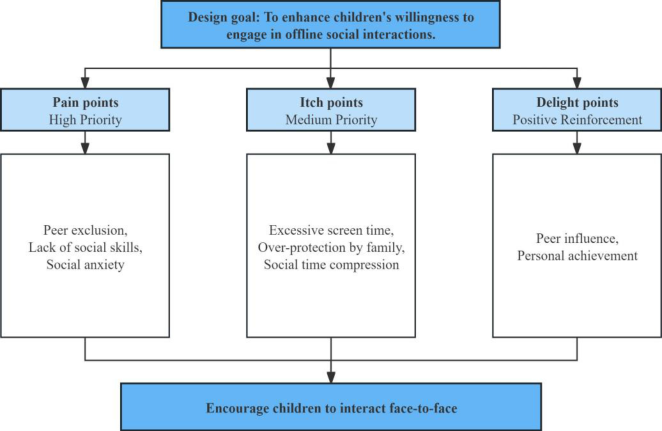
Therefore, through comprehensive analysis, we identified peer exclusion, lack of social skills and social anxiety as the design pain points. And excessive screen time, over-protection by family and social time compression are identified as design itch points. By synthesizing the findings of the influences of positive social experiences, we identified the core design delight points, peer influence and personal achievement. This research ultimately yields the design framework illustrated below.
Figure 1: The design framework based on endogenous priority construction.
VALIDATION Co-Design
The design prototype is a social robot. Through interviews with 12 participants, user needs were identified and summarized in the table below. Based on the design framework and the interview findings, we adopted user- central design to develop the prototype. Based on the gamification theory, the robot encourages children to proactively start social connect to peer, supports with suggesting engaging topics to enhancing the social motivation of children, and offers rewards after social interaction. We evaluated this prototype in the user test.
Table 4: The interview result of demand for social robots.
Table available in the original PDF paper.
Theme Demand Detailed Description Appearance Cute(4/12) It is small and round like a little doll.
Cool (2/12) It looks like mechanical robot.
Looks like the favorite character(3/12)
It looks like the characters in Egg Party (the game name) Function Accompany(9/12) It feels like there’s a little bodyguard accompanying me.
Topic Provision(5/12) It can give me suggestions like, “Could you ask your classmates if they’d like to read a book together?”
Encouragement(4/12) It can cheer me up when I’m refused, like.
Entertainment(3/12) It can play music and chat with me.
Memorability (1/12) It can help me remember new friends’ names and hobbies so I can better organize activities.
Secretion(2/12) It can be placed in a pocket without being noticed by others.
Participant and Procedure To validate the design framework, we conducted comparative experiments. Using the Child Social Anxiety Scale, we selected three children with scores of 0 (0-7 indicating normal social anxiety level), 10 (8-10 indicating mild social anxiety levels), and 14 (11-14 indicating moderate social anxiety level). Each participant was required to social in a simulated environment (without and with the prototype). After that, they were required to answer the 5-point social experience questionnaire and assign priority scores to each function based on the design framework.
Result
As shown in Table 5, children awarded the highest score of 5 for NO. 3, and moderate scores of 3.33 for NO. 1, NO. 2, NO. 5, NO. 7, and NO. 8. All these scores exceed 3 points, indicating the prototype’s effectiveness in these areas. The robot has most effectively alleviated children’s social anxiety. And it mitigated the impacts of peer exclusion, lack of social skills, and over- protection by family, and fostered deeper peer positive influence and personal achievement. However, children gave a lower score of 2.33 for NO.6 and the lowest score of 1.67 for NO. 4, suggesting the design prototype was not that effective in reducing time compression and limited in preventing excessive screen time from impairing social interactions.
Table 5: The social experience questionnaire.
Table available in the original PDF paper.
NO. Theme Question SD Mean
2.89 3.33
1 Peer exclusion With the robot as a companion, I no longer fear rejection or exclusion.
2 Lack of social skills I feel my social skills have improved,
2.89 3.33
and I can now take initiative.
0 5
3 Social anxiety With the company of robots, I no longer feel anxious.
2.89 1.67
4 Excessive screen time
The impact of electronic devices on my social interactions has diminished.
2.89 3.33
5 Over-protection by family
The robot reduces the impact of excessive family protection on my social life.
2.52 2.33
6 Social time compression
The compression of social time is gradually diminishing.
2.89 3.33
7 Peer influence With the robot, I prefer my peers even more and established a closer connection.
2.89 3.33
8 Personal achievement
This social robot makes me more confident.
As shown in Table 6, the functional scale scores demonstrated positive impacts across all robot prototype features (with each item averaging over 3/5), further corroborating the efficacy of the design framework. The pain points were rated as 5, 3.67, and 3.33; the functional scores corresponding to itch points were 5, 4.67, and 3.67; while the scores for delight points were 5 and 4.33. Functions 1, 4, and 7 received the highest level of satisfaction. An analysis of both tables reveals that while pain points received high scores in the functional evaluation, their scores were low on the user experience scale. Itch points scored highly in the functional assessment but scored less than 3.33 on the experience scale, indicating user expectations for improvements yet dissatisfaction with the current prototype’s solutions. In contrast, delight points achieved consistently high scores across both metrics.
Table 6: The functions and the priority rank.
Table available in the original PDF paper.
Trigger Function Mean
Theme NO
5
1 The child is refused by others. Provide comfort, companionship, and encouragement to the child after being refused.
5
Remind the child of the joys of real life and encourage him or her to participate in social interactions.
4 The child refuses to engage in social interactions because of electronic devices, or has already used the devices for more than one hour.
5
7 The child is invited by a peer to play or chat together.
Provide positive feedback by expressing approval for the peer, and reminding the child to give a hug or express gratitude to the peer.
4.67
Use mobile notifications to alert the parents, and inform them of the importance of social interaction.
5 The child is observed staying at home throughout the day, with social interaction time totaling less than 2 hours.
4.33
Praise the child for taking the initiative to invite others.
8 The child completes a social interaction lasting no less than 3 minutes. Especially when children actively invite others.
3.67
3 The child’s respiratory rate exceeds 30 breaths per minute and heart rate exceeds 110 beats per minute.
Encourage the child to perform breathing exercises by following the flashing lights, and provide timely guidance and reassurance to reduce tension during social interactions.
3.67
6 The child engages in prolonged sedentary study without interaction for more than 2 hours.
Remind the child to engage in social activities, and notify parents via text messages or other means to reduce their child’s workload.
3.33
Provide topics to continue the conversation and assist the child in responding when he ro she doesn’t know how to respond.
2 A normal conversation abruptly enters a silence lasting more than 10 seconds, or the child explicitly signals to the robot that he or she doesn’t know what to say.
*Table 6 presents children’s priority rank for each function, with Theme NO corresponding to NO in Table 5.
RESULTS
According to the design framework we established, the pain points which should be primarily solved are peer exclusion and social anxiety, and the effectiveness of design intervention of which were validated in this research. The study demonstrated that addressing these two design pain points effectively enhanced participation willingness. However, due to the small sample size and participants’ high confidence in their social skills, the
186 Liu and Wang impact on lack of social skills could not be validated. Itch points included excessive screen time, over-protection by family, and social time compression, although these were designated as secondary issues in the design framework, participants considered them equally critical and requiring resolution.
Meanwhile, the delight points corresponded to both high scores in social experience and feature evaluation, even exceeding those of design pain points. This suggests that enhancing children’s social engagement and amplifying their sense of enjoyment during social interactions proves more effective than merely addressing the challenges they encounter.
CONCLUSION
To facilitate face-to-face social interaction among children, this study developed an a design framework based on endogenous priority construction through literature review and semi-structured interviews. Comparative experimental validation confirmed the framework’s effectiveness, revealing that enhancing children’s social engagement and amplifying their enjoyment during interactions proves more effective than merely addressing the challenges they encounter. These findings provide theoretical guidance for designs aimed at promoting children’s face-to-face social skills.
However, the insufficient sample size in this study rendered the designed pain points validation lacking persuasiveness, constituting a limitation of the study.
REFERENCES
Birrell, L., Grummitt, L., Smout, S., Maulik, P., Teesson, M. and Newton, N. (2025).
Debate: Where to next for universal school-based mental health interventions? Child and Adolescent Mental Health, 30(1), pp. 92–95. Cameron, L. and Tenenbaum, H.R. (2021). Lessons from developmental science to mitigate the effects of the COVID-19 restrictions on social development. Group Processes & Intergroup Relations, 24(2), pp. 231–236. Gazelle, H. (2022). Peer exclusion and social withdrawal in childhood: Developmental
pathways to anxiety. Development and Psychopathology, 34(2), 345–360. Hand, K.L., Freeman, C., Seddon, P. J., Recio, M. R., Stein, A. and van Heezik, Y. (2018). Restricted home ranges reduce children’s opportunities to connect to nature: Demographic, environmental and parental influences. Landscape and Urban Planning, 172, pp. 69–77. Harverson, J., Paatsch, L., Anglim, J. and Horwood, S. (2025). Digital Technology
Use and Well-being in Young Children: A Systematic Review and Meta-analysis. Computers in Human Behavior, 168, 108660, pp. 1–23. Illingworth, G., Manchanda, T., Skripkauskaite, S., Fazel, M., & Waite, F. (2025).
Social jetlag and sleep habits in children and adolescents: Associations with autonomy (bedtime setting and electronics curfew) and electronic media use before sleep. Chronobiology International, 42(1), 46–57. Jansens, R., Prellwitz, M., Olofsson, A. and Lynch, H. (2023). The Representation of Children’s Participation in Guidelines for Planning and Designing Public Playspaces: A Scoping Review with ‘Best Fit’ Framework Synthesis. International Journal of Environmental Research and Public Health, 20(10), 5823. Joyce, K. and Loebach, J. (2026). Co-designing outdoor playspaces with children:
A framework for analyzing participant design priorities. Design Studies, 103, 101377.
A Design Framework Based on Endogenous Priority Construction 187 Kapp, K.M. (2012). The gamification of learning and instruction: Game-based
methods and strategies for training and education. San Francisco: Pfeiffer. Malti, T., Zuffianò, A., Cui, L., Colasante, T., Peplak, J., & Bae, N. Y. (2017). Children’s social–emotional development in contexts of peer exclusion. In Handbook on positive development of minority children and youth (pp. 295–306). Cham: Springer International Publishing. Marquet, O., Hipp, J.A. and Clennin, M.N. (2021). Housing and Community
Environments vs. Independent Mobility: Roles in Promoting Children’s Independent Travel and Unsupervised Outdoor Play. International Journal of Environmental Research and Public Health, 18(4), 2132. McIver, L. S. B. (2025). Beyond the Screen: Impact of Screen Time on Children’s Cognitive Development (Doctoral dissertation, Regent University). Misirli, A., Fotakopoulou, O., Dardanou, M. and Komis, V. (2025). The impact of
touchscreen digital exposure on children’s social development and communication: a systematic review. Frontiers in Psychology, 16, 1613625. Mitchell, S.B., Blank, L., McMellon, C., Russell, S. and Yousefi, A. (2025). The use of social prescribing and community-based wellbeing activities as a potential prevention and early intervention pathway to improve adolescent emotional and social development: A systematic mapping review. BMC Public Health, 25(1), 3495. OECD (2024). Social and Emotional Skills for Better Lives. Paris: OECD Publishing.
Chapanis, A. (1996). Human factors in systems engineering. Wiley Series in Systems Engineering and Management. Andrew Sage, series editor. Hoboken, NJ: Wiley. Sadrkhanlou, M., Maher, A., Alimohammadzadeh, K., Jafari, M. and Bahadori, M.
(2023). Applying the Delphi Approach to Prioritize Social Factors Affecting the Development of Children Under Six Years. BMC Public Health, 23. Salari, N., Heidarian, P., Hassanabadi, M., Babajani, F., Abdoli, N., Aminian, M., & Mohammadi, M. (2024). Global prevalence of social anxiety disorder in children, adolescents and youth: A systematic review and meta-analysis. Journal of Prevention, 45(5), 795–813. Salma, Z. et al. (2025). Effectiveness of Robot-Mediated Learning in Fostering
Children’s Social and Cognitive Development. Applied Sciences, 15(7), 3567. Shrestha, K. et al. (2025). Exploring Socially Assistive Peer Mediation Robots for Teaching Conflict Resolution to Elementary School Students. Proceedings of the AAAI Symposium Series, 5(1), pp. 405–414. Teague, S., Somoray, K., Shatte, A., Miller, D., Moss, K., Crawford, A., Wildman,
H., Kayal, D. and Hutchinson, D. (2026). Digital Media Use and Child Health and Development: A Systematic Review and Meta-Analysis. JAMA Pediatrics. doi: 10.1001/jamapediatrics.2026.0085. Van Petegem, S., Albert Sznitman, G., Darwiche, J., & Zimmermann, G. (2022).
Putting parental overprotection into a family systems context: Relations of overprotective parenting with perceived coparenting and adolescent anxiety. Family process, 61(2), 792–807. Yi, Z. et al. (2025). Building Friendships Across Borders: The Role of Social Robot Haru in Children Group Communication and Connection Development. 2025 34th IEEE International Conference on Robot and Human Interactive Communication (RO-MAN), pp. 65–72.
FIND THE COMPLETE VOLUME IN THE AHFE DIGITAL BOOKSTORE
Explore the complete digital volume
Human Systems Engineering and Design (IHSED2026): Future Trends and Applications
Read this individual research paper free through the original publisher, or explore the full digital proceedings book.