Purpose: Starting from users' daily health habits, this study analyzes the real needs of users for in-vehicle health services in driving scenarios. By integrating the context-awareness approach, it aims to enable users to interact more efficiently with the cabin in the driving environment. Methods: Firstly, the relevant theories of context awareness were reviewed, analyzing the advantages of integrating context awareness into intelligent health cabins and categorizing contexts into four types: user, environment, device, and time. Secondly, employing the context interview method and the Wizard of Oz Test, 24 white-collar individuals were deeply interviewed regarding their health service needs within the cabin. The analysis summarized the design focuses of four context types, establishing design strategies for intelligent health cabin systems based on context awareness. In the practical stage, the "Bianque" intelligent health cabin system scheme was developed based on the design strategies proposed in this paper, providing certain evidence for the design strategies. Conclusion: The application of context awareness theory in intelligent health cabins can effectively enhance user experience. Theoretically, design strategies for intelligent health cabin systems based on context awareness are proposed, and practically, the "Bianque" intelligent health cabin system design scheme is developed, along with relevant prototypes.
The automotive industry is witnessing rapid advancements in technology, transforming traditional cockpits into intelligent spaces. These intelligent cockpits integrate various systems to provide in-vehicle information and entertainment functions, offering a versatile experience for social, entertain- ment, family, and work purposes.
Amidst this technological revolution, intelligent health cockpits are emerg- ing as a significant innovation. The growing societal focus on health, highlighted in the “2021 National Health Insight Report,” underscores the demand for vehicles to offer humane healthcare solutions while traveling.
However, current research on intelligent health cockpits tends to pri- oritize technological advancements over user experience. Ma Jun, from Tongji University’s Human-Vehicle Relationship Laboratory, emphasizes the
Intelligent Healthy Cabin Design Strategy Based on Context Awareness Theory 231
importance of user-centric designs to address actual health requirements effectively.
Future health cockpits will leverage vehicle state information to offer per- sonalized, multi-dimensional health services, further establishing cars as the “third living space.” Context-awareness technology will play a crucial role in enhancing this experience, providing timely information tailored to users’ tasks and reducing cognitive load.
This user-centric approach benefits both users and automobile manufac- turers, offering personalized products and services while enhancing com- petitiveness. In this study, white-collar workers are the target demographic due to their busy lifestyles and growing health concerns, making them ideal candidates for health cockpit designs. Conducting systematic research and interviews with this group will inform the development of user-centric designs.
LITERATURE REVIEW
Context Awareness Theory Research Status In the realm of contextual understanding, a prevailing viewpoint asserts that it encompasses a collective set of information representing a specific situation, with an expectation for products to comport themselves appropriately within that context to fulfill user needs (Liu, 2019). Endsley initially proposed con- text awareness at the 1988 Human Factors and Ergonomics Society, defining it as the perception, comprehension, and anticipation of environmental cues within a designated time and space. With Mark Weiser’s formal exposition of Ubiquitous Computing in 1991, context awareness gained prominence in academic circles. In 1994, Schilit et al. suggested using computer programs to discern dynamic environments, understand user behavior, and deliver tailored services based on these dynamics, marking context awareness as a pivotal measure of product intelligence. In 2001, Dey defined a context-aware system as one leveraging contextual data to furnish users with essential informa- tion or services (Zilei, 2017), distinguishing between context types such as location, identity, activity, and time—a definition now widely embraced. In 2004, Byun et al. posited that context awareness entails a system’s capacity to extract, interpret, and harness contextual information to tailor its functions to the present context of use. Subsequently, in 2005, Kaltz et al. categorized context models into user & role, process & task, location, time, and device, and investigated the visualization applications of context awareness models. In summation, context awareness underscores devices’ apprehension of con- textual information fluctuations and the system’s responsive feedback, with the composition of contextual factors varying contingent upon the context (Cong, 2017).
Intelligent Health Cabin Research Status With the growing emphasis on health, automakers have developed branded “health cabins.” For instance, SkyHealth 2.0 by Skyworth Automotive offers specialized monitoring functions for user sleep, blood pressure, and heart
rate within the cabin, focusing on physiological health. In-car air quality is closely tied to physical and mental well-being and is a crucial vehicle quality indicator. AITO M5 prioritizes air quality in the intelligent cabin, boasting an air conditioning filter with over 97% bacterial inhibition rate and antibacterial values exceeding 97% on seats, seat cushions, backrests, and armrests, effectively preventing bacteria, molds, and viruses. Tianmei ET6’s “Health Rest Cabin” features a 10-way electric seat with adjustable leg support, adapting to users’ needs during different driving periods. It includes an automatic air conditioning system with PM2.5 efficient filter, negative ion purifier, and high-temperature circulation disinfection system. Major automakers offer varied interpretations of “health cabins,” focusing on environmentally friendly materials, air management systems, and health ecosystem services. To stay competitive, targeting users, differentiating solu- tions, and maintaining product competitiveness are essential. Integration of health monitoring systems, facial emotion recognition, vital sign detection, and medical IoT can actively monitor and diagnose human health.
Context Awareness and Intelligent Health Cabins Context awareness plays a crucial role in the design of intelligent health cabin systems, particularly in enhancing user experience. It enables the system to perceive and respond to contextual factors during driving, facilitating nat- ural human-machine interaction. Additionally, context awareness enriches user experiences by activating multisensory interactions and creating person- alized emotional connections between users and the cabin space. Overall, context awareness is essential for improving system intelligence, user safety, and comfort in automotive cabin environments, indicating a more intelligent and human-centered direction for future driving experiences.
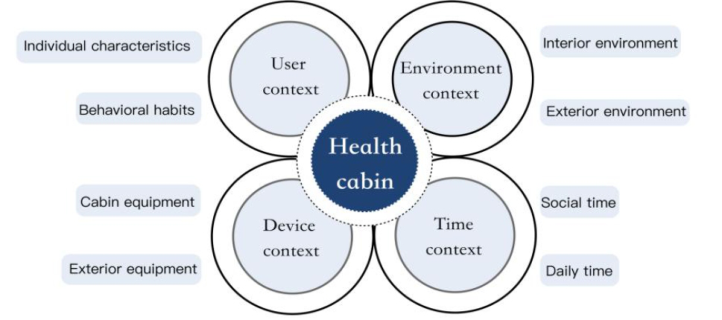
The contextual information within intelligent cabins is diverse and com- plex, with different factors influencing contextual awareness. Effectively categorizing and utilizing these factors is crucial in designing contextual awareness systems. Chen Yixuan classifies contextual information in vehi- cle AR-HUD interface design into environmental, driver, driving, and vehicle contexts. Wang Kaidi divides contextual factors in unmanned delivery vehi- cles into user, task, and environmental contexts. Chen Huailin categorizes context in agricultural production into user, work, equipment, and environ- mental contexts; Wu Jianbin et al., inspired by Professor Xin Xiangyang’s proposition of the five elements of experience: people, actions, means, pur- pose, and contexts (Xiangyang, 2015), classify the contextual states of driv- ing behavior into user context, social context, physical context, and temporal context. Drawing from this inspiration, this study categorizes contextual factors into four types: user context, environmental context, equipment con- text, and temporal context. The specific subdivision of contextual factors is illustrated in Figure 1.
These four types of contextual factors complement each other, exert mutual influence, and collectively form the foundation for the design of intelligent health cabin systems. The user context encompasses the basic characteristics and behavioral habits of the driver, serving as the object of
Intelligent Healthy Cabin Design Strategy Based on Context Awareness Theory 233
interaction. The environmental context encompasses all relevant informa- tion within and outside the cabin. The equipment context refers to the media used for interaction with the product, including both internal and external cabin devices. The temporal context considers the differentiated behavioral patterns at different stages of driving and the immediacy of task feedback, encompassing both everyday and societal temporal contexts. These contex- tual factors not only affect individuals’ reception of information and control over the system but also impact the efficiency of information transmission and the performance of system hardware.
Figure 1: Segmentation of contextual factors in smart health cabin.
DEMAND ANALYSIS IN INTELLIGENT HEALTH CABINS To comprehensively understand user demands for intelligent health cabins from a macroscopic perspective, the researcher employed a combination of contextual interview and green trail methods for investigative research.
Contextual Interview Method: Through one-on-one interviews with tar- get users, the study aimed to uncover authentic pain points related to health topics within the cabin. Prior to the interviews, interview outlines were estab- lished based on research objectives and the four contextual settings defined in earlier sections (see Table 1). Given that semi-structured interviews offer both the systematic comprehensiveness of structured interviews and the flex- ible freedom of open-ended interviews, this study adopted a semi-structured approach. Interviewers were required to familiarize themselves with the basic backgrounds of interviewees beforehand and introduce several loose topics related to the four contexts into the formal interviews. This approach allowed interviewees some time to grasp and imagine the contextual settings of the interviews. During the process, interviewers timely pursued key information points based on interviewees’ responses, thereby comprehensively exploring user demands and service issues. Additionally, due to the diverse perceptions among individuals and the cutting-edge nature of the industry context, 24 interviewees from various forefront industries, including education, internet,
finance, and e-commerce, were selected to ensure the authenticity and com- prehensiveness of the interview results, with ages ranging from 22 to 38 years old.
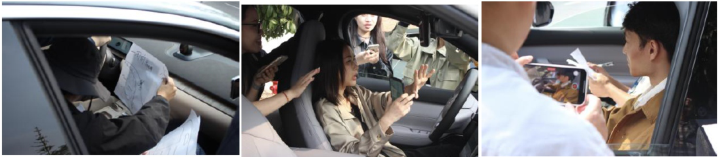
The Wizard of Oz Test: The Wizard of Oz Test involves selecting three representative users from contextual interviews for real-world testing. Dur- ing testing, users interact with assumed working prototypes, while responses from people, devices, applications, or contexts are manually created by operators (“magicians”) behind the scenes. Various parts of the service or sys- tem are carefully prepared and manipulated, such as using paper instead of screens for interactive content. Testers provide genuine reactions in this “real” environment, allowing them to immerse themselves in the product’s context and provide authentic feedback. Prior to formal testing, simulated opera- tions are conducted by two or more researchers. One researcher serves as the host, introducing the testing process to testers and observing and record- ing the process, while another researcher acts as the “magician,” simulating reactions from the context. A third researcher records the entire process and assists in reviewing experimental results later (see Figure 2).
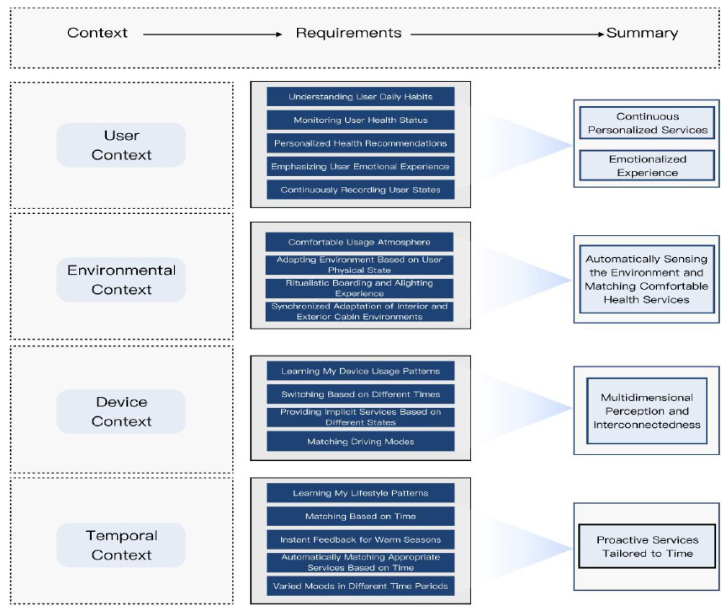
Through the organization of feedback data from the contextual inter- view and The Wizard of Oz Test, further summarization and analysis of design strategies for intelligent health cabins under different contexts were conducted (see Figure 3) in this user research.
Table 1. Outline of interviews for different contexts.
Table available in the original PDF paper.
Context of an interview Synopsis of an interview User context 1. Individual’s physical condition 2. Health needs and habits in daily life 3. Hobbies and interests in daily life 4. Emotional changes while driving 5. Physical changes while driving 6. Suggestions and measures for current health services Environment context 1. Physical state of users in different external environments 2. What is a comfortable internal space environment? 3. Experiences with the current healthy environment 4. Opinions and suggestions on the current healthy cockpit environment Device context 1. Electronic Device Usage Habits in Daily Life 2. Frequency of use of electronic devices in daily life 3. Individual device usage and preference 4. Usage of multiple devices 5. Environment of using different devices Time context 1. Regular routine in daily life 2. Level of psychological and physiological perception of time and seasons 3. Needs for different driving hours 4. What kind of time–specific services would you like to have?
Intelligent Healthy Cabin Design Strategy Based on Context Awareness Theory 235
Figure 2: The wizard of Oz test site.Figure 3: Contextual strategy summary.
CONTEXT-AWARE DESIGN STRATEGIES FOR INTELLIGENT HEALTH CABIN SYSTEMS Through research, it has been found that the basic functional modules and service systems of intelligent health cabin systems have gradually developed and tended towards maturity with the support of relevant technologies. However, there is still considerable room for improvement in user product experiences for intelligent health cabins. Therefore, based on the user, envi- ronment, device, and time contexts distilled from the interview content above, corresponding design strategies are proposed, supported by the design case of the Bianque Health Cabin.
USER CONTEXT Personalized Services
Intelligent health cabin systems encounter challenges in meeting diverse user needs, such as personalization, real-time responsiveness, diversity, and dynamism. Addressing these challenges requires user-centric personalized ser- vice models that actively perceive and analyze comprehensive user informa- tion, including daily actions, behavioral preferences, and dynamic interaction context (Xiaoming, 2020). Leveraging big data and AI technologies, these systems construct a basic user profile model to better understand users’ con- texts and provide precise and personalized cabin health solutions tailored to individual needs. Continuous data recording and iterative updating are cru- cial for system learning and evolution, enabling a deeper understanding of user behavior patterns, health conditions, and preferences over time. Analyz- ing large datasets allows the system to uncover hidden patterns and optimize algorithms for improved personalized services. Upholding user privacy dur- ing data collection and utilization is essential for building user trust (Andry, 2005).
Emotional Experience In addition to personalized services, intelligent health cabin systems should consider users’ psychological feelings and emotional needs. Context-aware technology supports understanding user behavior reasons and constructing user behavior and psychological expectation models. This enables more accu- rate identification of users’ higher-level needs, leading to more personalized and intimate services. Through warm words and caring gestures, the system can create a genuine sense of companionship for users, enhancing trust and sense of belonging to the intelligent cabin. Focusing on users’ psychological needs and emotional experiences creates humanized health services, deepens users’ emotional connection with the cabin, and fosters favorable conditions for further development.
Environmental Context Automatically Sensing the Environment and Matching Comfortable Health Services Automated environmental adaptation is key to optimizing the health cabin experience. Leveraging context-aware principles, systems detect changes and adjust cabin conditions accordingly, prioritizing user comfort and well-being. Temperature and humidity are automatically regulated to suit seasonal vari- ations, while smart devices monitor user health to tailor the environment further. For example, detecting dry skin prompts adjustments to increase air humidity. Beyond this, adaptations extend to light brightness and air quality, dimming lights at night and adjusting CO2 levels for fresher air. Addi- tionally, personalized health services are integrated based on user itineraries and health conditions, offering proactive measures for enhanced user well- being. Through continuous environmental sensing and individualized service provision, the system ensures user comfort and health promotion.
Intelligent Healthy Cabin Design Strategy Based on Context Awareness Theory 237
Equipment Context Multidimensional Perception and Interconnectedness In a smart health cabin service system, deploying various smart devices is crucial to broaden the perception scope and dimensions of contextual data, enhancing the accuracy of the perception system’s calculations. Within health cabin service scenarios, diverse interconnected terminal devices like smartphones, smart central controls, and terminal cameras gather users’ raw data. Through the synergistic use of these components, the system comprehensively perceives data from different contextual factors, compen- sating for singular device limitations. This collaborative function enables a holistic understanding of users’ environments, facilitating personalized services.
Interconnection between devices is vital. For example, smart cabin devices link with users’ personal devices, enhancing understanding of health sta- tus and behavior. This connectivity elevates service intelligence, meeting genuine needs. Linkage between cabin and non-cabin devices refines the ser- vice model. Seamless connectivity ensures data sharing, enabling continuous health management. In summary, the smart health terminal serves as the gate- way for perception and service delivery. With multidimensional perception, the health cabin enhances system intelligence, fostering user trust and driving system advancement.
Time Context Proactive Services Tailored to Time The design strategy based on time context perception operates in two dimen- sions: personal and social time. In personal time, the system tailors health services to users’ daily routines and health statuses, ensuring relevance throughout the day. Social time considerations also play a crucial role, with services adjusted to weekly activities. This approach ensures that the health cabin system’s services align closely with users’ lives, enhancing satisfaction and promoting healthy habits. Moreover, this design strategy presents oppor- tunities for system development. Continuous optimization enables more accurate perception of users’ time contexts, facilitating precise service deliv- ery. The distinction between personal and social time fosters innovation, allowing for tailored services that enhance satisfaction. Prioritizing time con- text perception is essential for ongoing optimization and user experience enhancement in health cabin systems.
DESIGN AND PRACTICE OF THE “BIAN QUE” INTELLIGENT HEALTH CABIN SYSTEM Building upon the aforementioned design methods and strategies, this study focuses on the design and application of the intelligent health cabin system, following a path guided by context awareness design principles. The outcome is the “Bian Que” Intelligent Health Cabin Service System.
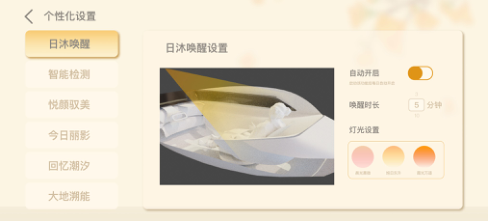
User Context: Continuous Personalized Services and Emotional Experience In terms of user context, in alignment with the design strategies summa- rized earlier, personalized service settings pages have been incorporated into the central control interface to meet users’ diverse and personalized needs. Users can customize various health functions based on their daily behav- iors and preferences (see Figure 4). This approach aims to provide users with more precise and intimate health services. Furthermore, in addition to user-provided personal information, the system also utilizes facial cameras and other devices to capture users’ health information continuously. It then records and updates the user’s health model, generating a personalized health report for each user on a weekly basis. These reports enhance the efficiency of health services provided to users.
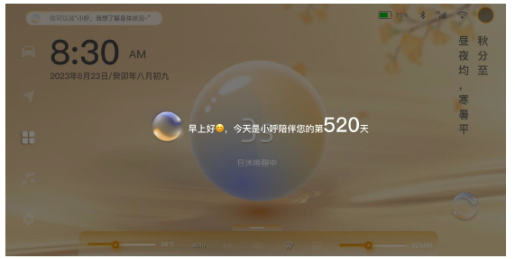
In terms of emotional experience within the user context, to enhance users’ emotional needs during driving, a vehicle-mounted IP assistant named “Xiao Hu”has been designed. It provides more personalized services based on users’ contextual demands. Additionally, in terms of expression, to strengthen the sense of companionship and authenticity for users during driving, the lan- guage design of “Xiao Hu” is more personified. For example, upon the user’s entry into the vehicle, it initiates a greeting mode and warmly mentions that it is the 520th day of accompanying the driver (see Figure 5). Through personi- fied language greetings and care, it breaks the coldness of traditional machine communication, deepening users’ emotional attachment to the cabin.
Figure 4: Personalized settings page.Figure 5: Emotional language in automotive interactive interfaces.
Intelligent Healthy Cabin Design Strategy Based on Context Awareness Theory 239
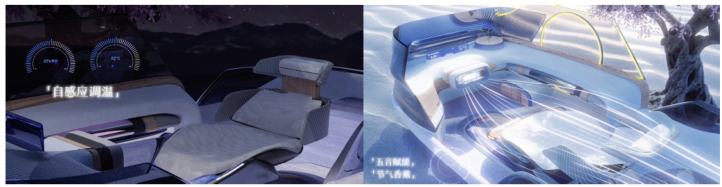
Environmental Context: Automatically Sensing the Environment and Matching Comfortable Health Services In the design of environmental context, the system can automatically adjust the interior environment of the cabin by sensing changes in the external envi- ronment. For instance, during the user’s daytime commute, the interior décor of the cabin predominantly features warm and vibrant colors to help uplift the user’s mood for the day. In the evening after work, if the system detects that the user is feeling fatigued and in need of rest, it adjusts the interior ambiance to cooler, darker tones to facilitate relaxation and recovery, avoiding harsh lighting that may disrupt the user’s rest. Furthermore, the system also adapts the environmental services based on the user’s personal health status. When the system detects dry air in the external environment, it automatically acti- vates the internal temperature and humidity adjustment function to ensure the user’s comfort and skin health. Similarly, if poor air quality is detected externally, the system initiates air purification services to maintain a healthy indoor environment (see Figure 6).
Figure 6: Color changes and automatic adjustment of temperature and humidity for health services inside the cabin at different times.
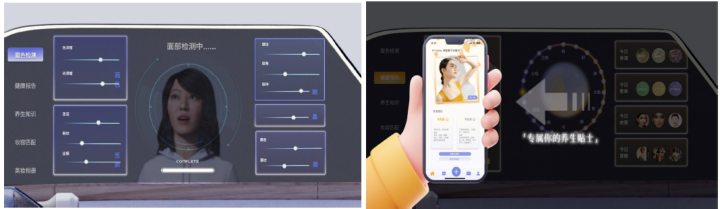
Equipment Context: Multidimensional Perception and Interconnectedness In the “Bianque” intelligent health cabin system, interconnected devices like smart controls and cameras collect user health data. Facial color detection in smart window glass identifies health conditions and provides improvement suggestions. When cabin devices predict user disembarkation, health-related advice is sent to the user’s phone. Collaborative efforts of various devices ensure data sharing, compensating for individual device limitations, offering contextualized services.
Interconnecting cabin and non-cabin devices enhances the service model. As users move from the vehicle cabin to home, seamless connection with smart home devices enables continuous data sharing. This ensures users’ health data and plans are consistently applied across scenarios, providing integrated health management services (see Figure 7).
Figure 7: Various sensing devices inside the cabin and the intelligent interconnection functionality with other devices.
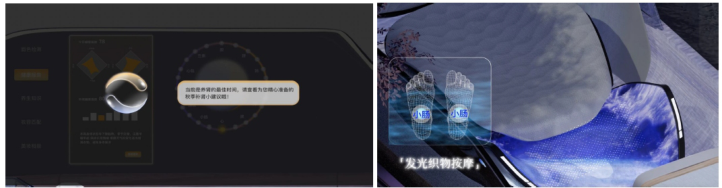
Time Context: Proactive Services Tailored to Time The design strategy for time context is primarily reflected in two dimensions: personal and social time. Regarding users’ personal time, the “Bianque” sys- tem can provide corresponding health services during their working hours. For example, during users’ commute home from work, the system can offer foot massage services tailored to the duration of their workday. Additionally, social time is also an essential factor considered in the design strategy. As illus- trated in the left image below, the cabin integrates traditional Chinese cultural elements such as the twenty-four solar terms to suggest corresponding design strategies for different solar terms. This design model also helps promote user health awareness and behavior change. By providing targeted health services during different time periods of users’ daily lives, it can guide users to develop good health habits and improve their health levels and quality of life (See Figure 8).
Figure 8: Health services for different time periods.
CONCLUSION
As a pivotal direction in advancing intelligent cabins, health cabins aim to address the diverse health needs of a broad user base. Despite numerous pro- posed solutions, challenges persist due to technological and service format limitations, hindering the accommodation of users’ varied needs. By integrat- ing contextual awareness theories and identifying four key situational factors, this study has derived design strategies for user, environment, device, and time contexts within intelligent health cabin services. Guided by these strategies,
Intelligent Healthy Cabin Design Strategy Based on Context Awareness Theory 241
the design of the “Bianque” health cabin has garnered recognition, offering valuable insights for future intelligent health cabin design.
With increasing health awareness, future research can delve deeper into user needs to tailor health services to specific driving scenarios. Advance- ments in technologies like autonomous driving, vehicle networking, and sensors enable machines to make more personalized decisions through con- textual awareness. Consequently, automobiles will transcend mere trans- portation, becoming integral to life and travel experiences. The integration of contextual awareness promises to significantly enhance the user experience of health services within the cabin.
ACKNOWLEDGMENT
Supported by Design-AI lab of China Academy of Art (CAADAI2022A001).
REFERENCES
A. Liu, L. Teo, D. Chen, S. Lu, T. Wuest, Z. Zhang, F. Tao, Biologically Inspired Design of Context-Aware Smart Products, Engineering (2019). Alghamdi, Wael; Shakshuki, Elhadi; R. Sheltami, Tarek (2012). Context- Aware Driver Assistance System. Procedia Computer Science, 10, 785–794. doi: 10.1016/j.procs.2012.06.100. Chu Si-Hsien. Research on the Application of Contextual Awareness in the Design
of Time Management App for College Students. Jiangnan University, 2019. Rakotonirainy, Andry (2005) Design of context-aware systems for vehicle using complex systems paradigms. In Tijus, Charles and Cambon de Lavalette, Brigite, Eds. Proceedings Workshop on safetyand context in conjunction with Context’05, pp. 43–51, Paris. Xin Xiangyang. Interaction design: From physical logic to behavioral logic. Decoration, 2015(01): 58–62. Rosemann, Michael and Recker, Jan (2006) Context-aware Process Design: Explor-
ing the Extrinsic Drivers for Process Flexibility - Steve Waiting for Paper. In Latour, Thibaud and Petit, Michael, Eds. Proceedings 18th International Confer- ence on Advanced Information Systems Enginnering. Proceedings of Workshops and Doctoral Consortium, pp. 149–158. Vahdat-Nejad, Hamed; Ramazani, Azam; Mohammadi, Tahereh; Mansoor, Wathiq (2016). A survey on context-aware vehicular network applications. Vehicular Communications. Wu Jianbin, Zhang Jingyuan, Zhang Linghao. Research on interaction design of in-
vehicle infotainment system based on context-awareness. Packaging Engineering, 2018, 39(16): 189–196. Yang Wenling. Research on human-computer interaction design of intelligent vehicles based on contextual awareness. Hunan University, 2018. Yin Cong. Research on Personalized Recommendation Methods for Converging
Contexts in O2O Environment. Wuhan University, 2020. Zhang Xiaoming. Research on Interaction Design for Offline Entertainment Planning Based on Context Awareness. South China University of Technology, 2021. Zhu Shuo, Jiang Xiao, Tang Yitao. Research on the design strategy of institutional
senior care service based on context-awareness. Packaging Engineering, 2022, 43(18): 136–143. Zuo Zilei, Jiang Xiao. Research on mobile shopping application design based on context-awareness [J]. Packaging Engineering, 2017, 38(24): 156–159.
LISTED IN THE AHFE DIGITAL BOOKSTORE CATALOGUE
Explore the complete digital volume
Ergonomics In Design
Read this individual research paper free through the original publisher, or explore the full digital proceedings book.
ISBN 978-1-964867-05-2
Explore this ISBN in the AHFE Bookstore ↗Listed in the July 2026 bookstore catalogue; search by ISBN to confirm current availability · Digital book purchase optional