Kyoko Kamimura (2024). Classification and Development Methods of Design Projects in Digital Marketing: Perspectives from Art and Design Thinking. In: Ergonomics In Design. AHFE Open Access, vol. 129, pp. 1–6. https://doi.org/10.54941/ahfe1004804
The purpose of this study is to propose an approach that reduces the workload of designers in design projects surrounding digital marketing and enables efficient and effective project progress. In this paper, I explored methods and approaches to reduce project workload based on project types and ways of thinking and conducted research and discussion on methods and approaches that enable efficient and effective project progress.With the advent of the VUCA (Volatility, Uncertainty, Ambiguity, and Complexity) era, design thinking and design methods are gaining attention in order to respond to these environmental changes and challenges. Particularly in digital marketing design projects, projects are becoming increasingly complex and larger as digital technology continues to explode. In addition, project characteristics and requirements continue to expand, and the selection of appropriate project methodologies remains confusing, affecting project progress and quality. While appropriate project development methodologies need to be selected to improve project quality, it is difficult to identify which methodologies are best suited for the project, and challenges remain in improving project quality. To address and avoid these characteristics, design projects have sought flexibility and creativity, moving away from the traditional waterfall process and adopting processes and methodologies that can adapt to change, such as agile approaches and iterations. The characteristics and thought processes of design projects surrounding digital marketing require us to seek means and methods to reduce the project load and propose methods and approaches that enable efficient and effective project progression.The overall research plan is to (1) examine development methods based on project classification, (2) examine the relationship between art thinking, design thinking, and issues in project classification, (3) examine a risk reduction model based on utilization thinking and problem-solving approaches in projects, and (4) create a risk reduction model. I conducted the research and discussion in (1) through (3) this time.(1) Examine development methodologies based on project classificationOrganize characteristics, strengths, and weaknesses of waterfall, agile, and hybrid (mixture of waterfall and agile). Based on design projects conducted over the past 10 years, examine which development style is best suited for the origins and type of project.(2) The Relationship between Thinking and Issues in Project ClassificationClassify the characteristic challenges found in design projects.2-1 Project Abstraction Caused by Changes in Strategy2-2 Portfolio and Product Management2-3 Examination of Uncertainty Brought about by Project Management Methods and Design Processes2-4 Boundary Object Development(3) Thinking about utilization and problem-solving approaches in projectsA summary of the ideas necessary to solve the four issues derived in (2).CONCLUSIONDesign projects allow for a structured approach to projects based on the type of project and the thinking utilized.It is important to structure the project according to the type of project and the thinking utilized. Efficient project promotion can be achieved by selecting an efficient project form based on project classification and utilized thinking characteristics, and by concentrating on priority issues that are likely to arise. In this project, we have worked on problem identification and consideration, and in the future we would like to work on verifying the effectiveness of the derived study results and creating a risk reduction model.
With the advent of the VUCA (Volatility, Uncertainty, Ambiguity, and Com- plexity) era, design thinking and design methods are gaining attention in order to respond to these environmental changes and challenges. Particu- larly in digital marketing design projects, projects are becoming increasingly complex and larger as digital technology continues to explode. In addition, project characteristics and requirements continue to expand, and the selection of appropriate project methodologies remains confusing, affecting project progress and quality. While appropriate project development methodolo- gies need to be selected to improve project quality, it is difficult to identify which methodologies are best suited for the project, and challenges remain in improving project quality. To address and avoid these characteristics, design projects have sought flexibility and creativity, moving away from the tradi- tional waterfall process and adopting processes and methodologies that can adapt to change, such as agile approaches and iterations. The characteris- tics and thought processes of design projects surrounding digital marketing require us to seek means and methods to reduce the project load and pro- pose methods and approaches that enable efficient and effective project progression.
The overall research plan is to (1) examine development methods based on project classification, (2) examine the relationship between art thinking, design thinking, and issues in project classification, (3) examine a risk reduc- tion model based on utilization thinking and problem-solving approaches in
projects, and (4) create a risk reduction model. I conducted the research and discussion in (1) through (3) this time.
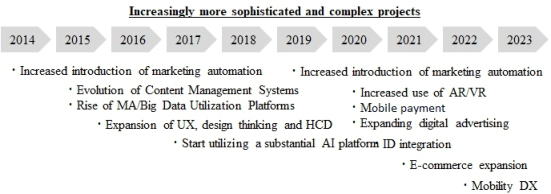
Figure 1: Design project changes in digital marketing.
Examine Development Methodologies Based on Project Classification Organize characteristics, strengths, and weaknesses of waterfall, agile, and hybrid (mixture of waterfall and agile). Based on design projects conducted over the past 10 years, examine which development style is best suited for the origins and type of project.
Table 1. Characteristics of project development methods in design projects.
Table available in the original PDF paper.
Feature Strong Point Weak Point Development Style High risk for requirement changes If the goal is clear, it is the simplest development model and reasonable.
Waterfall Basically, irreversible development method. Easily managed by planning and vulnerable to specification changes.
Difficult to universal- ize the entire project. Hard to imagine the final product.
Agile High flexibility to withstand changes in requirements during development
User First. (Customer involvement in the process) Fast development speed.
Hybrid (mixture of waterfall and agile)
When there are many engineers inexperienced in each development method, Agile is partially introduced to greatly reduce the risk of specification changes.
Appropriate for projects with low and vague requirements and many inexperienced members. Part of the process is done in an agile manner.
A project manager with a limited understanding of development methodologies cannot determine at what phase of the waterfall process to incorporate Agile.
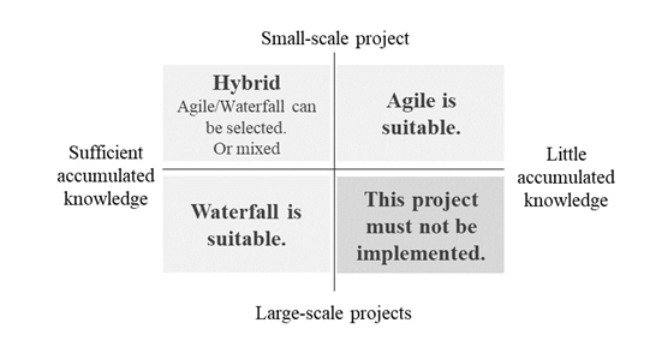
Design projects were classified according to whether they were small or large in scale, whether the project manager and project members had suffi- cient or insufficient accumulated knowledge, and the scale of the project, and development methods were examined.
Classification and Development Methods of Design Projects in Digital Marketing 3
If the project is large and there is little accumulated knowledge, the project should not be undertaken, but procurement of experts or, agile upstream processes, subdividing the project, or setting up a laboratory.
Figure 2: Classification of development methods by knowledge and project size.
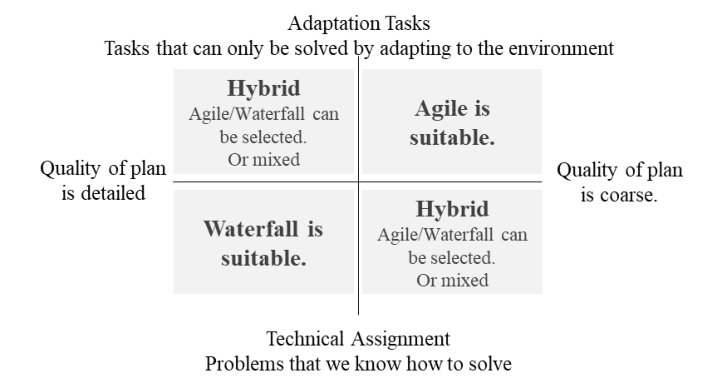
Classification of Projects by Project Assignment Classified projects based on how granular the planning needs to be based on personnel skills and environmental factors, whether the issues are fluid or known unknowns, and the type of issues and quality of planning in the project, and examined development methodologies.’
Figure 3: Classification of development methods by type of issue and quality of plan.
4 Kamimura
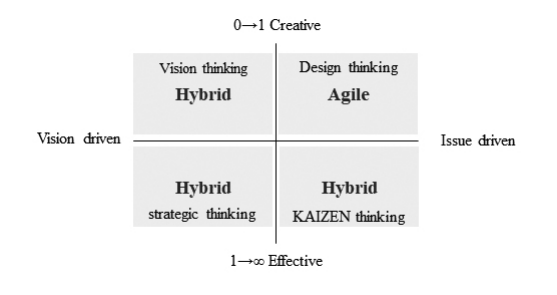
Design Projects Are Categorized by Thinking The development methods were examined according to whether they are creative or efficient, and whether they are strategy-driven, vision-driven, or issue-driven, based on the “four thinking cycles and four worlds” described in Kunitake Sato’s VisionDriven.
Agile development is suitable for design thinking-based problem-solving projects because it allows the project to proceed while solving problems, while visioning, strategic planning, and improvement are suitable for tasks that must be completed separately, such as those that require time for stake- holders to agree or those that cannot be implemented until the first step is decided. In some cases, a hybrid may be chosen because of the mix of tasks that must be completed for each, such as those that require time for stake- holder agreement or that cannot be implemented unless the previous steps are decided.
Figure 4: Classification of development methods by thinking.
The Relationship Between Thinking and Issues in Project Classification Classify the characteristic challenges found in design projects.
Project Abstraction Caused by Changes in Strategy With the advent of the VUCA era, the direction and goals of a project may be forcibly changed during the course of the project due to changes in business strategy or the market. Issues that cannot be addressed by existing knowl- edge and experience alone are arising, and abstract problems are becoming increasingly difficult to present concrete solutions and methods to.
Portfolio and Product Management When multiple projects are simultaneously underway due to digital disruption, they need to be overseen, integrated and managed at the portfo- lio level. Product management is also an important element, requiring design and development that takes into account the entire lifecycle of products and services. Overall optimization and individual optimization are important elements, and coordination and balance are difficult tasks.
Classification and Development Methods of Design Projects in Digital Marketing 5
Examination of Uncertainty Brought About by Project Management Methods and Design Processes Project management methods and design processes support efficient project progress and quality control, but they can also introduce new challenges and uncertainties. For example, challenges in consistency and information sharing between different processes, and dealing with unpredictable elements.
Boundary Object Development Boundary objects play an important role in connecting various elements and stakeholders, but their development and management requires coordi- nation among multiple areas of expertise and different departments, making communication and coordination skills a challenge.
Thinking About Utilization and Problem-Solving Approaches in Projects The following is a summary of the thinking required to solve the four issues derived from the relationship between thinking and issues in the project classification.
According to Yuji Akimoto, author of “Art Thinking”, Art Thinking emphasizes intuition and inspiration, and presents issues while facing one’s inner self, requiring insight and a unique perspective to ask the right ques- tions. Design Thinking emphasizes logical problem-solving, faces the prob- lem from the outside, and requires a thorough user perspective. For this reason, these two ways of thinking are the most commonly used in design projects.
Table 2. Problem-solving approach based on the thinking process.
Table available in the original PDF paper.
Art Thinking Design Thinking Abstraction of projects brought about by changes in strategy Prototyping from empathy, problem definition, and thought expansion Empathize with needs and desires and provide feasible solutions through collaborative work with stakeholders Don’t just focus on conventional correctness Radically rethink conventional project approaches and task changes and definitions Embodying ideas from observation and conception
Portfolio and product management
Emphasis on storytelling to communicate original ideas Use reflection and collaboration to incorporate new ideas and techniques Take a multidisciplinary perspective and do not hinder free thinking. (Collaborate with different experts) Avoid mass-production thinking.
Considering realistic issues such as economic and technical constraints from the user’s perspective and creating ideas to solve problems
Thorough utilization of user-centered thinking Divergence and convergence of ideas, prototyping, and iteration Examination of uncertainties brought about by project management methods and design processes Boundary Object Development Use visualization and co-creation to prepare more creative, flexible and empathetic language and materials
6 Kamimura
CONCLUSION
Design projects allow for a structured approach to projects based on the type of project and the thinking utilized.
It is important to structure the project according to the type of project and the thinking utilized.
Efficient project promotion can be achieved by selecting an efficient project form based on project classification and utilized thinking characteristics, and by concentrating on priority issues that are likely to arise. In this project, we have worked on problem identification and consideration, and in the future we would like to work on verifying the effectiveness of the derived study results and creating a risk reduction model.
ACKNOWLEDGMENT
I would like to thank Kazuhiko Yamazaki for useful discussions.
REFERENCES
Kunitake Sato. (2019). Vision Driven. Diamond Inc. Project Management Institute. (2017). PMBOK Guide 6th edition. Project Management Inst. Yuji Akimoto. (2019). Art Thinking. President Inc.
LISTED IN THE AHFE DIGITAL BOOKSTORE CATALOGUE
Explore the complete digital volume
Ergonomics In Design
Read this individual research paper free through the original publisher, or explore the full digital proceedings book.
ISBN 978-1-964867-05-2
Explore this ISBN in the AHFE Bookstore ↗Listed in the July 2026 bookstore catalogue; search by ISBN to confirm current availability · Digital book purchase optional