Recent years of cell phone development have proposed ways to extend the interaction with mobile devices by equipping the device with a touch-sensitive rear for back-of-device (BoD) interaction. Although previous work [1] provided a classification of hand-hold/grip styles, a detailed understanding of the location of high-frequency touch areas at the back of the cell phone and the position of different fingers is missing. Knowledge of this information is necessary to develop ergonomically based interaction techniques on the back of the device. In addition, the location of high-frequency gripping areas needs to be taken into account when designing the location and size of the heating elements of a cell phone, and such areas should be avoided as much as possible to achieve a better user experience. The purpose of this study is to investigate the distribution of high-frequency gripping areas in the portrait view (one-handed vertical screen scenarios) for BoD interaction of a cell phone. We conducted an experiment to collect the rear area of the phone held by one hand in the natural settings. The rear and surrounding bezel area of the phone is partitioned in 10*10mm squares, with a total of 8*16 grids. 60 human subjects (normal smartphone users recruited by demographic segments) participated in this study. Their hand-hold/grip behaviors data were recorded by simulating their natural usage of the testing device with using an ink-based handprint technique. Then, through image recognition, filter the grid of the rear and surrounding bezel area of the phone, where handprints area account for more than 40% of the grid area. The final processing of the experiment yields a high-frequency grip area map and its corresponding grip posture which indicates how the user hold the smartphone and their BoD interaction. The whole grip area can be divided into three major parts: purlicue area (space between the forefinger and thumb), index finger area, and three fingers (middle, ring, and pinky) area. The results show that in the purlicue area and three-finger area, the grip frequency is normally distributed, and the location and size of the specific areas where the users' grip frequency reaches 90% and 95% in these two areas are obtained. The high-frequency grasping area identified in this study could provide references to design BoD interaction and improve the touch experience on the rear of such devices. In addition, the research results can lay the foundation for exploring the thermal tactile experience of mobile devices, provide a theoretical basis for the PCB layout design of heating components in mobile phones, and guide the system optimization of mobile phone cooling systems.Reference:[1]Choi, Y., Jung, H., Park, J., & You, H. (2017, September). Analysis of grip posture for ergonomic smartphone interface design. In Proceedings of the Human Factors and Ergonomics Society Annual Meeting (Vol. 61, No. 1, pp. 1058-1061). Sage CA: Los Angeles, CA: SAGE Publications.
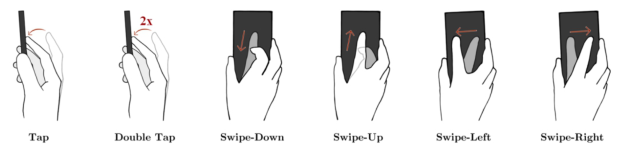
With the continuous development and increasing improvement of digital technology, cell phones have become an indispensable tool in daily life. Stud- ies have shown that one-handed interaction with handheld devices is the primary mode of usages for most users (Karlson et al., 2005). In order to enrich the user’s interaction experience and expand the interaction with mobile devices, researchers have proposed to realize the Back-of-Device (BoD) interaction by equipping mobile devices with a touch-sensitive rear part (see Figure 1). Back-of-device provide an alternative one-handed solu- tion to the limited thumb reachability problem by enabling the user to interact with previously unreachable areas of the screen (Shimon et al., 2015). Baud- isch and Chu (2009) proposed BoD interaction to enable further interaction with very small devices. Shimon et al. (2015) explored user-defined back-of- device gestures for mobile devices. During the interaction with a smartphone, the user experience is closely related to the way the user grips the phone.
High-Frequency Gripping Area for One-Handed Smartphone Rear Interactions 87
Previous work also showed that the way users grasp mobile devices affects their performance (Trudeau et al., 2012, Wolf et al., 2015) and restricts how they can interact with devices in the first place (Odell et al., 2012, Wolf et al., 2014). However, consumers’ behavisor have been changed through the evo- lution of device sizes and application adoption in recent years. Therefore to develop a more user-friendly interaction techniques on the back of a cell phone, it is necessary to have a better understanding of the location of the high-frequency touch regions on the back of a cell phone.
Figure 1: Examples of back-of-device gestures (Shimon et al., 2015).
In addition, the increasingly comprehensive functions and improved per- formance of mobile phones have led to user discomfort caused by phone overheating, especially in the intensive scenarios such as gaming. To achieve a better user experience in the aspect of physical interaction, the location of high-frequency gripping area needs to be taken into account when designing the location and size of the heating components inside the device.
Therefore, in order to enhance the user experience by developing back-of- device interaction techniques from an ergonomic approach, and optimizing the components design of cell phone heating systems, it is important to under- stand how the user naturally grips the smartphone, where the fingers are located, and what areas of the back of the device are covered when gripped. Yoo et al. (2015) measured the touchable areas of the index finger and thumb on a smartphone in a natural hand position. Zhang et al. (2022) detected how a smartphone was held by capturing images of the smartphone screen reflected on the cornea with a built-in front camera. Whereas grip postures for touch screen usage were studied in many researches, a detailed under- standing of the location of high-frequency touch areas at the back of the cell phone and the position of different fingers is lacking.
In this paper we report from a study that investigates the high-frequency gripping area in one-handed vertical screen scenarios, which provides a refer- ence for usable BoD interaction design and the PCB (Printed Circuit Board) layout design of heating components in smartphones. We decompose the high-frequency gripping area into three main parts and describe the corre- sponding high-frequency gripping posture. We study the patterns of grip frequency and obtain the location and size of the regions where the user’s grip frequency reaches 90% and 95%.
EXPERIMENT We conducted an experiment to collect the rear area of the phone held by one hand in the natural settings. We specifically focused on where the grasping
hand touches the rear of smartphone during the experiment. The study was conducted in a controlled lab environment in which participants were seated and fully immersed in their interaction with the smartphone. We refrained from any intervention with the participants and the experimental phone to avoid influencing the grasping method.
Participants The participants were composed with 30 normal smartphone users (15 females and 15 males, in the age of 18–30 years) who had normal (or corrected) vision and were free of hand disease. All participants had identi- fied the one-hand operation as their primary mode. People usually tend to use their dominant hand to operate the phone (Arif et al., 2012). To avoid this influence, all our participants were right-handed. Based on gender to hand length ratio data (from Human Dimensions of Chinese Adults GB/T 10000-2023), participants were recruited considering hand length distribu- tion in China with three hand types: small (153.51mm–172.67mm), medium (172.67mm–191.34mm), and large (191.34mm–209.48mm). Specific infor- mation about the participants is shown in Table 1.This study was approved by the local institutional review board.
Table 1. Specific information on the proportion and quantity of participant hand types.
Table available in the original PDF paper.
Number of Participants
Total Number of Participants
Hand typess Hand type ratio (from GB/T 10000-2023) Male & Small 0.023 1 15 Male & Medium 0.563 9 Male & Large 0.356 5 Female & Small 0.392 6 15 Female & Medium 0.544 8 Female & Large 0.032 1
Materials
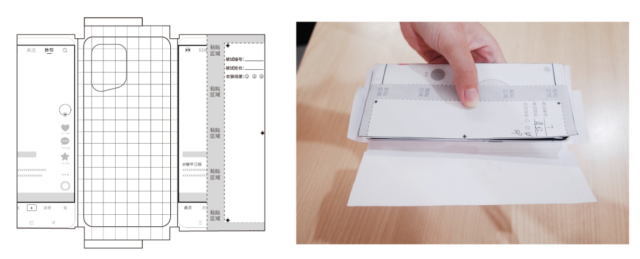
The experiments were performed on a OPPO Find X5 Pro (163.7 mm × 73.9 mm × 8.5 mm; 218 g). The size and weight are common in current regular smartphones, similar to HUAWEI Mate 60 Pro, Samsung Galaxy S23 Ultra or iPhone 15 Pro. To capture the gripping area and data analy- sis, we designed a grid paper according to the size of the phone, which can be attached to the phone (see Figure 2). The grid consists of 8 × 16 cells, the size of the cell located in the center area of the phone’s back panel is 10 mm × 10 mm, and the size of the cells located in the leftmost and rightmost columns of the back panel is 7 mm × 10 mm, whereas the outer rows and columns are at the edges of the phone. We used a kind of red ink to collect par- ticipants’ gripping handprints and used a camera to record how participants performed during the experiment.
High-Frequency Gripping Area for One-Handed Smartphone Rear Interactions 89
Figure 2: The grid paper which can be attached to the phone.
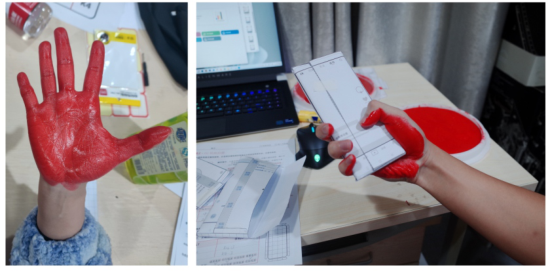
Procedure After participants understood the research purpose and filled out an informed consent form, the experiment began. The measurement of the mobile phone gripping area was carried out through four steps: measuring hand length, introducing tasks, familiarizing with the model, and collecting grip finger- prints. Firstly, use a vernier caliper to measure the participants’ hand length (measured from the carpus to the middle finger’s tip) to classify the hand type. After the researchers introduced the experimental tasks and procedures to the participants, they were asked to hold the experimental cell phone in a vertical screen with one hand, familiarize themselves with the feel of the phone, and find a natural and comfortable posture for holding the phone. A stable grasp was found when participants did not change the grasp for at least 30 seconds. Following that, we used red ink to record on grid paper the areas where participants touched the phone while holding it. The specific steps were as follows: participants were instructed to dip their right hand in evenly moist ink and gripped the phone with the grid paper using the grip posture they had just become familiar with (see Figure 3). The ink made a handrprint on the grid paper. It should be noted that the hand should not be moved during grip to maintain clear and complete fingerprints. Repeat the above operation three times to obtain an accurate image. We recorded the procedure on video and reviewed it afterwards to ensure the standardization of the experiment operations.
Figure 3: Collecting handprints with red ink.
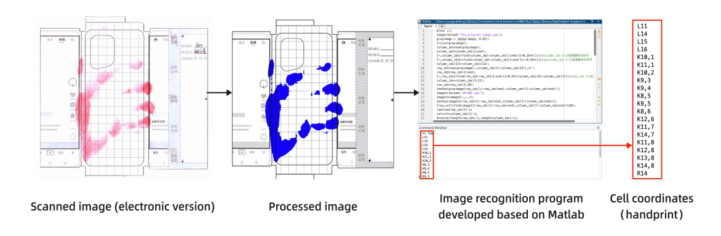
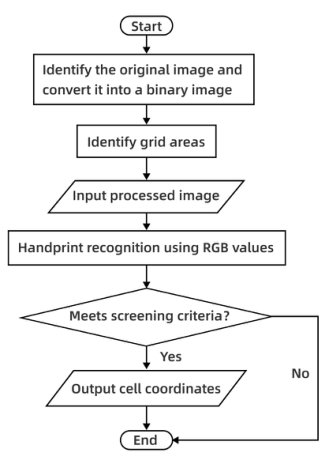
Data Collection and Processing In order to identify and collect the position information of the gripping area from the grid paper printed with the gripping handprint obtained from the experiment, three processing steps (see Figure 4) were carried out on the grid paper: (1) scanning the grid paper with grip handprints to obtain an electronic version of the image, (2) processing the images by the software (Adobe Pho- toshop) to improve the grip handprints quality, and (3) screening the target grid cells by using an image recognition program developed based on Matlab (see Figure 5) and output their positional coordinates. The screening crite- ria for image recognition programs are: screen grid cells with a fingerprint area that accounts for more than 40% of the grid cell area in the rear area or more than 20% of the cell area in the surrounding area. The position of these filtered grid cells is considered as the grip area.
Figure 4: Overview of image processing.Figure 5: The running mechanism of the image recognition program.
High-Frequency Gripping Area for One-Handed Smartphone Rear Interactions 91
RESULTS
The processing result of the experiment yieldes a high-frequency grip area map and its corresponding grip posture which indicates how the user hold the smartphone and their BoD interaction. The results show that in the purlicue area and three-fingers (the middle finger, the ring finger and the little finger) area, the grip frequency is normally distributed in the direction along the y-axis of the phone, and the location and size of the specific areas where the users’ grip frequency reaches 90% and 95% in these two areas are obtained.
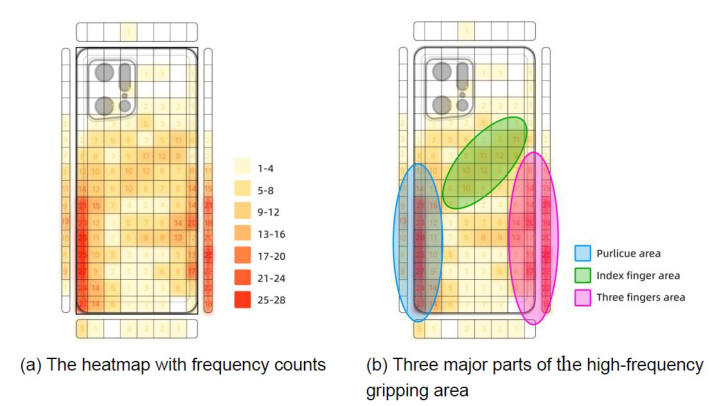
High-Frequency Gripping Area We counted and visualized the grip data of 30 participants obtained through the experiment to produce a high-frequency gripping area map displayed in Figure 6a. Different colors are used to represent different gripping frequen- cies, with colors ranging from light to dark representing gripping frequencies from low to high. The total number of grid cells screened as grip areas was 1055, with an average of 35.17 per participant, touching 19.98% of the 176 grid cells. The high-frequency gripping area can be divided into three major parts (see Figure 6b): purlicue area (the part of the hand between the thumb and the index finger), index finger area, and three-fingers (the middle finger, the ring finger and the little finger) area.
Figure 6: High-frequency gripping area maps (a) with frequency counts marked (b) with three major parts labeled.
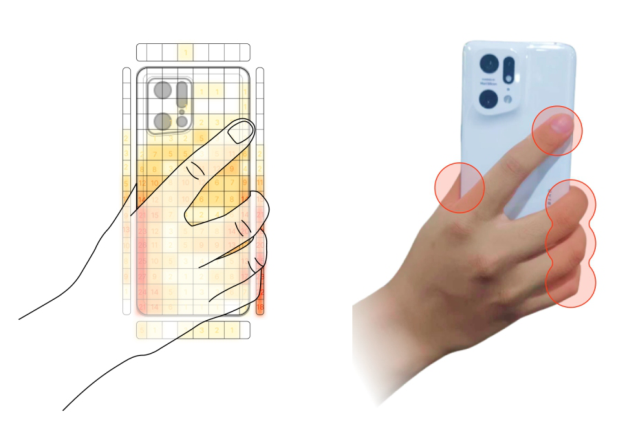
Its corresponding high-frequency grip posture (see Figure 7) was deter- mined from the morphology of the high-frequency gripping area map. The purlicue is stuck on the left side of the phone’s backboard, and the index fin- ger is naturally placed on the backboard, while the other three fingers hold the left side of the backboard.
Figure 7: High-frequency grip posture.
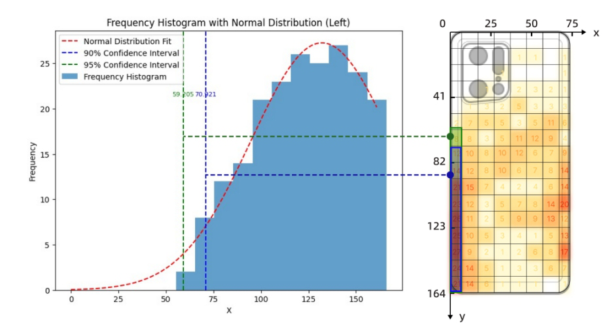
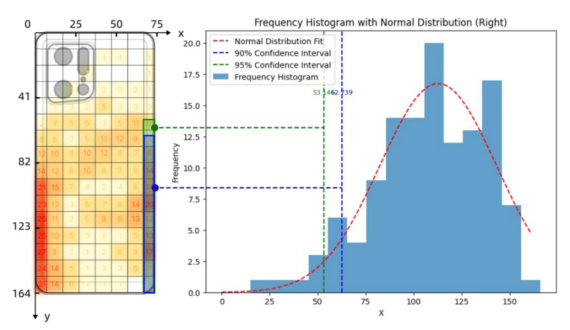
Grip Frequency Distribution Establish a coordinate system on the back of the phone with the top-left cor- ner as the origin, using the width direction of the phone as the x-axis, and the height direction as the y-axis. The axes represent the position in mm when facing the rear of the phone. From the high-frequency gripping area, it can be seen that the area with the highest gripping frequency is the left- most and rightmost columns of the grid paper, corresponding to the purlicue area and the three-fingers area. The grip frequency distribution of the three main parts was further analyzed, and the grip frequency histograms in the leftmost column (with x-axis coordinates ranging from 0 to 7mm) and the rightmost column (with x-axis coordinates ranging from 67mm to 74mm) were obtained as shown in Figure 8 and Figure 9.
The results show that in the purlicue area and three-fingers area, the grip frequency is normally distributed in the direction along the y-axis of the phone. The grip frequency distribution has no significant features in the index finger area. For the leftmost column of cells on the grid paper, the gripping frequency of users reaches 95% within the y-axis coordinates ranging from 59.205mm to 160mm. Additionally, within the y-axis coordinates ranging from 70.921cm to 160mm, the gripping frequency of users reaches 90%. For the rightmost column of cells on the grid paper, the gripping frequency of users reaches 95% within the y-axis coordinates ranging from 53.146mm to 160mm. Additionally, within the y-axis coordinates ranging from 62.739cm to 160mm, the gripping frequency of users reaches 90%. It indicates that fur- ther enhanced interaction with the edge of the device should be designed in such areas if we want to better utilize the users’ grip posture. On the other hand, it needs to avoid to place physcial buttons in such areas to reduce unintentional touch, as well as heating components inside.
High-Frequency Gripping Area for One-Handed Smartphone Rear Interactions 93
Figure 8: Frequency histogram in the leftmost column.Figure 9: Frequency histogram in the rightmost column.
CONCLUSION
This study aimed to investigate the distribution of high-frequency gripping areas in the portrait view (one-handed vertical screen scenarios) for BoD interaction of a cell phone. To that end, a user experiment was conducted to collect the rear area of the phone held by one hand in the natural settings. 30 human subjects (normal smartphone users recruited by demographic seg- ments) participated in this study. Their hand-hold/grip behaviors data were recorded by simulating their natural usage of the testing device with using an ink-based handprint technique. The study obtained a high-frequency grip- ping area map and its corresponding grip posture, which indicate how users hold their smartphones frequently.
The results of this study could be used to provide references to design BoD interaction and improve the touch experience on the rear of such devices. In addition, the research results can lay the foundation for exploring the thermal tactile experience of mobile devices, provide a theoretical basis for the PCB
layout design of heating components in mobile phones, and guide the system optimization of mobile phone cooling systems.
Limitations of this study and future directions are as follows. First, the experiment was conducted in a simulated environment, using a prototype to simulate the natural state of using a cell phone. Second, we only studied the grip pattern in the one-handed vertical screen scenario, so it is neces- sary to further verify the grip characteristics of smartphones in various usage scenarios. Finally, we could not conduct comparison by characteristics of sub- ject groups (e.g., gender, age, and hand type) due to limits in the number of the subjects. Further studies are needed to determine such differences.
ACKNOWLEDGMENT
This research was sponsored by the National Key Research and Develop- ment Program (2021YFF0900605), the Research Fund for Humanities and Social Sciences of the Ministry of Education (22YJA760082), the Science and Technology Innovation Program of Hunan Province (2022WZ1039), Lushan Lab Research Funding and the Fundamental Research Funds for the Cen- tral Universities. The authors would like to acknowledge the support of the participants in this study.
REFERENCES
Arif, A. S. (2012, December). A survey on mobile text entry handedness: How do users input text on handheld devices while nomadic?. In 2012 4th international conference on intelligent human computer interaction (ihci) (pp. 1–6). IEEE. Baudisch, P., & Chu, G. (2009, April). Back-of-device interaction allows creating
very small touch devices. In Proceedings of the SIGCHI Conference on Human Factors in Computing Systems (pp. 1923–1932). Karlson, A. K., Bederson, B. B., & SanGiovanni, J. (2005, April). AppLens and launchTile: Two designs for one-handed thumb use on small devices. In Pro- ceedings of the SIGCHI conference on Human factors in computing systems (pp. 201–210). Odell, D., & Chandrasekaran, V. (2012, September). Enabling comfortable thumb
interaction in tablet computers: A Windows 8 case study. In Proceedings of the Human Factors and Ergonomics Society Annual Meeting (Vol. 56, No. 1, pp. 1907–1911). Sage CA: Los Angeles, CA: SAGE Publications. Shimon, S. S. A., Morrison-Smith, S., John, N., Fahimi, G., & Ruiz, J. (2015, August).
Exploring user-defined back-of-device gestures for mobile devices. In Proceed- ings of the 17th International Conference on Human-Computer Interaction with Mobile Devices and Services (pp. 227–232). Trudeau, M. B., Young, J. G., Jindrich, D. L., & Dennerlein, J. T. (2012). Thumb motor performance varies with thumb and wrist posture during single-handed mobile phone use. Journal of biomechanics, 45(14), 2349–2354. Wolf, K., Schleicher, R., & Rohs, M. (2014). Touch Accessibility on the Front and
the Back of held Tablet Devices. In Haptics: Neuroscience, Devices, Modeling, and Applications: 9th International Conference, EuroHaptics 2014, Versailles, France, June 24–26, 2014, Proceedings, Part I 9 (pp. 161–168). Springer Berlin Heidelberg.
High-Frequency Gripping Area for One-Handed Smartphone Rear Interactions 95
Wolf, K., Schneider, M., Mercouris, J., & Hrabia, C. E. (2015). Biomechanics of front and back-of-tablet pointing with grasping hands. International Journal of Mobile Human Computer Interaction (IJMHCI), 7(2), 43–64. Yoo, H., Yoon, J., & Ji, H. (2015, August). Index finger zone: Study on touchable
area expandability using thumb and index finger. In Proceedings of the 17th Inter- national Conference on Human-Computer Interaction with Mobile Devices and Services Adjunct (pp. 803–810). Zhang, X., Ikematsu, K., Kato, K., & Sugiura, Y. (2022, April). ReflecTouch: Detecting Grasp Posture of Smartphone Using Corneal Reflection Images. In Proceedings of the 2022 CHI Conference on Human Factors in Computing Systems (pp. 1–8).
LISTED IN THE AHFE DIGITAL BOOKSTORE CATALOGUE
Explore the complete digital volume
Ergonomics In Design
Read this individual research paper free through the original publisher, or explore the full digital proceedings book.
ISBN 978-1-964867-05-2
Explore this ISBN in the AHFE Bookstore ↗Listed in the July 2026 bookstore catalogue; search by ISBN to confirm current availability · Digital book purchase optional