Mahmut Ekşioğlu, Ömer Gündüz (2024). A Critique of the Use of Information Axiom for Ergonomic Design. In: Ergonomics In Design. AHFE Open Access, vol. 129, pp. 120–126. https://doi.org/10.54941/ahfe1004817
Axiomatic design is a science-based design process based on two axioms. The first axiom, the Independence Axiom, maintains the independence of the functional requirements. When more than one design that satisfies the Independence Axiom is available, the second axiom, the Information Axiom can be used to select the best design. That is, among those designs that satisfy Independence Axiom, the design with the smallest information content is the best design. Since its invention, the axiomatic design approach has been widely used in product, software, organization, and system development. Several studies investigated the potential of its use for ergonomic design but found some flaws. So they modified the original information axiom to fit ergonomic design. However, through this study, it is shown that the alternative formulae proposed by these studies have also their flaws for most anthropometric design cases. This paper examines the original information axiom formula as well as the modified ones for their applicability to ergonomic design and identifies the shortcomings within them. Several anthropometric design examples are provided to illustrate these cases.
Axiomatic design (AD) theory developed by Suh (1990) is based on two fundamental axioms that eliminate the possibility of making mistakes when products – both hardware and software – are developed. The theory helps to overcome the shortcomings of the product development process that is based on a recursive ‘design/build/test’ cycle, which require continuing modifica- tions and changes as design flaws are discovered through testing (Suh, 2001). The trial-and-error approach to product design and development often leads to cost overrun and missed schedules (Suh, 1990, 2001, 2007). The two axioms are briefly described below.
The Independence Axiom. It is about maintaining the independence of the functional requirements (FRs). The FRs are the minimum set of independent requirements the design of a product (or software, organizations, systems, etc.) must satisfy. That is, when there are two or more FRs, the design solu- tion must be such that each one of the FRs can be satisfied without affecting the other FRs. In other words, the designer or decision maker must choose a correct set of design parameters (DPs) to be able to satisfy the FRs and
A Critique of the Use of Information Axiom for Ergonomic Design 121
maintain their independence. Here we are talking about functional indepen- dence (independence of functions of design from each other) but not physical independence. The details of the independence axiom can be found in Suh (1990).
The Information Axiom. It is about minimizing the information content of the design. In the case of existence of more than one alternatives that satisfies the Independence, the Information Axiom can pinpoint the best design. That is, among those designs that satisfy the Independence Axiom, the design that has the smallest information content is the best design. Because the infor- mation content is defined in terms of probability, the Information Axiom also states that the design that has the highest probability of success is the best design. This axiom may suggest that physical integration is desirable to reduce the information content if the functional independent can be main- tained (Suh, 1990). Even for the same task defined by a given set of FRs, it is likely that different designers will come up with different designs, all of which may be acceptable in terms of Independence Axiom: Indeed, there can be many designs that satisfy a given set of FRs. However, one of these designs is likely to be the best. The Information Axiom provides a quantitative mea- sure of the merits of a given design. And thus, it is useful in selecting the best among those that are acceptable. In addition, it provides the theoretical basis for design optimization and robust design (Suh, 2009).
The Information Axiom introduces a parameter known as “information content”to determine the optimal alternative. The alternative with the lowest information content value is considered the best design. Information con- tent essentially means that lower information values require less information during the design implementation phase. In simple terms, as the probabil- ity of satisfying the functional requirements (FRs) increases, the information content value decreases. Suh (1990) proposed an equation to calculate this information content value.
Equations and mathematical formulas are available in the original paper PDF.
Eq. 1 calculates the information value associated with a specific FR. In the equation, “pi” represents the probability of satisfying the ith FR. To obtain the information content value for the entire design alternative, simply sum all the calculated Ii values as described in the equation. This sum provides a comprehensive measure of the information content for the entire design alternative.
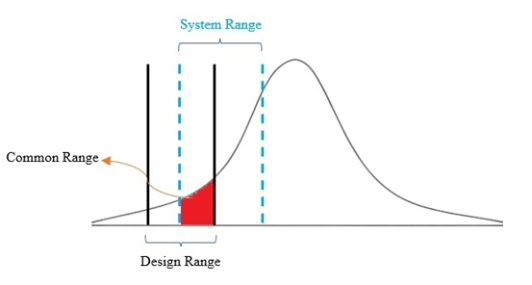
In any design, you can express the probability of success in terms of what an FR requires, given tolerances (the design range), and what the proposed alternative provides (the system range). These probabilities typically follow certain probability distributions. By using the system’s probability distribu- tion function, one can plot the probability ranges associated with the desired range, the system range, and the overlapping common range. This helps
122 Ek¸sio ˘glu and Gündüz
to evaluate the likelihood that the proposed design will meet the desired requirements within the specified tolerances (Suh, 1990).
Figure 1: Design range, system range and common range.
This study explores the applicability of the information axiom to ergonomic design, focusing particularly on anthropometric designs. It aims to identify flaws in the original information axiom and the proposed modified ones.
DESIGN FOR ANTHROPOMETRY Anthropometric design aims to accommodate wide range of users/operators typically 90% or more of the considered population. The two commonly used design approaches in anthropometric designs are: Design for adjusta- bility and design for extremes (minimum or maximum). Some designs such as chair seat height require adjustability within a range and some others for extreme either 5th%ile or 95th%tile depending on the design: for example, shelf heights are designed for 5%tile female reach capability and door heights are designed for 95th%ile male stature. Both design approaches are necessary if the product is used by a range of users.
Especially the design for adjustability separates ergonomic design from other design approaches. This is where original axiomatic design mainly fails to be used directly.
USE OF INFORMATION AXIOM IN ERGONOMIC DESIGN AND ITS SHORTCOMINGS Despite the widespread acceptance of the axioms of axiomatic design, some authors in ergonomics field (Helander and Lin, 2002; Karwowski, 2012) have claimed that the information value formula is poorly suited for ergonomic design, including areas such as design for adjustability and design for extremes. They argue that the formula, in its original form, can potentially mislead decision makers in selecting the best design alternative. Consequently, these authors have proposed revisions and modifications to the information value formula to better align it with the ergonomic design.
A Critique of the Use of Information Axiom for Ergonomic Design 123
They proposed modified information axiom formulae and new approaches as solutions to the shortcomings of the original information axiom. These proposed approaches are presented and critically examined for their suitabil- ity in ergonomic design below.
The Approach by Helander and Lin Helander and Lin (2002) argue that in certain situations, the original information axiom may mislead the decision-maker when viewed from ergonomics perspective. They argue that, based on the information axiom, when a specific design option is selected, it is assumed that any user who conforms to the distribution within the Design Range would be able to use it. However, this approach may not always be ergonomically suitable. Accord- ing to them, this inherent challenge stems from the definitions of design range and system range. To address this issue they have reevaluated and rede- fined these ranges with thoughtful consideration of human users. Suh (2007) acknowledged Helander as a pioneer in the application of Axiomatic Design within the field of ergonomics due to the findings of his studies.
The approach by Helander and Lin is examined below through an example and counter example.
Example (adapted from Helander and Lin, 2002). “In our scenario, we conducted a user survey to establish the preferred adjustable table heights. Based on the survey findings, we identified that the ideal height range fell between 20 and 30 inches, which gave us a design range (DR) of 10 inches. We then evaluated two tables from different manufacturers: (1) Table A had an adjustable height range of 20 to 25 inches, resulting in a System Range (SR) A of 5 inches. Within this range, the portion that aligned with user preferences was also 5 inches, termed the Common Range (CR) A. (2) Table B provided an adjustable height range of 20 to 35 inches, leading to a System Range (SR) B of 15 inches. Within this broader range, the segment that overlapped with user preferences amounted to 10 inches, known as Common Range (CR) B”.
System Range A Common Range A
System Range B Common Range B
According to AD, if we solely consider the information content, Table A would be selected because it has less information content compared to Table B. However, considering the adjustable design approach of ergonomics, Table B is the better choice since it can accommodate the full range of user prefer- ences, while Table A only half of them. Thus, from ergonomic perspective, Table B is the correct choice. This highlights the importance of consider- ing not only the information axiom but also the broader context and user requirements in the design selection process.
Helander and Lin (2002) accordingly have put forward a modification to address this ergonomics-related issue, aiming to provide a solution that better aligns with ergonomic considerations in design selection:
124 Ek¸sio ˘glu and Gündüz
Desired Range
where desired range refers to the ergonomic design range. By using their formula, they have obtained the following for the same example:
10 5
Desired Range A Common Range A
10 10
Desired Range B Common Range B
It seems that Helander and Lin’s formula yields a choice that aligns with the adjustable design approach. However, as we will show in the following counter example, this is not always the case.
A Counter Example for the Approach by Helander and Lin. Let’s consider that the desirable adjustable table height range is 10 to 15 inches resulting in a design range (DR) of 5 inch (15-10). We then evaluate two tables from different manufacturers: Table A with an adjustable height range of 10 to 15 inch resulting in a System Range (SR) A of 5 inch. That is, SR, DR and CR are all equal to 5 inch. Alternatively, let’s say, Table B offers an adjustable height range from 10 to 25 inch, leading to a System Range (SR) B of 15 inch (25-10). Within this broader SR, the area that overlaps with user preference (i.e., CR: common range) equals to 5 inch.
By using Helander and Lin’s information equation, the following I values are obtained:
5 5
Desired Range A Common Range A
5 5
Desired Range B Common Range B
Both designs provide the same information value; that is, we may select any of them.
Indeed, in this scenario, selecting Table A is a more suitable choice given that it aligns precisely what adjustable design calls for which accommodates 90% of population anthropometric value. On the other hand, although Table B also accommodates 90% of population anthropometric value, it is costly due to its unnecessarily excessive adjustability range. This example shows that the formula proposed by Helander and Lin does not account for the “cost” aspect of design.
The Approach by Karwowski Karwowski (2012) redefines the domains of AD as Human capabilities and limitations (Functional Domain), Design of Compatibility (Physical Domain), and Management of Compatibility (Process Domain). Furthermore, Kar- wowski (2012) describes information axiom as “The Human Incompatibility Axiom” and he modifies the original formula as follows:
) = −log2 Ci (4) Ci where “Ii” and Ci denote the incompatibility content and Compatibility index of a design, respectively.
A Critique of the Use of Information Axiom for Ergonomic Design 125
Karwowski (2012) defines Ci based on the decision maker’s objectives. It offers the flexibility to either reduce exposure to negative effects caused by a particular design parameter or enhance the positive effects of a desirable design parameter. This approach aims to mitigate system-human incom- patibility by tailoring the strategy to the specific goals of the decision maker.
If we intend to minimize exposure;
Ri = Maximum exposure value (ergonomic standard) Ai = Given design parameter This formula is valid when we have Ai>Ri. Then, we can calculate incompatibility content of a given design parameter as follows:
Ri Ai
Ai Ri
If we get Ai<Ri, C can be set to “1”. So that we will have I = 0. It appears that Karwowski (Karwowski, 2012) formula may not account for scenarios where design alternatives either meet the exact requirement (Ai = Ri) or when multiple alternatives satisfy the condition Ai<Ri.
Example. Let’s illustrate the use of the formula proposed by Karwowski for determining the ideal shelf height for general population. Using the design for minimum extreme approach, the ideal shelf height to fit at least 95% of population is determined with reference to 5th%tile female reach height of, say, 125 cm. Suppose we have two shelves, one with a height of 124 cm and the other one with 24 cm. From an ergonomic standpoint, the 124 cm shelf is the best option to choose. Karwowski’s formula, however, considers these two design equally acceptable alternatives since both satisfy the condition (Ai ≤Ri). Obviously, if one selects the 24 cm height shelf, many users would have problem using it.
If we intend to maximize adaptability;
This formula is valid when we have Ai<Ri. Then, we can calculate the incompatibility content of a given design parameter as follows:
Ri Ai
If we get Ai>Ri, C can be set to “1”. So that we will have I = 0. It appears that the formula by Karwowski (2012) does not address situa- tions where equality exists (Ai = Ri) or when multiple design alternatives satisfy Ai>Ri. In these cases, his formula might not be able to pinpoint the optimal alternative effectively. This is because alternatives that fulfil the
126 Ek¸sio ˘glu and Gündüz
Ai ≥Ri condition would all result in I = 0, creating a situation where there is no definitive method to choose one among them as the optimal choice.
Karwowski’s formula proves to be inadequate for dealing with alternatives that involve ranges. This limitation arises because the formula relies on single values for both ergonomic standards (R) and design parameters (A).However, in practical design scenarios, designers often work with ranges defined by upper and lower specification limits when specifying requirements and design parameters. As a result, it becomes difficult to seamlessly apply Karwowski’s formula with tolerance values.
In addition, Karwowski’s formula can potentially yield negative values in certain situations. Though Karwowski (2012) suggests replacing these neg- ative values with “1” as a workaround, this approach can mislead decision makers and may cause potential application errors. Taken together, these factors make Karwowski’s formula unsuitable for ergonomic designs.
CONCLUSION
The possibility of use of information axiom in ergonomic design is inves- tigated by Helander and Lin and Karwowski with some success. The real problem of using the information axiom arises in the case of design for adjustability and also for design for extremes. As shown through this study by counter examples neither the original nor the proposed modified infor- mation axiom formulae were successful in selecting the best alternatives for all ergonomic design cases. Therefore, a new approach is needed to over- come the shortcomings of the original and the modified information content approaches for ergonomic design.
REFERENCES
Helander, M. G., Lin, L. (2002). Axiomatc Design in Ergonomics and an Extension of the Information Axiom. Journal of Engineering Design, vol. 13, pp. 321–339. Karwowski, W. (2012) “The Discipline of Human Factors and Ergonomics,” Hand-
book of Human Factors and Ergonomics, pp. 3–37. Suh, N. P. (1990). The Principles of Design, New York: Oxford University Press. Suh, N. P. (2001). Axiomatic Design: Advances and Applications, New York: Oxford University Press. Suh, N. P. (2007). Ergonomics, axiomatic design and complexity theory, Theoretical
Issues in Ergonomics Science, vol. 8, no. 2, pp. 101–121.
LISTED IN THE AHFE DIGITAL BOOKSTORE CATALOGUE
Explore the complete digital volume
Ergonomics In Design
Read this individual research paper free through the original publisher, or explore the full digital proceedings book.
ISBN 978-1-964867-05-2
Explore this ISBN in the AHFE Bookstore ↗Listed in the July 2026 bookstore catalogue; search by ISBN to confirm current availability · Digital book purchase optional