Qin Du, Junjian Chen, Yuqian Wang, Linlin Feng, Yan Luximon (2026). NecKorrect: Customisation Ergonomic Interventions for Cervical Spine Health. In: Healthcare and Medical Devices. AHFE Open Access, vol. 211, pp. 42–52. https://doi.org/10.54941/ahfe1007467
Pillow design plays a critical role in spinal alignment and sleep quality. This study introduces NecKorrect, a data-driven ergonomic intervention designed to optimise cervical alignment through personalised curvature. Using a hybrid 3D and 2D anthropometric approach, we developed customised pillows and evaluated them through subjective comfort assessments and objective MRI-based biomechanical analysis. Results from five participants indicate that pillows maintaining a cervical Cobb angle of 7°–9° were associated with the highest comfort ratings for most users, though individual anatomical variations necessitated tailored interventions. A nonlinear relationship was observed between pillow slope and spinal correction, revealing a mechanical saturation threshold beyond which overcorrection may induce compensatory flexion. This research reveals the importance of personalised ergonomic solutions and provides a scalable framework for combining biomechanical correction with user subjective experience in pillow design.
Neck pain ranks as the fourth leading cause of disability, affecting over 30% of the population annually (Cohen, 2015). Sleep quality and spinal health are closely interconnected, with pillow design playing a vital role in maintaining proper cervical alignment and alleviating discomfort. Insufficient support for the neck and shoulders can disrupt spinal posture, contributing to neck pain, morning stiffness, impaired mobility, and diminished sleep quality. Inadequate pillow support may also lead to long-term musculoskeletal complicationss (Chen and Cai, 2012; Gordon, Grimmer-Somers and Trott, 2009, 2010; Gordon and Grimmer-Somers, 2011). Given the bidirectional relationship between sleep quality and musculoskeletal pain, iterative improvements in sleep system ergonomics, particularly pillow design, can have far-reaching public health implications (Jeon, Jeong et al., 2014; Chaiming and Eungpinichpong, 2020). The same design can be overly supportive for some users but insufficiently supportive for others. This can lead to discomfort and might even worsen the cervical health condition. To promote optimal comfort and spinal health, a well-designed pillow should be tailored to individual anthropometric characteristics, ensuring ergonomic support. In this context, this entails moving beyond Received March 3, 2026; Revised April 6, 2026; Accepted April 25, 2026; Available online July 20, 2026
NecKorrect: Customisation Ergonomic Interventions for Cervical Spine Health 43 one-size-fits-all solutions toward customised supports that adapt to the user’s unique spinal curvature and sleeping posture. However, achieving such personalisation requires a deeper understanding of biomechanical interactions between the human body and supportive devices. Although some researchers have posited that the suitable pillow should support users’ spinal alignment to keep natural neutral position, empirical evidence to substantiate this claim remains limited.
In this study, we introduce NecKorrect, a data-driven ergonomic intervention designed to optimise cervical spine alignment through customised pillow designs. The objective of the study is to design an ergonomic pillow that harmoniously incorporates both correctional function and the optimal perceived comfort. To ensure rigorous validation, the design will be evaluated through the combined use of subjective assessments alongside objective neuroimaging (MRI) methodologies. Our approach bridges the gap between biomechanical analysis and user-centred design, offering a scalable framework for personalised health interventions.
RELATED WORK
Design Approach Advances in ergonomics have led to various pillow designs oriented toward comfort, typically emphasizing spinal alignment in a neutral position. Anthropometric data from the head, neck, and shoulders have been incorporated (Cai et al., 2016), but most designs rely on simple one- dimensional parameters (height, width, length), neglecting the complex three- dimensional cervical anatomy. Consequently, single-height adjustments often fail to capture individual variation.
Corrective approaches have introduced anatomical imaging. For example, Wei et al. (2021) used MRI to design pillows based on cervical curvature and occipital contour, applying the Harrison method to define a personalized cervical arc. While integrating skeletal data, this method assumes an ideal sagittal arc, depends heavily on designer experience, and overlooks three- dimensional anatomy. Moreover, its impact on subjective comfort remains insufficiently validated.
Usability Assessment Traditional pillow design has relied on subjective metrics such as questionnaires, sleep diaries, and preference rankings (Chen et al., 2012; Cai et al., 2016). While informative, these measures are prone to bias and variability, limiting robust design standards and failing to capture objective outcomes like cervical alignment and muscle activity.
To address these gaps, recent studies have integrated biomechanical modeling, MRI, pressure mapping, and EMG to evaluate spinal health and sleep quality (Wei et al., 2021; Chaiming et al., 2020). MRI, in particular, enables high-resolution, non-invasive assessment of cervical alignment under different pillow configurations. Linking such objective findings with subjective comfort provides a more comprehensive framework for evaluating ergonomic pillow efficacy.
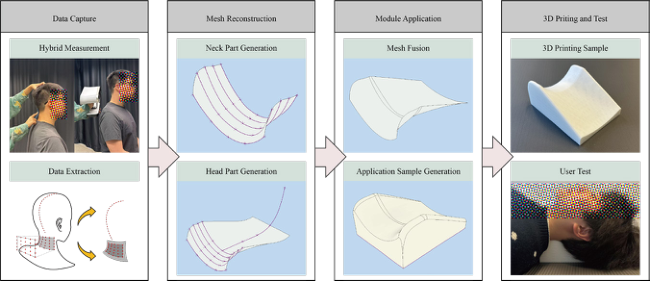
DESIGN CONCEPT Our research aimed to promote cervical spine health while ensuring comfort through a hybrid measurement approach integrating 3D and 2D anthropometric data. Participants were scanned in a neutral posture to customise the pillow design.
The pillow model was divided into two regions. For the cervical area, high- precision point cloud data were acquired using the Artec LEO 3D scanner. A surface reconstruction method based on uniform grid sampling reduced noise and computational complexity while preserving anatomical fidelity. For the occipital region, sagittal contours were captured with a serpentine ruler to balance support and mobility.
Key control points from both regions were integrated into a complete ergonomic model, yielding a baseline pillow (Pillow_100) that maintains neutral cervical alignment. This method ensures accuracy with minimal control points while allowing flexible parameter adjustment for ergonomic or functional requirements.
Figure 1: Pillow design and generation process.
METHOD
Participants Five healthy adults (2 males, 3 females) with no history of cervical spine disorders were recruited. Before the commencement of the study, ethical approval was secured from the institutional review board of the university. All participants received a comprehensive briefing on the study’s objectives and procedures and provided written informed consent before their involvement.
Table 1: Demographic information of the participants.
EXPERIMENT This study aims to develop a design intervention that achieves an optimal balance between perceived comfort and biomechanical correction. We sought to address two specific research questions:
RQ1: Which customised pillow design offers the optimal user experience (overall comfort, perceived neck support, and pillow wrapping)? RQ2: Which customised pillow design provides the most effective and
efficient biomechanical correction for cervical alignment?
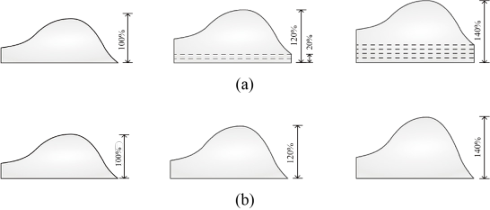
Preliminary Experiment We conducted a preliminary experiment to determine how to adjust the height of custom pillows and further explore their impact on user experience. We identified two approaches.
Approach 1: Fixed Pillow Curvature With Changed Vertical Elevation As Figure 2(a) shows, this method preserved the original geometric contour of the cervical-occipital contact surface while systematically elevating the entire pillow structure. Using a precision lifting platform, two prototype variants were generated by increasing the baseline height by 20% and 40%. Crucially, this approach maintained the intrinsic curvature of the support interface, focusing solely on height augmentation without altering the slope or regional morphology. of the pillows’ cervical-occipital contact surface. Raising the height by adjusting the sagittal plane slope changes the curvature of the cervical-occipital contact surface.
Approach 2: Pillow Curvature Adaptation With Sagittal Slope Modulation As Figure 2(b) shows, this strategy fundamentally reconfigured the pillow’s geometry by adjusting the sagittal plane slope of the cervical-occipital interface through the height adaptation. The height elevation (20% and 40% gradients) was achieved through progressive curvature modulation, wherein increasing the slope reduced the effective radius of curvature (R)
at the contact surface. This dual-action design simultaneously altered both global height and local curvature distribution, ensuring the cervical-occipital interface dynamically conformed to physiological lordosis.
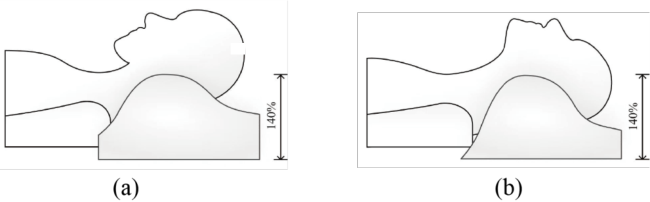
Figure 3: Sample of preliminary experiment: (a) occipital suspension; (b) cervical spine natural extension in sagittal plane.
In preliminary testing, Approach 1 induced progressive occipital suspension with increasing pillow elevation, forcing non-physiological cervical over- flexion, contradicting natural lordosis and risking disc compression and airway obstruction. In contrast, Approach 2 achieved elevation via curvature adaptation, passively adjusting cervical lordosis through sagittal extension, maintaining anatomical alignment and airway patency. Thus, Approach 2 was selected for formal experiments. For clarity, pillows are denoted by slope elevation percentage: Pillow_100 (baseline), Pillow_120 , and Pillow_140.
All prototypes were fabricated using FDM with PLA on a CREALITY K1 MAX printer (precision 0.04 mm). Three variants (Pillow_100, 120, 140) were produced per participant to systematically modulate surface curvature and spinal alignment. To enhance MRI visibility, internal cavities were infused with agar gel, ensuring compatibility and clear visualization of vertebra–pillow interactions User Study 1: Subjective Assessment
Participants were enrolled in a controlled experiment to evaluate their subjective experiences when using different pillow variants. Subjective perception was assessed across three dimensions: overall comfort, perceived neck support, and pillow wrapping. A 5-point Likert scale was employed to rate overall comfort (1 = uncomfortable to 5 = comfortable), perceived neck support (1 = inadequate to 5 = optimal), and pillow wrapping (1 = poor alignment to 5 = excellent alignment). Each participant completed three randomised trials, one for each curvature variant, under standardised supine posture and controlled environmental conditions. Each trial lasted 5 minutes, after which participants were asked to rate the pillow variant. To mitigate order effects, a 2-minute washout period was implemented between trials, during which participants engaged in neutral seated activities. Prototype identifiers and test results were recorded by the researchers but were not disclosed to the participants.
NecKorrect: Customisation Ergonomic Interventions for Cervical Spine Health 47 User Study 2: MRI Image
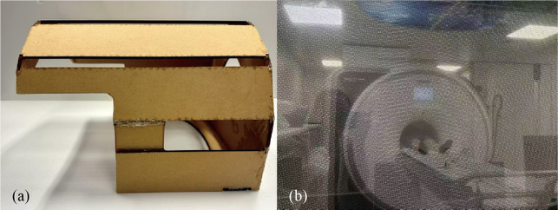
The MRI scanning was employed to view the cervical skeletal structure. Each participant was required to use a customized pillow under the neck to maintain a neutral position during MRI scanning. The subjects were asked to slightly adjust the position of the pillow to ensure they could lie down in the most comfortable neutral position. The imaging sequence followed Pillow_100, Pillow_140, and Pillow_120. For the scan settings, participants underwent three T1-weighted scans (TR = 450 ms; TE = 23 ms; FoV = 382 × 382 × 272 mm; voxel size = 0.6 × 0.6 × 0.8 mm; total acquisition time = 2:33 min).
Figure 4: (a) The wooden coil holder used in the MRI scan to hold the body coil; (b) The subject is undergoing MRI scanning.
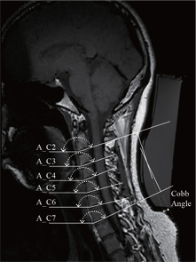
MRI images were processed using 3D Slicer (v5.6.2) to obtain cross- sectional views. Cervical alignment was quantified via Cobb angle measurements in Adobe Illustrator 2025, a standard metric for spinal curvature. Absolute angles were determined relative to the horizontal axis to ensure consistency, and relative angles between vertebrae (C2–C3, C3–C4, C5–C6, C6–C7, C7–T1) were calculated. These values enabled reproducible assessment of vertebral orientation and biomechanical relationships under different pillow conditions.
Figure 5: An example measurement of vertebra angles in a sagittal view.
To investigate the effects of different pillows on cervical spine curvature, we applied a numerical differentiation-based curvature calculation method to analyze the cervical spine curves of users lying on three different pillows. First, we identified the center coordinates of each vertebra and used them to
construct a dataset of key points. Then, we computed local curvature using the following gradient-based formula:
dx ddy - dy ddx =
dx +dy κ ⋅ ⋅
3 2 2 2 ( )
where κ represents the curvature value, dx and dy are the first-order gradients of the data points, and ddx and ddy are the second-order gradients. This formula quantifies the local bending degree of the cervical spine curve at different positions. By computing these parameters, we obtained the cervical spine curves for users lying on three different pillows, along with the curvature and variation values of each vertebra’s center point. Furthermore, to enhance the precision and continuity of the curves, we employed B-spline interpolation to refine the data, allowing for a more accurate representation of the influence of different pillows on cervical spine curvature.
RESULT
The results presented herein focus on the three primary pillow variants (Pillow_100, Pillow_120, and Pillow_140). Although other variants were administered in select cases to explore individual differences, it should be noted that the comparison results, unless explicitly stated, are confined to these three main designs.
Figure 5: An example measurement of vertebra angles in a sagittal view.
NecKorrect: Customisation Ergonomic Interventions for Cervical Spine Health 49 The Subjective Rate and Biomechanics
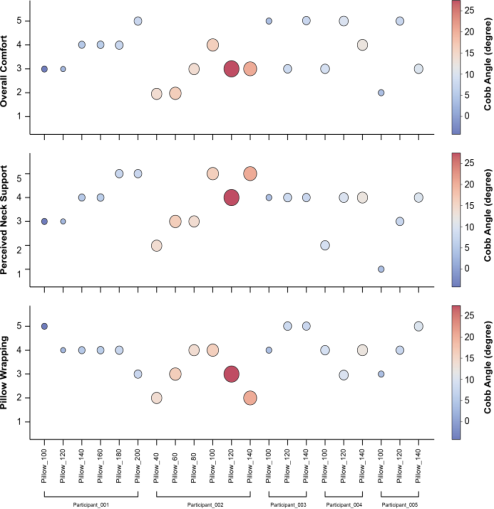
Across participants, Pillow_140 received the highest ratings for neck support. Participants 001–003 rated all variants ≥4, indicating adequate support, while 004–005 found Pillow_100 insufficient but rated Pillow_120/140 satisfactory.
All pillows scored relatively high for wrapping sensation (M = 4.0, 3.8, 4.0 for Pillow_100, 120, 140, respectively). Except participant 002 (score = 2 for Pillow_140), all ratings were ≥3, suggesting ergonomic design provided good cervical fit with minimal effect from surface curvature modifications.
Comfort ratings varied: 003 rated Pillow_100 and 140 as 5/5, 004–005 preferred Pillow_120, 001 favored Pillow_140, and 002 preferred Pillow_100. Additional testing confirmed these preferences: 001 selected Pillow_200 as most comfortable, while 002 continued to favor Pillow_100. MRI-based Cobb angle analysis indicated that participants with cervical profiles similar to 001, 003, 004, and 005 rated pillows maintaining Cobb angles of 7°–9° highest in comfort, whereas profiles resembling 002 favored Pillow_100.
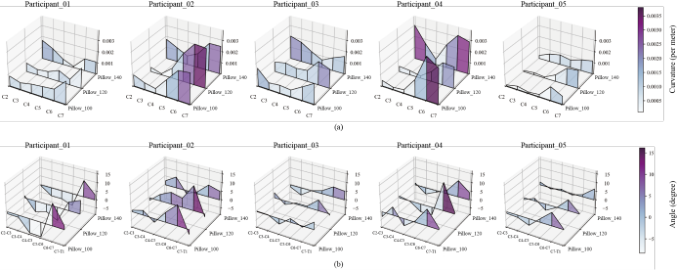
Figure 6: A plot of (a) cervical vertebrae geometric center curvature measured from each participant’s neutral posture on three pillows; (b) vertebra angles measured from each participant’s neutral posture on three pillows.Table 2: Cobb angle measurements and relative increase.
The Corrective Effects of Different Pillow Interventions As shown in Table 2, MRI evaluation quantified cervical Cobb angle changes in five participants under different pillow slopes. Relative percentage changes
indicated higher corrective efficiency from Pillow_100 to Pillow_120 than from Pillow_120 to Pillow_140, suggesting a mechanical saturation threshold. Most participants (001/004/005) exhibited a positive correlation between pillow slope and Cobb angle, though responses varied (002/003). Notably, participant 002 peaked at 27.46° with Pillow_120 but decreased to 20.44° with Pillow_140. All participants reported no cervical pathology. Participant 001 showed cervical kyphosis at Pillow_100, which resolved with increased slopes, supporting the intervention’s corrective potential.
Overall, cervical curvature increased with pillow slope, but vertebral angle changes were non-uniform. Some segments decreased, e.g., participant 003’s C3–C4 angle was higher at Pillow_100 than at Pillow_120/140. This indicates that while slope elevation aids kyphosis correction, it may induce compensatory flexion in certain cervical segments.
DISCUSSION
This study examined biomechanical and perceptual effects of customized pillow design on cervical alignment and comfort. Two consulting physicians confirmed that MRI revealed substantial inter-individual variation but no pathological findings; all participants were healthy, with no evidence of acute injury or compression of vertebral artery, nerve roots, or spinal cord. Clinical observations indicated no adverse effects, and some images suggested beneficial correction of cervical curvature.
Subjective ratings showed Pillow_140 provided the strongest neck support overall, though support perceptions varied. Participants 004–005 rated Pillow_100 insufficient, highlighting that neutral alignment may not universally ensure support. Wrapping scores were consistently high (M = 3.8–4.0), confirming ergonomic fit. Comfort ratings diverged: 001, 003, 004, and 005 reported highest comfort when Cobb angles were maintained at 7°–9°, whereas 002 consistently preferred Pillow_100 despite adjustments, underscoring individual variability.
Analysis revealed a nonlinear relationship between pillow slope and Cobb angle, with evidence of a mechanical saturation threshold. Pillow_120 generally provided greater corrective efficiency than Pillow_140, while excessive slope induced compensatory flexion in lower cervical segments. Thus, slope modulation enhances correction but requires caution to avoid biomechanical overcorrection.
CONCLUSION
This study presents a novel customised ergonomic pillow design concept along with the comprehensive evaluation which aimed at optimising cervical spine alignment while preserving perceived comfort. Our findings demonstrate that moderate cervical curvature, specifically within the 7°–9° Cobb angle range, is associated with the highest comfort ratings for most users. However, individual anatomical differences, as exemplified by participant 002, reveal that this range may not be universally applicable.
NecKorrect: Customisation Ergonomic Interventions for Cervical Spine Health 51 The nonlinear relationship between pillow curvature and spinal correction, along with evidence of a mechanical saturation threshold, suggests that overcorrection can lead to unintended biomechanical consequences, such as compensatory flexion in lower cervical segments. These insights underscore the importance of personalised ergonomic interventions over one-size-fits-all solutions.
Overall, this research contributes to the field of sleep ergonomics by offering a validated concept for designing pillows that harmonise biomechanical correction with perceptual comfort. Future work should explore long-term usage effects and broader population samples to further refine personalised design strategies.
ACKNOWLEDGMENT
The work described in this paper was fully supported by a grant from the Research Grants Council of the Hong Kong Special Administrative Region, China (Project No. GRF/PolyU 15607922).
REFERENCES
Blondel, V. D., Guillaume, J. L., Lambiotte, R., & Lefebvre, E. (2008). Fast unfolding of communities in large networks. Journal of Statistical Mechanics: Theory and Experiment, 2008(10), P10008. Cai, D., & Chen, H. L. (2016). Ergonomic approach for pillow concept design.
Applied Ergonomics, 52, 142–150. Chaiming, P., & Eungpinichpong, W. (2020). The development of pillow for healthy people: A pilot study. GEOMATE Journal, 19(73), 28–34. Chen, H. L., & Cai, D. (2012). Body dimension measurements for pillow design for
Taiwanese. Work, 41, 1288–1295. Clauset, A., Newman, M. E. J., & Moore, C. (2004). Finding community structure in very large networks. Physical Review E, 70(6), 066111. Cohen, S. P. (2015). Epidemiology, diagnosis, and treatment of neck pain. Mayo
Clinic Proceedings, 90(2), 284–299. Elsevier. Danon, L., Diaz-Guilera, A., Duch, J., & Arenas, A. (2005). Comparing community structure identification. Journal of Statistical Mechanics: Theory and Experiment, 2005(9), P09008. Gordon, S. J., & Grimmer-Somers, K. (2011). Your pillow may not guarantee a good
night’s sleep or symptom-free waking. Physiotherapy Canada, 63(2), 183–190. Gordon, S. J., Grimmer-Somers, K., & Trott, P. (2009). Pillow use: The behaviour of cervical pain, sleep quality and pillow comfort in side sleepers. Manual Therapy, 14(6), 671–678. Gordon, S. J., Grimmer-Somers, K. A., & Trott, P. H. (2010). Pillow use: The behavior
of cervical stiffness, headache and scapular/arm pain. Journal of Pain Research, 3, 137–145. Hullermeier, E., & Rifqi, M. (2009). A fuzzy variant of the Rand index for comparing clustering structures. In Proceedings of IFSA/EUSFLAT Conference (pp. 1294– 1298).
Jeon, M. Y., Jeong, H., Lee, S., Choi, W., Park, J. H., Tak, S. J., Choi, D. H., & Yim, J. (2014). Improving the quality of sleep with an optimal pillow: A randomized, comparative study. The Tohoku Journal of Experimental Medicine, 233(3), 183– 188. Lancichinetti, A., Fortunato, S., & Radicchi, F. (2008). Benchmark graphs for testing
community detection algorithms. Physical Review E, 78(4), 046110. Wei, H., Wang, C., Deng, Q., Song, Y., Wang, X., & Wang, J. (2021). Design and clinical application of personalized cervical spine correction pillow with three- dimensional printing. *Chinese Journal of Tissue Engineering
LISTED IN THE AHFE DIGITAL BOOKSTORE CATALOGUE
Explore the complete digital volume
Healthcare and Medical Devices
Read this individual research paper free through the original publisher, or explore the full digital proceedings book.
ISBN 978-1-964867-87-8
Explore this ISBN in the AHFE Bookstore ↗Listed in the July 2026 bookstore catalogue; search by ISBN to confirm current availability · Digital book purchase optional