Junjian Chen, Qin Du, Yan Luximon (2026). Rethinking the Sitting Posture Intervention: A Framework for Improving with Nudging. In: Human Systems Engineering and Design (IHSED2026): Future Trends and Applications. AHFE Open Access, vol. 237, pp. 138–149. https://doi.org/10.54941/ahfe1008154
1 School of Design, The Hong Kong Polytechnic University, Hong Kong SAR, China ↗
2 School of Design, The Hong Kong Polytechnic University, Hong Kong SAR, China; Laboratory for Artificial Intelligence in Design, Hong Kong Science Park, Hong Kong SAR China ↗
Prolonged sitting and poor posture contribute to musculoskeletal strain, visual fatigue, and cardiovascular risks. Although ergonomic guidelines exist, they often lack actionable, personalized thresholds for configuring visual display terminal (VDT) setups, reducing their real‑world effectiveness. This study introduces an evidence‑driven framework that combines predictive modelling with subtle behavioural nudging to promote healthier sitting posture without disrupting workflow. Using covert naturalistic observations, we developed a predictive model that identifies how screen size, height, and viewing distance influence the likelihood of forward head posture (FHP) and head over‑flexion. Instead of intrusive alerts such as pop‑ups or vibrations, the framework employs unobtrusive nudges that operate at the periphery of attention. These include automatic monitor adjustments using a low‑cost motorized stand and adaptive content zooming that simulates changes in viewing distance to encourage self‑correction. The system also explores mapping stretching motions to computer inputs to promote micromovements throughout work sessions. By integrating ergonomics, behavioural design, and accessible interactive technologies, the proposed approach offers a non‑intrusive pathway toward sustainable posture improvement. It enables personalized, context‑responsive posture support aligned with natural user behaviour, ultimately enhancing long‑term well‑being without compromising productivity.
The sedentary behaviour is under an increasing trend (Henson et al., 2023), and it is found to be associated with musculoskeletal discomfort (Mazaheri-Tehrani et al., 2023). Prolonged sitting in front of screens for work and leisure, accompanied by poor postural habits, amplifies the adverse effects of a sedentary lifestyle (Mashhadi et al., 2022). Forward head posture (FHP) and head over-flexion are two typical poor postures that can cause stiffness in the neck (Hansraj, 2014), negative effects on breathing (Koseki et al., 2019), balance issues (Kang et al., 2012) and chronic neck pain (Norasi et al., 2022).
Received April 8, 2026 Revised June 11, 2026 Accepted June 29, 2026 Available online September 25, 2026
Rethinking the Sitting Posture Intervention 139 The health risk prompts many intervention solutions for bad sitting postures (Krauter et al., 2024). However, most of them focus on detection technology rather than the underlying ergonomic causes. Poor posture often stems from mismatched workstation setups, such as improper chair–desk height or the lack of support. As a result, users may briefly correct their posture after receiving alerts, but quickly revert, with frequent reminders leading to annoyance and abandonment of the system (Adamczyk & Bailey, 2004; Zijlstra et al., 1999). A more effective approach is to optimize workstation settings so that neutral posture is maintained naturally (Nanthavanij, 2008).
Ergonomic furniture has been found to be an effective tool for improving posture and reducing musculoskeletal disorders (MSDs) (Bai et al., 2024). In such workstations, improper VDT setups have become the main cause of poor posture, while their severity is consistently linked to VDT size, height, and viewing distance. Smaller screens increase the likelihood of head over- flexion, and lower screen height is associated with greater neck flexion. Meanwhile, FHP worsens when the screen distance is too far or the screen size is small (Asundi et al., 2010; Fujimaki & Mitsuya, 2002; Guo et al., 2024; Seghers et al., 2003; Straker et al., 1997; Yadegaripour et al., 2021). Although controlled studies support these findings, participant awareness limits their applicability to real-world settings, highlighting the need for naturalistic research. Existing work also lacks predictive models for posture risk, and current ergonomic guidelines offer broad recommendations rather than specific thresholds.
Even with well adjusted furniture and VDT setups, poor posture can persist, making reminders necessary. Pop-up alerts are simple and attention- grabbing, but they are often criticized as intrusive and disruptive (Hsieh et al., 2021), also found to influence the user experience (Chatterjee, 2008) we focus on the role of advertisement size (large vs. small. Attempts to reduce interference, such as moving pop-ups to screen corners (Kunze et al., 2015) or designing polite variants, still results in distraction, irritation, or being ignored (Bahr & Ford, 2011; Islind & Willermark, 2022). These limitations highlight the need for alternative reminder formats that maintain effectiveness while minimizing annoyance.
Vibration-based feedback is promising in posture intervention because of its low intrusiveness. Studies show that people can multitask effectively when receiving physical cues (Heijboer et al., 2016). Vibration can be delivered through specialized peripheral devices or wearable devices such as smartwatches and fitness bands, which are becoming more popular. However, the requirement for extra hardware limits the adoption. Also, although the vibration is less intrusive, it can still trigger psychological reactance by reducing perceived autonomy, leading users to ignore, resist, or abandon the system (Rains, 2013; Steindl et al., 2015).
Rather than restricting free behaviour, designing an interaction mode that prompts the user to maintain a healthy posture without annoyance is more reasonable. Current systems rely on System 2 thinking, requiring conscious attention and increasing cognitive load, which disrupts workflow (Evans & Stanovich, 2013). In contrast, interventions that utilize automatic,
unconscious System 1 processes (Kahneman, 2011) reduce effort and minimize disruption. Subtle, implicit cues can nudge users toward a neutral posture more effectively than explicit instructions.
NATURALISTIC OBSERVATION AND PREDICTIVE MODEL CONSTRUCTION Study Design and Procedure
Naturalistic observation was used in this study because it allows researchers to examine how VDT use relates to poor sitting posture in real-world settings. This unobtrusive method captures authentic behaviour that is difficult to observe in controlled laboratory environments.
Objective This observation aims to verify whether the VDT-related factors (size, height, distance) are associated with bad postures and provide data for developing a predictive model.
Observation Site The study was conducted in various settings, including offices, computer rooms, and a university library, to capture diverse electronic device usage. Office participants mainly used laptops, sometimes with stands, while library users tended to adopt more casual postures and used tablets more frequently. Computer rooms featured desktop computers with standardized setups. To reduce confounding factors, only individuals seated in office chairs with back support and working at standard desks were included.
Observation Type A covert, non-participant observation method was used, meaning participants were unaware of being observed. This approach minimizes behaviour changes and allows uninterrupted data collection.
Posture Indicator This study concentrated on two prevalent maladaptive sitting postures: FHP and head over flexion.
VDT-Related Environmental Factors Since the direct measurement of screen height, screen size, and the viewing distance is impractical in natural settings, these data are represented categorically.
The VDT type can reveal screen size, and it is classified into five categories: 1) Desktop with a large monitor, 2) Desktop with a small monitor, 3) Laptop, 4) Tablet, and 5) Mobile Phone.
Rethinking the Sitting Posture Intervention 141 Screen height is visually assessed relative to the participant’s eye level and categorized into three levels based on the centre height of the screen: 1) Far below eye level (Below the xiphoid process), 2) Below eye level (Between the chin and xiphoid process), and 3) Near eye level (Above the chin but below the top of the head).
As for the viewing distance, it is also divided into three categories based on reachability: 1) Close (Reachable by moving only the forearm), 2) Medium (Requires movement of both the forearm and the upper arm), and 3) Far (Cannot be reached without moving the torso) Data Collection Procedure
The observer moved around the site to record each participant’s VDT-related factors and note whether they showed poor posture and its type. If a deviation was observed, the observer continued monitoring to confirm it persisted for over 30 seconds, ensuring brief movements were excluded. To protect privacy, all data were recorded in writing rather than through photographs.
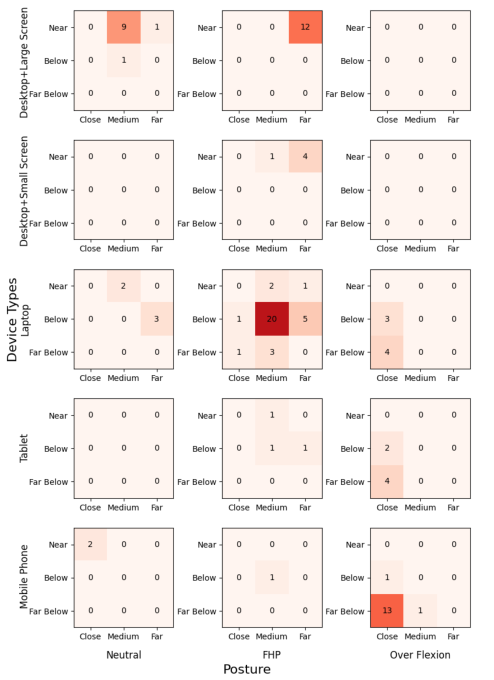
Observational Findings and Statistical Analysis A total of 100 participants were observed, and 82% displayed poor posture, while 54% with FHP and 28% with head over flexion. The sample included users of desktops with large monitors (23%), desktops with small monitors (5%), laptops (45%), tablets (9%), and mobile phones (18%). A heatmap in Figure 1 summarizes these patterns.
Chi-Square Test Since both sitting posture and VDT-related factors are categorical variables, Chi-Square tests were used to examine their associations. Specifically, the analysis assessed whether bad posture was related to (1) VDT type, (2) VDT height, and (3) VDT viewing distance.
The results of the Chi-Square tests indicated a significant association between each of the three factors and the occurrence of poor posture. For the VDT type, VDT height, and VDT distance, the results are χ2(8, N = 100) = 63.99, p < .01, χ2(6, N = 100) = 67.58, p < .01, and χ2(6, N = 100) = 88.46, p < .01.
Construction of Linear Regression Model To examine how each factor contributes to poor posture, a linear regression model was built. Because all variables from the naturalistic observations were categorical, they were first converted into numerical values. Since these variables are ordinal, categories were encoded according to their ranking
and normalized to a 0–1 scale to allow coefficient comparison. The specific encoding values are shown in Table 1. The posture categories were encoded differently depending on which posture the regression model aimed to predict.
Table 1: Encoding values for different categories.
The regression model predicts the occurrence of FHP and head over-flexion. For the FHP model, FHP was encoded as 1, and both neutral posture and over-flexion as 0. For the over-flexion model, over-flexion was encoded as 1, with the other two postures encoded as 0.
The linear relation can be written as y = C0 + C1 · X1 + C2 · X2 + C3 · X3, in which C0, C1, C2, and C3 are the coefficients and X1, X2, and X3 are variables of Device Type, Device Height, and Device Distance.
Using the statsmodels package in Python with the approach of ordinary least squares, the regression coefficients for the FHP and head over flexion were solved. Their values are listed in Table 2.
Table 2: Coefficients for the linear regression models of FHP and over flexion.
Table available in the original PDF paper.
Coefficient C0 C1 C2 C3 Value For FHP –0.11746 –0.37487 0.25490 1.54896
Value for over flexion 0.44897 –0.07014 0.48656 –0.76022 Since the result of the prediction is binary (A bad posture happens/A bad posture does not happen), a round function is added to the linear equation to make the predicted value become an integer, which is 0 or 1. Hence, the equation can be written as:
y = round(C0 + C1 · X1 + C2 · X2 + C3 · X3) After making predictions with this equation, the accuracy for the FHP is 90%, while that for over flexion is 97%.
Figure 1: A heatmap plot for the observation data.
Designing the Posture Invention System With Nudging The predictive model indicates that reducing viewing distance and raising screen height can effectively reduce FHP and head over-flexion. Previous work has explored motorized monitor adjustments, showing that moving physical or virtual displays can prompt posture changes (Shin et al., 2018; Takahashi et al., 2020) However, physically repositioning screens often requires bulky mechanisms such as robotic arms. Although studies using robotic systems demonstrated smooth, unobtrusive adjustments (Kronenberg et al., 2022; Shin et al., 2019), these setups remain impractical for everyday use.
Problem Analysis for Existing Solutions Robotic systems show promise for posture correction, but their high cost and technical complexity make them impractical for everyday use. This highlights the need for low-cost, user-friendly alternatives that provide similar ergonomic benefits without added burden. Since physically moving monitors is challenging, a digital approach is needed. Prior work shows that zooming display content can mimic the effect of reducing viewing
distance, though earlier implementations required large and uncommon displays for work (Shin et al., 2018). Harrison and Dey (2008) introduced a more practical system that detects forward leaning and adjusts content magnification accordingly. Although it helps reduce excessive leaning, its proportional zooming creates a drawback: users must continue leaning forward to maintain clarity, and greater magnification encourages even more leaning. Thus, while insightful, this approach requires redesigning for true ergonomic benefit.
When it comes to over-flexion, the most effective way to solve it is to elevate the screen approximately to eye level. While stands offer a simple solution, they depend on users to adjust them manually, resulting in an inconvenient step that often leads to incorrect or insufficient height settings. Our observations showed that even users with laptop stands frequently failed to raise their screens adequately. A motorized stand can address these issues by removing manual operation, but existing versions still require user input. An automated stand that adjusts itself to the ergonomically optimal height would provide the most effective solution.
System Design and Implementation General Design
To address FHP, we adapt the concept of content zooming, which shows that enlarging on-screen elements can reduce forward leaning. Instead of adjusting magnification proportionally to leaning, our system activates zooming only when the head crosses a forward-leaning threshold. The zoom level gradually increases until mild visual discomfort encourages the user to return to a neutral posture, and this zoomed state remains to prevent repeated leaning. Users can deactivate the zoom using a release key or by performing a chin tuck—a corrective movement known to strengthen deep neck flexors and counteract FHP (Albazee et al., 2024; Harman et al., 2005).
Addressing head-over-flexion requires an automated mechanism that can raise the screen to an ergonomically appropriate height. Although sitting height varies widely among users, manually entering this data reduces usability. Prior work has explored automated measurement: Wu et al. (2018) used a 3D depth camera to collect anthropometric data and control self-adjusting furniture, but the hardware cost limits the feasibility. A more accessible alternative by Sahu et al. (2021) used a standard camera to track the user’s head and adjust a laptop stand accordingly, though their system still required additional hardware like a Raspberry Pi. Since the device placed on the stand can already perform head tracking, adding external computing components becomes unnecessary.
Regular stretching helps reduce muscle fatigue and lower the risk of MSDs. However, most reminder systems rely on popup notifications, which disrupt workflow and negatively affect user experience. A more effective approach is to encourage self-initiated stretching rather than imposing external prompts. To achieve this, we propose mapping specific stretching movements to functional device inputs, turning ergonomic actions into meaningful interactions.
Rethinking the Sitting Posture Intervention 145 For example, neck flexion and extension could control page navigation, lateral bending could trigger scrolling, and head rotation could switch applications. This approach promotes regular movement while integrating ergonomic behaviour seamlessly into the user’s workflow. Implementing such a system requires accurate, real-time head-orientation tracking with minimal latency.
Technical Implementation Estimating user–screen distance typically relies on eye-to-screen measurements. Several libraries support this, including OpenCV, Dlib, OpenFace, Face Alignment, and MediaPipe. Among them, MediaPipe is most suitable due to its real-time, markerless facial landmark tracking across platforms without specialized hardware. Its Iris module directly estimates viewing distance with acceptable accuracy (Vakunov & Lagun, 2020). For screen-height adjustment, MediaPipe Face Mesh offers dense landmarks that serve as reliable anchor points and can also be used to compute head orientation. Prior work shows that MediaPipe achieves around 30 FPS on laptops (Chen et al., 2024), meeting low-latency, real-time requirements.
The implementation of zooming and stretch-motion-based input differs across platforms, but all follow the same design principle. Windows and macOS include built-in zoom features that can be controlled through predefined keystrokes, which can be automated using cross-platform Python libraries such as keystroke-sim. Stretch-based interactions can similarly be mapped to input commands using keystroke emulation. On tablets running iPadOS or Android, zooming can be achieved by tapping into system accessibility features through custom software, ensuring consistent functionality across device ecosystems.
Since many motorized stands already exist, there is no need to build one from scratch. If the stand’s motor can be controlled by software running on the user’s device, the system can automatically raise the screen to an ergonomically suitable height. This can be achieved by replacing the original control unit with a low-cost Arduino or ESP32 board while retaining the existing mechanical parts. Additional features can also be added, such as gently moving the screen up and down to encourage periodic neck flexion and extension, helping reduce static posture and the risk of MSDs.
DISCUSSION
This study confirms that VDT configurations, especially viewing distance and screen height, play a decisive role in shaping sitting posture. Naturalistic observations showed a high prevalence of poor posture (82%), reinforcing that ergonomic mismatches in real-world settings are a major contributor to FHP and head over-flexion.
The predictive model highlights the relative impact of each VDT factor: greater viewing distance strongly increases the likelihood of FHP, while lower screen height is the primary driver of over-flexion. These relationships also reveal tradeoffs, which are adjustments that reduce one type of poor posture may worsen another. This underscores the need for adaptive, rather than one-dimensional, ergonomic strategies.
Instead of relying on traditional interventions like pop-ups or vibration cues, which demand conscious attention, interrupt workflow, and often generate annoyance, this work proposes a nudging-based approach. Subtle mechanisms such as content zooming and automated screen elevation operate peripherally, prompting posture correction without increasing cognitive load or triggering user resistance. This aligns with behavioural principles favouring effortless, implicit guidance.
Technically, the framework is feasible due to accessible tools such as MediaPipe for real-time tracking and low-cost microcontrollers for motorized adjustments. The inclusion of motion-based interaction mapping further transforms corrective movements into functional input, increasing user engagement and reducing perceived disruption.
However, limitations remain. Data were collected within a single institution, and the linear model may oversimplify posture behaviour shaped by complex and nonlinear factors. Future work should explore more advanced modelling techniques, more diverse populations, and longterm evaluation. Ethical considerations, especially around user autonomy in unobtrusive systems, also require careful attention.
CONCLUSION
This work reframes posture correction through nudging, moving beyond intrusive alerts toward subtle, adaptive interventions embedded in everyday interaction. The study shows that viewing distance and screen height are key contributors to FHP and head over-flexion, and the predictive model provides a simple, evidence-based way to estimate posture risk.
Building on these insights, the proposed framework integrates real-time tracking with mechanisms such as content zooming and automated screen elevation to encourage natural posture correction without disrupting workflow. These strategies illustrate how behavioural principles can support ergonomic design in a low-friction, user-friendly manner.
While the findings highlight the promise of this approach, further research is needed to assess personalization, long-term effectiveness, and ethical transparency. Nonetheless, this work demonstrates how design-led nudging can embed healthier posture habits into everyday digital interaction.
REFERENCES
Adamczyk, P. D., & Bailey, B. P. (2004). If not now, when?: The effects of interruption at different moments within task execution. Proceedings of the SIGCHI Conference on Human Factors in Computing Systems, 271–278. Albazee, E., Alsubaie, H. M., Hintze, J. M., O’Riordan, I., Timon, C., Kinsella, J.,
Lennon, P., & Fitzgerald, C. W. R. (2024). The effectiveness of neck stretching exercises in alleviating neck pain and self-reported disability after thyroidectomy: A systematic review and meta-analysis of clinical trials. Head & Neck, 46(10), 2632–2649. Asundi, K., Odell, D., Luce, A., & Dennerlein, J. T. (2010). Notebook computer use on a desk, lap and lap support: Effects on posture, performance and comfort. Ergonomics, 53(1), 74–82.
Rethinking the Sitting Posture Intervention 147 Bahr, G. S., & Ford, R. A. (2011). How and why pop-ups don’t work: Pop-up
prompted eye movements, user affect and decision making. Computers in Human Behavior, 27(2), 776–783. Chatterjee, P. (2008). Are Unclicked Ads Wasted? Enduring Effects of Banner and Pop-Up Ad Exposures on Brand Memory and Attitudes. Journal of Electronic Commerce Research, 9(1). Chen, J., Wang, Y., & Luximon, Y. (2024). CamTroller: An Auxiliary Tool for
Controlling Your Avatar in PC Games Using Natural Motion Mapping. Proceedings of the CHI Conference on Human Factors in Computing Systems, CHI’24. Evans, J. St. B. T., & Stanovich, K. E. (2013). Dual-Process Theories of Higher Cognition: Advancing the Debate. Perspectives on Psychological Science, 8(3), 223–241. Fujimaki, G., & Mitsuya, R. (2002). Study of the seated posture for VDT work.
Displays, 23(1–2), 17–24. Guo, Z., Chen, Z., Pai, J., Fang, B., Liang, W., Su, G., & Zheng, F. (2024). Effects of laptop screen height on neck and shoulder muscle fatigue and spine loading for office workers. Work, 1–13. Hansraj, K. K. (2014). Assessment of stresses in the cervical spine caused by posture
and position of the head. Surg Technol Int, 25(25), 277–279. Harman, K., Hubley-Kozey, C. L., & Butler, H. (2005). Effectiveness of an exercise program to improve forward head posture in normal adults: A randomized, controlled 10-week trial. Journal of Manual & Manipulative Therapy, 13(3), 163–176. Harrison, C., & Dey, A. K. (2008). Lean and zoom: Proximity-aware user interface
and content magnification. Proceedings of the SIGCHI Conference on Human Factors in Computing Systems, CHI’08, 507–510. Heijboer, M., Van Den Hoven, E., Bongers, B., & Bakker, S. (2016). Facilitating peripheral interaction: Design and evaluation of peripheral interaction for a gesture-based lighting control with multimodal feedback. Personal and Ubiquitous Computing, 20(1), 1–22. Henson, J., De Craemer, M., & Yates, T. (2023). Sedentary behaviour and disease
risk. BMC Public Health, 23(1), 2048, s12889-023-16867–2. Hsieh, A.-Y., Lo, S.-K., Chiu, Y.-P., & Lie, T. (2021). Do not allow pop-up ads to appear too early: Internet users’ browsing behaviour to pop-up ads. Behaviour & Information Technology, 40(16), 1796–1805. Islind, A. S., & Willermark, S. (2022). Polite Interaction Design: Capturing the Users
Attention Without Compromising their Experienced Trust. AMCIS. Kahneman, D. (2011). Thinking, fast and slow. Farrar, Straus and Giroux. Kang, J.-H., Park, R.-Y., Lee, S.-J., Kim, J.-Y., Yoon, S.-R., & Jung, K.-I. (2012). The effect of the forward head posture on postural balance in long time computer based worker. Annals of Rehabilitation Medicine, 36(1), 98–104. Koseki, T., Kakizaki, F., Hayashi, S., Nishida, N., & Itoh, M. (2019). Effect of
forward head posture on thoracic shape and respiratory function. Journal of Physical Therapy Science, 31(1), 63–68. Krauter, C., Angerbauer, K., Sousa Calepso, A., Achberger, A., Mayer, S., & Sedlmair, M. (2024). Sitting Posture Recognition and Feedback: A Literature Review. Proceedings of the CHI Conference on Human Factors in Computing Systems, 1–20. Kronenberg, R., Kuflik, T., & Shimshoni, I. (2022). Improving office workers’
workspace using a self-adjusting computer screen. ACM Transactions on Interactive Intelligent Systems, 12(3), 1–32.
Kunze, K., Tanaka, K., Ishimaru, S., Kise, K., & Inami, M. (2015). Nekoze! – Monitoring and Detecting Head Posture while Working with Laptop and Mobile Phone. Proceedings of the 9th International Conference on Pervasive Computing Technologies for Healthcare. 9th International Conference on Pervasive Computing Technologies for Healthcare. Mashhadi, S. F., Khan, N., Shabbir, A., Islam, Q. B., Rao, F. J., Saadat, M., &
Amjad, A. (2022). Adverse effects of prolonged sitting behaviour on the general health and posture of medical students. Pakistan Armed Forces Medical Journal, 72(SUPPL-4), S869-73. Mazaheri-Tehrani, S., Arefian, M., Abhari, A. P., Riahi, R., Vahdatpour, B., Baradaran Mahdavi, S., & Kelishadi, R. (2023). Sedentary behavior and neck pain in adults: A systematic review and meta-analysis. Preventive Medicine, 175, 107711. Nanthavanij, S. (2008). Ergonomic intervention for improving work postures during
notebook computer operation. Journal of Human Ergology, 37(1), 23–33. Norasi, H., Tetteh, E., Sarker, P., Mirka, G. A., & Hallbeck, M. S. (2022). Exploring the relationship between neck flexion and neck problems in occupational populations: A systematic review of the literature. Ergonomics, 65(4), 587–603. Rains, S. A. (2013). The Nature of Psychological Reactance Revisited: A Meta-
Analytic Review. Human Communication Research, 39(1), 47–73. Sahu, M., Gnana Sundari, K., & Stephen, E. N. (2021). Design and fabrication of an automated laptop stand. In A. Arockiarajan, M. Duraiselvam, & R. Raju (Eds), Advances in Industrial Automation and Smart Manufacturing (pp. 131–139). Springer Singapore. Seghers, J., Jochem, A., & Spaepen, A. (2003). Posture, muscle activity and muscle
fatigue in prolonged VDT work at different screen height settings. Ergonomics, 46(7), 714–730. Shin, J., Choi, W., Lee, U., & Saakes, D. (2018). Actuating a monitor for posture changes. Extended Abstracts of the 2018 CHI Conference on Human Factors in Computing Systems, 1–6. Shin, J.-G., Onchi, E., Reyes, M. J., Song, J., Lee, U., Lee, S.-H., & Saakes, D. (2019).
Slow Robots for Unobtrusive Posture Correction. Proceedings of the 2019 CHI Conference on Human Factors in Computing Systems, 1–10. Steindl, C., Jonas, E., Sittenthaler, S., Traut-Mattausch, E., & Greenberg, J. (2015).
Understanding Psychological Reactance: New Developments and Findings. Zeitschrift Für Psychologie, 223(4), 205–214. Straker, L., Jones, K. J., & Miller, J. (1997). A comparison of the postures assumed when using laptop computers and desktop computers. Applied Ergonomics, 28(4), 263–268. Takahashi, A., Inazawa, M., Ban, Y., & Warisawa, S. (2020). Indirect posture
correction system without additional equipment using display content rotation: Proceedings of the 13th International Joint Conference on Biomedical Engineering Systems and Technologies, 266–273. Vakunov, A., & Lagun, D. (2020, August 6). MediaPipe iris: Real-time iris tracking & depth estimation. Wu, Y.-C., Wu, T.-Y., Taele, P., Wang, B., Liu, J.-Y., Ku, P., Lai, P.-E., & Chen, M. Y.
(2018). ActiveErgo: Automatic and personalized ergonomics using self-actuating furniture. Proceedings of the 2018 CHI Conference on Human Factors in Computing Systems, 1–8.
Rethinking the Sitting Posture Intervention 149 Yadegaripour, M., Hadadnezhad, M., Abbasi, A., Eftekhari, F., & Samani, A. (2021).
The effect of adjusting screen height and keyboard placement on neck and back discomfort, posture, and muscle activities during laptop work. International Journal of Human–Computer Interaction, 37(5), 459–469. Zijlstra, F. R. H., Roe, R. A., Leonora, A. B., & Krediet, I. (1999). Temporal factors in mental work: Effects of interrupted activities. Journal of Occupational and Organizational Psychology, 72(2), 163–185.
FIND THE COMPLETE VOLUME IN THE AHFE DIGITAL BOOKSTORE
Explore the complete digital volume
Human Systems Engineering and Design (IHSED2026): Future Trends and Applications
Read this individual research paper free through the original publisher, or explore the full digital proceedings book.