Jie Zhang, Junjian Chen, Luwei Chen, Yan Luximon (2023). A Novel Temple Clamping Force Measurement Method for Eyeglasses Design. In: Creativity, Innovation and Entrepreneurship. AHFE Open Access, vol. 74, pp. 53–59. https://doi.org/10.54941/ahfe1003305
1 School of Design, The Hong Kong Polytechnic University, Hong Kong SAR, China ↗
2 School of Design, The Hong Kong Polytechnic University, Hong Kong SAR, China; Laboratory for Artificial Intelligence in Design, Hong Kong Science Park, Hong Kong SAR, China ↗
The temple clamping force is an important factor affecting the fit and comfort of most eyeglasses. The temple height is usually very small (1.0~6.0 mm) and the clamping force is very low (0.0~1.0 N). However, the diameters of the effective area of available force sensors are usually larger than the temple height, and their lowest measurable force is sometimes larger than the clamping forces. This causes difficulty in measuring the clamping force using force sensors. Hence, we proposed a novel temple clamping force measurement method for eyeglasses, which only uses a digital tension meter. In this method, the displacement of the ear attachment points (EAPs) at the temple was computed based on the static and wearing expanded lateral distance of EAPs; and then the tensile force was measured based on the temple displacement by using a digital tension meter. The method has been applied to investigate the relationship between the measured clamping forces and the perceived fit scores of the temples. The experimental results are consistent with the previous report, which demonstrates the reliability of our proposed method.
Eyeglasses are an important tool for improving vision, increasing facial attra- ctiveness, enhancing visual function, or conveying information. The global prevalence of myopia is growing alarmingly, especially in East Asia (Foster et al., 2014), which has led to an increase in the number of myopic glas- ses. There is a rapid growth in the field of augmented reality (AR) in recent years (Danielsson et al., 2020), which also has led to an increase in the num- ber of AR glasses. Regardless of mass customization and personalization of eyeglasses, the high perceived comfort level is one important objective.
In essential, the temples are the commonly used components for eyeglasses (e.g. eyeglasses for myopia, hyperopia, or astigmatism, sunglasses, AR glas- ses), and the clamping force at the temple region can significantly affect the comfort perceptions for the eyeglasses (Zhang & Luximon, 2017). Too much clamping force may cause pain in the ear attachment area of the wearer. On another hand, too little clapping force may not provide enough friction at the
temples to prevent the glasses from sliding. Hence, confirming the comforta- ble clamping force of the temples for the users is significant. Moreover, it is the foundation to measure the clamping force of the temples.
In previous studies, the clamping force of the temple is usually measu- red by using various strain gauges as a control or independent variable in experiments. Du et al. (2022) placed a strain gauge (FlexiForce® A201 1 lb, Tekscan Inc., USA; accuracy of 1/4 ±3%) on the head contact area of the prototype’s right temple to measure its clamping force as a control varia- ble. Instead of measuring the clamping force directly on the temporal regions of the head, Kouchi et al. (2004) pasted a strain gauge (Kyowa Electronic Instruments Co. Ltd., KFG-2-120-C1-11) on the medial (lateral) side of the eyeglasses’ temple. Similarly, Mashima et al. (2011) attached a strain gauge (Kyowa) on the temple arm of the wearing eyeglasses and measured the vol- tage as the clamping force; their objective is to investigate the relationship between the clamping force (an independent variable) and wearing comfort around ears.
In this study, instead of using strain gauges, we developed a novel device based on a digital tension meter to measure the clamping force at the temples indirectly. We calculated the displacement of the temple contact points based on their lateral distances under static and wearing conditions, and then mea- sured the tensile force to increase the lateral distance of two temple contact points (under static condition) by the same displacement. Since there is alw- ays an equal and opposite force for each force, this tensile force is also equal to the clamping force at the temples. Furthermore, we applied this method to measure various clamping forces, investigated the quantified relationships between the objective clamping forces and subjective human perceptions, and confirmed the clamping force with the highest perceived comfort score.
METHOD
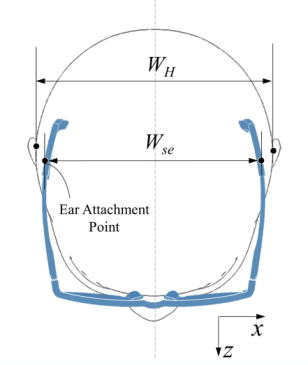
To each force, there is always an equal and opposite force. Hence, instead of the (online) clamping force, we measure the offline clamping force (ten- sion) with the same displacement of the ear attachment points (EAPs) at the temple. In the temple clamping force measurement for each participant, the static Wse and wearing Wwe expanded distances of the EAPs on the temple (see Figure 1) were measured using the digital vernier and spreading caliper, respectively. Because the eyeglasses are symmetric, the displacement d of the EAP for one temple is, d=(Wse - Wwe) /2. Wwe=Wt + WH, where Wt is the width (thickness) of the temple.
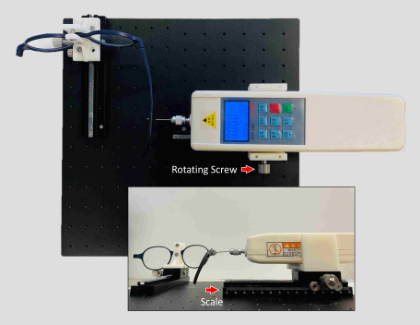
To measure the clamping force, we designed and produced a device using a digital tension meter (Model: SH-2, Shanghai Siwei Instrument Manufactu- ring Co., Ltd., Shanghai; resolution: 0.001; and range: 0–2 N, see Figure 2). In our experiment, with the eyeglass frame held in place, the tension meter was slid from the position with the tensile force of 0 N to a new position with a displacement d using the rotating screw. In this new position, since action and reaction forces are reciprocal (opposite) on the temple, the measured tensile force equals the corresponding clamping force when the participant wears this eyeglass frame. Because this clamping force is very small (usually
A Novel Temple Clamping Force Measurement Method for Eyeglasses Design 55
(a) (b)
Figure 1: Eyeglasses with a head model under different conditions. (a) Static condi- tion. (b) Wearing condition. Wse and Wwe: the expansion distances of the ear contact (attachment) points at the temple under static and wearing conditions correspondin- gly. WH: the head width. d: displacement of the ear attachment points. Wt: the width (thickness) of the temple around the ear attachment points. F: the clamping force of one-side temple.
(a)
(b)
Figure 2: Offline temple clamping force measurement using a digital tension meter. (a) digital rendition of our measurement device. (b) actual measurement device in use.
ranging from 0.0-0.6 N) and the tension meter is very sensitive, the tensile forces were measured three times and the average was calculated as the result.
APPLICATIONS Experiments
Because there is no valid measure of the clamping force on the wearer, it is difficult to compute the errors of the proposed method directly. Theoreti- cally, the greater the displacement of the temples, the greater the clamping force at the temples, and the tighter the wearer perceives. Hence, we chan- ged the temple displacement of the eyeglasses to produce different clamping forces, recruited participants to perceive their fit, and examined the relati- onship between the measured clamping forces and perceived fit scores. The fit of the temples was defined as the perceived ability to wear the eyeglasses properly with the clamping force at the temple region being neither too loose nor too tight.
In this experiment, 30 Chinese children (15 males and 15 females) aged 14–17 years were recruited. The independent and dependent variables are the clamping force and perceived fit scores, respectively; and the control variables are the eyeglasses weight, temple height/length, and nose pads width. For each participant, six eyeglasses prototypes with different clamping forces were tested and the fit of the temples was evaluated by using 7-point Likert scale questions (Extremely loose, loose, slightly loose, perfect fit, slightly tight, tight, and extremely tight). Moreover, each prototype was evaluated under static conditions, where each participant was asked to sit calmly without engaging in any strenuous body movements, which represented conditions experienced during work or study. Hence, each participant had six prototy- pes and seven tests (including one repetitive test). There was a one-minute break between tests.
Since discrete data can increase the representation of knowledge behind the original data and help knowledge retrieval methods to produce better results (Fu, 2011; Chaudhari et al., 2014), a data discretization method was used to transform the clamping forces from continuous data F into discrete data ¨F by using an interval tf : ¨F = Round(F / tf) × tf, where Round(·) is a rounding function. Ordinary least squares (OLS) regression (Montgomery et al., 2021; Freund et al., 2006) was performed to compute trendlines to quantify the relationships between the measured clamping forces and perceived fit scores for the temples.
RESULTS
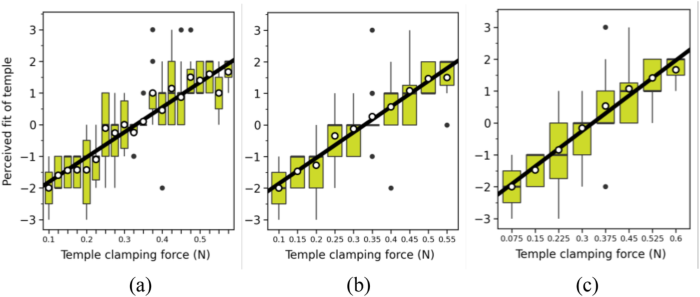
To confirm the reliability of the perceived fit scores of the temples, the colle- cted repeated data were used to calculate the intraclass correlation coefficient (0.75). This indicates the good reliability of our collected data (McGraw & Wong, 1996). Table 1 and Figure 3 show the quantitative and qualitative mathematical modeling results of perceived fit scores of the temples using OLS regression with different force intervals, respectively. Different force intervals can lead to a different number of observations, thereby producing different trendlines. The R-squared (R2) values for different trendlines are
A Novel Temple Clamping Force Measurement Method for Eyeglasses Design 57
Table 1. Mathematical modeling results of perceived fit scores for the temples using OLS regression with different force intervals.
Figure 3: Fitted trendlines with original data distributions of temple’s perceived fit sco- res by using different intervals tf in data discretization. (a) tf = 0.025. (b) tf =0.050. (c) tf =0.075. The green boxplots indicate the perceived fit score distributions under the specific temple clamping force, the white scatters indicate the mean perceived fit scores, and the black lines indicate the fitted linear trendlines. Note that there is a linear relationship between the measured clamping forces and perceived fit scores, which is not affected by the intervals in data discretization.
more than 0.9, which indicates a strong relationship between the indepen- dent and dependent variables. The coefficients of the three trendlines (see Table 1) are similar and the qualitative results (see Figure 3) also show these trendlines are similar, especially their slopes. This shows that there is no signi- ficant difference in the use of the three different force intervals in the data discretization to calculate the trendlines.
DISCUSSIONS Since the temple clamping force can significantly affect the wearer’s percei- ved comfort, measuring the temple clamping force is a basic technique for eyeglasses fit and comfort evaluation. However, there are limited studies on this important technique.
A previous report (Saadeh et al., 2017) conducted a performance compa- rison among several commonly used sensors and found that FSR 402 can measure the lowest force (0.423N), followed by FlexiForcer® A201 (0.522 N). The temple height is usually very small (1.0∼6.0 mm) and the clam- ping force is also small (0.0∼1.0 N). However, because of the available force sensors, their diameters of sensing area are usually larger than the temple hei- ght, and their lowest measurable force is sometimes larger than the clamping
forces. These can easily lead to the inaccurate measurement of the temple clamping force on the ear regions. Furthermore, before measurement for strain gauges, the relationship between the load and the strain is needed to be calibrated by hanging a weight on the temple. However, their calibration status is usually different from their measurement status (the sensitive grid is easily deformed on the facial surface and their contact area and positions are not the same), and this discrepancy also easily decreases their measurement accuracy.
In comparison, there are three advantages of our method: (1) our method has a wider application range, which can measure the clamping forces of the temples with all current heights; and (2) our method is more conveni- ent, which can also use the wearer’s head width to measure the clamping forces and does not need a force calibration. This with the perceived comfort trendlines can be used to predict the overall comfort and assess the products for the target population. However, our method only measures the tensile force of the EAP at the temple, in which status is also different from the actual eyeglasses-wearing status for the wearer. Because there is no valid mea- sure of the clamping force on the wearer, it is also unknown how much of a measurement error this status difference would lead to.
We applied our method to investigate the relationship between the mea- sured clamping forces and perceived fit scores of the temples successfully. The experimental results indicate that there is a strong linear relationship between the measured clamping forces and perceived fit scores of the tem- ples. This is consistent with previous studies on the relationship between the prototype sizes (corresponding to different pressures) of in-ear wearables and their perceived fit scores (Fu & Luximon, 2021). Hence, this applica- tion demonstrates the reliability of the proposed clamping force measurement method for eyeglasses.
CONCLUSION
In this paper, we proposed a novel temple clamping force measurement based on a digital tension meter for eyeglasses. Compared to the force sensors, this method is more convenient and has a wider application range for temples with various heights. Although there is no valid measure to provide ground- truth data to calculate the measurement accuracy of our method, we have used a temple-fit perception experiment to demonstrate its reliability. We believe that this novel method can be applied to investigate the comfortable clamping force for various eyeglasses and optimize their ergonomics design, e.g., eyeglasses for myopia, hyperopia, or astigmatism, sunglasses, and AR glasses.
ACKNOWLEDGMENT
The work described in this paper was supported by grants from the Resea- rch Grants Council of the Hong Kong Special Administrative Region, China (Project No. GRF/PolyU 15603419) and the Hong Kong Polytechnic Uni- versity (School Awards of Outstanding Achievement 20 & 21, Project ID P0040352).
A Novel Temple Clamping Force Measurement Method for Eyeglasses Design 59
REFERENCES
Chaudhari, P., Rana, D. P., Mehta, R. G., Mistry, N. J., & Raghuwanshi, M. M. (2014). Discretization of temporal data: a survey. arXiv preprint arXiv:1402.4283. Danielsson, O., Holm, M., & Syberfeldt, A. (2020). Augmented reality smart glasses
in industrial assembly: Current status and future challenges. Journal of Industrial Information Integration, 20, 100175. Du, Y., Liu, K., Ju, Y., & Wang, H. (2022). A comfort analysis of AR glasses on physical load during long-term wearing. Ergonomics, (pp. 1–15). Foster, P., & Jiang, Y. (2014). Epidemiology of myopia. Eye, 28, 202–208. Freund, R. J., Wilson, W. J., & Sa, P. (2006). Regression analysis. Elsevier. Fu, F., & Luximon, Y. (2021). Comfort and fit perception based on 3D anthropome-
try for ear-related product design. Applied Ergonomics: 103640. Fu, T. C. (2011). A review on time series data mining. Engineering Applications of Artificial Intelligence, 24, 164–181. Kouchi, M., & Mochimaru, M. (2004). Analysis of 3D face forms for proper sizing
and CAD of spectacle frames. Ergonomics, 47, 1499–1516. Mashima, M., Yoshida, H., & Kamijo, M. (2011). Investigation of wearing comfort of eyeglasses with emphasis on pain around the ears. In Proceedings of the International Conference on Biometrics and Kansei Engineering (pp. 228–231). McGraw, K. O., & Wong, S. P. (1996). Forming inferences about some intraclass
correlation coefficients. Psychological methods, 1, 30. Montgomery, D. C., Peck, E. A., & Vining, G. G. (2021). Introduction to linear regression analysis. John Wiley & Sons. Saadeh, M. Y., Carambat, T. D., & Arrieta, A. M. (2017). Evaluating and modeling
force sensing resistors for low force applications. In Smart Materials, Adaptive Structures and Intelligent Systems. American Society of Mechanical Engineers volume 58264. Zhang, J., & Luximon, Y. (2017). An interview study on children’s spectacle frame fit. In International Conference on Applied Human Factors and Ergonomics (pp. 81–88). Springer.
LISTED IN THE AHFE DIGITAL BOOKSTORE CATALOGUE
Explore the complete digital volume
Creativity, Innovation and Entrepreneurship
Read this individual research paper free through the original publisher, or explore the full digital proceedings book.
ISBN 978-1-958651-50-6
Explore this ISBN in the AHFE Bookstore ↗Listed in the July 2026 bookstore catalogue; search by ISBN to confirm current availability · Digital book purchase optional