Furqan Ali Shah, Anthony Kong, Yan Luximon (2025). Exploring the Effects of Virtual Windows on Emotional Well-being in Older Adults: A Systematic Review. In: Creativity, Innovation and Entrepreneurship. AHFE Open Access, vol. 166, pp. 75–82. https://doi.org/10.54941/ahfe1006113
The emotional well-being of older adults is crucial for maintaining overall health, particularly in the face of social isolation, anxiety, and depression, which can significantly impact their quality of life. This systematic review evaluates the effects of virtual window therapy on emotional well-being in this demographic, focusing on its impact on anxiety, mood, and overall life satisfaction. A comprehensive analysis of 10 relevant studies revealed from 782 studies that participants using virtual windows experienced significant reductions in anxiety and improvements in mood. The immersive experience, enhanced by full-spectrum lighting and views of natural scenes, contributed to greater environmental satisfaction and reduced cognitive load, fostering a connection to nature. These factors collectively supported increased emotional resilience and life satisfaction. Overall, virtual window therapy presents a promising intervention for improving emotional well-being in older adults, alleviating anxiety while promoting a positive emotional state, thus warranting further research into its long-term benefits and practical applications in various settings.
The emotional health of older adults is greatly influenced by their living environment and can be negatively affected when settings are marked by social isolation and a lack of natural stimuli. Older adults often face challenges, such as social isolation and a lack of natural stimuli, which leads to increase feelings of anxiety and depression (Pati et al., 2015).
Previous studies have primarily focused on general populations or specific settings, resulting in a gap regarding the unique emotional needs of older adults. Furthermore, much of the existing research has been small-scale or exploratory, lacking robust evidence on the effectiveness of virtual window therapy tailored to this demographic.
This review aims to investigate the content, technology, methods, and adaptations of virtual windows, addressing critical issues in geriatric mental health. These inquiries seek to reveal both the evolution of virtual window technologies and their potential therapeutic benefits for the emotional well- being of older adults.
The systematic review method is a structured approach to assessing the effectiveness of virtual windows on the emotional health of older adults. Establishing criteria for inclusion, conducting extensive literature searches, screening studies, extracting relevant data, synthesising findings, and reporting results.
The research questions are: 1. What is the development landscape of virtual windows for the older adults? 2. How effective is virtual window therapy for older adults?
SELECTION CRITERIA Studies were included that focused on older adults, a demographic particularly susceptible to emotional challenges such as loneliness and depression also published within 10 years were considered to ensure that the findings reflect on methodologies and technological advancements. Only publications in English were included. The review encompassed full-text works published in various formats, such as book chapters, conference proceedings, and peer-reviewed journals, to ensure a thorough overview of the literature.
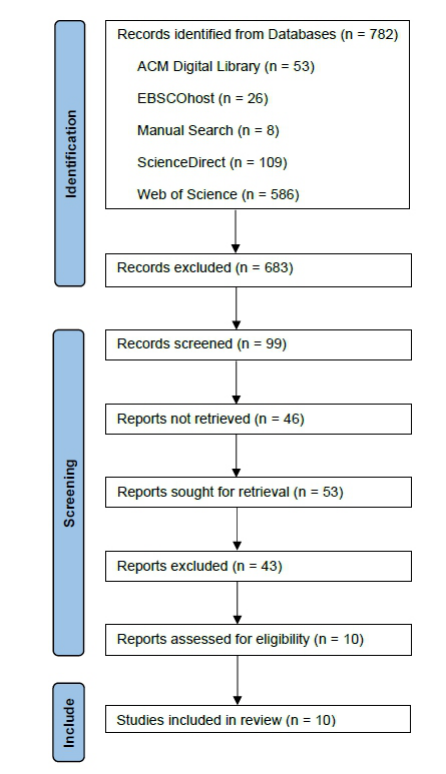
The literature search yielded 782 records from five databases: ACM Digital Library (53), EBSCOhost (26), Manual Search (8), ScienceDirect (109), and Web of Science (586). The search strategy focused on standardised databases using specific keywords: (“Older Adults” OR “Elderly” OR “Geriatrics” OR “Aging” OR “Aged”) AND (“Interaction Design” OR “User Experience” OR “UX”) AND (“Emotion” OR “Emotions” OR “Emotional”) AND (“Virtual Window” OR “Virtual Windows”). This targeted approach aimed to identify studies involving older individuals aged 65 to 95 years, providing a solid foundation for evaluating the emotional benefits of virtual window therapy.
After a rigorous screening process, the review ultimately analysed 10 studies published between 2014 and 2024. This selection reflects careful consideration of the relevance and quality of the studies, ensuring that the conclusions drawn are both current and applicable to the target population. Data extraction involved gathering relevant information from each study, including the design, sample size, intervention details, measured outcomes, and key findings.
Each study’s assessed using established criteria step is crucial, as it guarantees that the conclusions are based on synthesised findings from the selected studies offer insights into the effectiveness of virtual window therapy in enhancing emotional well-being among older adults. Preliminary results indicate that engaging with virtual windows featuring moving images can lead to noticeable improvements in mood and emotional states among residents in care settings. The dynamic nature of the content appears to foster a sense of connection with the outside world, alleviating feelings of isolation and enhancing overall mental health.
Exploring the Effects of Virtual Windows on Emotional Well-Being in Older Adults 77
Figure 1: Study screening process according to the preferred reporting items for systematic reviews and meta-analyses (PRISMA) (Page et al., 2021).
RESULTS
The outcomes of the 10 relevant studies revealed may improve in emotional well-being among older adults highlighting that visual natural stimuli can positively influence mental health by reinforcing the biophilia hypothesis, which suggests that a connection to nature fosters emotional health and provides significant psychological benefits (Pati et al., 2015).
Table 1: Data extraction.
Table available in the original PDF paper.
Author Year Tools Aim Method Sample Size Findings Review Not applicable Progress in Zhao et al.
Not applicable To analyse (2022)
emotion recognition; challenges in robustness and context remain.
effective methods for emotional response recognition in various contexts.
To measure Experiment 45 Urban settings
Valtchanov & ellard, (2015) The head-mounted display has an
increase cognitive load; natural scenes are restorative.
Arrington monocular eye-tracker.
cognitive load and affective responses in urban vs. Natural imagery.
Dutta, (2019) Handheld Uprtek To Review The
Experiment 9 Tuneable Leds
MK350 Spectrometer For Measuring Emission Spectrum, CCT,
And CRI
Impact Of Full Spectrum Virtual Windows On Emotional Well-Being.
To investigate Experiment 50 Nature stimuli
Improve Indoor Environments, Positively Affecting Health. Pati et al., (2015) Ceiling-mounted photographic sky reduce stress and anxiety in healthcare settings.
effects of visual nature stimuli on healthcare outcomes.
To explore how Survey 20 Led windows Sen et al., (2018) Servodan led virtual windows metrue sim
spectral irradiance meter
led virtual windows affect healthcare environments that lack natural light.
enhance lighting and room satisfaction in clinical settings. Mangkuto et al., Philips origami
To analyse the Experiment 1 Virtual windows
(2014) bpg762
require better lighting to meet standards.
virtual window prototypes’ energy usage and lighting performance.
Tseng et al., Not Applicable To examine the
Review Not Applicable Virtual windows
(2016)
enhance mental and emotional health in the elderly.
advantages of virtual windows for elderly individuals in windowless environments.
Mack et al.,
To investigate Survey 25 T2i models
(2024)
Text-to-image models,midjourney, dall-e 2, and stable diffusion
1.5, for image generation.
disability representation in ai and mitigate harmful stereotypes.
perpetuate negative stereotypes; there is a need for diverse representation Chan et al.,
Analyse the Experiment 8 Virtual nature
(2023)
Virtual reality (vr) headset: htc vive-pro.
outcome of virtual nature experience on mental health.
experiences enhance well-being and pro- environmental attitudes.
Continued
Exploring the Effects of Virtual Windows on Emotional Well-Being in Older Adults 79
Table 1: Continued Author Year Tools Aim Method Sample Size Findings
Table available in the original PDF paper.
Interview 17 The app aims to
Dowds &
To explore how
masthoff, (2015)
Mobile app (“window to the outside world”),
reduce social isolation for older adults.
the app can enhance well-being and social engagement among older adults.
The review results identify that virtual window therapy may alleviate emotional distress among older adults, thus highlighting an emerging area of interest in geriatric care with the potential for broader applications in similar settings. The development of cutting-edge technologies like virtual windows can enhance indoor light quality and support psychological and physiological health. They also show that inadequate exposure to natural light due to the prevalence of poor-quality artificial lighting can result in significant biological dysfunctions, health risks, and economic costs (Dutta, 2019). A nature scene in an urban environment emphasizes how important low- level visuals properties, particularly visual spatial properties, as it attracted longer fixation times than urban scenes, which results in higher cognitive load, as indicated by increased blink rates. Spatial frequencies in the mid-to- high range are essential to stimulate positive emotional reactions, whereas low spatial frequencies impact cognitive processes and attention (Valtchanov & Ellard, 2015).
DISCUSSION
Impact of Nature on Emotional Well-Being The review shows that older adults experience may improve in emotional and psychological well-being when exposed to visual stimuli from nature, which supports the biophilia hypothesis. This core assertion connects interactions with nature to better mental health, affirming the belief that humans have an intrinsic connection to the natural environment. The urgent need to integrate natural elements into urban or confined living spaces is highlighted, as such settings often heighten feelings of loneliness and depression. In areas where nature is scarce, the risk of mental health challenges increases, emphasizing the importance of thoughtful design interventions.
Cognitive Benefits of Natural Visuals Evidence suggests that the visual characteristics of nature scenes can promote longer attention spans and lower cognitive load, enhancing both focus and emotional responses. For instance, Valtchanov & Ellard (2015) found that urban settings increase cognitive load, while natural scenes are restorative. This finding provides concrete proof of how nature can positively affect cognitive functions, reinforcing the idea that visual elements from natural environments contribute to better emotional regulation. Therefore, it is crucial to design spaces that fulfil not only physical requirements
but also stimulate cognitive and emotional interaction, advocating for a comprehensive approach to environmental design in healthcare and living environments.
Virtual Environment and Health Additionally, positive biological effects associated with exposure to natural elements demonstrate how virtual environments can promote mental and physical health. Dutta (2019) reviewed the impact of full-spectrum virtual windows on emotional well-being, concluding that tuneable LEDs improve indoor environments, positively affecting health. These settings can mitigate the negative consequences of insufficient natural light found in many residential and care facilities, illustrating the potential for virtual nature to fill gaps in environmental quality that impact health.
To effectively utilize the benefits of virtual environments, various integration strategies can be employed. For instance, healthcare settings such as hospitals and assisted living facilities could install virtual windows in patient rooms and common areas, providing soothing views of nature that reduce stress and anxiety. Pati et al. (2015) demonstrated that nature stimuli reduce stress and anxiety in healthcare settings. This application showcases how research can be translated into tangible improvements in patient recovery and care. Similarly, community centers could develop immersive virtual experiences that engage older adults in social activities, allowing them to explore natural landscapes or participate in local events, thereby enhancing social interactions and reducing feelings of isolation.
The creation of technology platforms that combine virtual window experiences with social networking can further enhance community connections. These platforms create shared spaces for users to engage with one another, facilitating interactions that might not happen in conventional environments. Encouraging users to share stories and local news enables active participation in their communities, fostering a richer social network that nurtures empathy and cohesion. Furthermore, virtual nature experiences can provoke discussions, allowing users to react to and comment on natural scenes, which can lead to deeper conversations and strengthen community ties. The ability to connect with others, join virtual events, and engage in community activities can significantly improve emotional wellness and build supportive networks. Dowds and Masthoff (2015) explored how a mobile app aimed to reduce social isolation for older adults, highlighting the importance of technology in enhancing social engagement.
FUTURE DIRECTION To progress in this field, future investigations should focus on the long- term effects of virtual environment stimuli over mental health outcomes across various demographic groups. It is vital to assess the scalability and cost-effectiveness of implementing such technologies in diverse settings, particularly in low-income areas, to ensure that all individuals have access to mental health resources. Longitudinal studies could yield valuable insights into how these interventions influence social connections and
Exploring the Effects of Virtual Windows on Emotional Well-Being in Older Adults 81
overall quality of life over time. Collaborative efforts among technologists, healthcare professionals, and urban planners will be essential in developing integrated solutions that address both individual and community needs. This holistic strategy can enhance our understanding of how technology can be leveraged to improve mental health and well-being in increasingly urbanized environments, ensuring that everyone can benefit from the positive impacts of nature.
CONCLUSION
Prior studies predominantly targeted general populations or specific contexts, often overlooking the distinct challenges faced by older adults. Moreover, much of the studies has been characterized by small-scale or exploratory designs, which limits the generalizability of the findings. There is a notable absence of comprehensive reviews that synthesize available evidence on the effectiveness of virtual window therapy, which hinders the ability to draw robust conclusions about its impact. Additionally, practical guidance for implementing virtual window therapy in real-world settings, particularly within care facilities, remains sparse. This lack of systematic evidence and practical recommendations underscores the need for further research that not only evaluates the efficacy of virtual window therapy but also addresses the unique requirements of older adults. Future studies should aim to provide a clearer understanding of how to effectively integrate virtual nature experiences into care environments, ensuring that the emotional and psychological well-being of seniors is adequately supported in a long term.
ACKNOWLEDGMENT
We sincerely thank The Jockey Club Design Institute for Social Innovation, PolyU Jockey Club, and Operation SoInno Action Project for their invaluable support and contributions. This project is supported by a grant from the Research Grants Council of the Hong Kong Special Administrative Region, China (Project No. P0052989).
REFERENCES
Chan, S. H., Qiu, L., & Xie, T. (2023). Understanding experiences in metaverse: How virtual nature impacts affect, pro-environmental attitudes, and intention to engage with physical nature. Computers in Human Behavior, 149, 107926. https: //doi.org/10.1016/j.chb.2023.107926 Dowds, G., & Masthoff, J. (2015). A virtual “window to the outside world”:
initial design and plans for evaluation. In S. Lawson & P. Dickinson (Eds.), 2015 British HCI Conference Lincoln, Lincolnshire, United Kingdom (pp. 265–266). Association for Computing Machinery. https://doi.org/10.1145/ 2783446.2783603 Dutta, P. S. (2019). Full spectrum phosphors for white LEDs and virtual windows for light and health applications. ECS Journal of Solid State Science and Technology, 13(1), 016023. https://doi.org/10.1149/2.0422001JSS Mack, K. A., Qadri, R., Denton, R., Kane, S. K., & Bennett, C. L. (2024). “They
only care to show us the wheelchair”: Disability representation in text-to-image
AI models. In F. F. Mueller, P. Kyburz, J. R. Williamson, C. Sas, M. L. Wilson, P. T. Dugas, & I. Shklovski (Eds.), CHI ‘24: CHI Conference on Human Factors in Computing Systems Honolulu HI USA May 11–16, 2024 (pp. 1–23). Association for Computing Machinery. https://doi.org/10.1145/3613904.3642166 Mangkuto, R., Wang, S., Meerbeek, B., Aries, M., & Loenen, E. V. (2014). Lighting performance and electrical energy consumption of a virtual window prototype. Applied Energy, 135, 261–273. https://doi.org/10.1016/j.apenergy.2014.08.001 Pati, D., Freier, P., O’Boyle, M., Amor, C., & Valipoor, S. (2015). The impact of
simulated nature on patient outcomes: A study of photographic sky compositions. HERD: Health Environments Research & Design Journal, 9(2), 36–51. https: //doi.org/10.1177/193758671559550 Sen, S., Nielsen, T., Nielsen, E., Ole, P., & Cortes, D. (2018). LED virtual windows are valuable in windowless consultation rooms. Danish Medical Journal, 65(9), 1–5. Tseng, K. C., Hoang, H.-K., & Huang, P.-H. (2016). A study exploring the concept
of virtual windows for the elderly. In C. S. Margherita Antona (Ed.), 10th International Conference, UAHCI 2016, Held as Part of HCI International 2016, Toronto, ON, Canada, July 17-22, 2016, Proceedings, Part II. Universal Access in Human-Computer Interaction. Interaction Techniques and Environments (pp. 466–471). Springer Cham. https://doi.org/10.1007/978-3-319-40244-4_45 Valtchanov, D., & Ellard, C. G. (2015). Cognitive and affective responses to natural scenes: Effects of low level visual properties on preference, cognitive load and eye- movements. Journal of Environmental Psychology, 43, 184–195. https://doi.org/ 10.1016/j.jenvp.2015.07.001 Zhao, S., Yao, X., Yang, J., Jia, G., Ding, G., Chua, T.-S., … Keutzer, K. (2022).
Affective image content analysis: Two decades review and new perspectives. IEEE Transactions on Pattern Analysis and Machine Intelligence, 44(10), 6729–6751. https://doi.org/10.1109/tpami.2021.3094362
LISTED IN THE AHFE DIGITAL BOOKSTORE CATALOGUE
Explore the complete digital volume
Creativity, Innovation and Entrepreneurship
Read this individual research paper free through the original publisher, or explore the full digital proceedings book.
ISBN 978-1-964867-42-7
Explore this ISBN in the AHFE Bookstore ↗Listed in the July 2026 bookstore catalogue; search by ISBN to confirm current availability · Digital book purchase optional