Mengru Liu, Anthony Kong, Fuxuebing Huang (2025). Exploring Kinetic Meditation as an Emerging Frontier in Technology-Assisted Mindfulness: A Comparative Review. In: Human Factors in Design, Engineering, and Computing. AHFE Open Access, vol. 199, pp. 874–882. https://doi.org/10.54941/ahfe1006900
Mindfulness has gained increasing attention in digital health research due to its demonstrated mental and physiological benefits (Plencler et al., 2024; Yusim & Grigaitis, 2020). While technologies such as mobile apps, wearables, and virtual reality (VR) have increasingly supported mindfulness practices, the majority of interventions continue to emphasize static meditation such as seated breathing and body scanning (Chandrasiri et al., 2020; Zafar et al., 2020). In contrast, kinetic meditation, including yoga, Taiji, and mindful walking, engages both body and mind through slow, intentional movement and embodied awareness, offering a more holistic approach to well-being (Barton et al., 2024; Niksirat et al., 2019). Despite this potential, the incorporation of kinetic meditation into technology-assisted mindfulness remains limited and underexplored in the current literature. To investigate this gap, we propose the following research questions aimed at identifying the overlooked role of kinetic meditation in technology-assisted mindfulness and exploring future opportunities for its integration into digital design.RQ1: What underexplored areas exist in current technology-assisted mindfulness research?RQ2: How can future mindfulness technologies be designed to support kinetic meditation practices?This study first analyzes a dataset of 3,053 peer-reviewed publications to examine publication trends and disciplinary contributions in technology-assisted mindfulness research. It then conducts a comparative review of 10 empirical articles from top-tier HCI journals and 30 peer-reviewed empirical studies retrieved from the Web of Science database (2014–2024). Using qualitative thematic coding, we examined technological applications, mindfulness categories, and sensory design strategies to identify key characteristics of the field, reveal differences between high-impact and broader empirical studies, and highlight underutilized design opportunities in the leading HCI literature.Across both sources, we find that technology-assisted kinetic meditation remains underrepresented, with the majority of interventions continuing to emphasize static meditation delivered through VR-based visuals, ambient soundscapes, and audio guidance (Lee et al., 2023; Payne et al., 2024). Despite its limited presence, the kinetic interventions identified in both top-tier and broader studies consistently demonstrate notable advantages: enhanced presence enabled by visual-auditory immersion, deeper interoception supported by movement-synchronized vibroacoustic feedback, and greater user engagement through motion tracking (Barton et al., 2024; Le Roy et al., 2024; Niksirat et al., 2019). These features suggest that kinetic meditation may provide more dynamic and integrative support for psychological and physiological regulation than static formats. However, most existing implementations remain constrained by passive content delivery, a narrow focus on individual stress relief, and an overreliance on visual and auditory design, with limited incorporation of haptic or other multisensory interaction elements. This review highlights future design opportunities to develop more active, adaptive, multi-sensory, and socially connected environments that foster embodied awareness, sustained engagement, and holistic well-being through technology-assisted kinetic meditation.In conclusion, this review outlines a theoretical direction for immersive environment design within the digital health domain, where embodied interaction, physiologically responsive feedback, and multisensory immersive media support both psychological and physiological regulation. Practically, it offers insights for developing next-generation mindfulness technologies that move beyond static practice toward more adaptive, immersive, and socially connected kinetic meditation experiences for diverse users.
In recent years, technology-assisted mindfulness has gained widespread attention in both research and practice, driven by the growing integration of digital tools into mental health interventions. From mobile applications and wearable devices to immersive virtual environments, a wide range of systems have been developed to enhance the accessibility, interactivity, and effectiveness of mindfulness practices (Crescentini et al., 2016; Rockstroh et al., 2021; Roos et al., 2024). These interventions typically use visual, auditory, and physiological feedback cues to help stabilize attention, regulate emotions, and foster embodied awareness across clinical, educational, and occupational contexts (Choi et al., 2022; Hugh-Jones et al., 2023; Niksirat et al., 2019).
Mindfulness practices can generally be categorized into two forms: static meditation, such as seated breathing, body scanning, and guided imagery, and kinetic meditation, which involves intentional bodily movements, including yoga, walking, or Tai Chi (Niksirat et al., 2019). However,
Exploring Kinetic Meditation as an Emerging Frontier in Technology-Assisted Mindfulness 875
current technology-assisted mindfulness research remains heavily centered on static forms of meditation, with limited exploration of movement- based practices. This imbalance constrains the exploration of embodied awareness and bodily-sensory engagement that hold growing relevance across interdisciplinary domains, including physical recovery, emotionally supportive design, and body-based therapeutic practices (Barton et al., 2024; Niksirat et al., 2019).
Therefore, this review conducts a comparative analysis between top- tier HCI journals and broader empirical studies. The goal was to identify underexplored mindfulness categories, technological applications, and sensory design approaches, particular the limited representation of kinetic meditation, and to inform future research direction in this field.
This study is guided by the following research questions: RQ1: What underexplored areas exist in current technology-assisted mindfulness research?
RQ2: How can future mindfulness systems be designed to support kinetic meditation practices?
COMPARATIVE REVIEW METHODOLOGY To examine the landscape of technology-assisted mindfulness within digital and immersive environments, this study adopted a structured comparative review methodology. The analysis proceeded in two stages: (1) mapping the publication trends and disciplinary convergence in the field, and (2) conducting a detailed comparative analysis between top-tier HCI journal studies and broader empirical research.
Mapping the Field A bibliometric search was conducted in the Web of Science Core Collection using a combination of mindfulness-related terms (e.g., “mindfulness,” “meditation”) and digital technology keywords (e.g., “virtual reality,” “wearables,”“mobile applications”). After filtering for peer-reviewed journal articles, 3,053 records remained. The findings reveal a growing academic interest in this interdisciplinary field since 2014, with peak publication activity around 2022. Contributions span psychiatry, psychology clinical, computer science, and healthcare, highlighting both the interdisciplinary convergence between mental health and computing, and the growing adoption of mindfulness as a scientifically validated intervention supported by interactive technologies.
Comparative Dataset Construction To enable a structured comparison, two datasets were curated. The first dataset includes 10 empirical studies selected from five top-tier Q1 HCI journals indexed by the SJR platform: Virtual Reality, ACM Transactions on Computer-Human Interaction, Computers in Human Behavior, Computers in Human Behavior Reports, and IEEE Transactions on Affective Computing. A keyword search for “mindfulness” across
these journals yielded 145 articles. After a two-stage screening process, excluding review articles, unrelated studies, and those lacking technological interventions or empirical measures, 10 eligible articles were retained.
The second dataset comprises 30 peer-reviewed empirical studies published between 2014 and 2024, retrieved from the Web of Science Core Collection. The search combined keywords related to mindfulness (e.g., “mindfulness,” “meditation”), technological integration (e.g., “virtual reality,” “wearables,” “mobile applications”), and sensory approaches (e.g., “visual,” “auditory,” “haptic”). From an initial pool of 151 articles, the dataset was refined through exclusion of non-journal, non-English, review papers, and studies lacking either technological intervention or empirical evaluation, resulting in 30 included studies. These two datasets provide a structured foundation for comparing key features across top-tier and broader mindfulness research. An inductive coding approach was applied to examine three thematic dimensions: (1) mindfulness categories, (2) technological applications, and (3) sensory design approaches.
DESCRIPTIVE RESULTS Mindfulness Categories
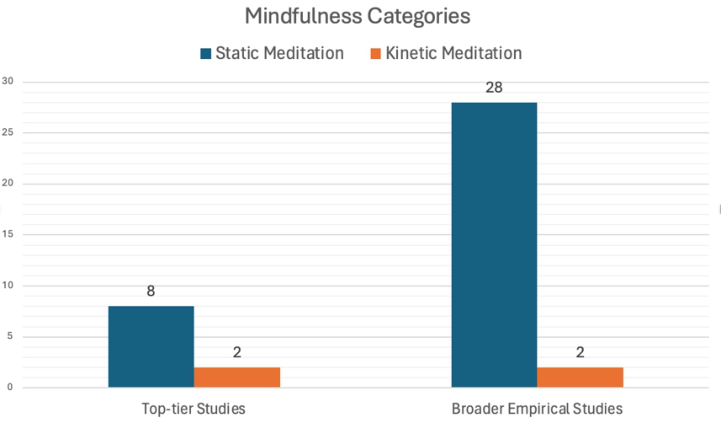
Static meditation practices continue to dominate both top-tier HCI journals (8 studies) and broader empirical research (28 studies) (see Figure 1). These interventions primarily involve non-movement-based practices such as seated breathing, body scanning, and focused attention, reflecting the prevailing conceptualization of mindfulness as a still, introspective practice (Hunkin et al., 2021; Lan et al., 2021; Scott et al., 2022).
Figure 1: Mindfulness categories in top-tier and broader studies.
Exploring Kinetic Meditation as an Emerging Frontier in Technology-Assisted Mindfulness 877
In contrast, kinetic meditation has received comparatively limited attention (2 top-tier, 2 broader studies). Despite its limited presence, these few cases illustrate promising directions for embodied mindfulness in digital environments. For example, research has begun to leveraged VR and mobile platforms to support slow, breath-coordinated movements that fostered interoceptive awareness and focused bodily engagement (Barton et al., 2024; Niksirat et al., 2019). In the broader dataset, studies have conducted a videoconference-delivered mindfulness program incorporating Taiji-inspired physical movements, demonstrating the feasibility of remote delivery for combining bodily and meditative practices in a group setting (Krägeloh et al., 2019). While others introduced an immersive cycling system that embedded physical activity within a VR environment, enhancing affective stability, sensory integration, and psychological presence (Le Roy et al., 2024). Taken together, these studies signal the potential of kinetic meditation to enhance engagement, bodily awareness, and psychophysiological regulation, yet it remains an underexplored direction in current technology-assisted mindfulness research.
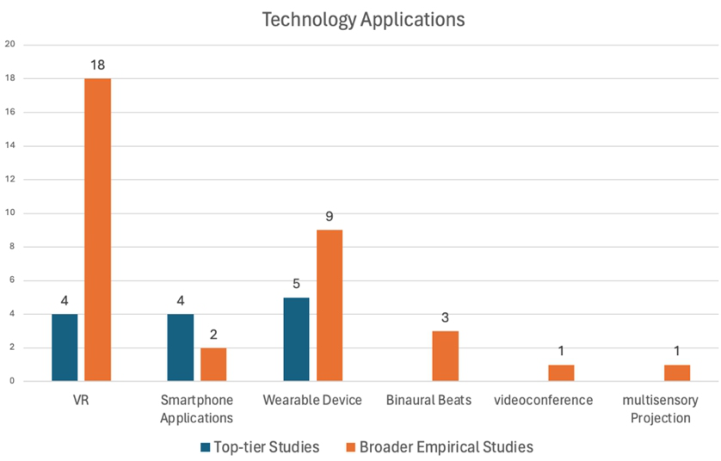
Technological Applications VR emerges as the dominant technological application across both top-tier (4 studies) and broader empirical research (18 studies) (see Figure 2). It is favored for its ability to construct immersive, distraction-free environments that support attentional stability and emotional decentering in mindfulness practices (Barton et al., 2024; Chandrasiri et al., 2020). Another prominent category is wearable devices, including EEG sensors, heart rate monitors, and vibrotactile feedback systems, are also frequently integrated (5 top-tier, 9 broader studies), reflecting a growing focus on embodied experiences and real-time physiological feedback as mechanisms for interoceptive awareness and regulation (Greig et al., 2024; Payne et al., 2024). In contrast, mobile applications appear more frequently in top-tier studies (4 top-tier, 2 broader studies), possibly reflecting their early prominence in mindfulness technology due to accessibility and ease of integration (Chittaro and Vianello, 2014; Roos et al., 2024). However, their reduced presence in broader empirical studies may signal a shift toward more immersive and embodied formats. Lastly, binaural beats, videoconferencing, and multisensory projection systems were each found in only one broader empirical study. Although their presence is limited, these technologies reflect exploratory efforts to diversify mindfulness delivery, yet remain peripheral in mainstream research.
In these studies, technologies are integrated to enrich the functionality and adaptability of mindfulness systems. For example, VR is combined with pressure sensors to monitor physiological responses and provide real-time stress regulation within immersive environments (Lan et al., 2021; Lee et al., 2023). Similarly, binaural beats are paired with EEG or VR to influence brainwave activity, enhancing attentional focus, emotional regulation, or pain relief (Perales et al., 2019; Sas and Chopra, 2015). These examples reflect a growing trend toward multi-technology integration, which enables more adaptive, embodied, and immersive mindfulness experiences.
Figure 2: Technology applications used in mindfulness studies.
Sensory Design In recent years, sensory design has emerged as a prominent approach to enhance perception and responsiveness to internal bodily cues (Finck et al., 2023). Through inductive coding of the reviewed studies, four major sensory design approaches were identified: visual, auditory, haptic, and olfactory.
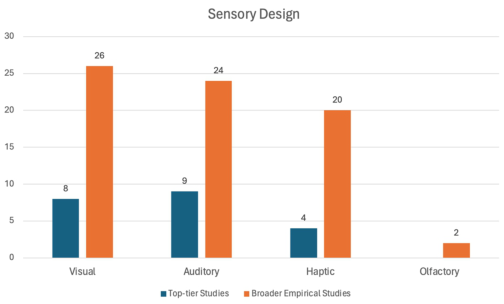
Visual and auditory designs dominate across both top-tier and broader empirical studies, reflecting their central role in crafting emotionally resonant and immersive environments (see Figure 3). Visual designs were employed in both top-tier (8 studies) and broader studies (26 studies), commonly incorporating nature scenes (e.g., forests, beaches), animated instructions, or bodily representations (e.g., lung models, body outlines) to support relaxation and bodily awareness (Greig et al., 2024; Payne et al., 2024). Similarly, auditory cues appeared in top-tier (9 studies) and broader studies (24 studies), including voice guidance, natural soundscapes, or ambient music to stabilize attention and emotional states (Riches et al., 2024; Seabrook et al., 2020). Haptic feedback was used in top-tier (4 studies) and broader studies (20 studies), utilizing tools such as EEG sensors, ECG monitors, and vibroacoustic cushions to enhance bodily engagement and interoceptive sensitivity (Choi et al., 2022; Salminen et al., 2022). Olfactory design was notably scarce, found only in broader studies (2 studies), where nature- inspired scents like bergamot were used to promote calm and sensory anchoring (Nieto-Vallejo et al., 2021).
These sensory design approaches suggest that while current implementations heavily rely on visual and auditory modalities, there is growing interest in incorporating richer haptic and olfactory cues. Such multisensory strategies offer promising potential for delivering immersive, embodied, and emotionally grounded mindfulness experiences in next-generation mindfulness interactive systems.
Exploring Kinetic Meditation as an Emerging Frontier in Technology-Assisted Mindfulness 879
Figure 3: Sensory design approaches used in mindfulness studies.
In summary, the comparative review reveals three key patterns in current technology-assisted mindfulness research. First, static meditation continues to dominate across both top-tier and broader studies, while kinetic meditation remains notably underexplored despite its demonstrated benefits for embodied awareness and psychophysiological engagement. Second, immersive technologies, especially VR, have become key mediums for delivering mindfulness experiences. The observed trend toward multi- technology integration indicates an increasing focus on designing systems that are both adaptive and interactively responsive. Finally, while visual and auditory approaches remain dominant, the increasing incorporation of haptic feedback and the continued underuse of olfactory elements highlight an uneven sensory design landscape, suggesting further opportunities to foster more emotionally resonant and embodied mindfulness experiences. These findings collectively highlight critical gaps and emerging opportunities, setting the stage for the discussion of future research directions.
DISCUSSION
Underexplored Areas in Current Technology-assisted Mindfulness Research (RQ1) While movement-based practices have been recognized in wellness and rehabilitative contexts for their benefits in mind-body integration, they are still largely absent from mainstream HCI mindfulness research. This reflects a broader limitation in current digital approaches to supporting embodied awareness, particularly in the context of kinetic meditation. Advances in immersive technologies, including integration with motion tracking, spatialized audio, biofeedback, and haptic stimulation, are beginning to expand the scope for more physically engaged mindfulness experiences (Barton et al., 2024). These capabilities provide the foundation for reimagining mindfulness not as a static state but as a bodily-informed cognitive process shaped through movement and interaction (Le Roy et al., 2024). As immersive systems gain broader use in digital health and wellbeing, future research should explore how kinetic meditation can blend motion, sensory input, and emotional regulation may enhance user engagement and
adaptability, offering new directions for designing embodied and responsive mindfulness experiences (Niksirat et al., 2019).
Designing Future Systems to Support Kinetic Meditation Practices (RQ2) To support kinetic meditation in future mindfulness technologies, there must be a shift from delivering static and pre-structured content toward creating embodied and adaptive systems that respond dynamically to users’ physiological, emotional, and behavioral states. Recent studies have demonstrated the potential of integrating technologies such as virtual reality, biofeedback, and haptic interfaces into cohesive systems (Crescentini et al., 2016; Zafar et al., 2020). These systems enable real-time feedback and movement-based interaction, allowing bodily signals and environmental cues to continuously influence each other (Lan et al., 2021). For instance, changes in brain activity or heart rate can adjust visual or haptic stimuli, creating an ongoing loop between internal states and external experiences.
In addition, current sensory designs remain imbalanced. Most systems rely heavily on visual and auditory channels. This limits the capacity of technology-assisted mindfulness to fully support bodily engagement and interoceptive awareness. Enhancing haptic and olfactory engagement may provide deeper grounding and improve the overall effectiveness of kinetic meditation practices (Finck et al., 2023).
Social and collective aspects of movement-based mindfulness also remain underexplored. While some studies have experimented with remote or group formats, few have utilized immersive environments that allow users to interact in shared virtual spaces (Salminen et al., 2022). Future systems could be designed to enable multiple participants to synchronize movement, regulate attention, and support each other emotionally within a digitally mediated space. Designing mindfulness experiences that incorporate both movement and shared interaction may help create more engaging systems.
CONCLUSION
Technology-assisted mindfulness has achieved significant progress, with VR emerging as a dominant platform and visual-auditory channels playing a central role in shaping immersive experiences. However, this review highlights the limited presence of kinetic meditation and the relatively underexplored potential of tactile and olfactory modalities. Future systems could benefit from integrating real-time physiological feedback, expanding multisensory design, and enabling socially connected practices in shared virtual environments. These directions support a transition toward more embodied, adaptive, and interactive mindfulness experiences, positioning kinetic meditation as a promising pathway to deepen engagement and enhance psychophysiological regulation in digital health contexts.
ACKNOWLEDGMENT
The work described in this paper was partially supported by a grant from the Hong Kong Polytechnic University (Project No. P0054247).
Exploring Kinetic Meditation as an Emerging Frontier in Technology-Assisted Mindfulness 881
REFERENCES
Barton, Adam C. Do, Michael. Sheen, Jade and Byrne, Linda K. (2024). The restorative and state enhancing potential of abstract fractal-like imagery and interactive mindfulness interventions in virtual reality, Virtual Reality Volume 28, No. 1. Chandrasiri, Amaya. Collett, James. Fassbender, Eric and De Foe, Alexander. (2020).
A virtual reality approach to mindfulness skills training, Virtual Reality Volume 24, No. 1. Chittaro, Luca and Vianello, Andrea. (2014). Computer-supported mindfulness: Evaluation of a mobile thought distancing application on naive meditators, International Journal of Human-Computer Studies Volume 72, No. 3. Choi, Kyung Yun. Elhaouij, Neska. Lee, Jinmo. Picard, Rosalind W and Ishii,
Hiroshi. (2022). Design and evaluation of a clippable and personalizable pneumatic-haptic feedback device for breathing guidance, Proceedings of the ACM on Interactive, Mobile, Wearable and Ubiquitous Technologies Volume 6, No. 1. Crescentini, Cristiano. Chittaro, Luca. Capurso, Viviana. Sioni, Riccardo and Fabbro, Franco. (2016). Psychological and physiological responses to stressful situations in immersive virtual reality: Differences between users who practice mindfulness meditation and controls, Computers in Human Behavior Volume 59. Finck, Carolyn. Avila, Alba. Jiménez-Leal, William. Botero, Juan Pablo. Shambo,
Daniel. Hernandez, Susana. Reinoso-Carvalho, Felipe and Andonova, Veneta. (2023). A multisensory mindfulness experience: Exploring the promotion of sensory awareness as a mindfulness practice, Frontiers in Psychology Volume 14. Greig, Lachlan. Coundouris, Sarah P. Randhir, Swaraj. Henry, Julie D and Baghaei, Nilufar. (2024). Receiving self-compassion in the virtual world: Testing the potential value of biofeedback, Behaviour Research and Therapy Volume 180. Hugh-Jones, Siobhan. Ulor, Michelle. Nugent, Trish. Walshe, Sophie and Kirk, Mike.
(2023). The potential of virtual reality to support adolescent mental well-being in schools: A UK co-design and proof-of-concept study, Mental Health & Prevention Volume 30. Hunkin, Hugh. King, Daniel L and Zajac, Ian T. (2021). EEG neurofeedback during focused attention meditation: Effects on state mindfulness and meditation experiences, Mindfulness Volume 12, No. 4. Krägeloh, Christian U. Medvedev, Oleg N. Taylor, Tamasin. Wrapson, Wendy. Rix,
Grant. Sumich, Alexander. Wang, Grace Y. Csako, Rita. Anstiss, David. Ranta, Jussi T. Patel, Ninad and Siegert, Richard J. (2018). A pilot randomized controlled trial for a Videoconference-Delivered Mindfulness-Based group intervention in a nonclinical setting, Mindfulness Volume 10, No. 4. Lan, Kun-Chan. Li, Che-Wei and Cheung, Yushing. (2021). Slow breathing exercise with multimodal virtual reality: A feasibility study, Sensors Volume 21, No. 16. Le Roy, Barbara. Martin-Krumm, Charles. Poupon, Charlotte. Richieri, Raphaëlle.
Malbos, Eric. Barthélémy, Fanny. Guedj, Eric and Trousselard, Marion. (2024). Virtual exercise in medicine: A proof of concept in a healthy population, JMIR Formative Research Volume 8. Lee, Bo Mi. Kim, Sung-Wan. Lee, Bong Ju. Won, Seung-Hee. Park, Yong-han. Kang, Chae Yeong. Li, Ling. Rami, Fatima Zahra and Chung, Young-Chul. (2023). Effects and safety of virtual reality-based mindfulness in patients with psychosis: A randomized controlled pilot study, Schizophrenia Volume 9, No. 1. Nieto-Vallejo, Andrés-Eduardo. Ramírez-Pérez, Omar-Fernando. Ballesteros- Arroyave, Luis-Eduardo and Aragón, Angela. (2021). Design of a neurofeedback training system for meditation based on EEG technology, Revista Facultad de Ingeniería Volume 30, No. 55.
when trying to quantify immersion with secondary tasks, Frontiers in Virtual Reality Volume 5. Perales, Francisco J. Riera, Laia. Ramis, Silvia and Guerrero, Alejandro. (2019).
Evaluation of a VR system for pain management using binaural acoustic stimulation, Multimedia Tools and Applications Volume 78, No. 23. Riches, Simon. Bartlett, Uma. Bird, Zoe. Williams, Grace. Nicholson, Sarah L.
Winter, Helen. Pollard, Clair and Arday, Isobel. (2024). Implementing a virtual reality-based intervention to support the wellbeing of mental health staff in the workplace: A mixed-methods pilot study, Journal of Workplace Behavioral Health. Rockstroh, Christoph. Blum, Johannes and Göritz, Anja S. (2021). A mobile VRbased respiratory biofeedback game to foster diaphragmatic breathing, Virtual Reality Volume 25, No. 2. Roos, Corey R. Kiluk, Brian. Carroll, Kathleen M. Bricker, Jonathan B. Mun, Chung
Jung. Sala, Margarita. Kirouac, Megan. Stein, Elena. John, Maya. Palmer, Robert. DeBenedictis, Andrew. Frisbie, Jena. Haeny, Angela M. Barry, Declan. Fucito, Lisa M. Bowen, Sarah. Witkiewitz, Katie and Kober, Hedy. (2024). Development and initial testing of mindful journey: A digital mindfulness-based intervention for promoting recovery from substance use disorder, Annals of Medicine Volume 56, No. 1. Salminen, Mikko. Jarvela, Simo. Ruonala, Antti. Harjunen, Ville J. Hamari, Juho.
Jacucci, Giulio and Ravaja, Niklas. (2022). Evoking physiological synchrony and empathy using social VR with biofeedback, IEEE Transactions on Affective Computing Volume 13, No. 2. Sas, Corina and Chopra, Rohit. (2015). MeditAid: A wearable adaptive neurofeedback-based system for training mindfulness state, Personal and Ubiquitous Computing Volume 19, No. 7. Scott, Julia A. Sims, Max. Harrold, Lee. Jacobus, Nicole. Avelar, Cecilia and Durham, Jeffrey. (2022). Transformation of buddhist mandalas into a virtual reality installation, Leonardo Volume 55, No. 3. Seabrook, Elizabeth. Kelly, Ryan. Foley, Fiona. Theiler, Stephen. Thomas, Neil.
Wadley, Greg and Nedeljkovic, Maja. (2020). Understanding how virtual reality can support mindfulness practice: Mixed methods study, Journal of Medical Internet Research Volume 22, No. 3. Zafar, M. Abdullah. Ahmed, Beena. Rihawi, Rami AI and Gutierrez-Osuna, Ricardo.
(2020). Gaming Away Stress: Using Biofeedback Games to Learn Paced Breathing, IEEE Transactions on Affective Computing Volume 11, No. 3.
LISTED IN THE AHFE DIGITAL BOOKSTORE CATALOGUE
Explore the complete digital volume
Human Factors in Design, Engineering, and Computing
Read this individual research paper free through the original publisher, or explore the full digital proceedings book.
ISBN 978-1-964867-75-5
Explore this ISBN in the AHFE Bookstore ↗Listed in the July 2026 bookstore catalogue; search by ISBN to confirm current availability · Digital book purchase optional