Guido Tillema, Boris Englebert (2025). Beyond Full Flight Simulators: Investigating Mini Motion Platforms in Helicopter VR Simulation. In: Human Factors in Design, Engineering, and Computing. AHFE Open Access, vol. 199, pp. 808–818. https://doi.org/10.54941/ahfe1006893
Virtual Reality (VR) is increasingly being explored as a cost-effective and flexible alternative to traditional full flight simulators for flight crew training. In addition to reducing costs, VR-based simulators offer greater versatility by integrating a range of Commercial Off-The-Shelf (COTS) components. One such component is the mini motion platform—compact motion devices that are significantly smaller and less complex than the full-scale hexapod platforms typically used in full flight simulators. However, their limited motion range raises questions about the extent to which they can meaningfully contribute to the realism and effectiveness of flight training.This study investigates the integration of a mini motion platform, paired with a classical washout algorithm, in a VR-based helicopter flight simulation environment. Using a setup that includes COTS helicopter controls, a mini motion platform, and a Varjo XR-3 headset, participants performed a series of helicopter flight tasks. Data was collected across scenarios with and without motion support, focusing on metrics such as user comfort, pilot performance, and subjective user experience.The results shed light on both the opportunities and limitations of using mini motion platforms in this context. In particular, they underscore challenges in cueing highly dynamic helicopter maneuvers, while also identifying specific areas where such platforms can enhance training outcomes. The insights from this research contribute practical recommendations for leveraging mini motion platforms to support effective and immersive VR helicopter flight training.
The integration of Virtual Reality (VR) into flight simulation is rapidly transforming the landscape of pilot training, offering a promising and cost- effective alternative to conventional full flight simulators. VR-based training environments can be developed at a fraction of the cost and footprint of traditional systems, while still providing high levels of immersion and interactivity (Dymora et al., 2021), (Marron et al., 2024), (Oh, 2020). Particularly for rotary-wing platforms, the flexibility of VR enables the exploration of varied mission scenarios without the need for expensive infrastructure or proprietary hardware (Martini, 2024).
Beyond Full Flight Simulators: Investigating Mini Motion Platforms in Helicopter 809
Despite these advantages, the transition from full flight simulators to VR-based alternatives introduces new challenges. A key concern is the absence or limitation of physical motion feedback, which can reduce the realism of the simulation and negatively affect both user comfort as well as training effectiveness for initial pilot training on rotary wing platforms (De Winter, Dodou & Mulder, 2012), (Kim, Hwang & Park, 2020). In traditional full flight simulators, large-scale six degrees-of-freedom (6DoF) motion platforms are used to convey the physical sensations of flight. These platforms are effective but are also expensive, maintenance-intensive, and have a large footprint—factors that are counterproductive to the foreseen benefits and applicability for low-cost VR-based systems.
To bridge this gap, mini motion platforms—compact, commercial off-the- shelf (COTS) motion systems—have emerged as a potential solution. These platforms are significantly smaller and simpler than full-scale hexapods, typically requiring around one-tenth of the footprint of a full flight simulator, making them an attractive option for integration with VR environments. As a recognition of the applicability of mini motion platforms for VR helicopter flight simulation, the European Aviation Safety Agency (EASA) has included a set of qualification requirements and guidelines for motion platforms with a reduced motion envelope in a recently published special conditions paper (EASA, 2023).
However, their limited motion envelope raises questions about their actual value in enhancing training realism, fidelity, and comfort. Specifically, it is unclear whether such platforms can provide meaningful motion cues that benefit training effectiveness and user experience, or if their constrained dynamics introduce sensory mismatches that could lead to cybersickness or degraded task performance (Chang, Kim & Yoo, 2020).
This study investigates the integration of a mini motion platform into a VR-based helicopter flight simulation environment. Using a human-in-the- loop experiment, the study explores the effects of motion support—based on a classical washout algorithm—on user comfort, pilot performance, and subjective experience.
The goal of this research is to explore the potential and limitations of mini motion platforms in VR flight training with regard to user comfort and pilot performance, and to provide initial insights into their possible use. Rather than testing predefined hypotheses, this study takes an exploratory approach, aiming to identify trends and considerations that can inform the development of more immersive, portable, and accessible VR flight simulators for future pilot training applications.
METHOD
To investigate the effect of a mini motion platform on comfort and performance in VR-based helicopter flight simulation, a human-in-the-loop experiment was conducted. The study involved participants performing a set of flight tasks in a VR-based helicopter flight simulator with a mini motion platform. The experiment was performed under two conditions: (1) a Motion-Off condition, in which the motion platform remained inactive,
810 Tillema and Englebert
and (2) a Motion-On condition, in which the platform was active and driven by a classical washout algorithm, as the industry-standard motion cueing algorithm (Reid and Nahon, 1985).
Simulation Setup For the human-in-the-loop experiment simulation setup, a simulated AgustaWestland AW139 helicopter flight model was utilized, coupled with low-fidelity helicopter flight controls and a Varjo XR-3 visual device to present the virtual environment. The generation of the virtual environment was accomplished using Unity version 2020.3.4. Motion feedback was provided by a mini motion platform (PS-6TM- 150, Motion Systems) with six degrees of freedom. The platform offers translational excursions of up to ±120 mm in surge, ±97 mm in sway, and –93 mm to +104 mm in heave. Rotational excursions reach up to ±24.5
in roll, –23.0
to +23.8
in pitch, and ±21.8
in yaw. Motion was driven by a classical washout algorithm, a cueing strategy originally developed for large-scale motion platforms.
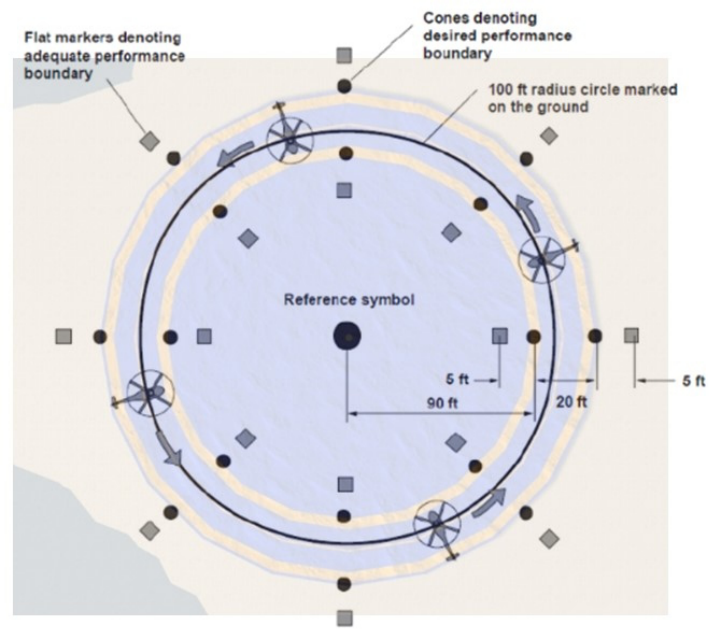
To ensure uniformity in each participant’s experimental flight profile, a scenario encompassing multiple Mission Task Elements (MTE) from the ADS-33E-PRF (Baskett, 2000) was devised. Despite executing various MTEs during the scenario, particular attention was directed towards the ADS- 33E-PRF pirouette MTE during results analysis, as it was deemed both the most dynamic and the most flight-technically challenging maneuver. In this task, the participants were instructed to navigate a circular trajectory while maintaining a consistent heading, aligned with a pole in the circle center, at specified distance and height. The scenario also incorporated a 15-knot wind in a fixed direction. Due to the dynamic, near-ground maneuvers in the pirouette MTE, it is expected that the simulated motion may be equally as dynamic, which may heighten cybersickness more profoundly compared to stable tasks at higher altitudes. This anticipation is rooted in the likelihood of increased sensory conflict due to elevated sensory visual and vestibular sensory inputs (Lawson, 2014) (Zelie and Qadeer, 2019). Figure 1 provides a visual representation of the pirouette MTE virtual track and flight task, and detailed specifications of the pirouette performance can be found in Table 1.
Cybersickness Measurements Given the acknowledged variability in motion sickness susceptibility across individuals, participants in the experiment underwent the Motion Sickness Susceptibility Questionnaire (MSSQ), designed by Golding (2006), before their involvement. This questionnaire aims to assess the diverse degrees of motion sickness susceptibility within the participant pool. The outcomes of the MSSQ will serve as a means to elucidate any irregularities or notable outliers observed in the cybersickness results. Additionally, participants will self-report their motion sickness rating using the Misery Scale (MISC) (Bos and Patterson, 2006), following the completion of each MTE. Ranging from 0 (“No problems”) to 10 (“Vomiting”), the MISC provides a quantifiable measure of the discomfort experienced by participants during the experiment.
Participants Four helicopter pilots from the Royal Dutch Air Force were enlisted for the experiment, averaging 35.8 years in age (SD = 6.83 years) and with an average flight experience of 1634 hours (min = 400, max = 4000).
812 Tillema and Englebert
Among them, three pilots specialized in operating the Chinook, while one pilot possessed proficiency in both the AW139 and the NH90 helicopters.
The combined MSSQ score for the four participants averaged 8.75 (SD = 7.89). This positions the mean score within the 40th to 50th percentile range for motion sickness susceptibility, indicating a slightly lower susceptibility compared to the general population average (Golding, 2006). Consequently, it was deduced that they could partake in the experiment without significant concern for experiencing excessive sickness.
Research Design As discussed, the experiment featured two conditions to assess the influence of mini motion platforms on user comfort and performance in VR-based helicopter flight simulation: the Motion-Off condition (baseline), in which the motion platform was disabled, and the Motion-On condition, in which motion cues were provided by a mini motion platform in conjunction with a classical washout algorithm.
Each participant underwent both conditions on the same day, following a within-subjects design with a counterbalanced order to mitigate potential order effects. Prior to the first condition, participants completed a familiarization run in the Motion-Off configuration to become acquainted with the virtual environment, the helicopter controls, and the visual setup. Following the familiarization run, participants rested until reporting a MISC (Bos and Patterson, 2006) score of 0, ensuring no carryover effects into the measured runs.
During each condition, participants completed a standardized flight scenario consisting of several Mission Task Elements (MTEs) selected from the ADS-33E-PRF guidelines. These included; Hover, Pirouette, Depart- Abort, Hovering Turn, and Slalom. Although all MTEs were executed during each condition, the pirouette maneuver received particular focus during analysis.
Each MTE was performed twice per condition, resulting in a total scenario duration of approximately 30 minutes per condition. After each MTE, participants verbally reported their current level of cybersickness using the Misery Scale (MISC). The condition was aborted if a participant reported a score of MISC 3 or higher, to prevent excessive discomfort and to ensure participants could return to baseline before starting the next condition.
Following each condition, participants were given sufficient time to recover from any symptoms, again requiring a MISC score of 0 before beginning the subsequent run. This procedure ensured that the development of cybersickness in one condition did not affect responses in the next.
Dependent Measures and Data Analysis Given the limited sample size and the exploratory nature of the experiment in this paper, no formal statistical analyses are undertaken. Nevertheless, various parameters and participant feedback are evaluated. Descriptive statistics and visual representations of user comfort, specifically the MISC scores reported, are examined to scrutinize differences across conditions. Pilot performance involves the analysis of pertinent pirouette performance parameters, encompassing height deviation, distance deviation, and deviation
Beyond Full Flight Simulators: Investigating Mini Motion Platforms in Helicopter 813
from the heading corresponding to a specific position. Furthermore, flight trajectories for each condition are mapped and evaluated using the performance conditions outlined in Table 1. Performance parameters were also analyzed for the other MTE tasks, however, since the pirouette was deemed the most dynamic and therefore the most relevant for cybersickness, data for the other MTEs is omitted for brevity.
RESULTS
As described in the previous chapter, the results analysis features a descriptive assessment of both user comfort and pilot performance measurements. The user comfort, pilot performance and subjective user experience results are presented in the next sections.
User Comfort
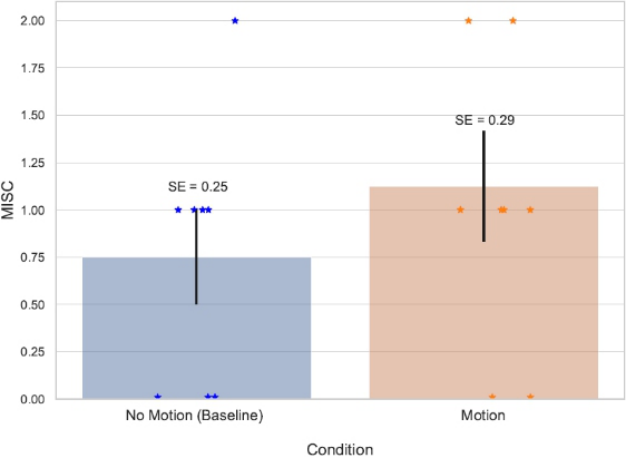
Figure 2 presents the average Misery Scale (MISC) scores reported after the pirouette MTE in both experimental conditions. While overall MISC scores remained low across participants, a slight increase in reported discomfort was observed in the Motion-On condition.
In the Motion-Off (baseline) condition, the average MISC score was 0.75 with a standard error (SE) of 0.25. In the Motion-On condition, this increased to an average of 1.00 (SE = 0.29). Although the difference is modest, it suggests that the addition of motion may introduce slightly elevated levels of discomfort.
Importantly, no participants exceeded the abort threshold of MISC = 3, and all were able to complete both conditions without interruption. The results indicate that while the motion platform did not induce severe cybersickness, its impact on overall comfort warrants further attention, particularly in the context of highly dynamic maneuvers such as the pirouette.
A paired t-test was conducted to assess the difference in MISC scores between the two conditions. The result was not statistically significant (t7 = −0.607, p = 0.563), indicating that the addition of motion did not lead to a significant change in reported user discomfort.
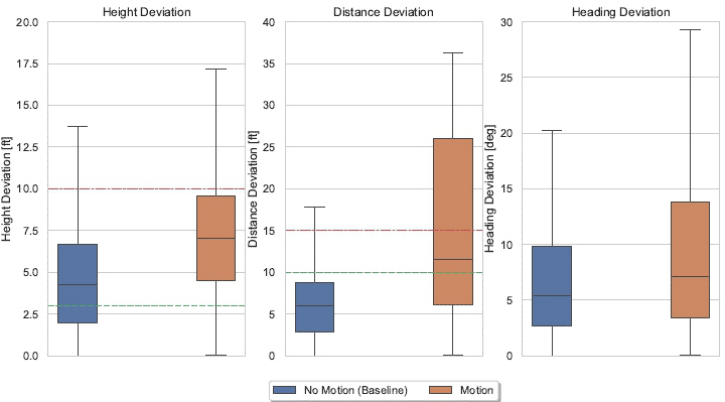
Pilot Performance In accordance with the performance metrics for the ADS-33 pirouette MTE, the height, distance, and heading deviations for all available data points are presented in Figure 3 and Figure 4 for both experimental conditions. By comparing the observed deviations with the desired and adequate performance margins defined in the ADS-33E-PRF standard, Table 1, it becomes clear that maintaining the desired level of control was particularly challenging in the Motion-On condition for height and heading, while distance control in the Motion-Off condition mostly remained within desired performance margins.
With respect to heading deviation, for which it is clear from Figure 3 that deviations in excess of five degrees are common, a deviation of zero degrees is desired as the participants were instructed to keep the nose of the helicopter pointed to the center object in the pirouette MTE parcourse.
814 Tillema and Englebert
Figure 2: Average MISC scores and standard errors (SE) reported for the pirouette.Figure 3: Pilot performance in terms of the height, distance, and heading deviation.
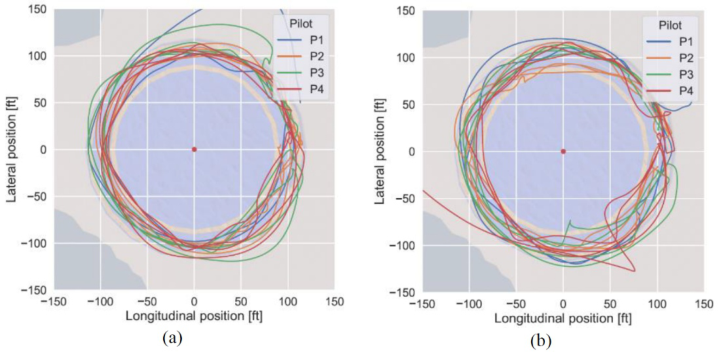
The flight trajectories shown in Figure 4 further illustrate the observed deviations from Figure 3. While both conditions display reasonably circular paths, the trajectories in the Motion-Off condition (Figure 4a) appear tighter and more consistent compared to the Motion-On condition (Figure 4b), where greater variation in distance from the center point is visible.
Beyond Full Flight Simulators: Investigating Mini Motion Platforms in Helicopter 815
Figure 4: Pirouette MTE pilot flight trajectories for the two experiment conditions: (a) Motion-Off and (b) Motion-On.
When comparing the two conditions, it can be observed that the Motion-On condition generally resulted in higher deviations across all three applicable control axes, most notably in height and distance. This suggests that the addition of motion cues, rather than aiding performance, may have negatively affected control precision during this task. It can be argued that this is due to the suboptimal motion cueing algorithm employed (i.e., classical washout algorithm), which was originally designed for large-scale motion platforms and not specifically tuned for the limited motion envelope of a mini motion platform.
As the pirouette is both a visually dynamic and flight-technically challenging maneuver, accurate and well-tuned motion cueing becomes especially important. The higher deviations observed in the Motion-On condition may be related to the limited motion envelope of the platform in combination with the use of a classical washout algorithm, which was originally developed for large-scale simulators. On a short-stroke system, such an algorithm may result in cues that do not always align with pilot expectations. This aligns with the findings from Englebert (2025), that compact motion systems can provide valuable cues for sustained low- frequency forces, slow rotational rates, and short-lived low-magnitude accelerations, but are less suited for high-amplitude or rapid motions.
Subjective User Experience In addition to the objective measures, participants were asked to reflect on their experience under both experimental conditions. Feedback revealed mixed opinions on the use of motion cues.
Some participants noted that the motion platform added value during low-dynamic maneuvers, such as hover, where the motion feedback felt supportive and natural. However, during more dynamic tasks, particularly the pirouette, several pilots described the motion as too sensitive, abrupt,
816 Tillema and Englebert
or unrealistic. Movements in yaw and pitch were reported as the most unpleasant, with motion sometimes perceived more as turbulence than accurate flight feedback. Additionally, during high-amplitude maneuvers, the platform often reached its limits, leading to sudden stops that acted as false motion cues and that disrupted immersion.
One pilot’s observation was that the motion platform responded directly to pilot inputs, rather than reflecting the aircraft’s motion, which was disorienting.
Preferences were split: two participants favored the Motion-On condition for added realism, while two preferred the Motion-Off condition.
Overall, the feedback highlights that while motion can enhance the simulation experience, its effectiveness is highly dependent on tuning of the motion cueing algorithm and the maneuver for which the motion is simulated, especially given the limitations of compact motion platforms.
CONCLUSION
This study explored the integration of a mini motion platform into a VR- based helicopter flight simulator, with the ultimate goal of assessing whether such compact systems can bring VR setups closer to the fidelity of full-scale simulators. As a means to this end, the study evaluated the platform’s impact on user comfort, pilot performance, and subjective user experience. Using a within-subjects design, participants completed a set of ADS-33 Mission Task Elements (MTEs), with a particular focus on the pirouette maneuver, under two experimental conditions: Motion-Off (baseline) and Motion-On.
The analysis of user comfort, as measured by the Misery Scale (MISC), showed a small increase in discomfort in the Motion-On condition. However, scores remained low overall and well below the abort threshold, indicating that the mini motion platform did not induce significant cybersickness. A paired t-test confirmed that the difference was not statistically significant.
In terms of pilot performance, deviations in height, distance, and heading were analyzed against ADS-33 performance criteria. The results showed that control precision was generally higher in the Motion-Off condition, particularly for height and distance control. The Motion-On condition introduced slightly larger deviations and more variability, suggesting that motion feedback did not enhance—and may in some cases have negatively affected—performance during this visually dynamic and control-intensive maneuver.
Participant feedback further supported these findings. While some noted that the motion platform added realism during stable maneuvers, most reported that during dynamic tasks, the motion cues felt overly sensitive, abrupt, or unrealistic. These effects may be linked to the limited motion envelope of the platform in combination with the use of a classical washout algorithm, originally designed for large-scale simulators. It has been shown that short-stroke platforms can reproduce low-frequency cues (e.g., sustained accelerations or slow attitude changes) well, but struggle with high-frequency, high-acceleration motion that violates the motion envelope (Englebert & Tillema, 2025). One participant remarked that the platform appeared to
Beyond Full Flight Simulators: Investigating Mini Motion Platforms in Helicopter 817
respond to pilot inputs rather than reflecting aircraft motion—highlighting a perceptual disconnect that may have disrupted immersion.
Overall, the findings conclude that while mini motion platforms offer a promising avenue for enhancing VR flight simulation, their effectiveness depends heavily on the quality of motion cueing and the helicopter flight profile. Given the limited range of such platforms, a dedicated motion cueing algorithm is required to match their characteristics. Developing and validating such algorithms represents a separate research challenge beyond the scope of the current study but will be essential for fully leveraging the potential of compact motion systems in immersive flight training environments.
REFERENCES
Baskett B. “ADS-33E-PRF Aeronautical Design Standard Performance Specification – Handling qualities requirements for military rotorcraft”. In: Defense Technical Information Center (2000). Bos J. E., Mackinnon S., and Patterson A. “Motion sickness symptoms in a ship simulator: Effects of inside, outside, and no view”. In: Aviation, Space, and Environmental Medicine 76 (2006), pp. 1111–1118. Chang, E., Kim, H., & Yoo, B., “Virtual Reality Sickness: A Review of Causes and
Measurements“, International Journal of Human-Computer Interaction (2020), Vol. 36(11), pp. 1–25. doi: 10.1080/10447318.2020.1778351. De Winter, J. C. F., Dodou, D., & Mulder, M., “Training Effectiveness of Whole Body Flight Simulator Motion: A Comprehensive Meta-Analysis”, The International Journal of Aviation Psychology, Vol. 22(2), 2012, pp. 164–183. doi: 10.1080/ 10508414.2012.663247. Dymora, P, Kowal, B, Muzerik M., & Romana, S. “The Effects of Virtual Reality
Technology Application in the Aircraft Pilot Training Process”, IOP Conference Series (2021). Sanya, Hainan Province, China. doi: 10.1088/1757–899X/1024/1/ 012099. Englebert, B & Tillema, G, “Objectively Evaluating Short-Stroke Motion Systems in Helicopter Flight Simulation”, Proceedings of the European Rotorcraft Forum (2025). Venice, Italy. European Aviation Safety Agency (EASA), “FSTD Special Conditions for the Use
of Head Mounted Displays (HMD) Combined a Motion Platform with Reduced Motion Envelope”, European Union Aviation Safety Agency (EASA), 2023. Golding J. F. “Predicting individual differences in motion sickness susceptibility by questionnaire”. In: Personality and Individual Differences 41 (2006), pp. 237–238. doi: 10.1016/j.paid.2006.01.012. Kim, J., Hwang, J., & Park, T., “Effect of Motion Cues on Simulator Sickness
in a Flight Simulator”, Proceedings (Part I) of the Virtual, Augmented and Mixed Reality: Design and Interaction: 12th International Conference (2020), Copenhagen, Denmark. doi: 10.1007/978–3-030–49695-1_3. Lawson B. “Motion sickness symptomatology and origins”. In: Handbook of Virtual Environment: Design, Implementation, and Applications (2014), pp. 531–600. Marron, T., Dungan, N., Namee, B. M., & O’Hagan, A. D., “Virtual Reality and Pilot
Training: Existing Technologies, Challenges, and Opportunities”, The Journal of Avia-tion/Aerospace Education and Research, Vol. 33(1), February 2024, doi: 10.58940/2329–258X.1980.
818 Tillema and Englebert
Martini, T, “Evaluation of Virtual and Mixed Reality Technologies in Helicopter Simulation”, Proceedings of the Vertical Flight Society 80th Annual Forum & Technology Display (2024), Montreal, Canada. Oh, C. G., “Pros and Cons of A VR-based Flight Training Simulator; Empirical
Evaluations by Student and Instructor Pilots”, Proceedings of the Human Factors and Ergonomics Society Annual Meeting (2020), Vol. 64, pp. 193–197. doi: 10.1177/1071181320641047. Reid, L. D., and Nahon M. A., “Flight Simulation Motion-Base Drive Algorithms: Part 1–Development and Testing of the Equations,” University of Toronto, Institute of Aerospace Studies, UTIAS Report No. 296, 1985. Zelie B. and Qadeer A. “Vestibular and mulit-sensory influences upon selfmotion
perception and the consequences for human behavior”. In: Frontiers in Neurology 10 (2019), pp. 1664–2295. doi: 10.3389/fneur.2019. 00063.
LISTED IN THE AHFE DIGITAL BOOKSTORE CATALOGUE
Explore the complete digital volume
Human Factors in Design, Engineering, and Computing
Read this individual research paper free through the original publisher, or explore the full digital proceedings book.
ISBN 978-1-964867-75-5
Explore this ISBN in the AHFE Bookstore ↗Listed in the July 2026 bookstore catalogue; search by ISBN to confirm current availability · Digital book purchase optional