Yu-Hsuan Huang, Chien-Hsiung Chen (2026). Exploring the User Experience of Virtual Reality in Displaying and Learning High-Risk Home Appliances. In: Accessibility, Assistive Technology and Digital Environments. AHFE Open Access, vol. 202, pp. 80–90. https://doi.org/10.54941/ahfe1007299
The global shift in consumption habits following the pandemic has driven a substantial increase in household appliance utilization. However, this surge is accompanied by rising appliance-related hazards, primarily linked to user errors and the ineffectiveness of dense traditional instruction manuals. To mitigate these safety issues, this study investigates the efficacy of Virtual Reality (VR) as an innovative medium for experiential learning, selecting an oven as the target product due to its high-heat risks. The objective was to create a needs-compliant VR environment and compare its usability and user experience against a conventional physical learning model. An experiment with thirty participants collected quantitative data via the System Usability Scale (SUS) and qualitative insights through semi-structured interviews. Results demonstrated a statistically significant superiority of the VR experience, indicating exceptional usability and enhanced learning effectiveness. This validates VR as a powerful tool for accelerating product comprehension and safety education. The study concludes by contributing actionable design principles for immersive applications, emphasizing information layering, multimodal feedback, behavioral verification mechanisms, and dedicated guidance for VR novices.
The period following the global pandemic has witnessed a substantial surge in both the demand for and the overall usage rates of home appliances. While these devices offer undeniable convenience in daily life, this increased reliance has concurrently brought to light a growing and serious concern regarding safety issues associated with their operation. Evidence from London Economics (2023) indicates a significant problem, reporting that approximately 750,000 accidental injuries annually are directly linked to unsafe home appliances. A critical analysis reveals that the majority of these unfortunate incidents arise from users’ improper product operation, a lack of fundamental electrical knowledge, or a general disregard for crucial safety instructions during use (National Fire Agency, MOI., 2022). This alarming trend underscores a pervasive problem: current methods for disseminating essential appliance knowledge often fall short, making it challenging for users, particularly novices, to genuinely comprehend product functionalities Received January 20, 2026; Revised April 2, 2026; Accepted April 22, 2026; Available online July 20, 2026
Exploring the User Experience of Virtual Reality 81 and safe operating procedures. Traditional learning avenues, such as lengthy instruction manuals or online videos with limited interactive demonstrations, frequently prove inadequate in effectively preparing users for real-world scenarios. Therefore, there is a pressing need to bridge this knowledge gap and mitigate the associated risks.
In response to this challenge, virtual reality (VR) emerges as a promising innovative approach. VR technology possesses inherent advantages, notably its ability to transcend traditional temporal and spatial limitations, allowing for the effective simulation of real physical properties of 3D objects within an immersive virtual environment. This capability presents a unique opportunity to create novel experiential channels for learning and interaction that go beyond static traditional media. By leveraging VR, it becomes possible to design rich, interactive learning environments where users can engage with appliances safely and effectively, potentially transforming how product knowledge is acquired. Consequently, this study aims to explore an innovative approach to address the aforementioned safety concerns. The core objective is to investigate how to effectively convey correct appliance knowledge before product use. Specifically, this study seeks to construct a user-centric virtual reality (VR) experience environment to meet identified user needs.
LITERATURE REVIEW
Virtual Reality Applied to Home Appliances Virtual reality (VR) offers the advantage of transcending temporal and spatial limitations, effectively simulating real physical properties such as gravity, buoyancy, mass, and friction of 3D objects within a virtual environment (Liang et al., 2016; Widder & Gorsky, 2013). In recent years, some home appliance brands have applied VR technology to product display and marketing scenarios. For example, IKEA launched the immersive IKEA VR Experience on the Steam platform in 2016, offering three preset kitchen scenes for consumers to virtually experience home layouts before making a purchase. Similarly, Samsung introduced Samsung Life Unstoppable in 2020, showcasing its latest technologies and products through virtual home scenarios, video explanations, and demonstrations of appliance design features.
Veteran VR developers Deruette and Applebee (2017) posit that all VR development projects can be positioned along two axes of complexity: Environment and Interfaces. The “environment” refers to the virtual space and objects viewed by the user through a head-mounted display (HMD), while “interfaces” are the control elements that connect the user to the virtual world, facilitating interaction during the experience (Deruette & Applebee, 2017). The focus of development projects will consequently vary depending on the specific VR application’s goals, objectives, and uses.
Virtual Home Appliances Product Experience Design Previous in-depth interview findings indicate that while the demand for home appliance usage has significantly increased, there has been a corresponding rise in electrical accidents. To leverage the potential of VR to enhance home
82 Huang and Chen appliance displays and user experiences, while simultaneously meeting user needs, improving learning outcomes, and promoting safety, the following eight design directions can be pursued (Huang et al., 2023).
Visualizing 3D product function instruction: Providing clear, three- dimensional visual guides for product functionalities.
Modularizing product instruction steps: Breaking down complex instructions into manageable, sequential modules.
Proactively offering precautions and electrical knowledge: Automatically presenting important safety warnings and fundamental electrical information.
Demonstrating errors instead of just error reminders: Showing users common mistakes and their consequences in a virtual environment, rather than just stating what not to do.
Enabling repeated viewing for deeper impression: Allowing users to re-watch or re-experience instructions to reinforce learning.
Providing an option to enable audio explanations: Giving users the choice to turn on or off narrated instructions.
Integrating real-world cases into virtual instruction: Incorporating actual accident scenarios or common usage pitfalls into the virtual learning experience.
Incorporating entertaining elements: Adding engaging and fun aspects to the virtual instruction to improve user retention and motivation.
User Experience and System Usability Scale Gould and Lewis (1985) emphasized that throughout the entire development and design process, user needs must be considered from the user’s perspective. Only through continuous refinement and improvement based on various design evaluations at each stage can a design that meets user expectations be achieved. Designing interactive products, services, environments, or systems that support human daily activities can foster effective communication and interaction, thereby enhancing the overall user experience (Sharp et al., 2019).
The System Usability Scale (SUS), proposed by Brooke in 1996, is a widely used tool for evaluating product operability, system interfaces, and service usability. This scale employs a five-point Likert scale, where users express their level of agreement across ten items, with scores ranging from 1 (strongly disagree) to 5 (strongly agree). It can be used to compare the usability and overall satisfaction between different systems, products, or services. The SUS has become a standard tool for assessing the usability of digital products and systems, extensively applied in human- computer interaction (HCI) design, user research, and product validation. Although it has been around for decades, SUS remains a core method for designing and evaluating digital products, continuously expanding and refining with the evolution of emerging technologies and usage scenarios (Bangor, et al., 2009).
METHOD
Participants This study aims to construct a user-centric VR experience environment to meet specific needs, focusing on investigating whether different experience modes impact participants’ perceptions and satisfaction during product display and learning. Therefore, participants must be at least 18 years of age and possess full civil capacity, meaning they can independently provide informed consent and assume full legal responsibility for their actions. Additionally, participants must have normal sensory and cognitive abilities to complete the experimental tasks of this study. Based on these considerations, this study will recruit 30 participants with a balanced gender ratio, meeting the following criteria: aged 18 or above, possessing at least one prior experience using the experimental product, and having basic visual, reading, and cognitive abilities. Information regarding participants’ age and educational background will be collected concurrently.
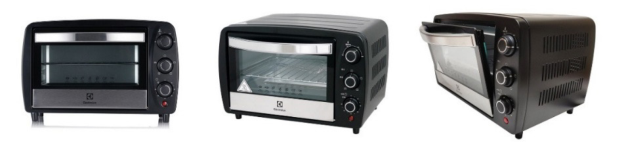
Research Materials and Experimental Space Given the diverse range of hazardous home appliances that, despite relatively simple operation, involve high temperatures, and considering the need for virtual operation experiences and user interaction, this study selected an oven (ELECTROLUX EOT3818K) as the target product for developing the experimental content (Figure 1). The choice of an oven as the experimental subject was based on several key considerations. Despite its relatively straightforward operational steps, the oven possesses inherent high-temperature risks that users can easily overlook. This oversight often leads to a false sense of security, and improper operation can significantly increase the risk of fire incidents. Furthermore, the oven’s relatively limited number of operational steps makes it an ideal and manageable subject for a pilot study, allowing for focused investigation into the effectiveness of virtual experiences in conveying crucial safety and usage information.
Figure 1: The target oven selected for the experiment.
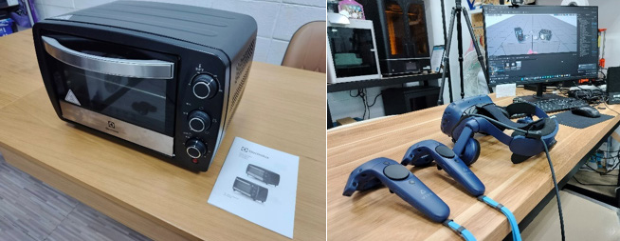
The experiment will be conducted in two groups: a physical oven product experience and a virtual oven product experience. The physical experience will take place in a designated laboratory space, while the virtual experience will be tested within a VR environment constructed using Unreal Engine software. Both the physical and virtual experimental spaces are illustrated in Figure 2.
Figure 2: Experimental samples of physical and virtual oven experience modes.
Experimental Design The experiment for this study can be divided into several steps. The first part involves research material collection and virtual environment construction. For the physical oven product experience group, participants directly operated an existing oven product available in the laboratory, simultaneously reading its instruction manual. Conversely, the virtual oven product experience group mimicked the content presented to the physical group, featuring the same product appearance, dimensions, materials, functionalities, and operational instructions within the VR environment. The specifics of this content will be detailed in the results section. This included measuring the physical product dimensions and modeling the oven product using 3ds Max software. Subsequently, Unreal Engine software was used to configure the product display, operational instructions, and interactive settings. This study designed various tasks to simulate participants’ process of viewing product displays, learning product operation, and interacting with the product within the virtual environment. The five tasks are as follows.
1. Product structure and function browsing 2. Product display and information reading 3. Product learning and understanding effect 4. Hazard Communication and Understanding 5. Product operation and experience The second part is the experimental phase. During this phase, participants are required to wear an HTC VIVE PRO 2 Full Kit and interact with the product display in the virtual environment constructed with Unreal Engine to complete the tasks. The experimental process is expected to last approximately 10–15 minutes.
Finally, after completing the experiment, participants will be asked to fill out the SUS questionnaire to evaluate the usability of the virtual oven product experience design service. Following this, semi-structured interviews will be conducted based on participants’ behavior and reactions during the experiment to document their experience perceptions, preferences, and suggestions. The collected data will then be statistically analyzed using IBM SPSS Statistics.
RESULTS
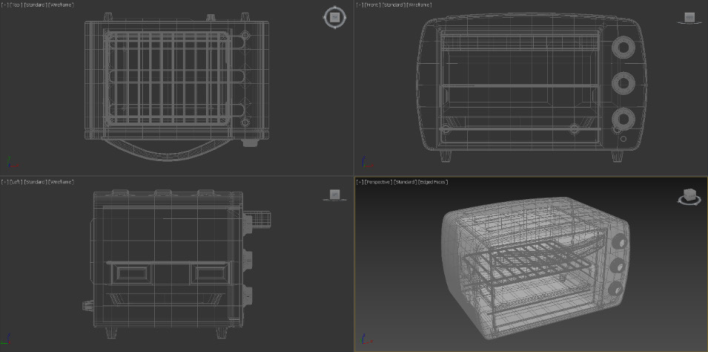
VR Virtual Oven Product Experience Environment Design First, to construct the 3D oven model required for the VR virtual home appliance experience, we meticulously measured the exact overall length, width, and height, as well as the precise dimensions of individual components, of a physical oven in the real environment using a tape measure (Figure 3). This step was crucial to ensure user experience and realism within the VR environment. Subsequently, the product’s 3D model was completed in 3ds Max software, including component separation, UV unwrapping, and material channel settings (Figure 4).
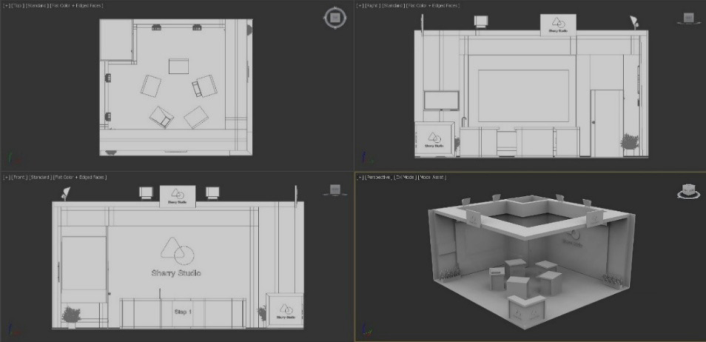
Next, the 3D oven and scene models were imported into Unreal Engine software for VR environment construction (Figure 5). Considering that first- time VR users might spend more time learning to operate the VR controller for movement and selection, this study’s VR product space was designed in a radial-shaped layout. This arrangement minimizes the time participants need to spend moving, requiring movement only when viewing product introductions or exiting the scene.
Figure 5: Product space planning diagram in VR environment.
The oven product scene will offer participants three main experience items: product introduction, product usage steps, and practical case operations. The product introduction content will display the oven’s structure using an exploded view, accompanied by an official brand video from Electrolux introducing the product. The usage steps are modularized into Step 1 to 4, with the virtual content sequentially demonstrating and allowing experience in four stages: pre-use settings, in-use operation, post-use cleaning, and hazard demonstration. Furthermore, the scene also incorporates entertaining elements and real-world cases identical to those in actual environments as mini-quizzes. These quizzes challenge participants to complete specific tasks based on the knowledge they’ve acquired, such as baking a pizza or a burger, thereby verifying whether participants truly understand the product (Table 1).
Table 1: Oven scene interactive storyboard.
Table available in the original PDF paper.
Task Description Step 1 Product structure and function browsing
Step 2 Product display and information reading
Step 3 Product learning and understanding effect
(Continued)
Table 1: Continued.
Table available in the original PDF paper.
Task Description Step 4 Hazard Communication and Understanding
Product operation and experience
Case Operation
Results of Descriptive Statistics By means of the convenience sampling method, this study invited 30 participants in the experimental tests, divided into two groups: the Physical Group (physical oven product experience) and the Virtual Group (virtual oven product experience), with 15 participants in each group (Table 2). There were 15 male and 15 female participants in total. After the experiment, all participants completed the SUS questionnaire to quantitatively assess the usability and satisfaction of their experience. Subsequently, researchers used SPSS software to conduct an independent samples t-test to examine statistical differences between the two groups. Additionally, semi-structured interviews, a qualitative research method, were conducted to gain deeper insights into participants’ subjective feelings and behavioral feedback.
Table 2: Descriptive statistics of experimental groups.
Table available in the original PDF paper.
Group N Experience Mode Physical oven product experience 15
Virtual oven product experience 15 Gender Male 15
Female 15
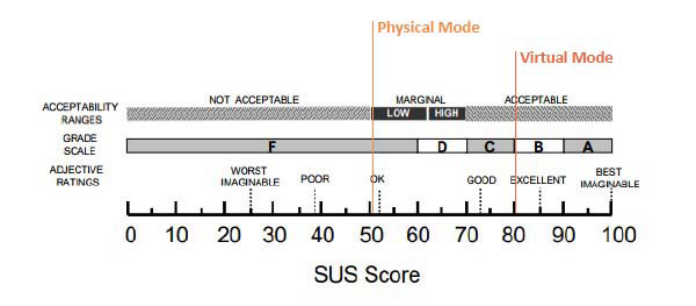
SUS Analytic Results After the experiment, participants completed the SUS questionnaire, providing five-point Likert scale ratings across various aspects, including overall usability, interface design, and learnability. An independent samples t-test analysis, conducted at a 95% confidence level, revealed a significant difference between the two groups (t = −9.123, p = 0.000 < 0.05). The detailed statistical results are presented in Table 3, and the SUS t-test analysis results are shown in Table 4, with a score comparison chart in Figure 6.
Specifically, the virtual oven experience group achieved a score of 80.33 (SD = 7.13), indicating higher participant satisfaction with its operability and overall experience. In contrast, the physical oven experience group
88 Huang and Chen scored 51.17 (SD = 10.13), which is below the SUS average benchmark of 68, suggesting that users were generally dissatisfied with this experience mode.
Table 3: Results of SUS score.
Table available in the original PDF paper.
User Score User Score User Score A1 50.00 A11 40.00 B6 72.50
Physical Mode M (S.D.) Virtual Mode M (S.D.) t Sig.
−9.123 .000*
SUS Score 51.17 (10.13)
80.33 (7.13)
* p<0.05, there is a significant difference
Figure 6: Comparison of the SUS scores between the two experience modes (reference: Bangor et al., 2009).
DISCUSSION
The VR experience designed in this study demonstrated significant advantages in usability and learning effectiveness. Quantitative results from the System Usability Scale (SUS) revealed a stark contrast: the virtual group achieved an average score of 80.33, classified as “Good” (Bangor et al., 2009), whereas the physical group scored only 51.17 (“Poor”). This statistical superiority
Exploring the User Experience of Virtual Reality 89 validates VR as a robust tool for reducing the cognitive load associated with high-risk appliance learning. Qualitative feedback corroborated these findings, with participants praising the VR environment for its intuitive 3D presentation, information chunking, and immediate spatial guidance. Unlike physical environments where users must search for information, the VR interface’s multimodal feedback and clear labeling allowed for profound comprehension of product functions and operational procedures, thereby enhancing engagement and alertness.
Despite the positive reception, the study identified specific usability challenges. Novice users reported that controller operations—specifically grabbing and rotating objects—lacked intuitiveness, and rapid viewpoint changes occasionally induced dizziness. Furthermore, while the VR experience excelled in operational guidance, it could not yet fully replicate the comprehensive technical depth of a physical instruction manual. Although participants found physical manuals information-rich, the dense text and poor formatting often hindered readability. This suggests that while VR offers unique advantages in visual and interactive learning, future iterations should focus on refining controller mechanics and balancing information depth to complement traditional documentation.
Broader implications of this study extend beyond educational settings. The results suggest VR’s potential as a pre-purchase experiential tool in retail environments, allowing consumers to simulate operations and boost purchasing confidence. Additionally, manufacturers could leverage cloud- based VR platforms to broadcast updates on new products and safety risks. By providing immersive, updateable educational content, such systems could significantly mitigate user error, reduce accident rates, and lower customer service costs.
CONCLUSION
This study validated the efficacy of Virtual Reality in enhancing user experience and safety education for high-risk home appliances. By comparing a purpose-built VR oven environment against a physical baseline, the results demonstrated that VR significantly outperforms traditional methods in showcasing product features and strengthening cognitive learning. Based on these findings, we propose four critical design principles for future immersive applications: (1) Information Layering and Chunking, utilizing step-by-step instructions and exploded diagrams to effectively decompose high-load procedural knowledge; (2) Multimodal Feedback, where future designs should incorporate voice prompts or haptic feedback to reinforce warnings during high-risk steps; (3) Behavioral Verification Mechanisms, exemplified by practical operations like the pizza baking task, to significantly boost engagement and self-efficacy; and (4) Dedicated Novice Guidance, employing techniques such as teleportation or assistive cursors to mitigate dizziness and lower operational thresholds. Future implementations should integrate these strategies with supplementary information channels to fully bridge the gap between virtual simulation and real-world operational competence.
REFERENCES
Bangor, A., Kortum, P. and Miller, J. (2009). Determining What Individual SUS Scores Mean: Adding an Adjective Rating Scale. Journal of Usability Studies, 4, 114–123. Brooke, J. (1996). SUS-A quick and dirty usability scale. Usability evaluation in
industry, 189(194), 4–7. https://doi.org/10.1201/9781498710411 Deruette, A., & Applebee, A. (2017, Feb 6). Getting Started With VR Interface Design. https://www.smashingmagazine.com/2017/02/getting-started-with-vr- interface-design/ Gould, J. D., & Lewis, C. (1985). Designing for usability: key principles and what
designers think. Communications of the ACM, 28(3), 300–311. https://doi. org/10.1145/3166.3170 Huang, Y. H., Chen, C. H., & Liang, Y. W. (2023). Research on user experience and needs of virtual reality learning home appliances. Engineering Proceedings, 55(1), 28. https://www.mdpi.com/2580764 IKEA. (2016, Apr 5). IKEA VR Experience. https://store.steampowered.com/
app/447270/IKEA_VR_Experience/ London Economics. (2023, March 1). Safety of Smart Domestic Appliances: A review of the opportunities for smart technology to enhance product safety. https://www. gov.uk/government/publications/safety-of-smart-domestic-appliances National Fire Agency, MOI. (2022). 110 Annual National Residential
Fire Statistics Analysis Report. https://www.nfa.gov.tw/pro/index. php?act=download&ids=16394 (In Chinese) Norman, D.A. (2014). The Design of Everyday Things (Revised & Expanded Edition). Yuan-Liou Publishing: Taipei, Taiwan. Plotsker, E., Wolfe, E. M., Slavin, B. R., White, N., Cook, J., & Panthaki, Z. J. (2022).
A characterization of home maintenance equipment-related hand and lower arm injuries. Journal of clinical orthopaedics and trauma, 31, 101943. https://doi. org/10.1016/j.jcot.2022.101943 Samsung. (2020, September 2). [Video] Samsung Marks a New Era of Innovation With Virtual Experience ‘Life Unstoppable’. https://news.samsung.com/ global/samsung-marks-a-new-era-of-innovation-with-virtual-experience-life- unstoppable Sharp, H., Preece, H., & Rogers, Y. (2019). Interaction Design: Beyond Human-
Computer Interaction. (5th ed.). Indianapolis, IN: Wiley. Taipei City Government Fire Department. (2019, June 25) Pay Attention to the Hidden Crisis Decryption when Using Home Appliances. Available online: https:// www.119.gov.taipei/ (In Chinese) Widder, M., & Gorsky, P. (2013). How students use a software application for
visualizing 3D geometric objects to solve problems. Journal of Computers in Mathematics and Science Teaching, 32(1), 89–120. https://www.learntechlib.org/ primary/p/40423/
LISTED IN THE AHFE DIGITAL BOOKSTORE CATALOGUE
Explore the complete digital volume
Accessibility, Assistive Technology and Digital Environments
Read this individual research paper free through the original publisher, or explore the full digital proceedings book.
ISBN 978-1-964867-78-6
Explore this ISBN in the AHFE Bookstore ↗Listed in the July 2026 bookstore catalogue; search by ISBN to confirm current availability · Digital book purchase optional