Weimin Zhai, Chien-Hsiung Chen (2023). Effects of Information Layout and Dynamic Presentation of Banner Advertising on the User Interface Design of Mobile Food Ordering Application. In: Usability and User Experience. AHFE Open Access, vol. 110, pp. 269–278. https://doi.org/10.54941/ahfe1003200
With more and more users using smartphones to order food online, in order to attract users, advertisements are widely used in various mobile food ordering APPs (MFOAs). The presentation of information in the user interface of MFOA is an essential factor pertinent to the user experience. This study aimed to explore the usability of information layout and dynamic presentation of banner advertising in an MFOA's operation and to suggest future design improvements. A 2 x 2 between-subjects experiment was planned to help explore whether the information layout (i.e., list-style and matrix-style) and dynamic presentation of banner advertising (i.e., static and dynamic ads) affect users' task performance and their subjective evaluations. This experiment used a convenience sampling method, and a total of 32 participants were recruited to participate in the experiment. Data collection for the experiment included participants' task performance, subjective ratings on a 7-point Likert scale and semi-structured interviews. The generated results revealed that: (1) Information layout with different types affected the participants' task performance; (2) Dynamic presentation of banner advertising affected users' task performance; (3) Information layout affected participants' subjective evaluations of the degree of preference and attractiveness; matrix-style was better than list-style; (4) There was a significant interaction between information layout and dynamic presentation of banner advertising in the subjective measure of the degree of preference, list-style is rated significantly higher in static ads than in matrix-style. However, the opposite result is obtained for dynamic ads. The findings generated from the research can be a good reference for developing the user interface design for MFOAs.
With the rapid development of mobile Internet technology, more and more users are using smartphones for various types of purposes. E-commerce is gradually shifting to mobile commerce (Lin, Qiu, Chaveesuk, & Chaiya- soonthorn, 2021). Users can perform shopping behaviors, such as product information search, information comparison, orders, and payment on the shopping APP’s interface (Patel & Pandit, 2021). As more and more mobile
shopping APPs continue to be introduced, people can hardly live without mobile shopping platforms for food, clothing, housing, and transportation. Especially during the COVID-19 pandemic, staying socially distant has lar- gely reduced the frequency of eating out (Lock, 2020). At the same time, MFOAs are gaining popularity among consumers (Kapoor & Vij, 2018), and users can order food from various restaurants more easily and conveniently through MFOAs. It can be said that MFOAs are gradually changing the way how consumers dine (Wang et al., 2022).
As we all know, advertising is an important channel for merchants to mar- ket their products in mobile shopping APPs. Almost all APPs are embedded with advertising messages, which is a major way of revenue for APP platform operators (Liu & Liu, 2019). A good advertisement can bring a perfect visual experience to users and stimulate consumers’ desire to shop (Zhang, Luo, Wu, & Deng, 2021), thus increasing the sales performance of the shopping platform (Loveland et al., 2019). Past research has found that dynamic ban- ner ads evoke higher emotional engagement, and users invest more attention and attraction (Cassioli, 2019). However, when users operate mobile shop- ping APPs, sometimes the visual effect of advertisement will inevitably bring a cognitive load to users due to the limitation of mobile screen size and limi- ted cognitive resources of humans. When users perceive the ads as intrusive, they negatively evaluate the advertised product or brand (de Groot, 2022) and even pose the risk of user boredom (Ghose & Han, 2014). Therefore, Shah et al. (2020) suggest that marketers need to rationalize their adver- tising design with full consideration of users’ needs. In addition, in a user interface, the design of the information layout affects the user’s visual search strategy, and the user often has to switch between different layout styles to obtain sound cognitive processing (Lim et al., 2014). The different informa- tion layouts have a significant impact on user search behavior and attention (Wu & Song, 2021). In mobile shopping platforms, consumers require more cognitive resources to help process the visual elements of the interface (Reber et al., 1998). Past studies have confirmed that the visual appearance of shop- ping APPs is an important factor influencing users’ shopping attitudes (Fu, Zhang, & Jiang, 2018). Therefore, how to enhance the usefulness and ease of use of the shopping APP interface to improve user experience have become the key for shopping APP merchants to compete (Hu, Feng, & Wen, 2020). How- ever, there is not enough research on the information layout and dynamic presentation of banner advertising in MFOAs. Therefore, this study aimed to explore the interface usability of information layout and dynamic pre- sentation of banner advertising in an MFOA’s operation and to enhance the shopping experience of MFOAs consumers.
METHOD
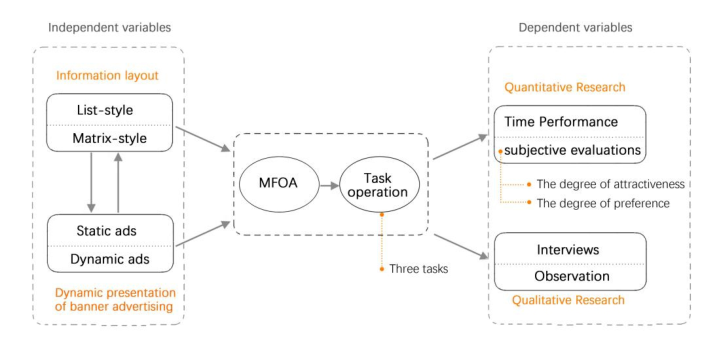
In this study, a 2 × 2 between-subject design was employed in the experi- ment, in which the two independent variables were “information layout”and “dynamic presentation of banner advertising.” The two levels of the infor- mation layout are list-style and matrix-style, and the two levels of dynamic
Effects of Information Layout and Dynamic Presentation of Banner Advertising 271
Figure 1: The research framework of this study.
presentation of banner advertising are static and dynamic ads. The following is the research framework of this study (see Figure 1).
Participants This study invited 32 participants (i.e., 18 males and 14 females) in the range of 18 to 30 years old to interact with different MFOAs via the convenience sampling method. The education level is above the bachelor’s degree. They have experience in using MFOAs. All participants had standard or corrected- to-normal vision and were all right-handed. Each participant could complete the experiment independently. The participants agreed to participate and signed the consent form. They all fully understood the experimental tasks and questionnaires. The experiment duration was approximately 25 minutes, and the participants were paid approximately US$7 (about 200 NTD) for participating in the experiment.
Materials and Apparatus The experimental prototypes were created with Proto.io. Illustrator was used for graphic design and drawing in this experimental design. The experimental prototypes were designed to simulate the Burger King shopping APP. The experiment is equipped with an IOS 5.5-inch screen (i.e., iPhone 7 Plus) with 1920×1080 pixels and 401 ppi. The experimental site is a laboratory free from noise and external interference.
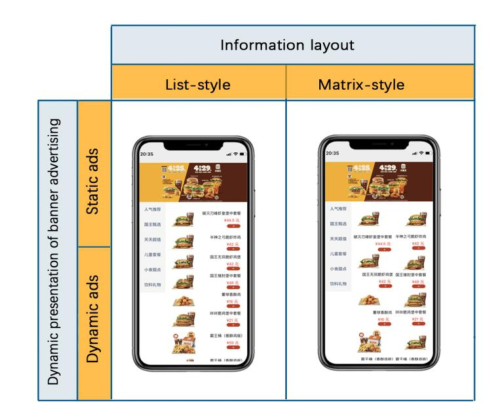
Experimental Design and Procedure The prototypes of this experiment are shown in Figure 2. Before the experi- ment, participants were informed of the research purpose. Then participants were asked to complete a questionnaire and consent form with basic infor- mation about their individuals. Screen recording software recorded each participant’s task completion time for further analysis. After completing all the tasks, participants were required to fill out a questionnaire of subjective
272 Zhai and Chen
Figure 2: The prototype of this experiment.Table 1. Experimental task designs of this study.
Table available in the original PDF paper.
Task number Descriptions Task 1 Find the price of Double Original Crispy Chicken Burger in the Daily Value section Task 2 Find the price of 100 NTD in the Snacks & Desserts section Task 3 Compare the lowest price in the popular recommendations section
evaluations. A semi-structured interview was conducted at the end of the experiment.
In addition, three tasks of this experiment were determined as shown in Table 1 (including visual search and information comparison tasks). A simu- lation of one of the most frequently used MFOAs in Taiwan was used to help participants take part in the experiment. The participants of this study were all students from the National Taiwan University of Science and Technology. In addition, the controlled variables were the same environmental settings with stable WiFi speeds.
RESULTS
A between-subject design was conducted for further statistical analysis in this study. The collected data regarding the main effects of the information layout, dynamic presentation of advertising, and their interaction effects on partici- pants’ task completion time (i.e., in seconds), as well as subjective evaluations were analyzed using the SPSS software.
Effects of Information Layout and Dynamic Presentation of Banner Advertising 273
Table 2. The two-way analysis of variance (ANOVA) of each task regarding participants’ task completion time.
Table available in the original PDF paper.
Source SS df MS F p η2 LSD test Task 1 Information
1.36 1 1.36 0.41 0.529 0.01
layout
8.96 1 8.96 2.68 0.113 0.09
Ad presentation
2.17 1 2.17 0.65 0.427 0.02
Information layout×Ad presentation Task 2 Information layout 18.39 1 18.39 7.32 0.011* 0.21 matrix-style < list-style Ad presentation
8.84 1 8.84 3.52 0.071 0.11
23.70 1 23.70 9.43 0.005* 0.25 dynamic ads < static ads Information layout×Ad presentation Task 3 Information
* Significantly different at the α=0.05 level (*p < 0.05); ** Significantly different at the α=0.01 level (*p < 0.01)
Analysis of Task Completion Time The results generated from the between-subject design of the task 1 completion time are shown in Table 2. It revealed no significant difference in the main effect of the information layout (F(1, 28)= 0.41, p = 0.529 > 0.05; η2 = 0.01). There was also no significant difference in the main effect of the dynamic presentation of banner advertising (F(1, 28)=2.68, p = 0.113 > 0.05; η2 = 0.09). Besides, there existed no significant interaction effect between the information layout and the dynamic presentation of banner advertising (F(1, 28)= 0.65, p = 0.427 > 0.05; η2 = 0.02).
The results generated from the between-subject design of the task 2 com- pletion time are shown in Table 2. It revealed a significant difference in the main effect of the information layout (F(1, 28)= 4.22, p = 0.049 < 0.05; η2 = 0.01). This means that the task completion time of the matrix-style (M = 5.02, SD = 1.17) was significantly shorter than that of the list-style (M = 6.22, SD = 2.41). Besides, there was also a significant difference in the main effect of the dynamic presentation of banner advertising (F(1, 28)=5.78, p = 0.023 < 0.05; η2 = 0.17). This means that the task completion time of the dynamic ads (M = 4.92, SD = 1.26) was significantly shorter than that of the static ads (M = 6.33, SD = 2.31). However, there existed no significant interaction effect between the information layout and the
274 Zhai and Chen
Table 3. The two-way analysis of variance (ANOVA) of participants’ subjective evaluations.
Table available in the original PDF paper.
Source SS df MS F p η2 LSD test Information layout 6.13 1 6.13 5.86 0.022* 0.17 list-style < matrix- style The degree of attracti- veness
0.13 1 0.13 0.12 0.732 0.00
Ad presentation
0.50 1 0.50 0.48 0.495 0.02
Information layout×Ad presentation Information layout 3.13 1 3.13 4.93 0.035* 0.15 list-style < matrix- style The degree of prefere- nce
1.13 1 1.13 1.78 0.194 0.06
Ad presentation 8.00 1 8.00 12.62 0.001* 0.31 Information layout×Ad presentation
* Significantly different at the α=0.05 level (*p < 0.05); ** Significantly different at the α=0.01 level (*p < 0.01)
Equation reproduced from the original PDF.
The results generated from the between-subject design of the task 3 com- pletion time are shown in Table 2. It revealed no significant difference in the main effect of the information layout (F(1, 28)= 0.79, p = 0.382 > 0.05; η2 = 0.03). However, there was a significant difference in the main effect of the dynamic presentation of banner advertising (F(1, 28)=6.79, p = 0.015 < 0.05; η2 = 0.20). This means that the task completion time of the dynamic ads (M = 6.02, SD = 1.47) was significantly shorter than that of the static ads (M = 7.63, SD = 2.06). There existed no significant interaction effect between the information layout and the dynamic presentation of banner advertising (F(1, 28)= 2.46, p = 0.128 > 0.05; η2 = 0.08).
Analysis of Subjective Evaluations According to the 7-point Likert scale (i.e., 1: least agree, 7: most agree) used for the questionnaire of subjective evaluations, the results of participants’ responses after completing the assigned tasks were collected for further stati- stical analysis. The results of the between-subject two-way ANOVA regarding participants’ subjective evaluations are provided in Table 3.
The results generated from the between-subject two-way ANOVA in terms of the degree of attractiveness are shown in Table 3. It revealed a significant difference in the main effect of the information layout (F(1, 28)= 5.86, p = 0.022 < 0.05; η2 = 0.17). This means that the degree of attractiveness
Effects of Information Layout and Dynamic Presentation of Banner Advertising 275
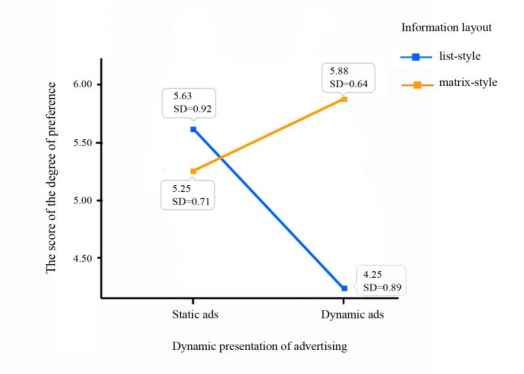
Figure 3: The interaction diagram of the “information layout” and the “dynamic presentation of advertising” regarding the degree of preference.
of the matrix-style (M = 5.19, SD = 0.98) was significantly higher than that of the list-style (M = 4.31, SD = 1.01). However, there was no significant difference in the main effect of the dynamic presentation of banner adver- tising (F(1, 28)=0.12, p = 0.732 > 0.05; η2 = 0.00). There also existed no significant interaction effect between the information layout and the dyna- mic presentation of banner advertising (F(1, 28)= 0.48, p = 0.495 > 0.05; η2 = 0.02).
The results generated from the between-subject two-way ANOVA in terms of the degree of preference are shown in Table 3. It revealed a significant dif- ference in the main effect of the information layout (F(1, 28)= 4.93, p = 0.035 < 0.05; η2 = 0.15). This means that the degree of attractiveness of the matrix- style (M = 5.56, SD = 0.73) was significantly higher than that of the list-style (M = 4.94, SD = 1.12). However, there was no significant difference in the main effect of the dynamic presentation of banner advertising (F(1, 28)=1.78, p = 0.194 > 0.05; η2 = 0.06). There existed a significant interaction effect between the information layout and the dynamic presentation of banner advertising (F(1, 28)= 12.62, p = 0.001 < 0.05; η2 = 0.31). Figure 3 illustra- tes that the degree of preference of the list-style (M = 5.63, SD = 0.92) was significantly higher than that of the matrix-style (M = 5.25, SD = 0.71) when the banner advertising was static. In contrast, the degree of preference of the matrix-style (M = 5.88, SD = 0.64) was significantly higher than that of the list-style (M = 4.25, SD = 0.89) when the banner advertising was dynamic.
DISCUSSIONS In the experiment, Task 2 asked participants to find the price of 100 NT in the snack and dessert section. The task was a comparison of location search
276 Zhai and Chen
and information. It was found that the main effect of information layout was significant, i.e., participants performed faster in the case of matrix-style. This result is consistent with earlier research that in matrix-style is more consistent with the user’s F-shaped visual search style (Shrestha et al., 2007). Further- more, in both Task 2 and Task 3, it was found that the main effect of the dynamic presentation of banner advertising was significant. That is, partici- pants performed faster in the presence of dynamic advertising. One possible reason for this is that the dynamic banner advertisements are located at the top of the MFOA interface, where the user’s visual field is usually focused at the center of the screen in a mobile interface (Wooley et al., 2007), and the dynamic banner advertisements related to product information somew- hat modulate the visual atmosphere of the interface and tend to evoke higher emotional engagement from users (Cassioli, 2019). Therefore, this is the reason why users operate faster in the case of dynamic ads.
The results of the subjective evaluations showed that the mean scores for all levels of the research variables were higher than the medium level of 4 according to a 7-point Likert scale. We found significant main effects of infor- mation layout in both the subjective evaluations of attractiveness level and preference level. That is, participants rated the matrix-style higher than list- style. One possible reason for this is that matrix-style is more in line with users’ visual search habits. In addition, compared to matrix-style, list-style arranged information densely on the right side of the user interface, which may increase the visual complexity of users due to the limitation of mobile screen size. In contrast, matrix-style is sparser in information presentation than list-style (Hwang & Lee, 2018). Matrix-style may be more appealing to participants in MFOA interfaces where the amount of information swiped up and down is modest.
Furthermore, in a subjective evaluation of the degree of preference, we also found a significant interaction between information layout and dynamic presentation of advertising. That is, the degree of preference of the list-style was significantly higher than that of the matrix-style when the banner adver- tising was static. In contrast, the degree of preference of the matrix-style was significantly higher than that of the list-style when the banner advertising was dynamic. In the experiment, the main goal of the participants is to com- plete the visual search for product information in the middle of the screen. The presence of dynamic banners at the top of the screen not only does not disturb the user but also adjusts the visual aesthetics of the user interface when the user browses the matrix-style with more visual focus in the lower middle of the screen and sparser (Hwang & Lee, 2018). In contrast, list-style is characterized by placing information centrally on the side of the screen, and the user’s visual focus is more concentrated on the middle right of the screen during the task, while the dynamic banner ads may affect the user’s visual search fluency because of the prominent display. Therefore, when the advertisement is dynamic, the preference degree of matrix type is obviously higher than that of list type. In static ads, many product images including sta- tic banner advertising images are more scattered in matrix-style, and, on the contrary, users may prefer to search visually in a smaller range of information presentation in list-style.
Effects of Information Layout and Dynamic Presentation of Banner Advertising 277
CONCLUSION
This study examined the combined effects of information layout and dyna- mic presentation of banner advertising on participants’ task performance and subjective evaluations. Based on the experimental results, more concrete evi- dence is provided for the visual design of MFOA interfaces. Several specific design recommendations for the user interface contributed by this study are listed as follows: (1) Information layout with different types affected the participants’ task performance. (2) Dynamic presentation of banner advertising affected users’ task perfor- mance. (3) Information layout affected participants’ subjective evaluations of the degree of preference and attractiveness; matrix-style was better than list- style. (4) There was a significant interaction between information layout and dynamic presentation of banner advertising in the subjective evaluztion of the degree of preference, list-style is rated significantly higher in sta- tic ads than in matrix-style. However, the opposite result is obtained for dynamic ads.
This study’s findings can contribute to the research on the user interface design of MFOAs. It is also recommended that designers may consider adding more visual design variables or even multimodal design to help expand the mobile shopping APP interface research. These design features of the user interface are worth further investigation.
Funding: This research study received no external funding. Conflicts of Interest: The authors declare no conflict of interest. Consent to participate: Informed consent was obtained from all partici- pants.
The authors would like to acknowledge.
REFERENCES
Fu, Y., Zhang, D., & Jiang, H. (2018) ‘Comparison of Users’ and Desi- gners’ Differences in Mobile Shopping App Interface Preferences and Desi- gns’, In Companion Proceedings of the The Web Conference 2018, pp. 31–32. doi:10.1145/3184558.3186914. Ghose, A. and Han, S. P. (2014) ‘Estimating Demand for Mobile Applications in the New Economy’, Management science, 60(6), pp. 1470–1488. doi:10.1287/mnsc.2014.1945. Hu, T. W. et al. (2020). ‘Process Design and Evaluation of App Interface for
Delivery Platform-Take Foodpanda as an Example’, In 2020 the 6th Inter- national Conference on Communication and Information Processing, pp.1–6. doi: doi.org/10.1145/3442555.3442556. Hwang, Y. M. and Lee, K. C. (2018) ‘Using an Eye-Tracking Approach to Explore Gender Differences in Visual Attention and Shopping Attitudes in an Online Shop- ping Environment’, International journal of human-computer interaction, 34(1), pp. 15–24. doi:10.1080/10447318.2017.1314611.
278 Zhai and Chen
Kapoor, A. P. and Vij, M. (2018) ‘Technology at the dinner table: Ordering food online through mobile apps’, Journal of retailing and consumer services, 43, pp. 342–351. doi:10.1016/j.jretconser.2018.04.001. Lim, J. H., Ryu, T. and Kim, Y. (2014) ‘Effects of Visual Stimulus on Response Beh-
avior of Control-on-Display Interface’, International journal of human-computer interaction, 30(4), pp. 291–302. doi:10.1080/10447318.2013.858459. Lin, X. et al. (2021) ‘The Acceptance Model of Mobile Shopping Apps in China’, In 2021 3rd International Conference on Information Technology and Computer Communications, pp. 69–72. doi:10.1145/3473465.3473477. Liu, H. and Liu, S. (2019) ‘Considering In-App Advertising Mode, Platform-App Channel Coordination by a Sustainable Cooperative Adver- tising Mechanism’, Sustainability (Basel, Switzerland), 12(1), p. 145. doi:10.3390/su12010145. Lock, S. (2020) ‘Year-over-year daily change in seated restaurant diners due to the
coronavirus (COVID-19) pandemic worldwide from Fenruary 24 to October 12, 2020’, Food Drink. Serv. Loveland, K. A., Smith, K. T. and Smith, L. M. (2019) ‘Corporate Image Advertising in the Banking Industry’, Services marketing quarterly, 40(4), pp. 331–341. doi:10.1080/15332969.2019.1665906. Patel, V. and Pandit, R. (2022) ‘Impact of Quality of Unfamiliar Shopping App on
Initial Trust Formation: A Moderated Mediation of Risk Attitude’, Vision (New Delhi, India), 26(4), pp. 441–453. doi:10.1177/0972262920984542. Reber, R., Winkielman, P. and Schwarz, N. (1998) ‘Effects of Perceptual Fluency on Affective Judgments’, Psychological science, 9(1), pp. 45–48. doi:10.1111/1467- 9280.00008. Terlutter, R. and Capella, M. L. (2013) ‘The Gamification of Advertising: Analysis
and Research Directions of In-Game Advertising, Advergames, and Adverti- sing in Social Network Games’, Journal of advertising, 42(2-3), pp. 95–112. doi:10.1080/00913367.2013.774610. Wang, X. et al. (2022) ‘A Study of Chinese Consumers’ Consistent Use of Mobile Food Ordering Apps’, Sustainability (Basel, Switzerland), 14(19), p. 12589. doi:10.3390/su141912589. Wu, J. and Song, S. (2021) ‘Older Adults’ Online Shopping Continuance Intentions:
Applying the Technology Acceptance Model and the Theory of Planned Beha- vior’, International journal of human-computer interaction, 37(10), pp. 938–948. doi:10.1080/10447318.2020.1861419. Wooley, B. et al. (2022) ‘Influence of dynamic content on visual attention during video advertisements’, European Journal of Marketing, 56(13), pp. 137–166. doi:10.1108/EJM-10-2020-0764. Zhang, C. et al. (2021) ‘Research on the Matching of Advertisement and Inter-
face Background Color of Online Shopping App: Based on Eye Movement Experiment’, In International Conference on Man-Machine-Environment System Engineering, pp. 585–592. doi:10.1007/978-981-16-5963-8_80.
LISTED IN THE AHFE DIGITAL BOOKSTORE CATALOGUE
Explore the complete digital volume
Usability and User Experience
Read this individual research paper free through the original publisher, or explore the full digital proceedings book.
ISBN 978-1-958651-86-5
Explore this ISBN in the AHFE Bookstore ↗Listed in the July 2026 bookstore catalogue; search by ISBN to confirm current availability · Digital book purchase optional