Emre Celikay, Ole Schmidt, Chantal Olijnik, Gordon Konieczny (2026). Universal Accessibility in Civil Aircraft Cabin - Single Aisle Aircraft Lavatory "Accessibility for all“. In: Accessibility, Assistive Technology and Digital Environments. AHFE Open Access, vol. 202, pp. 137–143. https://doi.org/10.54941/ahfe1007304
In the context of our research project, RECab (Resource Efficient Aircraft Cabin), which is concerned with the sustainable and resource-efficient design of aircraft cabins, our focus has been on the barrier-free use of service modules in aircraft cabins. To illustrate this, we will use aircraft lavatories as a case study. This requirement is rooted in legislative imperatives for universal accessibility in air travel for all users, with particular emphasis on those with various limited mobility and especially those reliant on wheelchairs. The utilisation of aircraft lavatories by wheelchair users is a matter of significant concern. It is evident that the utilisation of aircraft lavatories poses a considerable challenge for wheelchair users, in addition to the significant difficulties experienced by users without mobility impairments. The team developed a solution that considers user- and usage-specific factors of aircraft cabin areas, as well as operational and safety-critical functions. The outcome of the collaboration between HAW Hamburg (UAS) and Diehl Aviation was the development of the Accessible Single Aisle Aircraft Lavatory Door 1, a solution designed to enhance accessibility for passengers with reduced mobility on single-aisle aircraft. This innovative lavatory design addresses the common barriers posed by cramped facilities, allowing users to travel comfortably and independently, while also enhancing the overall experience for all travellers. The lavatory features a spacious layout that accommodates an onboard wheelchair and provides sufficient room for a support person, ensuring dignity and ease of use considering security critical aspects in that very special area close to the aircraft cockpit. The Accessible Single Aisle Aircraft Lavatory Door 1 is available in two different configurations: retrofit for existing aircraft and line-fit options for new aircraft. Moreover, the design is in accordance with the imminent U.S. Department of Transportation regulations for new single-aisle aircraft. It contributes to the enhancement of inclusivity and accessibility within the domain of air travel, catering to the diverse requirements of passengers and has been designed to maintain the existing cabin layout, thereby ensuring that airlines do not experience any loss of revenue space.
Mobility is a fundamental human capability and basic need. It represents dignity and independence, and enables individual autonomy, self-confidence, and social participation (UN-SDG 9 (2026), UN-SDG 11 (2026). However, in commercial aviation, many aircraft cabin designs, particularly in single-aisle configurations, limit the mobility of a substantial group of passengers due to certain boundary conditions. Lavatories are among the most restrictive and regulated aircraft cabin service modules because their confined dimensions often prevent people with reduced mobility from using them independently, especially but not only wheelchair users. Consequently, affected passengers frequently experience situations that are uncomfortable, undignified, or even exclusionary, which leads some to avoid air travel altogether.
Designing cabin environments that support mobility for a diverse passenger population (DBAG (2025)) is a central challenge for an equal access to transportation in general and of inclusive aircraft design in our case. In response, the Accessible Single Aisle Lavatory Door 1 project investigates architectural approaches to improve lavatory accessibility, ensuring integration into the existing cabin structure while maintaining operational and economic viability. Two complementary design solutions were developed: a line fit option for new aircraft and a retrofit variant for in-service fleets. These solutions enable independent lavatory usage for passengers with reduced mobility in single-aisle aircraft. This project supports two basic functions in aircraft cabins:
Maintain abilities of home.
Support independence.
These functions are achieved by improving and maintaining mobility within the cabin and making the onboard lavatories easier to use, as outlined in the project.
BACKGROUND
Accessibility in Aircraft Cabin Design Accessibility in aviation is increasingly recognized as a fundamental aspect of inclusive mobility. Existing single-aisle aircraft lavatories are typically too confined to allow wheelchair manoeuvring or assisted transfers, forcing passengers with mobility impairments to avoid air travel or accept dehumanizing restrictions such as holding in, using diapers, dehydration and fasting. Most current accessible lavatory solutions rely on modifying aft galley areas, often resulting in loss of revenue space or complex cabin rearrangements. Other solutions use curtains to create temporary visual barriers for wheelchair users but not separated areas.
The U.S Department of Transportation published new regulatory requirements in August 2023 (DOT 2023) to improve the current situation for wheelchair bound passengers regarding the lavatory usage on single-aisle aircraft. These requirements emphasize independent use, adequate space,
Universal Accessibility in Civil Aircraft Cabin - Single Aisle Aircraft Lavatory 139 and accommodation of both the passenger and an attendant. Consequently, aircraft interior design must balance accessibility, safety, certification compliance, and economic efficiency within highly constrained spatial envelopes.
Mobility and Usage Requirements The accessibility of aircraft lavatories is primarily determined by the ability of passengers with reduced mobility (PRM) to perform essential usage tasks and scenarios independently or with limited assistance under the spatial constraints of a single-aisle cabin (e.g. Airbus A320 and Boeing B737 aircraft families) (EP (2006). For the present study, the mobility- and usage related requirements associated with lavatory use were defined based on typical interaction sequences for wheelchair users and persons with motoric impairments (ECA (2003). Current and improved accessibility was analysed using the functional demonstrator of an onboard wheelchair (OBW), a mock-up of the Area at door 1 as well as anthropometric dummies (95th percentile American Male and 5th percentile Japanese Female) inside CATIA V5 software environment. The analysis covered lavatory approach and the key interaction points between passenger with reduced mobility and lavatory, such as approach and access to functional elements inside it.
The relevant usage requirements include the following motion segments:
Approaching the lavatory at door 1 left (D1L) using an onboard wheelchair within the aisle constraints of a single-aisle aircraft (e.g. Airbus A320 or Boeing B737 families).
Entering and exiting the lavatory through the door opening.
Manoeuvring the wheelchair within the available internal space.
Transferring between wheelchair and toilet under restricted spatial conditions.
Reaching and operating functional elements such as handrails, flush controls, washbasin, and mirror.
Accommodating a supporting attendant when required while preserving personal dignity and privacy.
Considering safety, security, and evacuation related constraints associated with the lavatory’s location in the forward cabin area.
These usage scenarios are characterized by very limited manoeuvring space and turning radii, limited reach and grip envelopes, and reduced transfer spaces (for parallel or pivotable transfers), which define critical design requirements for accessible lavatory concepts. In addition, the location of the lavatory in the forward cabin area introduces further constraints related to safety, security separation (cockpit-door area), and evacuation routes.
Two different design approaches and concepts for lavatories in single- aisle aircraft can be distinguished with respect to these mobility and usage requirements. Conventional lavatory designs are based on fixed internal layouts and offer only minimal manoeuvring space, thereby limiting independent use by passengers with reduced mobility. In contrast, the
Accessible Single Aisle Lavatory Door 1 incorporates adjacent cabin space to increase functional volume, improving wheelchair manoeuvrability and independent or assisted use while maintaining the existing cabin layout.
Inclusivity and Sustainability Sustainability in aircraft cabin design extends beyond ecological efficiency and economic performance and increasingly encompasses social dimensions such as inclusivity, equity, and equal access to mobility. In this context, reducing inequalities between different passenger groups represents a key aspect of sustainable aviation. Limited accessibility of essential service modules, such as lavatories, disproportionately affects passengers with reduced mobility and restricts their autonomy, comfort, and participation in air travel. Addressing such disparities contributes directly to social sustainability by enabling more equitable use of cabin infrastructure and supporting the principle of mobility for all.
At the same time, inclusive design solutions as part of an universal accessibility approach that integrate accessibility without additional spatial or operational costs align social objectives with economic and resource- efficient considerations. Consequently, reducing accessibility-related inequalities in aircraft cabins can be understood as an integral component of holistic, sustainable cabin design rather than as an isolated compliance- driven requirement.
METHODOLOGY
The methodological approach of this study follows a structured, user centred design process aimed at improving lavatory accessibility for passengers with reduced mobility in single aisle aircraft. Based on the defined mobility and usage requirements, functional and spatial analyses were conducted to identify critical constraints related to manoeuvrability, transfer, reachability, and safety relevant cabin interfaces (BMIBT (2002)).
Based on the conducted analyses, accessible lavatory concepts for a Door 1 (front left door in the main cabin) location were developed. To validate the developed concepts, a physical mock-up was constructed, and practical usage tests were carried out, allowing the assessment of real interaction sequences and the identification of strengths and remaining limitations under realistic conditions.
RESULTS
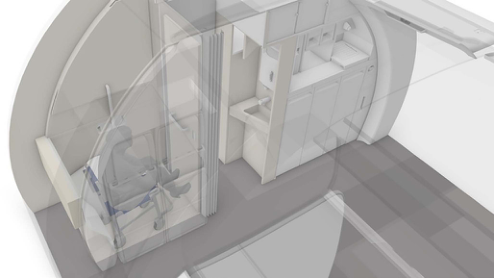
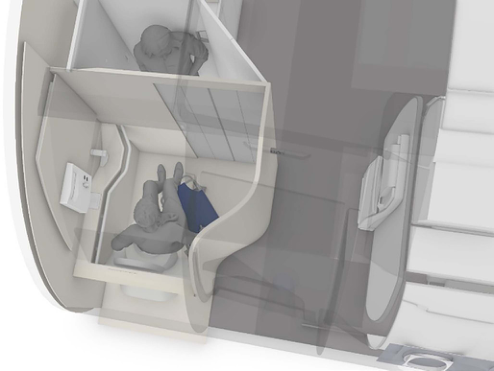
The developed retrofit lavatory (Figure 1) and line-fit (Figure 2) concepts significantly improve accessibility and usability in single-aisle aircraft. Both solutions allow the onboard wheelchair to function as a transfer seat and provide sufficient space for an accompanying attendant, enabling independent use while reducing cabin crew workload. By enlarging the functional volume and utilizing adjacent cockpit aisle space, wheelchair manoeuvrability is improved, and transfer angles are reduced to approximately 45°, supporting
Universal Accessibility in Civil Aircraft Cabin - Single Aisle Aircraft Lavatory 141 safer and more intuitive transfers. Importantly, the concepts preserve the existing cabin layout, ensure evacuation conformity, and result in no loss of revenue space.
The retrofit solution (Figure 1) for an alteration of existing operated aircraft enables continued access to the washbasin even when the lavatory is occupied, avoids changes to the existing lavatory structure, requires no relocation of cabin attendant seats. By relocating the lavatory washbasin onto the galley and using its water connection, the lavatory benefits of spatial enlargement, which can be used to integrate supporting and functional elements in reach to enhance accessibility. An additional folding door between the lavatory and the galley module can be used to include the Galley-Lavatory-Aisle for assisting personal, while maintaining the dignity and privacy of the user. This configuration allows either one larger lavatory or one lavatory and one smaller area for assisting personal. Since this configuration offers a visual and hard barrier it is also secondary barrier conform, allowing pilots safely use the lavatory (EASA (2023).
Figure 1: Lavatory door 1 - Retrofit solution (own illustration).
The line-fit configuration (Figure 2) further benefits from a larger door cutout which is made possible due to the larger footprint, an accessible washbasin with integrated handrail, and the use of a second door as a secondary barrier near the cockpit. The reconfiguration of the entrance area makes it possible to gain 40.5cm in lavatory width enhancing the footprint. The spatial enlargement is used to integrate a larger door cutout easing the wheelchair approach, as well as an accessible washbasin with integrated handrail, and the use of a second door as a secondary barrier near the cockpit. The improved spatial layout and (new) support elements also enhance usability for other passenger groups, such as elderly travellers, parents and plus size passengers.
Figure 2: Lavatory door 1 – Line-fit solution (own illustration).
CONCLUSION / OUTLOOK This study shows that accessible lavatory design in single-aisle aircraft is possible without sacrificing revenue space or executing complex cabin reconfigurations. The proposed line-fit and retrofit solutions at Door 1 enable independency for passengers with reduces mobility by utilizing the onboard wheelchair as a transfer seat.
Reduced transfer angles to approximately 45° ensures safer and shorter transfers, without restricting evacuation conformity and existing cabin layouts. In addition to wheelchair users, the improved spatial layout also supports elderly individuals, travellers with temporary mobility impairments and plus sized travellers. By addressing the serious accessibility gab in commercial aviation, the project contributes to social sustainability and the principle of equal mobility for all passenger groups. Further studies should focus on certification aspects and operational implementation into real cabin environments.
ACKNOWLEDGMENT
This work was supported by the LuFo VI-2 project “Hollistische Untersuchungen zur ressourceneffizienten Kabinen- HEUREKA” (engl.: Holistic studies on resource-efficient cabins, project number 20K2103D) funded by the Federal Ministry for Economic Affairs and Climate Action based on the decision of the German Bundestag.
The article has been proofread using artificial intelligence (www.deepl. com).
REFERENCES
BMIBT (2002): Bavarian State Ministry of Interior, Building and Transport - DIN 18040-1 and DIN 18040-2 – Design guidelines for accessible design https://www.stmb.bayern.de/assets/stmi/buw/baurechtundtechnik/ planungsgrundlagen_barrierefreies_bauen.pdf, (accessed 2026-04-17)
Universal Accessibility in Civil Aircraft Cabin - Single Aisle Aircraft Lavatory 143 DBAG (2025): Deutsche Bahn AG - The 5th Accessibility Program of Deutsche
Bahn AG https://assets.static-bahn.de/dam/jcr:5c29d6e4-9a89-41d3-b6d6- 0fab4e612a20/5_Programm%20zur%20Barrierefreiheit%20der%20 Deutschen%20Bahn%20AG.pdf, (accessed 2026-04-17) DOT (2023): Department of Transportation, Final Rule - Accessible Lavatories on Single-Aisle Aircraft, https://www.transportation.gov/airconsumer/final-rule- accessible-lavatories-single-aisle-aircraft-PDF, August 1, 2023, (accessed 2026- 04-17) EASA (2023): European Union Aviation Safety Agency (EASA) - Certification
Specifications and Acceptable Means of Compliance for Large Aeroplanes (CS-25) https://www.easa.europa.eu/en/document-library/certification-specifications/ group/cs-25-large-aeroplanes#cs-25-large-aeroplanes, (accessed 2026-04-17) ECA (2003): European Concept for Accessibility (ECA) 2003 – Technical Assistance Manual https://www.design-fuer-alle.de/wp-content/uploads/EDAD_ECA_ Technical_Assistance_Manual_2003.pdf, (accessed 2026-04-17) EP (2006): European parliament and council – REGULATION (EC) No 1107/2006
OF THE EUROPEAN PARLIAMENT AND OF THE COUNCIL of 5 July 2006 concerning the rights of disabled persons and persons with reduced mobility when travelling by air, (accessed 2026-04-17) https://eur-lex.europa.eu/legal-content/ EN/TXT/HTML/?uri=CELEX:32006R1107 UN-SDG 11 (2026): United Nations – Regional Information Centre for Western Europe https://unric.org/en/sdg-11/, (accessed 2026-04-17) UN-SDG 9 (2026): United Nations – Regional Information Centre for Western
Europe https://unric.org/en/sdg-9/,(accessed 2026-04-17)
LISTED IN THE AHFE DIGITAL BOOKSTORE CATALOGUE
Explore the complete digital volume
Accessibility, Assistive Technology and Digital Environments
Read this individual research paper free through the original publisher, or explore the full digital proceedings book.
ISBN 978-1-964867-78-6
Explore this ISBN in the AHFE Bookstore ↗Listed in the July 2026 bookstore catalogue; search by ISBN to confirm current availability · Digital book purchase optional