Maycon Gustavo Costa Dos Anjos, Marcelo Soares, Eduardo Ferro, Mauricio Duque (2026). Limits and Risks of Artificial Intelligence Use in Ergonomics. In: Universal Design and Design for Inclusion. AHFE Open Access, vol. 209, pp. 17–25. https://doi.org/10.54941/ahfe1008015
The integration of Artificial Intelligence (AI) into work systems has been associated with automation and data-driven decision-making. However, in ergonomics, predominantly techno-centered approaches reveal significant structural limits and risks. Grounded in ergonomics of activity and sociotechnical systems theory (Guérin et al., 2001; Falzon, 2014; Salmon et al., 2021), this paper critically examines how algorithmic modeling may reduce transparency, increase cognitive demands, and oversimplify the contextual and interpretative nature of real work activity. While Industry 5.0 emphasizes human-centered technological integration (European Commission, 2021), AI systems often operate through abstraction and generalization that may shift evaluative authority away from professional judgment (Grote, 2023). The study argues that AI should function as a supportive analytical resource rather than as a substitute for ergonomic reasoning, highlighting the need for methodological boundaries that preserve human mediation, contextual interpretation, and systemic coherence in ergonomic practice.
The rapid expansion of Artificial Intelligence (AI) in contemporary work systems represents one of the most significant transformations in organizational structures and decision-making processes in recent decades. Industry 4.0 consolidated digitalization, automation, and data integration as central drivers of productivity and operational efficiency (Xu et al., 2021). More recent industrial perspectives emphasize the need to rebalance technological advancement with human-centered principles, resilience, and sustainability (Leng et al., 2022; European Commission, 2021). Within this evolving landscape, ergonomics assumes a strategic position, as it mediates the relationship between technological innovation and the conditions under which human work is performed.
Historically, ergonomics has been established as a discipline dedicated to adapting work systems to human capabilities and limitations (Chapanis, 1965; Karwowski, 1996). From its origins in human–machine engineering to its contemporary systemic perspective, the field has consistently emphasized
that technical systems must be designed in alignment with human cognitive, physical, and organizational characteristics. Moraes and Mont’Alvão (2012) highlight that modern ergonomics integrates physical, cognitive, and organizational dimensions, recognizing that work performance is inseparable from the broader sociotechnical environment in which it occurs.
The ergonomics of activity introduces a critical epistemological distinction between prescribed work and real activity (Guérin et al., 2001; Falzon, 2014). Real work is characterized by variability, adaptive regulation, situated decision-making, and continuous negotiation of constraints. Workers do not merely execute predefined tasks; they interpret, adjust, and compensate for unforeseen conditions. This perspective challenges reductionist approaches that attempt to represent human activity solely through standardized indicators or predefined models.
In this context, AI-based systems are increasingly incorporated into ergonomic practice, particularly in areas such as posture recognition, risk monitoring, predictive analysis, and performance evaluation. While such systems may enhance data processing capacity and reduce inter-evaluator variability, their integration is not epistemologically neutral. Algorithmic models operate through pattern recognition and statistical abstraction, potentially simplifying complex and situated work dynamics. As noted in discussions on sociotechnical systems (Salmon et al., 2021), technological systems reshape organizational interactions and redistribute authority and responsibility. Similarly, advanced automation introduces new configurations of accountability, raising concerns about transparency and professional judgment (Grote, 2023).
Therefore, the central issue is not whether AI can contribute to ergonomic analysis, but under what conditions such integration remains coherent with the foundational principles of ergonomics. To what extent can AI capture the contextual and adaptive nature of real work activity? What organizational and psychophysiological risks may emerge from intensive algorithmic mediation? And how might the increasing reliance on automated systems affect the interpretative and systemic foundations of ergonomic practice?
This paper critically examines the limits and risks associated with the use of Artificial Intelligence in ergonomics. Grounded in classical ergonomic theory and contemporary discussions on digital transformation and sociotechnical systems, the analysis seeks to clarify the structural tensions between algorithmic rationality and human-centered work analysis. By identifying these tensions, the article contributes to a more cautious and methodologically structured integration of AI into ergonomic practice.
THEORETICAL BACKGROUND Ergonomics emerged as a scientific field concerned with optimizing the interaction between humans and technical systems. Early developments in human–machine engineering emphasized that system failures often resulted from misalignment between human capabilities and technological demands (Chapanis, 1965). This foundational insight established the principle that technological systems must be designed in accordance with human
Limits and Risks of Artificial Intelligence Use in Ergonomics 19 characteristics rather than requiring humans to adapt to rigid technical constraints. Over time, ergonomics evolved into a broader discipline integrating physical, cognitive, and organizational dimensions of work (Karwowski, 1996; Moraes & Mont’Alvão, 2012).
Karwowski (1996) conceptualizes ergonomics as a discipline embedded within sociotechnical systems, emphasizing that performance and well-being are interdependent outcomes. In such systems, human actors, technologies, organizational structures, and environmental conditions interact dynamically. This systemic perspective becomes particularly relevant in highly digitalized contexts, where AI-driven tools mediate decision-making, monitoring, and evaluation processes. Moraes and Mont’Alvão (2012) reinforce that ergonomic analysis must consider not only physical workload but also cognitive demands, communication flows, and organizational dynamics, especially in technologically complex environments.
The ergonomics of activity provides a crucial epistemological framework for understanding the limits of automated modeling. Guérin et al. (2001) argue that prescribed tasks differ substantially from real activity, as workers continuously regulate their actions in response to variability and unforeseen constraints. Falzon (2014) further emphasizes that work activity is situated and interpretative, shaped by contextual factors that cannot be fully anticipated at the design stage. This perspective highlights the importance of direct engagement with real work situations and warns against purely formal or standardized representations of activity.
When AI systems are introduced into ergonomic practice, they often rely on structured datasets and predefined parameters. While such systems can detect patterns and support quantitative assessments, they operate through abstraction and generalization. From the standpoint of ergonomics of activity, this mode of representation presents inherent limitations. Real work involves micro-adjustments, tacit knowledge, informal coordination, and subjective interpretation, elements that may not be fully captured by statistical modeling (Guérin et al., 2001; Falzon, 2014). Consequently, algorithmic outputs should not be equated with comprehensive representations of work activity.
Contemporary discussions on digital transformation further contextualize these tensions. Xu et al. (2021) describe Industry 4.0 as driven by digital integration and automation, while Leng et al. (2022) emphasize emerging paradigms that advocate collaborative configurations between humans and intelligent systems. The European Commission (2021), in its Industry 5.0 framework, explicitly reinforces the need for human-centeredness, ethical responsibility, and resilience in technological integration. However, the transition from automation-centered to human-centered rhetoric does not automatically resolve structural tensions between efficiency-driven technological systems and the interpretative foundations of ergonomics.
In addition, sociotechnical systems research highlights that technological integration reshapes authority, accountability, and professional roles (Salmon et al., 2021). Advanced automation may alter decision hierarchies and redistribute responsibility within organizations. Grote (2023) underscores that increasing levels of automation introduce complexity in accountability
structures, particularly when algorithmic systems influence safety-related decisions. In ergonomic contexts, where professional judgment plays a central role, the opacity and perceived objectivity of AI outputs may subtly shift evaluative authority away from human experts.
Therefore, the theoretical foundation of this study rests on three interconnected premises: (1) ergonomics prioritizes adaptation of systems to human capacities; (2) real work activity is variable, situated, and interpretative; and (3) technological systems reshape sociotechnical configurations and professional responsibilities. These premises provide the analytical basis for examining the limits and risks associated with AI integration in ergonomic practice.
METHODOLOGY
This study adopts a conceptual and theoretical-critical approach aimed at examining the structural limits and risks associated with the integration of Artificial Intelligence into ergonomic practice. Rather than empirically testing a specific AI tool, the objective is to critically analyze the coherence between algorithmic modeling and the theoretical foundations of ergonomics, particularly the ergonomics of activity perspective.
The methodological strategy was based on a theoretically structured review of core references in ergonomics, ergonomics of activity, and sociotechnical systems. The references were organized into three analytical axes: (i) classical ergonomics and systemic human factors (Chapanis, 1965; Karwowski, 1996; Moraes & Mont’Alvão, 2012); (ii) ergonomics of activity and constructive ergonomics (Guérin et al., 2001; Falzon, 2014); and (iii) contemporary discussions on AI integration and sociotechnical transformation (Xu et al., 2021; Leng et al., 2022; European Commission, 2021; Salmon et al., 2021; Grote, 2023).
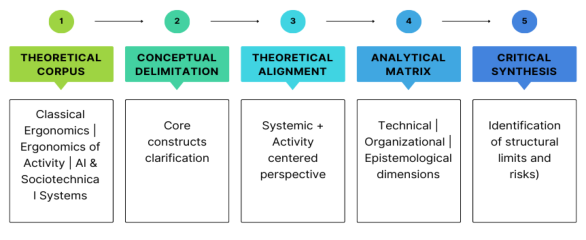
The analytical procedure unfolded in four stages. First, conceptual delimitation was performed to clarify central constructs such as AI in work systems, ergonomic intervention, and real work activity. Second, theoretical alignment was established by articulating systemic ergonomics with the activity-centered perspective, emphasizing variability, situated regulation, and contextual interpretation (Guérin et al., 2001; Falzon, 2014). Third, an analytical matrix was developed to categorize risks into three complementary dimensions: technical-representational limits, organizational and psychophysiological risks, and epistemological implications for ergonomic practice.
Finally, a critical synthesis was conducted to identify structural tensions between algorithmic abstraction and contextual work analysis, relating these tensions to broader debates on human-centered technological integration (European Commission, 2021; Salmon et al., 2021; Grote, 2023).
The analytical procedure adopted in this study is summarized in Figure 1.
Figure 1: Analytical procedure adopted in the study. (Elaborated by the authors, 2026).
This methodological design ensures theoretical transparency, internal coherence, and consistency between the conceptual framework, the limits identified, and the implications discussed in subsequent sections.
LIMITS AND RISKS OF AI USE IN ERGONOMICS The first structural limitation of Artificial Intelligence in ergonomics concerns its representational capacity. Algorithmic systems operate through structured datasets, predefined variables, and statistical pattern recognition. However, as emphasized by Guérin et al. (2001), real work activity cannot be reduced to predefined parameters, since it involves situated regulation, contextual negotiation, and adaptive strategies developed in response to variability.
Falzon (2014) reinforces that activity is interpretative and constructed in action, shaped by constraints that are often invisible to formal models. When AI systems attempt to model work through measurable indicators alone, there is a risk of oversimplification, in which the richness of activity is reduced to quantifiable outputs. This reduction does not merely limit analytical precision; it may distort the very object of ergonomic inquiry by privileging formalized representations over lived work experience.
A second set of risks emerges at the organizational and psychophysiological levels. Moraes and Mont’Alvão (2012) argue that ergonomic analysis must integrate physical, cognitive, and organizational dimensions, especially in technologically complex environments. AI-based monitoring systems frequently introduce continuous data collection and performance tracking mechanisms that may increase cognitive demands and reduce discretionary space for workers.
Within Industry 4.0 environments, digital integration tends to intensify performance measurement and productivity metrics (Xu et al., 2021). Although such mechanisms are often justified as efficiency-enhancing, they may inadvertently contribute to work intensification, surveillance practices, and reduced autonomy. In this context, the incorporation of AI does not simply provide analytical support; it reshapes the conditions under which work is performed and evaluated.
From a sociotechnical perspective, the integration of AI alters decision hierarchies and redistributes responsibility. Salmon et al. (2021) highlight that complex sociotechnical systems require careful coordination between
human and technological components, particularly in safety-critical contexts. When algorithmic systems influence evaluation or risk assessment processes, questions of accountability and transparency become central. Grote (2023) emphasizes that increasing automation introduces new challenges regarding human oversight and decision authority. In ergonomic practice, where professional judgment plays a fundamental role, the perceived objectivity of algorithmic outputs may shift authority away from human experts. This shift can subtly transform the role of the ergonomist from interpreter of activity to validator of system-generated metrics.
Beyond technical and organizational concerns, the most profound limitation lies at the epistemological level. Ergonomics, particularly in its activity-oriented tradition, is grounded in the premise that understanding work requires contextual engagement and interpretative analysis (Guérin et al., 2001; Falzon, 2014). AI systems, by contrast, are built upon abstraction and generalization. While abstraction is necessary for modeling, it becomes problematic when treated as a comprehensive substitute for situated analysis. Karwowski (1996) argues that sociotechnical systems must balance technical performance with human well-being. If AI becomes the primary mediator of ergonomic evaluation, there is a risk that measurable performance indicators will overshadow qualitative dimensions of experience, meaning, and regulation.
Contemporary industrial discourse reinforces the importance of human- centered integration. The European Commission (2021) explicitly frames technological transformation around human well-being, resilience, and sustainability. Leng et al. (2022) similarly discuss emerging industrial paradigms that emphasize collaborative configurations between humans and intelligent systems. However, the existence of human-centered rhetoric does not automatically guarantee human-centered implementation. Without explicit methodological boundaries, AI integration may prioritize operational efficiency over the interpretative foundations of ergonomic analysis. The central risk, therefore, is not the existence of AI itself, but the uncritical assumption that algorithmic modeling can replace or fully represent the complexity of human activity.
Taken together, these limitations reveal that AI use in ergonomics must be carefully delimited. The issue is not whether AI can contribute to data processing or support certain analytical tasks. Rather, the challenge lies in preventing representational reduction, organizational intensification, and epistemological displacement. Maintaining coherence with the foundational principles of ergonomics requires that AI remain a supportive instrument, subordinated to human-centered interpretation and systemic analysis. Only under such conditions can technological innovation coexist with the discipline’s commitment to understanding and transforming real work.
RESULTS AND DISCUSSION
The theoretical analysis conducted in this study demonstrates that the integration of Artificial Intelligence into ergonomic practice must be approached with methodological caution. The limits identified are not incidental or temporary, but structural, emerging from the tension between algorithmic rationality and the foundational principles of ergonomics. While
Limits and Risks of Artificial Intelligence Use in Ergonomics 23 AI systems are effective in processing large volumes of structured data and identifying statistical regularities, the ergonomics of activity emphasizes that work is not merely a set of measurable variables, but a dynamic process shaped by situated regulation and contextual adaptation (Guérin et al., 2001; Falzon, 2014). This tension suggests that AI can complement, but not replace, interpretative analysis.
From a systemic perspective, the findings indicate that AI integration may influence the configuration of sociotechnical systems beyond analytical support. As highlighted by Salmon et al. (2021), technological systems reshape communication flows, coordination mechanisms, and authority structures within organizations. When AI-generated outputs become central references for evaluation, they may subtly redefine performance criteria and decision priorities. Grote (2023) notes that increasing automation often requires redefining human roles in oversight and accountability. In ergonomic contexts, this may translate into a shift from activity-centered evaluation toward metric-centered validation, potentially narrowing the scope of professional judgment.
Organizational implications are equally significant. Xu et al. (2021) describe how Industry 4.0 environments intensify data integration and performance monitoring, often aligning technological development with productivity goals. Although efficiency gains are relevant, Moraes and Mont’Alvão (2012) stress that ergonomic interventions must consider cognitive workload, autonomy, and organizational well-being. AI-mediated monitoring may increase transparency in some respects, but it can also generate continuous evaluative pressure. This pressure may alter workers’ regulatory strategies, influencing how they manage variability and constraints in real work situations.
The discussion also reveals that the risk is not solely technical or organizational, but conceptual. Ergonomics, particularly in its activity- oriented tradition, is grounded in direct engagement with real work situations and the recognition of tacit knowledge, informal adjustments, and contextual negotiation (Guérin et al., 2001; Falzon, 2014). Algorithmic abstraction, by contrast, prioritizes generalization and predictability. When abstraction is treated as equivalent to understanding, there is a danger of epistemological reduction. Karwowski (1996) argues that sociotechnical systems must balance performance optimization with human-centered design principles. If AI becomes the dominant evaluative framework, qualitative dimensions of experience and meaning may be marginalized.
Contemporary policy discourse reinforces the importance of human- centered integration. The European Commission (2021) explicitly frames technological transformation within principles of resilience, sustainability, and human well-being. Leng et al. (2022) describe emerging industrial paradigms that advocate collaborative configurations between humans and intelligent systems. However, the results of this analysis suggest that collaboration cannot be assumed; it must be structured through methodological boundaries. Without explicit safeguards, AI integration may privilege efficiency-driven metrics over contextual interpretation.
Therefore, the central implication of this study is that AI should be positioned as a supportive analytical resource rather than as a substitute for ergonomic reasoning. Maintaining coherence with the discipline’s
foundations requires that algorithmic outputs remain subject to professional interpretation and contextual validation. The challenge lies not in rejecting technological innovation, but in ensuring that its integration does not redefine the analytical core of ergonomics.
A balanced incorporation of AI demands explicit recognition of its representational limits, organizational consequences, and epistemological implications.
CONCLUSION
The incorporation of Artificial Intelligence into ergonomic practice reflects broader transformations occurring within contemporary sociotechnical systems. As digitalization advances and data-driven decision-making becomes more prevalent, AI-based tools are increasingly positioned as instruments capable of enhancing analytical efficiency and standardizing evaluation processes. However, the analysis developed in this paper demonstrates that such integration is not neutral and must be critically examined in light of the foundational principles of ergonomics.
The first major limitation identified concerns the representational capacity of AI systems. While algorithmic models can process structured information and detect statistical patterns, they do not fully capture the situated, adaptive, and interpretative character of real work activity described by the ergonomics of activity (Guérin et al., 2001; Falzon, 2014). Reducing complex work dynamics to quantifiable indicators risks oversimplifying the object of analysis and may obscure critical dimensions of regulation, variability, and tacit knowledge. Consequently, AI outputs should not be interpreted as comprehensive representations of work, but as partial analytical resources.
At the organizational level, the integration of AI may contribute to intensified monitoring, reconfigured accountability structures, and altered professional roles. In Industry 4.0 environments characterized by data integration and performance metrics (Xu et al., 2021), AI systems can reinforce productivity-driven logics. Ergonomics, however, is grounded in balancing system performance with human well-being (Karwowski, 1996; Moraes & Mont’Alvão, 2012). Without explicit safeguards, the incorporation of AI may unintentionally shift evaluative authority away from contextual professional judgment toward algorithmic outputs, thereby narrowing the scope of ergonomic intervention.
The most significant risk identified in this study lies at the epistemological level. Ergonomics, particularly in its activity-oriented tradition, is founded upon interpretative engagement with real work situations and systemic understanding of sociotechnical interactions. If AI-based abstraction is treated as equivalent to contextual analysis, there is a risk of redefining the analytical core of the discipline. Maintaining coherence with human-centered principles, as emphasized in contemporary industrial discourse (European Commission, 2021; Leng et al., 2022), requires explicit methodological boundaries that preserve interpretative authority and systemic perspective.
Limits and Risks of Artificial Intelligence Use in Ergonomics 25 In conclusion, Artificial Intelligence should not be rejected as incompatible with ergonomics, but neither should it be uncritically embraced as a comprehensive solution. Its integration must be guided by clear methodological criteria that recognize representational limits, organizational implications, and epistemological constraints. Only by preserving the centrality of human- centered analysis can ergonomics incorporate technological innovation without compromising its scientific identity and commitment to understanding and transforming real work.
ACKNOWLEDGMENT
The authors are grateful to the CAPES – Coordenação de Apoio ao Aperfeiçoamento de Pessoal de Nível Superior (Coordination for the Improvement of Higher Education Personnel) and FACEPE - Fundação de Amparo a Ciência de Pernambuco (Pernambuco Science and Technology Support Foundation) for sponsoring this study.
REFERENCES
Chapanis, A. (1965). Man–machine engineering. Belmont, CA: Wadsworth. European Commission. (2021). Industry 5.0: Towards a sustainable, human-centric and resilient European industry. Brussels: European Commission. Falzon, P. (2014). Constructive ergonomics. Boca Raton, FL: CRC Press. Grote, G. (2023). Shaping the development and use of artificial intelligence: How
human factors and ergonomics expertise can become more pertinent. Ergonomics, 66(11), 1702–1710. Guérin, F., Laville, A., Daniellou, F., Duraffourg, J., & Kerguelen, A. (2001).
Compreender o trabalho para transformá-lo: A prática da ergonomia. São Paulo: Blucher. Karwowski, W. (1996). The discipline of ergonomics and human factors. In W.
Karwowski (Ed.), International Encyclopedia of Ergonomics and Human Factors. London: Taylor & Francis. Leng, J., Sha, W., Wang, B., Zheng, P., Zhuang, C., Liu, Q., & Wang, L. (2022).
Industry 5.0: Prospect and retrospect. Journal of Manufacturing Systems, 65, 279–295. Moraes, A., & Mont’Alvão, C. (2012). Ergonomia: Conceitos e aplicações. Rio de Janeiro: 2AB. Salmon, P. M., Stanton, N. A., Walker, G. H., & Jenkins, D. P. (2021). Distributed
Situation Awareness: Theory, Measurement and Application to Teamwork. Boca Raton, FL: CRC Press. Xu, X., Lu, Y., Vogel-Heuser, B., & Wang, L. (2021). Industry 4.0 and Industry 5.0 Inception, conception and perception. Journal of Manufacturing Systems, 61, 530–535.
LISTED IN THE AHFE DIGITAL BOOKSTORE CATALOGUE
Explore the complete digital volume
Universal Design and Design for Inclusion
Read this individual research paper free through the original publisher, or explore the full digital proceedings book.
ISBN 978-1-964867-85-4
Explore this ISBN in the AHFE Bookstore ↗Listed in the July 2026 bookstore catalogue; search by ISBN to confirm current availability · Digital book purchase optional