This paper presents a case study and research investigation into how Industrial Design (ID) students’ confidence and interview objectives within user interview processes are correlated with gender. The study examines the design process and outcomes produced in a semester-long senior industrial design studio at the University of Kansas (KU) in which students developed and tested innovative concepts for men’s and women’s lacrosse protective equipment. The mixture of gender demographics amongst the class and lacrosse players provided a unique opportunity to observe how male and female interviewers perceive user research and their primary interview objectives. Throughout the product development process, user interviews provide crucial strategic insights to the user’s needs and preferences - this in turn provides an outline for the designer to refer to when making design decisions, ensuring that the product remains aligned with the core needs of the user. Therefore, it is important to understand how students learn and perceive user interview processes to produce designers who possess the ability to conduct user interviews and drive product development with the focus and design intent of the user’s core needs. The influence that confidence plays on students' and professionals’ perceptions of their own worth and skill has been established in previous research (Mastrella et al. 2023) However, the lens of how gender in ID affects this confidence and subsequent implications has not yet been cross examined with the ID user interview process to see how gender as a variable affects the learning and development of ID students’ user interview skillsets.
The Industrial design process leverages insights and feedback derived from user interviews to define the initial design intent by identifying what problems are worth solving within the product market. Throughout the design process, user interviews are also essential for design validation, ensuring that the product’s functions and features serve as a solution for their targeted needs. When applying to jobs, women have been proven to be more reserved than men when pursuing and submitting applications for roles. This is a fear specifically of not qualifying for every required skill, a self-confidence that ultimately deters more women than men away from the application
process (Mohr, 2014). The larger effects of confidence and self-assurance in skill and self-worth have been proven to have significant impacts on perceived professional performance, especially within the luxe price category. Therefore, we understand that how interviewers perceive themselves before entering the interview can strongly influence the insights they derive, in turn affecting the design decision-making process.
The quality of user insights derived from interviews is also highly dependent on the style of the interview. It is therefore important in an interview style to attempt to make the interviewee feel comfortable enough to be honest and vulnerable, even as it means adjusting approach, tone, question style, etc (Garbarski et al., 2016).
The study of research methods (meta research) has revealed the impact that interview structure and dynamics have on the quality of insights derived (Loannidis, 2018), providing an opportunity to extend the interview lens to ensure the highest quality of insights, user needs, and their end products that we can achieve. This study seeks to understand how gender influences the overall perception of user interviews, as well as the intentions interviewers enter interviews with.
RESEARCH METHODS This study used a mixed-methods approach to investigate design students’ perception of the user interview process, especially in how confidence and core goals are affected by variables like gender.
The quantitative data was gathered through a survey administered to the class of 6 men and 4 women (n = 10). The survey consisted of a broad examination of the interviewers’ (design students) and interviewees’ (lacrosse players) perceptions of the user interview process in a series of 5 questions + 11 questions that were duplicated by how many interviews the respondent participated in (1 – 5). This essay will narrow its focus to the subset of questions (3 total) that inquired about the interviewer’s personal confidence and priorities when approaching user interviews, as it relates to this meta research examination of interview processes.
The qualitative data was gathered through semi-structured interviews of an equal number of 3 men and 3 women from the same class. Each interviewee was consistently asked the same 4 questions regarding interview goals, apprehensions, insights, and gender dynamics; follow-up and clarifying questions were additionally asked per interview.
Because of the small sample size of this case study, any correlations found between gender and data found would need further exploration to define a consistent pattern beyond this initial case study observation.
Research Results The quantitative survey results, questions 1, 2, & 3, are as follows:
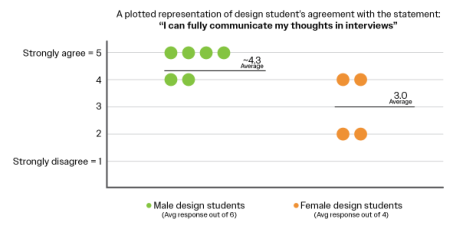
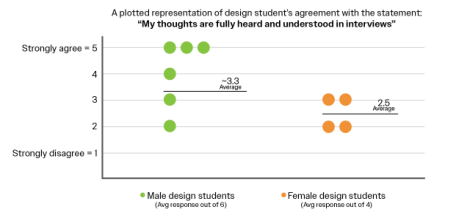
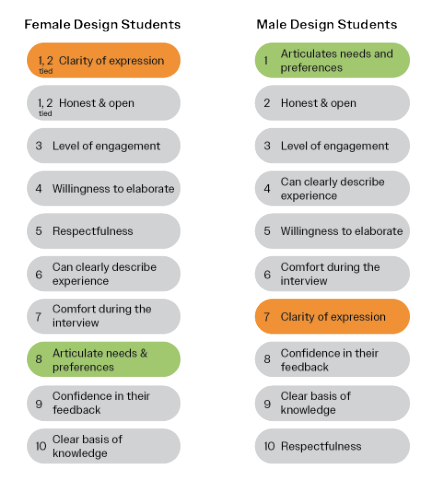
Figure 1: Plot of interviewer confidence levels in their communication ability Male and female design students’ rating a question on a Likert-scale on confidence within the interview process.Figure 2: Plot of interviewer confidence levels in being understood in interviews Male and female design students’ rating a question on a Likert-scale on confidence within the interview process.Figure 3: Priority list of interview qualities Responses from male and female interviewers were averaged and reordered from most (1) to least (10) important.
The qualitative interview results of 3 female ID students & 3 male ID students from this same class are as follows:
Table 1: List of qualitative questions and answers Male and female design students’ responses to a list of 4 questions.
Table available in the original PDF paper.
Q1: What are your main goals when you go into an interview?
Women:
Men: “To make the person comfortable before asking questions.” “To create a friendly vibe” “to try and get rid of my biases” “I want to get them on a ramble” “Broad strokes to learn about their preferences” “To learn more about the topic that they are an expert on” “to be neutral” “I want them to go down rabbit holes”
Q2: Is there anything about interviews that makes you feel apprehensive?
Women:
Men: “Them hating the design and walking away with nothing” “I am nervous to talk to them, or to ask for too much from people” “Not being able to fulfil everyone’s desires, wants, or opinions” “initiating” “finding the right people to talk to” “them thinking I don’t know what I am talking about and feeling dumb” “When you are towards the end and you show them something that they hate” “I am nervous they won’t take me or the interview seriously – I am always surprised when they do”
Q3: How do you gauge a valuable user insight?
Women:
Men: “When the interviewee and I are getting really excited about something together” “I use their initial reaction and body language to “I give more value to interviews where they are enthusiastic and excited about what we are talking about” “when you hear something completely unexpected”
Q4: Have you ever noticed gender as a variable in the interview process?
Women:
Men: “I don’t think so, but maybe I just wasn’t aware of it” “I am not sure” “not that I noticed” “When we would be talking one-on-one, everything was fine. But if a guy walked up to also interview, I felt like I couldn’t compete anymore.” “I felt like they already assumed that I didn’t know anything about sports” “they were always more interested in what the boys had to say”
DISCUSSION
The quantitative data found from the survey relates strongly to the qualitative data found from the semi-structured interviews. According to the data shown in Figure 1, women rate themselves on average as 26% less confident than men that they can communicate their own thoughts in interviews. Additionally, the range of responses for women was 2 (disagree) - 4 (agree), whereas the range of responses for men was 4 (agree) - 5 (strongly
Industrial Design Student User Interviews: Confidence, Objectives, & Gender 15 agree). These data points correlate with the insights of the interviews, as the women expressed more apprehensions about initiating interviews and being perceived as ill-prepared or not “smart” in the interview. However, the men interviewed expressed that they do not feel much apprehension about user interviews. According to data shown in Figure 2, women rate themselves as 16% less confident on average than men that their thoughts will be fully heard and understood in interviews. Additionally, the range of responses for the women was 2 (agree) - 3 (neutral), and the men’s range of responses was from 2 (agree) - 5 (strongly agree). This correlates with the insight from the women’s interviews that they felt when they were one- on-one with an interviewee, they were the primary contact; however, if a male interviewer stepped into the conversation beside them, they felt that they no longer held a primary role, and that they and their questions took on a secondary role. When the women and men were asked to prioritize a list of user interview priorities, a large majority of the qualities aligned; however, 2 qualities had a standout divergence from each other across the gender line. While the women, on average, ranked “clarity of expression” from an interviewee as the top 1 most important quality, the men ranked this same quality as 7th on the list of 10. In a similar divergence, the men on average ranked “articulates needs & preferences” from an interviewee as the top 1 most important quality, whereas the women ranked this same quality as 8th out of the 10. All the listed priorities on the list are worthy qualities to maintain in user interviews - however, the priority order reveals an interesting difference in driving objectives. The “clarity of expression” prioritized by the female design students focuses on the “how” of the user interview, and the “articulates needs & preferences” prioritized by the male design students focuses on the “what.” The priority difference between these interview objectives creates an inconsistency in overall approach to the user interview and therefore may influence incongruent outcomes. Further research would need to be done to understand what these design outcomes may be, and in what ways they differ if at all.
CONCLUSION
Based on this data, a large divide is drawn between self-confidence and, therefore, willingness to pursue user interviews, leading some female students to not participate in user interviews altogether when the choice is presented. The data also identified a difference in main goals between the male and female design students, with the men prioritizing articulating and direct needs more, and the women prioritizing clearly expressed experiences. Both characteristics are important in conducting user interviews, as they balance each other greatly. A distinguishable difference in how the gender of the students determines their priorities and main goals in user interviews shows an opportunity to provide clear and aligned instruction on user interview goals to yield consistent interviews and consistent results. Meanwhile, a difference of 26% and 16% in relative confidence levels approaching user interviews based on gender poses a concern that fewer women in ID will feel comfortable performing interviews, creating disproportion in representation when gathering insights from different groups of people. Because user
interviews for students and professionals alike are also such a crucial part of the process for product success & portfolio building, a distinguishable difference in user interview participation based on gender could pose consequences to the process’s thoroughness and hiring ability.
This research creates an opportunity to explore the implications of the findings of this case study further in more controlled environments, creating a foundation to explore concepts like:
- Simulate user interviews to assess interview/interviewee dynamics with different gender arrangements - Expand study scope to interview perspectives and differences in the professional world - Expand study scope to other universities and regions - Draw the connection between user research insights and product user needs success
REFERENCES
Dana Garbarski, Nora Cate Schaeffer, Jennifer Dykema, . (2016). Interviewing Practices, Conversational Practices, and Rapport: Responsiveness and Engagement in the Standardized Survey Interview https://pmc.ncbi.nlm.nih.gov/articles/ PMC5110268/ Ioannidis JPA (2018) Meta-research: Why research on research matters. PLoS Biol
16(3): e2005468. https://doi.org/10.1371/journal.pbio.2005468 Lundeberg, M. A., Fox, P. W., & Punćcohaŕ, J. (1994). Highly confident but wrong: Gender differences and similarities in confidence judgments. Journal of Educational Psychology, 86(1), 114–121. https://doi.org/10.1037/0022-0663.86.1.114 Mastrella, S. J., Powell, D. M., Bonaccio, S., & McMurtry, C. M. (2023). The impact
of interviewees’ anxious nonverbal behavior on interview performance ratings. Journal of Personnel Psychology, 22(2), 99–110. https://doi.org/10.1027/1866- 5888/a000319
LISTED IN THE AHFE DIGITAL BOOKSTORE CATALOGUE
Explore the complete digital volume
Universal Design and Design for Inclusion
Read this individual research paper free through the original publisher, or explore the full digital proceedings book.
ISBN 978-1-964867-85-4
Explore this ISBN in the AHFE Bookstore ↗Listed in the July 2026 bookstore catalogue; search by ISBN to confirm current availability · Digital book purchase optional