Betsy Barnhart (2022). Adaptation In 3D Modeling Pedagogy: How Covid-19 upended then improved course outcomes. In: Interdisciplinary Practice in Industrial Design. AHFE Open Access, vol. 48, pp. 53–58. https://doi.org/10.54941/ahfe1002015
Covid-19 thrust Industrial Design education into virtual learning in the spring of 2019, with fully remote or hybrid learning continuing at many institutions throughout the 2020-2021 academic calendar. This paper discusses how meeting the needs of students with various levels of ability in a computer-aided design (CAD) course while fully online unexpectedly created a number of novel approaches for teaching and providing feedback for both in person and remote education. Traditionally in person CAD courses have relied on instructors providing brief tutorials followed by students following textbook assignments or completing CAD projects. Many CAD courses have also been using a flipped classroom model, integrating short video demos the instructor would record for students to watch prior to the in person class. This method is preferred by students over traditional lecture format (Boronyak, 2021). When our CAD course was unexpectedly turned into a fully virtual course, neither of these methods effectively met the needs of students. The class time became disjointed, with just one students question taking over the virtual space, leaving other students frustrated. This paper follows the hypothesis that if students learning complex 3D modeling programs are provided with video tutorials beyond short demos, but have access to videos walking through each chapter when learning new content, followed by similar assignments without instruction, students of all abilities will be able to understand and learn the content, developing stronger CAD skillsets as industrial designers. Therefore, the goal is to explore tools for academia to efficiently teach CAD virtually or in person to a broader set of students, raising the abilities and understanding of all students at their own pace.This paper discusses how over three years two scenarios were explored, teaching CAD fully remotely and then integrating the methods used back into in person learning. When fully remote the instructor created videos working through each chapter assigned prior to each class, with added verbal explanations of the content. Additional assignments were created through CAD drawings reinforcing content from each chapter, but without instruction. In addition, the instructor created video recordings of themselves working through students questions in Solidworks, sending only the recording back to the student so they could follow along at their own pace. These teaching methods were integrated into the curriculum when the course resumed in person learning. The videos made it possible for everyone in the class to progress at their own speed, students could reference the videos when the instructor was helping other students. Students continued to email CAD files to the instructor for projects and were provided a video tutorial of the instructor walking through the CAD and explaining how to solve the issues. At the end of the course students perceptions were evaluated by an anonymous survey. CAD projects completed prior to virtual learning and after the course was restructured were compared, showing an increase in build complexity and understanding. We see this initial investigation within this institution as a model for further investigations at other institutions and professional practice.
Computer Aided Design (CAD) is a core skillset in current industrial design curriculum. Students in industrial design must demonstrate an ability to model complex forms, often organic in shape with compound surfacing to achieve a specific aesthetic, while also meeting manufacturing needs such as material thicknesses, draft, parting lines, etc. and be built parametrically so the designer or others on their team can make adjustments to the CAD file.
Industrial Design CAD courses typically focus on Solidworks for parame- tric building and Keyshot for rendering photo realistic images. These courses are often offered in-person instruction, with instructors providing brief tuto- rials followed by students working in class, following textbook assignments, and completing CAD projects, using the CAD program to build their own
designs. These courses follow similar pedagogy to engineering CAD courses even though industrial design students learn 3D CAD software at a speed slower than their engineering peers learning the same software (Wu, 2009). Many CAD courses have also been using a flipped classroom model, lecture content is moved online, students engage with pre-recorded and voiced over lectures prior to class meetings, which then focus on group work or pro- jects instead of learning skillsets (Zhu, 2016) (Gross & Dinehart, 2016). Students prefer short video demonstrations in flipped classrooms over tra- ditional lecture format as students can reference materials at their own pace or later if needed (Boronyak, 2021). Another version of a flipped classroom is in a fully online environment for project-based engineering design courses, coursework and projects are available online, but all meetings are virtual. Student outcomes were stronger than in person learning, but took more time for students and instructors than a standard in-person course (James-Byrnes & Holdhusen, 2012).
Covid-19 thrust Industrial Design education into virtual learning in the spring of 2019, with fully remote or hybrid learning continuing at many insti- tutions throughout the 2020-2021 academic calendar. This paper discusses how the author updated her coursework to better meet the needs of industrial design students with various levels of ability in a Computer-Aided Design (CAD) course prior to Covid-19. Then shifted direction dramatically while classes moved fully online, creating several approaches for teaching CAD to industrial design students. After returning to in–person learning she integra- ted aspects of virtual learning back into the classroom. This paper reviews the exploration and shift in pedagogy over a four-year period, the author revie- wed course outcomes and compared them to the prior traditional in-person course and conducted student interviews. The goal is to explore tools for academia to efficiently teach CAD virtually or in person to a broader set of students, raising the abilities and understanding of all students at their own pace.
COURSE RESTRUCTURING TO ENSURE HIGHER LEARNING OUTCOMES OF ALL STUDENTS The University of Kansas 3 credit INDD 350 Computer Aided Design course is mandatory for 3rd year industrial design students. The course met two days a week for 2.5 hours with learning focused on parametric building in Solidworks and photorealistic rendering in Keyshot. Over a four-year period different methods of instruction were explored, at first questioning creative problem solving while learning Solidworks and then best utilizing online resources for instruction off site. Initially students with an engine- ering background learned content at a higher rate and showed a stronger level of understanding with the initial in-person course setup, most introdu- ctory Solidworks textbooks feature coursework aimed at meeting the needs of engineering students and less towards industrial design student learning needs. The instructor investigated methods to increase comprehension of Solidworks for industrial design students.
Adaptation in 3D Modeling Pedagogy: How Covid-19 Upended 55
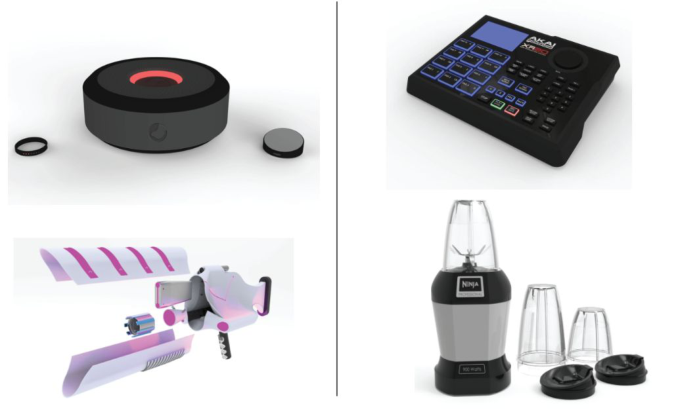
Figure 1: Students’ Solidworks builds of their own designs on left. (2018), Solidworks existing product rebuilds on right (2019).
Methods
The Computer Aided Design course was held in person following more tra- ditional in person teaching methods. The instructor would give a short, live demo on the topic being taught that class period. Students followed textbook assignments in class asking questions and having the instructor or a TA assist in answering. The instructors were often busy with other students, so they would ask peers or wait for the instructor to become available. In addition to textbook learning students had three creative design projects throughout the semester in which they created and built their own product in Solidworks (See Figure 1).
The engineering students and a small portion of the industrial design were successful; however, most students were not able to build parametric, complex products with compound surfaces that met manufacturing speci- fications. After assessing the Solidworks models the students did not build for manufacturing, there were no fasteners, scale and proportions were not appropriate for the product, there was little thought to draft or parting lines, and there were errors in surfacing. When students built to their own design, they did not meet the Solidworks expectations of manufacturing or of current trends in product design. The following year the students were instructed to rebuild an existing product exactly, exploring the hypothesis that students were building to their skillset, not learning how to build according to real product needs. The outcomes for the final project replicating the product were stronger than the prior course. Students built more complex surfaces, draft, and parts were built for manufacturing. However, many students con- tinued to struggle learning Solidworks and they were unable to replicate their existing product.
56 Barnhart
Online: An Unexpected Resource Between the 2019 and 2020 course the author restructured the coursework to better meet the needs of industrial design students, focusing content on lofts, sweeps, and surfacing details to better meet the needs of industrial design forms and products currently in production. The coursework was pul- led from three separate textbooks instead of just following one so form driven exercises would be the focus, students would also have no creative projects, only rebuilds of existing products to enforce coursework at key points in the semester. Students built a replica of a multi-part, hand tool to enforce solid building, a shaving razor with organic form and over-mold for lofts, sweeps, and surfacing, and a final project replicating a multi-body product. However, because of Covid-19 the course was unexpectedly taught online. It became immediately clear that the author was unable to assist multiple students who needed help working through textbook assignments and students didn’t have a neighbor to get assistance from, creating confusion and frustration.
The author began creating a flipped classroom experience, providing pre- recorded short demos related to but not the exact assignment; however, students still were unable to work through chapter assignments without more help than we were able to provide online. The author then created detailed videos working through each textbook assignment with narration explai- ning why each step or tool was used. These videos were made available at the beginning of each class and students no longer were frustrated or confu- sed. The majority of students were able to follow along with the videos and were able to work independently during class time or outside of class, while students who were struggling now had more time to work with the TA or the instructor. The overall learning outcomes were much stronger and were represented in the independent projects replicating existing products.
Another finding while remote was a shift in how troubleshooting build issues was handled. When the students could not solve a problem for their independent projects, they emailed the instructor their Solidworks file, and the instructor created a detailed and narrated video of herself working through the Solidworks problem. Only the video was made available to the student, not the edited CAD file, these videos were accessible to the entire class if others had related questions. Prior to online learning, the instructor or TA would work through the problem in front of the student on their com- puter explaining the process, then delete the work the instructor had done, or save the CAD as a separate file for the student to reference and have the stu- dent try and recreate the solution. However, if the student was still confused, they struggled to understand how to solve the problem. The narrated videos working through independent project questions increased students’ confide- nce in the program, they saw and heard how the instructor worked through the issue and could re-watch the instruction as many times as needed until they were able to resolve the issue as well.
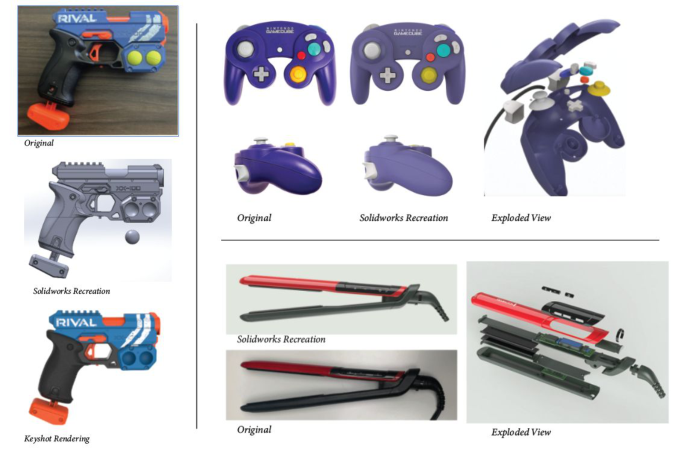
Overall student outcomes were stronger than the instructor expected. Stu- dents showed an ability to build complex forms in Solidworks, including compound surfaces. Students demonstrated the ability to build for manufa- cturing that had not been exhibited in prior courses. This included correct
Adaptation in 3D Modeling Pedagogy: How Covid-19 Upended 57
Figure 2: Students’ Solidworks replica builds of existing products on left (2020), Solidworks replica builds of existing products on right (2021).
and consistent material thicknesses, appropriate use of draft and an under- standing of parting lines, dimensions were correct and drawings were fully defined. The students were able to accurately recreate complex products (See Figure 2).
A Return to In-Person Learning Courses returned to in-person learning for the Fall of 2021, but many aspects of the prior online experience were brought into the in-person classroom. A flipped model was added to the coursework, Solid Professor videos were assi- gned prior to each class starting, with instruction to watch the videos before beginning in-class work. Students continued to use the narrated video tutori- als of each chapter assignment; however, additional assignments were created which closely resembled the content covered in the chapter assignment. Only CAD drawings were provided for the additional assignment, but they ensured students were able to independently work through the skillsets covered. Three Solidworks rebuild projects were still assigned. When interviewed, students felt they could build most concepts they designed in their 3rd year industrial design studio or rebuild most existing products. Course outcomes for stu- dents of all backgrounds were strong with this new curriculum and mode of teaching.
CONCLUSION
This study was conducted to understand how classroom format affected lear- ning outcomes for an industrial design CAD course, specifically Solidworks modeling. The author understood that traditional methods of teaching Solidworks was only meeting the needs of a few students in the class, leaving
58 Barnhart
a majority of industrial design students not understanding the fundamentals of parametric modeling, building for manufacturing, or using best modelling strategies and planning. Students struggled learning complex surfacing work, critical to industrial design CAD modeling.
Overall, the new course was time intensive for the instructor. Creating descriptive videos for each assignment took a high level of effort and would not have been initiated without the unexpected turn of events during Covid 19 and moving the class online for the entire 2020 Fall Semester. However, the learning outcomes were much stronger than in person learning with the course structured with students following the textbook without instruction. The following year was also time intensive for the instructor. The class moved back to in-person learning with continued use of the prior year’s textbook videos, but added coursework re-iterating most textbook assignments, with as needed video walkthroughs of CAD questions, and projects replicating three existing products. This was a high level of work needed by the instru- ctor, however the coursework exceeded expectations in learning outcomes, with industrial design and engineering students both learning Solidworks at the same rate and capacity.
The author believes combining all aspects of the new hybrid-flipped model was critical to the success of the coursework. Watching Solid Professor videos prior to the start of class with access to the textbook videos made the stu- dents better understand the content and understand why they were using certain tools or features. The instructor added projects re-iterating the text- book without any instruction reinforces the prior textbook instruction and forces the students to problem solve using the same methods independently of a textbook or video. Although initial effort for the instructor to implement these course elements is high, the content can be re-used each time the course is taught and as the instructor has more available time during the class period since most students are able to understand questions by watching the video tutorials, the instructor is able to spend more time with students who are struggling, allowing for greater student success.
REFERENCES
Boronyak, A. (2021), “Student Feedback on Best Practices for Flipped Classroom Courses in a First-year CAD Course” ASEE Virtual Annual Conference Content Access. Virtual Conference. https://peer.asee.org/37743 Gross, S. P., & Dinehart, D. W. (2016). “Pre- and post-class student viewing behaviors
for recorded videos in an inverted sophomore mechanics course.” ASEE Annual Conference Proceedings. New Orleans, LA. James-Byrnes, C. R., & Holdhusen, M. H. (2012), Online Delivery of a Projectbased Introductory Engineering Course Paper presented at 2012 ASEE Annual Conference & Exposition, San Antonio, Texas. Wu, J. (2009). A Study of the Learning Models Employed by Industrial Design Stu-
dents When Learning to Use 3D Computer-Aided Design (CAD) Software. Int’l. J.Arts Education, retrieved from ed.arte.gov.tw Feb. 15, 2014. Zhu, H. (2016). A flipped solid mechanics course designed based on the interactive, constructive, active, and passive (ICAP) framework. ASEE Annual Conference Proceedings. New Orleans, LA.
LISTED IN THE AHFE DIGITAL BOOKSTORE CATALOGUE
Explore the complete digital volume
Interdisciplinary Practice in Industrial Design
Read this individual research paper free through the original publisher, or explore the full digital proceedings book.
ISBN 978-1-958651-24-7
Explore this ISBN in the AHFE Bookstore ↗Listed in the July 2026 bookstore catalogue; search by ISBN to confirm current availability · Digital book purchase optional