Susan Sokolowski, Nicole Demby, Ezra Ende, Chrissy Bettencourt (2022). Understanding Footwear Traction Performance to Reduce the Risk of Outdoor Falls and Improve Mobility for the Aging Population. In: Interdisciplinary Practice in Industrial Design. AHFE Open Access, vol. 48, pp. 100–107. https://doi.org/10.54941/ahfe1002021
Knowing that healthy aging lifestyles are connected to mobility and independence, the researchers wanted to examine how industrial design could be utilized to support this demographic. This research examined the traction performance of key footwear styles, to make recommendations on how to improve outsole design, to reduce the risk of outdoor falling. Falls are the leading cause of death and disability for the aging population. A footwear traction test method adapted from ASTM F2333-04 was used to collect data from six footwear styles with four common outdoor walking surfaces (wet and dry) and foot contact directions (normal and shuffle). The data determined that although the footwear tested were marketed for traction and safety, they greatly decreased performance in wet conditions and performed inconsistently across all flooring surfaces and outsole contact directions. Results from the work determined that better care with outsole design could improve footwear performance for aging users and potentially reduce the risk of injury for this growing demographic.
Outdoor Falling Twenty-five percent of Americans over the age of 65 are treated in Emergency Rooms (ER) each year for falling, and approximately half of those falls occur- red outdoors (Aging.com, n.d.; Nyman, Ballinger, Phillips & Newton, 2013). Despite the serious nature of falling for aging adults, most of the research published only looks at indoor falls (Nyman, Ballinger, Phillips & Newton, 2013). One of the risk factors contributing to outdoor falls is poorly functi- oning footwear (Centers for Disease Control and Prevention, 2017). There is an opportunity to learn how footwear traction design could be more effective for outdoor walking surface environments.
Common Outdoor Walking Surfaces Through reviewing the literature regarding outdoor falls, four walking surfa- ces were selected to study (Chippendale & Raveis, 2017; Nyman, Ballinger,
Understanding Footwear Traction Performance to Reduce the Risk of Outdoor Falls 101
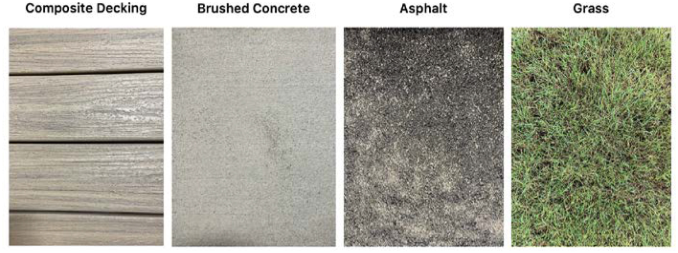
Phillips & Newton, 2013; Li, Keegan, Sternfeld, Sidney, Quesenberry Jr, & Kelsey, 2006). They included composite decking, brushed concrete, asphalt and grass. Photos representing the surfaces are presented in Figure 1. For testing purposes, jigs containing each of the outdoor surfaces were created.
Figure 1: Typical outdoor walking surfaces.
Recommended and Popular Footwear for Aging Users Six commercial footwear products were identified through internet research to benefit active aging users who desire durability, ease-of-use, slip-resistance, and comfort. They included the Rockport Let’s Walk Mary Jane, New Bala- nce 577 V1, Saucony ProGrid Integrity, Sketchers Go Walk 4 Pursuit, Crocs Classic Clog and Adidas Adilette Comfort Slide (Table 1).
Table 1. Footwear products recommended for aging users.
Table available in the original PDF paper.
By defining the outdoor walking surfaces and footwear products, the rese- archers were able to conduct a study to learn about traction performance, to make better footwear outsole design recommendations to reduce the risk of outdoor falls and enable healthy mobility.
METHOD
Study Goals and Variables To understand the traction performance characteristics of the six footwear styles, several variables were considered. Independent variables included the identified footwear samples, the four outdoor walking surfaces (e.g., com- posite decking, brushed concrete, asphalt, grass), environmental conditions (e.g., wet/dry) and direction of outsole contact (e.g., straight/angled). The straight direction of outsole contact replicated a shuffled foot strike, where the user’s foot would contact the floor through the center front of the out- sole. The angled contact replicated toe-off through a normal walking/jogging foot strike pattern. The dependent variable was the amount of force requi- red to pull each footwear sample across each outdoor surface/environmental condition/direction in Newtons, as collected with a strain gauge. Traction per- formance measured by the amount of force it took to pull each sample across each of the flooring conditions and outsole contact direction. The higher the force recorded, the better the traction performance.
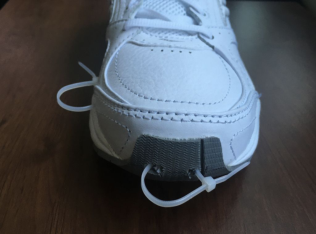
Footwear Sample Preparation Each of the six footwear samples were prepared by cutting two 3x3mm holes, evenly spaced 15mm apart, 35mm up from the floor, into the toe region of the sample – for the shuffled foot strike (straight outsole direction) traction testing,. Through the two holes, a zip tie was threaded and secured to create a loop so the strain gauge could be attached. For the normal foot strike (angled outsole direction) testing, each of the footwear samples were prepared by cutting two 3x3mm holes on its’ medial side, spaced 15mm apart, 55mm from the toe and 35mm up from the floor. A second zip tie was threaded through those two holes and secured to create a loop for the stain gauge to be inserted. Figure 3 demonstrates how the footwear samples were prepared.
Figure 3: Footwear sample preparation.
Understanding Footwear Traction Performance to Reduce the Risk of Outdoor Falls 103
Four uniform weights were also placed inside of each footwear sample, weighing 963g. The weights were used to keep the footwear samples from losing contact with the outdoor surfaces during testing.
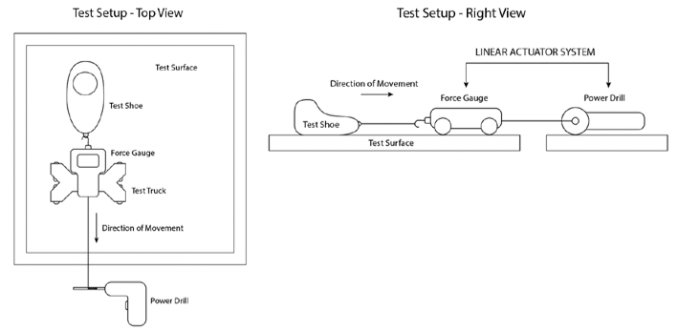
DATA COLLECTION PROCEDURE Once prepared, the footwear samples were individually placed on each of the four outdoor surfaces and attached to the strain gauge with the zip tie (for each contact direction), for data collection. The strain guage method (Figure 4) was adapted from ASTM F2333-04 (Traction Characteristics of the Athletic Shoe-Sports Surface Interface) to measure relative traction (ASTM, 1990). This method allowed for a cost-effective, student-led ver- sion of the linear traction test without the need for expensive tools. The test method utilized a power drill that wound a cord at a constant speed to drag each footwear sample across the various flooring surfaces. Attached to the cord between the drill and footwear samples was a strain gauge which collected the peak force required to drag each shoe across each surface. This method of traction testing is a method of analyzing the relative traction betw- een each footwear sample and does not create values that stand on their own.
Figure 4: Data collection method set-up.
Data for dry conditions were collected first and then the surfaces were prepped for wet conditions by spraying them with water. For each foot con- tact direction/surface condition, three peak force measures (in Newtons) were collected and averaged.
RESULTS
From the averaged data collected, bar charts were made to compare results for each footwear sample, outdoor surface type and foot contact direction.
Composite Decking Observations The two athletic shoes (New Balance and Saucony) performed best traction- wise on composite decking compared to the other footwear samples, for all conditions (Table 2). All footwear samples but the Adidas slide tested better in dry conditions than wet. The Adidas slide tested the same in all conditions and had the least amount traction overall.
Table 2. Traction results (in Newtons) for composite decking.
Table available in the original PDF paper.
Brushed Concrete Observations The New Balance and Rockport shoes performed best on the dry brushed concrete surface (shuffle and normal foot contact directions), requiring the most force to pull them across the surface (Table 3). In wet conditions (shuffle and normal foot contact directions), the Saucony shoe performed best. The Adidas slide performed the worst overall (in all test conditions). Compared to the composite decking tests, all shoes had more traction on the brushed concrete.
Table 3. Traction results (in Newtons) for brushed concrete.
Table available in the original PDF paper.
Understanding Footwear Traction Performance to Reduce the Risk of Outdoor Falls 105
Asphalt Observations The Rockport and New Balance shoes demonstrated to have the most tra- ction on dry asphalt, in the shuffled foot contact direction (Table 4). The Saucony, New Balance and Rockport shoes tested relatively the same in dry, straight conditions. Shoes on all wet asphalt surfaces tested inferior to the dry surfaces, and the Adidas slide tested the worse overall.
Table 4. Traction results (in Newtons) for asphalt.
Table available in the original PDF paper.
Grass Observations On grass, the most unique results were observed – where almost all the shoes tested, had higher relative traction values on wet surfaces, compared to dry (Table 5). Like the other surfaces evaluated, the Adidas slide tested the worse overall.
Table 5. Traction results (in Newtons) for grass.
Table available in the original PDF paper.
DISCUSSION
Findings Through identifying walking surfaces and footwear products, researchers were able to understand relative traction performance, to make footwear outsole design recommendations to reduce the risk of outdoor falls. The first finding was that none of the footwear styles evaluated performed well on any of the wet surfaces tested, except for grass. It is hypothesized that because the grass sample had long blades, additional traction was provided when wet. This finding could be confusing for aging users, as all the other surfaces were more slippery when wet, and when transferring between walking surfa- ces (e.g., going from grass to concrete) an accident could happen because of the extreme performance differences and proprioceptive feedback. Footwear outsole designs that had traction patterns that avoided trapping water and had lugs that stood-off from the outsole web, performed better overall (e.g., New Balance, Rockport, Saucony). No matter the surface and foot contact direction, the Adidas slide performed the worse. This is likely due to its’ flat and undefined outsole design.
Limitations and Future Research There were several limitations to this study. Since only six footwear samples were tested, others could have been evaluated, with different relative traction results. Although the outdoor walking surfaces were based upon research conducted by Chippendale et al. (2017) Nyman et al. (2013) and Li et al. (2006), other surfaces could have been used, such as recycled rubber, bark dust, and natural wood decking. The student-led testing set-up had limitati- ons too, where the strain gauge was modified with a dolly to insure pulling consistency. A more sophisticated tool could have been built - including an articulated foot, or the testing could have been completely outsourced to a lab that runs ASTM tests, however the purpose of the research was for students to learn how to devise a simple footwear traction test and collect relevant test data to understand new design parameters. Lastly, human wear tests could have also been involved, but limitations due to the pandemic made that impossible at the time of the research.
In the future the findings could be used to design more functional footwear outsole patterns that interface better with outdoor walking surfaces. From those designs, they could be re-tested using the method outlined in the study to determine relative functionality. Human wear tests could also be involved to compare to the mechanical testing results. Together, this work could help reduce the risk of outdoor fall injuries for this growing demographic.
ACKNOWLEDGEMENT
This research was funded through the 2019-2020 University of Oregon Col- lege of Design Tinker Hatfield Innovation Award - Design for Healthy Aging project. Surface test samples were prepared by University of Oregon student Jake Brawner.
Understanding Footwear Traction Performance to Reduce the Risk of Outdoor Falls 107
REFERENCES
Aging.com. (n.d.). Fact sheet: Falls – the biggest threat to senior health and safety.
Website: https://aging.com/falls-fact-sheet/ American Society for Testing and Materials (ASTM). (1990). Standard test method for traction characteristics of the athletic shoe-sports surface interface: F2333-04. Annual Book of ASTM Standards, 1412–1420. Centers For Disease Control and Prevention. (2017). Important Facts About Falls.
Website: https://www.cdc.gov/homeandrecreationalsafety/falls/adultfalls.html Chippendale, T., Raveis, V. (2017). Knowledge, behavioral practices, and experiences of outdoor fallers: Implications for prevention programs. Archives of gerontology and geriatrics, 72, 19–24. Li, W., Keegan, T. H., Sternfeld, B., Sidney, S., Quesenberry Jr, C. P., Kelsey, J. L.
(2006). Outdoor falls among middle-aged and older adults: a neglected public health problem. American journal of public health, 96(7), 1192–1200. Nyman, S. R., Ballinger, C., Phillips, J. E., Newton, R. (2013). Characteristics of outdoor falls among older people: a qualitative study. BMC geriatrics, 13(1), 1–14.
LISTED IN THE AHFE DIGITAL BOOKSTORE CATALOGUE
Explore the complete digital volume
Interdisciplinary Practice in Industrial Design
Read this individual research paper free through the original publisher, or explore the full digital proceedings book.
ISBN 978-1-958651-24-7
Explore this ISBN in the AHFE Bookstore ↗Listed in the July 2026 bookstore catalogue; search by ISBN to confirm current availability · Digital book purchase optional