Ahmed Baruwa, Susan Sokolowski, Jacob Searcy, Daniel Lowd (2023). Machine Learning to Define Anthropometric Landmarks for Relevant Product Design 2D Blueprint Measures. In: Interdisciplinary Practice in Industrial Design. AHFE Open Access, vol. 100, pp. 1–6. https://doi.org/10.54941/ahfe1002965
Functional designers use 3D body scan measurements to create 2D pattern blueprints, to develop products that size and fit bodies appropriately - to enable safety, comfort, and activity-related performance. To gather measures, surface anthropometric landmarks are critical, to enable accuracy and consistency between scans. However, many 3D scan databases do not include data with anthropometric landmarks, making bodies challenging to measure. Therefore, the purpose of this research was to develop a machine learning (ML) model for the automatic landmarking of 3D body scans from raw point clouds. A deep neural network model was developed, using the Civilian American and European Surface Anthropometry Resource (CAESAR) scan dataset (2002) for training. The model enabled 3D scans from any device that outputs in color to be used for landmark automation. Results of this work have also demonstrated that ML landmarking can enable bulk processing of 3D body scan point cloud data more efficiently compared to traditional manual landmarking methods.
The functional design of products worn on the human body is based upon a careful melding of science and art (Watkins and Dunne, 2015). Functional products can include footwear, apparel, and equipment – for users that parti- cipate in a wide variety of activities, including athletics, firefighting, military, and space operations, safety and healthcare. Fit of these products is criti- cal, where poor fit can affect performance, comfort, and safety. To enable a good fit, specific anthropometric measures that are derived from anthropo- metric landmarks are needed from the body to develop accurate 2D product blueprints.
Anthropometric landmarks are anatomical locations on the surface of the body that can found on any body type, size, or shape to help derive anthro- pometric measures (ISO, 2017). However, a large majority of anthropometric 3D scan databases do not include relevant landmarks needed to collect measures, to draft accurate 2D blueprints for functional products. Without appropriate landmarks, product designers and developers are approximating
measures, developing products that do not fit or are spending hundreds of hours re-landmarking 3D scans to their best ability to acquire appropriate measures. Therefore, purpose of this research was to develop a machine lear- ning (ML) model for the automatic landmarking of 3D body scans from raw point clouds, to derive better body measures for the drafting of relevant 2D blueprints to improve product fit, performance, safety, and comfort.
BACKGROUND
ML gives computers the ability to recognize patterns in data and translate them to inferential knowledge without being explicitly programmed (Samuel, 1959). ML has seen widespread success in diverse domains such as medical surgery (Nguyen et al., 2020), speech recognition (Baevski et al., 2020), and self-playing agents (Silver, 2016). ML continues to show promise in applica- tions that require automatic landmarking on the human body, where several studies have demonstrated its’ capabilities for the task. Pinte, Fleury and Maurel (2021) used a ML model to localize electrode positions from Magne- tic Resonance Imaging (MRI) scans by pre-training it on Ultrashort Echo time (UTE) sequences of MRI images. Hargreaves et al. (2003) performed forensic facial reconstruction on fossil bones using a generative deep learning algori- thm trained on a limited amount of learning data. Grishchenko et al. (2022) created “BlazePose GHUM Holistic,” a lightweight neural network pipeline for estimating 3D landmarks from monocular images. Giachetti et al. (2014) organized a point-localization contest for automatic landmarking on body scans, however, their method used hand engineered features and a small data set. In this work, we used ML to automatically identify 3D coordinates of lan- dmarks in point cloud data from 5000 3D body scans from the 2002 Civilian American and European Surface Anthropometry Resource (CAESAR) data- base. This was done by training a deep neural network on the large database of scans, where useful features were extracted from the data and mapped to landmark locations that can be referenced for anthropometric measurements.
METHODOLOGY
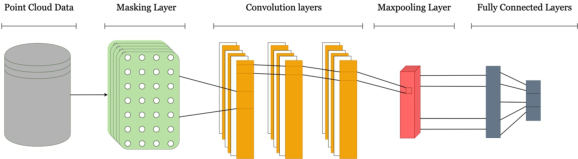
PointNet (Qi et al., 2016) and VoxNet (Maturana and Scherer, 2015) are examples of ML methods developed for point cloud analysis. We utilized a simple convolutional neural network with smaller number of parameters making it memory efficient for learning from large point clouds. This model was a multi-layered, schematically shown in Figure 1. During training, the
Figure 1: Model architecture.
Machine Learning to Define Anthropometric Landmarks 3
input to the neural network was a batch of 3D body scan point clouds, where one of the pre-processing steps was to normalize the point cloud coordina- tes to meters, as the CAESAR data had mixed metric scales. We padded the point clouds to a uniform dimension of 200000×3 and passed the point cloud tensor through a masking layer to inform the network of the padded locati- ons. The tensor was next passed through a stack of 1D convolution layers, where each convolution used 128 (1x1) filters. The stack of convolution was then followed by a global max-pooling layer to aggregate point features and reduce the tensor to a single dimension. The resulting tensor was followed by two fully connected (FC) layers. The first FC layer had 512 channels; the second had three channels. All hidden layers were equipped with Leaky- ReLU non-linearity. The training was done by optimizing the mean squared error (MSE) objective between predicted and ground truth landmarks using Adam at a learning rate of 1e-3. Training was done over 100 epochs and took 2-hours to reach convergence. Implementation was done with TensorFlow (Abadi et al., 2016) on a 32GB NVIDIA Tesla V100 GPU.
Table 1. Landmark body categories and landmark labels of the CAESAR database.
The CAESAR 3D body scan database is large with semantic landmark infor- mation. The database consists of scans of both sexes in three postures 1) standing (A-pose), 2) seated comfortable working (B-pose), and 3) seated coverage (B-pose). The 3D scans were stored as 3D point clouds, where each scan contained about 200K vertices per scan. We split the entire CAESAR dataset into a 7K training set and 2K samples for validation. There was a total of 100 landmarks in CAESAR, we selected 74 landmarks that have at least 10 samples in the entire dataset and trained a model for each of them.
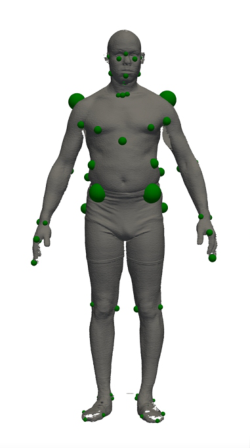
We divided the landmarks into five mutually exclusive body categories described in Table 1. The average MSE per body category is shown in Table 2. Our model performed well on all body categories, achieving an MSE smaller than 1.83 cm, except for the crotch category which is known in the anthro- pometry field to be difficult to approximate. These errors were also described pictorially and specifically in Figure 2, where the size of the green sphere is proportional to the average radial deviation of the measurements made by
Table 2. Average MSE per category in the CAESAR database.
Table available in the original PDF paper.
Body Category Average MSE (cm) Head 1.83 Torso 0.91 Digits 1.77 Crotch 2.28 Limbs 1.48
Figure 2: Predicted model landmark locations on an example 3D scan from the CAESAR database. The larger spheres depict larger prediction errors.
Machine Learning to Define Anthropometric Landmarks 5
the model from the true landmark. Using our model, the largest errors were evident for the left and right acromion and left and right iliocristale. These landmarks are also known in the anthropometric field to be challenging to identify by humans.
CONCLUSION
Through this research we used ML to automatically identify 3D coordinates of anthropometric landmarks in point cloud data from a large database of 3D body scans (in color). In future work, ML models will be used to take anthropometric measurements, and to train new landmarks - ones different from the CAESAR dataset to enable custom measurement capabilities rela- ted to human performance and functional product creation. For example, in this study we were able to train the 10th rib mid-spine landmark with as few as 25 scans, suggesting that smaller 3D scan databases with different landmarks could be used for training. This research also demonstrated that known tedious anthropometric measurement procedures could be expedited to develop more relevant 2D blueprints, to enable the efficient commercializa- tion of functional products that fit better - to improve performance, comfort, and safety.
ACKNOWLEDGMENT
This work was supported by the Wu Tsai Human Performance Alliance and the Joe and Clara Tsai Foundation.
REFERENCES
Abadi, M., Agarwal, A., Barham, P., Brevdo, E., Chen, Z., Citro, C., Corrado, G. S., Davis, A., Dean, J., Devin, M., and Ghemawat, S. (2016). “TensorFlow: A system for large-scale machine learning.” 12th USENIX Symposium on Operating Systems Design and Implementation (OSDI 16), pp. 265-283. Baevski, A., Zhou, Y., Mohamed, A., and Auli, M. (2020). “wav2vec 2.0: A frame-
work for self-supervised learning of speech representations.” Advances in neural information processing systems, 33, pp. 12449-12460. Giachetti, A., Mazzi, E., Piscitelli, F., Aono, M., Hamza, A. B., Bonis, T., Claes, P., Godil, A., Li, C., Ovsjanikov, M., and Patraucean, V. (2014). “SHREC’14 Track: Automatic location of landmarks used in manual anthropometry.” In Eurograph- ics Workshop on 3D Object Retrieval, pp. 93–100. Grishchenko, I., Bazarevsky, V., Zanfir, A., Bazavan, E. G., Zanfir, M., Yee, R.,
Raveendran, K., Zhdanovich, M., Grundmann, M., and Sminchisescu, C. (2022). “BlazePose GHUM holistic: Real-time 3D human landmarks and pose estima- tion.” arXiv preprint arXiv:2206.11678. Hargreaves, M., Ting, D., Bajan, S., Bhavnagri, K., Bassed, R., and Chang, X. (2003).
“A generative deep learning approach for forensic facial reconstruction.” In 2021 Digital Image Computing: Techniques and Applications (DICTA), pp. 1–7 IEEE. ISO. (2008). “7250-1: Basic human body measurements for technological design - Part 1: Body measurement definitions and landmarks.” International Organiza- tion for Standardization, Geneva, Switzerland.
Maturana, D. and Scherer, S. (2015). “Voxnet: A 3D convolutional neural network for real-time object recognition.” In 2015 IEEE/RSJ International conference on Intelligent Robots and Systems (IROS), pp. 922–928, IEEE. Nguyen, N., Priola, S.M., Ramjist, J., Guha, D., Dobashi, Y., Lee, K., Lu, M.,
Androutsos, D., and Yang, V.X. (2020). Machine vision augmented reality for pedicle screw insertion during spine surgery. Journal of Clinical Neuroscience, 72, pp. 350–356. Pinte, C. Fleury, M., and Maurel, P. (2021). “Deep learning-based localization of EEG electrodes within MRI acquisitions.” Frontiers in Neurology, 12, p.644278. Qi, C., Su H., Mo K., and Guibas L. (2017). “Pointnet: Deep learning on point sets
for 3D classification and segmentation.” In Proceedings of the IEEE conference on computer vision and pattern recognition. pp. 652–660. Robinette, K. M., Blackwell, S., Daanen, H., Boehmer, M., and Fleming, S.
(2002). ”Civilian American and European Surface Anthropometry Resource (CAESAR), final report.” Volume 1, summary. Sytronics Inc Dayton, OH. Samuel, A. L. (1959). “Some studies in machine learning using the game of checkers,” IBM Journal of Research and Development 44:1.2, pp. 210–229. Silver, D., Huang, A., Maddison, C. J., Guez, A., Sifre, L., Van Den Driessche,
G., Schrittwieser, J., Antonoglou, I., Panneershelvam, V., Lanctot, M., and Die- leman, S. (2016). “Mastering the game of go with deep neural networks and tree search.” Nature, 529(7587), pp. 484–489. Watkins, S. M. and Dunne, L. (2015). ”Functional clothing design: From sportswear to spacesuits.” Bloomsbury Publishing USA.
LISTED IN THE AHFE DIGITAL BOOKSTORE CATALOGUE
Explore the complete digital volume
Interdisciplinary Practice in Industrial Design
Read this individual research paper free through the original publisher, or explore the full digital proceedings book.
ISBN 978-1-958651-76-6
Explore this ISBN in the AHFE Bookstore ↗Listed in the July 2026 bookstore catalogue; search by ISBN to confirm current availability · Digital book purchase optional