Susan Sokolowski, Emily Karolidis, Arya Hakimian (2023). Sports Apparel Warm and Cool Touch Effusivity Spectrums Based on Human Perception. In: Interdisciplinary Practice in Industrial Design. AHFE Open Access, vol. 100, pp. 16–24. https://doi.org/10.54941/ahfe1002967
In the sports product industry, technical apparel materials can be developed to be perceived warm or cool to the human touch. Those created for warm touch are typically for cold environments - generating warmth for athlete comfort, whereas cool touch materials are developed for hot environments – making the athlete’s skin surface feel cool and fresh. These attributes can be engineered into the face or back side of the material – providing different point-of-purchase and next-to-skin perceptual experiences. The goal of this study was to define warm and cool touch effusivity spectrums that the sports apparel industry can reference when developing new technical materials. The warm and cool touch characteristics of common sports materials were evaluated mechanically with a Modified Transient Plane Source (MTPS) sensor and perceptually with a human subject fingertip test protocol. From the data collected, cool and warm touch effusivity spectrums were determined for face and back material sides. For the face side of the material specimens, subjects’ perception of warmth was at an average effusivity value of 145.9 (+/-23.1), and cool at 182.2 (+/-19.7). For the back side of the specimens, the materials were perceived warm at 138.6 (+/-22.6), and cool at 177.3 (+/-19.3). The results of this study provide sports apparel material developers insight into target effusivity value ranges for athlete warm or cool touch perceptual experiences.
Recent technical material developments in the sports apparel industry have been focused on influencing human perception through warm or cool touch. Materials developed for warm touch are typically suited to cold environments - generating warmth for athlete comfort, whereas cool touch materials are developed for hot environments – to refresh the athlete’s skin surface and feel cool. These attributes can be engineered into the face or the back side of the material, providing different point-of-purchase and next-to-skin perceptual experiences. Despite these technical advancements, there is a lack of standar- dization in the sports apparel industry of what quantitatively constitutes the perception of ‘warm’ or ‘cool’ touch. What are the guidelines for developers when innovating warm or cool touch materials for technical sports apparel?
Sports Apparel Warm and Cool Touch Effusivity Spectrums 17
The goal of this study was to define warm and cool touch effusivity spectrums that can be referenced by the sports apparel industry when developing future materials.
BACKGROUND
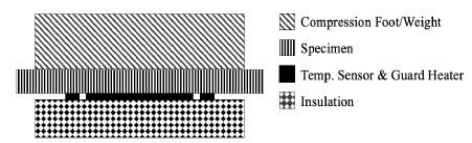
Measuring Effusivity Effusivity is the scientific metric used to mechanically measure warm and cool touch. By definition, effusivity is the ability of a material to exchange heat with its’ surroundings, also known as a material’s thermal inertia (Blaine, 2018). Mathematically, effusivity is the square root of the product of the material’s thermal conductivity and volumetric heat capacity (Blaine, 2018). Effusivity is measured with a device called the Modified Transient Plane Sou- rce (MTPS) sensor (Figure 1). At a high-level, the MTPS is a single sided, interfacial sensor that applies a momentary constant heat source to the mate- rial specimen being evaluated (CTherm, n.d.). Through this process, the rise in temperature that occurs between the sensor and the specimen, induces a voltage drop of the sensor element. This change directly determines the ther- mal effusivity value of the material specimen, therefore, defining its’ warm or cool touch characteristics.
p
In detail, the rate of increase of the MTPS sensor temperature is inversely proportional to the thermal effusivity of the evaluated specimen (Sokolow- ski, et al., 2022). Therefore, in a MTPS measurement, the heat capacity of the sensor is omitted (Sokolowski et al., 2022). The reported value is solely a function of the thermal properties of the specimen, given by e =
ρCK, where ‘e’ is thermal effusivity (Sokolowski et al., 2022). Although the MTPS apparatus does affect the heat flux of the system, the effect of the apparatus can either be separated out mathematically or through a calibration process (Emanuel, 2001). The MTPS sensor conforms to ASTM D7984: Standard Test Method for Measurement of Thermal Effusivity of Fabrics, which allows thermal effusivity values to be compared across systems and laboratories (ASTM, 2016).
Measuring Perceived Warm and Cool Touch Despite the ability to mechanically quantify material thermal properties using the MTPS sensor, effusivity as a metric still lacks association with human perception. Tactile human perception as a measurement can be highly vari- able (Schneider and Feussner, 2017). In order to measure subjective thermal
perception, a consistent protocol is necessary to establish methodological reliability between human subjects. Controlling subject contact with the specimens, visual bias, and environmental temperature are all factors that require consideration when regulating a perceptual experience.
To isolate haptic feedback and eliminate visual bias, it is recommended that subjects wear a blindfold, or have a blocked view of the textiles being evaluated (AATCC Technical Manual, 2007). Consistency must be provi- ded in the instruction given to subjects on how to properly assess the textile swatches. It is recommended that the subjects use the fingertips of their domi- nant hand to contact the fabric swatch (AATCC Technical Manual, 2007). The fingertips and the thenar eminence of the palm have been identified as the most thermosensitive regions of the hand, where the individual is able to best discriminate between temperature differences (Stevens & Choo, 1998; Ho and Jones, 2006; Tiest and Kappers, 2009; Wongsriruksa et al., 2012). In order to prevent the transfer of body heat onto the textile surface, instruction on how to touch the fabric sample must be provided. Literature recommends that the subject contacts the textile using light strokes and taps for less than a 5 second period (AATCC Technical Manual, 2007). Other considerations to developing a human perception protocol to measure warm and cool touch include consistent preparation of specimens (e.g., same size, same mounting method), cleaning and sterilization of the hands, along with controlling hand temperature.
METHODOLOGY
Material Specimens The materials evaluated in this study were provided by four global sports apparel industry partners, who asked to remain anonymous. The materials represented a wide range of sport apparel end-uses - including sweatshirts, wetsuits, T-shirts, base layers, mid layers, shirting, pants, and shells, across a broad scope of material constructions (knits and wovens) and finishes. In total, 37 materials were evaluated mechanically, using the MTPS sensor using ASTM D7984 to collect specimen effusivity, and perceptually, with human subjects performing the fingertip test protocol to determine warm and cool touch perception.
Effusivity Measurement Method From the materials provided, 10×10 cm specimens were cut to collect effusi- vity data. When using ASTM D7984, the specimen thickness must exceed.10 cm, therefore, if multiple layers were required to achieve thickness, the cut squares were staggered such that no two contained the same yarn alignment. Before effusivity measures were collected, the material specimens and the MTPS system were conditioned to 21 ± 2
C with a relative humidity of 65 ± 5% for four hours according to ASTM D1776: Standard Practice for Conditioning and Testing Textiles (ASTM, 2020).
Thermal effusivity values were collected from the face and back sides of the cut specimens. Procedurally, each specimen was placed onto the MTPS
Sports Apparel Warm and Cool Touch Effusivity Spectrums 19
sensor, and a fixed force load of 500 gF was applied to ensure consistent con- tact. Five consecutive MTPS sensor measurements were performed for each specimen using the Textiles I calibration. Three test sets were completed for each material. Between each test set, the specimen was removed and placed on the sensor at a different location to ensure precision of the data collected from the specimen. Results were then averaged.
For this study, the effusivity test method used assumed dry conditions and 1:1 fit of the apparel, as the specimens were not wetted or stretched during data collection. Face and back side effusivity measures were collected, as in the sports performance apparel industry both sides of the material are of importance to the consumer. The face side is the ‘marketable’ side of the material and can convey cool touch at retail when merchandise is displayed folded on a table or hung on hangars, whereas the back is the ‘next to skin’ side and is in direct contact with the athlete during sport (Sokolowski et al., 2022).
Warm and Cool Touch Fingertip Perception Measurement Method To collect the warm and cool touch fingertip perception data, the 37 mate- rial specimens from the effusivity portion of the study were narrowed to 15 (face and back sides) to reduce human sensory overload. Through this redu- ction, careful attention was made to include a wide range of effusivity values, fiber contents, constructions, finishes and end uses. Because the effusivity values on the face and back sides of the materials differed, the selected 15 face specimens were not identical to the selected 15 back specimens.
The selected materials were laser cut into 20.32 × 27.94 cm rectangular specimens that were backed by identically sized paper cardstock. The backing helped to minimize the influence of test surface thermal conductivity during the perception test. A 1.6 cm paper cardstock bezel was also laser cut and attached to the face of each specimen to prevent material curling or fraying during human subject handling. This preparation was completed for all 15 material fronts and backs (30 specimens total).
Upon Institutional Review Board (IRB) approval, 30 human subjects were recruited to perform the perception component of the study. Subjects were between the ages of 18 and 35, with an equal percentage of male and female subjects. The age range was identified by the sports apparel industry par- tners and reflective of target users. Participants were also required to be recreationally active and regularly wear athletic apparel.
Upon arriving to the lab, signing consent, and being informed of the study procedures, the subject cleaned their hands with a disposable wipe, offering hand sterilization while standardizing hand temperature. The subject was then seated at the assessment table. To control the variability of cutaneous perception between subjects, several measures were put in place during the data collection protocol. First, subjects were given a blindfold to eliminate any visual prejudice associated with the material specimens. Secondly, they were instructed on how to properly touch the materials by using the fingertips of their dominant hand and tapping the specimen t<5 seconds to best perceive its thermality without transferring body heat onto the material surface. Once
the subject was comfortable with the procedures, the warm and cool touch perception data was collected.
To collect warm touch perception data, the specimens were laid out from 15–1 (coolest to warmest in effusivity value), and the subject tapped on each material sample to determine when they started to feel warm. At the point when the subject felt warmth, the position (15-1) of the specimen was noted. This procedure was completed for face and back sides.
Similarly, to collect cool touch perception data, the specimens were laid out from 1–15 (warmest to coolest) and the subject tapped each one in order to deter when they started to feel cool. At the point when the subject felt cool touch, the position (1-15) of the specimen was noted. This procedure was completed for face and back sides.
RESULTS
Effusivity Data The effusivity values collected with the MTPS sensor, along with descripti- ons and fiber content of the 15 selected material specimens (face and back sides) are presented in Table 1 and Table 2, respectively. Based on the mea- sured effusivity values, the material specimens were then organized for the collection of warm and cool touch perception data.
Perception Data Participants The sex and age characteristics of the 30 perception study participants are presented in Table 3. For this study, there was equal subject representation by sex. Participants aligned to the typical age range of human subjects studied in the sports apparel industry (e.g., 18–35 years). All participants reported that they were physically active and regularly wear athletic apparel.
Face Side Warm and Cool Touch Perception Results When presenting the material specimens in order of highest effusivity (rank 15, coolest touch) to lowest effusivity (rank 1, warmest touch), sub- ject perception of warm touch occurred, on average, between specimens 6 and 5 for the material face. This perception of warmth was associated with an average effusivity value of 145.9, with a coefficient of variation of 15.9.
When presenting the material specimens in order of lowest effusivity (rank 1, warmest touch) to highest effusivity (rank 15, coolest touch), subject perception of cool touch occurred, on average, at specimen 9 for the material face. This cool touch was associated with an effusivity value of 182.2, with a coefficient of variation of 10.8. For the fabric face, the identification of cool touch was at a lower coefficient of variation, suggesting improved perceptual precision between subjects.
Sports Apparel Warm and Cool Touch Effusivity Spectrums 21
Table 1. Specimen face details.
Table available in the original PDF paper.
General description Fiber content
Specimen Effusivity value 1 54 Cotton/polyester fleece (sweatshirt weight)
Back Side Warm and Cool Touch Perception Results When presenting the material specimens in order of highest effusivity (rank 15, coolest touch) to lowest effusivity (rank 1, warmest touch), sub- ject perception of warm touch occurred, on average, at material 4 for the material back. This perception of warmth was associated with an average effusivity value of 138.6, with a coefficient of variation of 16.3.
When presenting the material specimens in order of lowest effusivity (rank 1, warmest touch) to highest effusivity (rank 15, coolest touch), subject
Sex 18 to 25 years old 26 to 35 years old Total Male 10 subjects 5 subjects 15 subjects Female 8 subjects 7 subjects 15 subjects
perception of cool touch occurred, on average, between specimens 7 and 8 for the material back. This cool touch is associated with an effusivity value of 177.3, with a coefficient of variation of 10.3. Like the material face, the iden- tification of cool touch presented with a lower coefficient of variation than
Sports Apparel Warm and Cool Touch Effusivity Spectrums 23
warm touch for the material backs, suggesting improved perceptual precision between subjects.
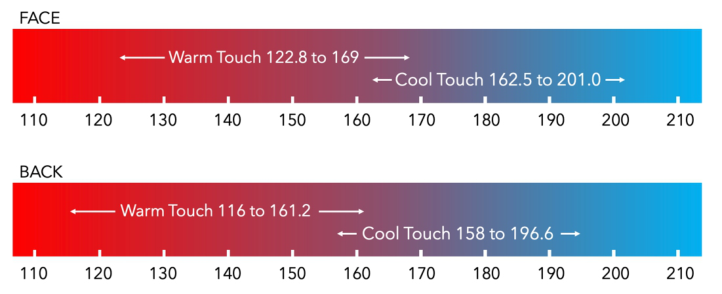
Effusivity Spectrums of Warm and Cool Touch From the perception data collected, warm and cool touch effusivity spe- ctrums were developed for the face and back sides of the evaluated materials (Figure 2).
Figure 2: Face and back effusivity spectrums of warm and cool touch, based on participant perception.
From the effusivity spectrums, it can be noted that there were similar ran- ges of cool and warm touch perception for material face and back sides. It can also be assessed that the perceived range of cool touch compared to warm touch was more precise at 38.5 (face) and 38.6 (back), compared to the warm ranges of 46.2 (face) and 45.2 (back). This suggests that humans may be able to perceive cool touch better than warm touch.
CONCLUSION
Innovating performance materials to keep athletes warm or cool while trai- ning and competing is of great importance to sports apparel manufacturers. Metrics like warm or cool touch can be communicated as intellectual pro- perty and establish a point of difference at retail. The results of this study provide material developers reference target effusivity ranges that achieve warm or cool touch perceptual experiences for athletes.
ACKNOWLEDGMENT
The understanding of the MTPS sensor instrumentation and effusivity data collection was provided by CTherm Technologies Inc. Material samples were supplied to the researchers by four global sports apparel industry partners who wish to remain anonymous.
REFERENCES
American Association of Textile Chemists and Colorists [AATCC] (2007) ‘Fabric Hand: Guidelines for the Subjective Evaluation of,’ AATCC Technical Manual: Evaluation Procedure 5, pp. 382–283. American Society of Testing and Materials [ASTM) ] (2020) ASTM D1776M-20:
Standard practice for conditioning and testing textiles, 07.01, pp. 1–5. American Society of Testing and Materials [ASTM] (2016) ASTM D7984: Standard test method for measurement of thermal effusivity of fabrics using a modified transient plane source (MTPS) Instrument, 07.02, pp. 1–5. Blaine, R. L. (2018) ‘In Search of Thermal Effusivity Reference Materials,’ Journal
of Thermal Analysis and Calorimetry, 132(2), pp. 1419–1422. CTherm Technologies Inc. (2020.), ‘Method Selection in Thermal Conductivity Characterization’, Available at: https://ctherm.com/methodreviewwp/#Form_Titl e. (Accessed 22 January 2023). Emanuel, M. (2001) ‘Effusivity Sensor Package (ESP) System for Process Moni-
toring and Control’. In 28th International Thermal Conductivity Conference Proceedings, pp. 256–268. Ho, H., and Jones, L. A. (2006) ‘Contribution of Thermal Cues to Material Discrimination and Localization,’ Perception & Psychophysics,68(1), pp. 118–128. doi:10.3758/bf03193662 Schneider, A. and Feussner, H. (2017). Biomedical engineering in gastrointestinal
surgery. Academic Press, pp. 434–436. Sokolowski, S. L., Karolidis, E., Hakimian, A. and Ackermann, S. (2022) ‘Measuring Cool Touch of Key Sports Performance Apparel T-Shirt Materials Using a Modified Transient Plane Source (MTPS) Sensor to Inform Future Technology Development,’ In TMS 2022 151st Annual Meeting & Exhibition Supplemental Proceedings, pp. 1327–1337. Stevens, J. C. and Choo, K. K. (1998) ‘Temperature Sensitivity of the Body Surface
Over the Life Span,’ Somatosensory & Motor Research, 15, pp. 13–28. Tiest, W. M. and Kappers, A. M. (2009) ‘Tactile Perception of Thermal Diffusivity.’ Attention, Perception, & Psychophysics, 71(3), pp. 481–489. doi:10.3758/app.71.3.481 Wongsriruksa, S., Howes, P., Conreen, M., and Miodownik, M. (2012) ‘The Use of Physical Property Data to Predict the Touch Perception of Materials,’ Materials & Design, 42, pp. 238–244. doi:10.1016/j.matdes.2012.05.054
LISTED IN THE AHFE DIGITAL BOOKSTORE CATALOGUE
Explore the complete digital volume
Interdisciplinary Practice in Industrial Design
Read this individual research paper free through the original publisher, or explore the full digital proceedings book.
ISBN 978-1-958651-76-6
Explore this ISBN in the AHFE Bookstore ↗Listed in the July 2026 bookstore catalogue; search by ISBN to confirm current availability · Digital book purchase optional