Susan Sokolowski, Chrissy Bettencourt (2022). Understanding Footwear Traction Performance to Reduce the Risk of Indoor Falls and Improve Mobility for the Aging Population. In: Interdisciplinary Practice in Industrial Design. AHFE Open Access, vol. 48, pp. 108–116. https://doi.org/10.54941/ahfe1002022
Falls are the leading cause of death and disability for the aging population. The goal of this research was to understand the traction performance of key footwear styles to make recommendations on how to improve outsole design, to reduce the risk of indoor falling and enable mobility for aging users. Dry and wet traction tests were conducted on three common flooring materials, with six footwear styles. The data collection method was adapted from ASTM F2333-04, as a more attainable, student-led version of a linear traction test without the need for expensive lab equipment. Results determined that although the footwear tested were marketed for traction and safety, they greatly decreased performance in wet conditions and performed inconsistently across all flooring surfaces and outsole contact directions. From the findings opportunities exist to redesign shoe outsoles and flooring to improve safety.
Healthy Aging and Industrial Design Fifty-four million people are estimated to be over the age of 65 in the United States (U.S) (U.S. Census Bureau, 2017). This demographic will almost dou- ble by the year 2050, where growth can be attributed to better medical care, diet, and lifestyle (Sokolowski, 2020). Knowing that healthy aging lifestyles are connected to mobility and independence, the researchers wanted to exa- mine how industrial design could be utilized to support this demographic. Historically, products designed for aging users have been underrepresented (Sokolowski, 2020).
The Realities of Falling As aging is the progressive deterioration of organs and tissues resulting in a reduced capacity to regulate internal processes – where falls and fear of falling are more likely to occur (Sokolowski, 2020). Nearly 25% of Americans over the age of 65 fall each year, where an older adult is treated in the Emergency Room (ER) every 11 seconds, and every 19 minutes, an older adult dies from a fall (Aging.com, 2021). These facts are staggering, totaling to about 3 million
Understanding Footwear Traction Performance to Reduce the Risk of Indoor Falls 109
individuals treated in ERs and 27,000 deaths annually (Centers for Disease Control and Prevention, 2017; Centers for Disease Control and Prevention, 2016). The fear of falling also has a detrimental impact on the quality of life as individuals may limit their activities leading to further physical and mental decline. One of the risk factors to related to falling is poorly functioning footwear (Centers for Disease Control and Prevention, 2017). There is an opportunity for industrial designers to help reduce the risk of falls and enable activity for aging Americans through the investigation of footwear traction design for indoor environments such as hospitals and aging care facilities.
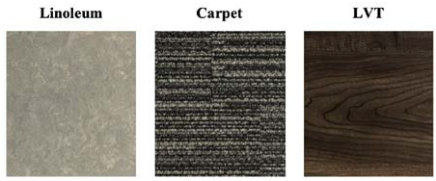
Common Indoor Flooring To better understand how footwear traction could be improved for aging users, it was important to understand the indoor flooring surface interfa- ces associated with falling. The researchers worked with a local architecture firm to determine the most common flooring materials used for hospitals and aging care facilities in the U.S. (Kuhn, personal communication, 2020). Flooring types were identified as linoleum, carpet, and Luxury Vinyl Tile (LVT). Linoleum surfaces are made from wood flour, rosin, ground lime- stone, powdered cork, jute, pigments, and linseed oil, with a cork backing and waxed/sealed surface (Scientific America, 2010). Carpeting is typically made from nylon 6,6 with a synthetic cushioned backing and coated sur- face for stain-resistance (Strathmore, n.d.). LVT is made from a base core comprised of polyvinyl chloride (PVC) resins, pigments, calcium carbonate, plasticizers, fungicide and UV stabilizers; where a cushioned backing layer, and a digital image (e.g., wood grain) is overlaid on top of the core for aesthe- tic purposes (California Flooring and Design, 2019). Photos representing the common flooring types are presented in Figure 1.
Figure 1: Typical indoor flooring materials.
Recommended and Popular Footwear for Aging Users On-line research was conducted to determine the most recommended and popular footwear styles for aging users who are active and desire durabi- lity, ease-of-use, slip-resistance, and comfort. Six products were identified, including the Rockport Let’s Walk Mary Jane, New Balance 577 V1, Sau- cony ProGrid Integrity, Sketchers Go Walk 4 Pursuit, Crocs Classic Clog and Adidas Adilette Comfort Slide (Table 1).
110 Sokolowski and Bettencourt
Table 1. Recommended/popular footwear products for aging users.
Table available in the original PDF paper.
Through identifying the most common flooring and footwear produ- cts, the researchers were able to conduct a study to understand traction performance of the key footwear styles, to make footwear outsole design recommendations to reduce the risk of indoor falls and enable mobility.
METHOD
Study Goals and Variables Several variables were involved to holistically understand the traction cha- racteristics of the key footwear styles, to make design recommendations to reduce the risk of falls for aging users. Independent variables included the six identified footwear samples, three flooring samples, flooring conditions (wet/dry) and direction of outsole contact (straight/angled). The straight dire- ction of outsole contact replicated a shuffled foot strike, where the user’s foot would contact the floor through the center front of the outsole. The angled contact replicated toe-off through a normal walking/jogging foot strike pat- tern. The dependent variable in the study was the amount of force required to pull each footwear sample across each floor sample/condition/ direction in Newtons. Force was collected using a strain gauge. Traction performance was therefore measured by the amount of force it took to pull a footwear sample across each of the flooring conditions and outsole contact direction. The higher the force recorded, the better the traction performance.
Understanding Footwear Traction Performance to Reduce the Risk of Indoor Falls 111
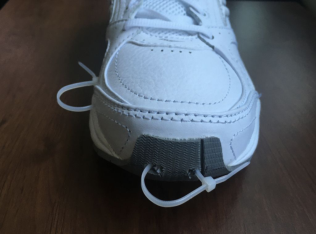
Footwear Sample Preparation For shuffled foot strike (straight outsole direction) traction testing, each of the six footwear samples were prepared by cutting two 3x3mm holes, evenly spaced 15mm apart, 35mm up from the floor, into the toe region of the sam- ple. Through the holes, a zip tie was threaded and secured to create a loop so the strain gauge could be attached. For the normal foot strike (angled out- sole direction) testing, each of the six footwear samples were prepared by cutting two 3x3mm holes on its’ medial side, spaced 15mm apart, 55mm from the toe and 35mm up from the floor. A second zip tie was threaded through those two holes and secured to create a loop for the stain gauge to be inserted. Figure 3 demonstrates how the footwear samples were prepared. Four uniform metal weights were also placed inside of each footwear sam- ple, weighing 963g prior to data collection. The weights were used to keep the footwear samples from losing contact with the flooring during traction testing.
Figure 3: Footwear sample preparation.
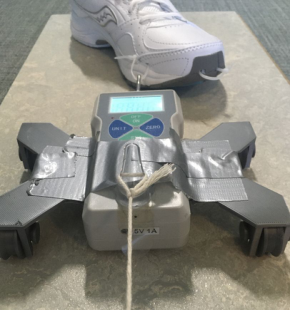
Data Collection Procedure The prepared footwear samples were individually placed on each of the three flooring samples and attached to the strain gauge through the zip tie (for each outsole contact direction), for data collection. The strain guage method (Figure 4) was adapted from ASTM F2333-04 (Traction Characteri- stics of the Athletic Shoe-Sports Surface Interface) to measure relative traction (ASTM, 1990). This method allowed for a cost-effective, student-led ver- sion of the linear traction test without the need for an expensive lab setup. Rather than using an linear actuator, the test method utilized a power drill that wound a cord at a constant speed to drag each footwear sample across the various flooring surfaces. Attached to the cord between the drill and test shoe was a strain gauge which collected the peak force required to drag each shoe across each surface. This method of traction testing is purely a method of analyzing the relative traction between each shoe tested and does not create values that stand on their own.
Data for dry conditions were collected first and then floor samples were prepped for wet conditions by spraying them with water before each data collection. In-between wet flooring tests, samples were wiped dry with a
112 Sokolowski and Bettencourt
Figure 4: Data collection set-up for dry, normal foot strike, linoleum conditions.Table 2. Example of the data collected for one shoe, in the study.
paper towel and re-wetted. For each contact direction/flooring condition, three separate peak force measures (in Newtons) were collected and averaged. Table 2 outlines how data were collected for one shoe.
RESULTS
This study was conducted to understand the traction performance of key foo- twear styles, to make outsole design recommendations to reduce the risk of indoor falls and enable mobility for the aging population. From the avera- ged data collected, bar charts were constructed to compare results for each flooring type and conditions.
Linoleum Observations The two athletic shoes (New Balance and Saucony) provided the most tra- ction compared to the other footwear samples, for all conditions. These two shoes, along with the Rockport Mary Jane, provided better performance when shuffling forward. The Adidas slide provided the least amount traction in comparison to the other footwear samples, under all conditions. The wet flooring conditions highly affected traction, where almost 50% performance was lost compared to the dry conditions.
Carpet Observations On carpet the New Balance, Saucony and Rockport shoes performed bet- ter in all conditions requiring the most force to pull them across the floor sample, and the Adidas slide performed the worst. However, in all footwear
Understanding Footwear Traction Performance to Reduce the Risk of Indoor Falls 113
Table 3. Traction results (in Newtons), for linoleum flooring.
Table available in the original PDF paper.
Table 4. Traction results (in Newtons), for carpet flooring.
Table available in the original PDF paper.
Table 5. Traction results (in Newtons), for LVT flooring.
Table available in the original PDF paper.
conditions better traction performance was observed when shuffling forw- ard. Compared to the linoleum, the shoes had less traction on carpet. All footwear tested performed less on wet carpet flooring, but not as great of an effect as observed with the linoleum flooring.
114 Sokolowski and Bettencourt
LVT Observations Similar performance trends were observed with the LVT flooring, where the two athletic shoes (New Balance and Saucony) provided the most traction. However, for this flooring type results were more inconsistent, where some shoes had better traction while shuffling and for others it was better with the normal toe-off foot strike pattern. Again, wet conditions affected traction, and compared to the linoleum and carpet, the LVT provided less traction overall.
DISCUSSION
Findings Through identifying common flooring and footwear products, the research- ers were able to understand traction performance, to make footwear outsole design recommendations to reduce the risk of indoor falls and enable mobi- lity for aging users. The first finding was that none of the footwear styles evaluated performed well in any of the wet flooring conditions tested. Alth- ough this may be an obvious finding, it is important to discuss as shared living spaces in hospitals and aging care facilities are cleaned often and foo- twear choice could be part of the solution to keep users safe - if of course the outsole was designed appropriately. Testing results from the linoleum floo- ring in the study were especially concerning, as all footwear styles performed very well in dry conditions, but they also loss the greatest amount of tra- ction in wet conditions (~50%). This could be confusing for aging users, as they may have relied on or have had history with the linoleum surfaces being safe but could be easily surprised and/or thrown-off balance in wet conditions because of the inherent performance differences. Footwear out- sole designs that have good traction in dry and wet conditions are imperative to prevent slips and falls. Traction patterns that avoid trapping water, have hard/sharp edges to assist with foot strike stabilization and/or can release water are design recommendations that could improve performance.
No matter the flooring condition, the footwear styles that had flatter and less defined texture patterns (Adidas, Crocs), performed poorly. Through learning from the top shoe performers in the study (New Balance and Sau- cony), it could be hypothesized that by defining more and creating deeper traction outsole lug patterns - performance could be improved, if the patterns do not hold water and create slippage while in use.
Lastly, in most of the testing configurations, footwear traction performa- nce was at its’ highest in the shuffling configuration. This should be flagged as a major concern, as these results suggest that users might adapt their foot strike pattern to shuffling, as they could discover they are more secure with this type of floor contact with their shoes. Shuffling is not a way to promote confidence or enable activity with aging users, as it can slow down motion, negatively change body mechanics and create a sense of uncertainty. Dynamic and pliable outsole textures that can microscopically “suction” to the floor and help to proprioceptively engage the feet are design recommendations
Understanding Footwear Traction Performance to Reduce the Risk of Indoor Falls 115
to improve traction and could provide better sensation to affirm safety and enable healthy foot strike patterns.
Limitations It is important to discuss the limitations of the study. Only six footwear sam- ples were tested, where a myriad of other products are available in the market that could have been evaluated, with different results. Although the flooring samples were carefully selected with help from a local architecture firm that specializes in built environments for the aging, other surfaces could have been assessed, such as tile, concrete and natural wood flooring. The testing set-up had limitations as well, where the strain gauge was modified with a dolly and power drill to ensure pulling consistency. A more sophisticated tool could have been built, but it was out of budget scope. Foot strike direction could have been assembled in a more sophisticated manner, to include fully articu- lated foot mannequin, yet again it was out of budget scope for the project. Human wear tests could have also been integrated as part of the study, but limitations due to the pandemic made that impossible at the time of the study.
Future Research Several opportunities exist for future research. The most obvious work is to use the findings from the study to design more functional footwear outsole patterns that work on other surfaces and conditions, and then compare them to existing products. Other soft footwear products, like slippers and socks could be studied to look at traction performance with the same flooring con- ditions. Flooring design through surface texture and materials, is another way to address the problem (especially when wet). Similar studies could be conducted with footwear and outdoor walking surfaces (e.g., concrete, asph- alt, grass, turf, walking trails). Human wear tests may also be integrated to compare to the mechanical testing results. Given the serious consequences falling and the underrepresentation of aging users in industrial design, rese- arch efforts to reduce the risk of falling and enabling activity could greatly benefit this growing population.
ACKNOWLEDGEMENT
This research was funded through the 2019-2020 University of Oregon Col- lege of Design Tinker Hatfield Innovation Award - Design for Healthy Aging project, and the Institute for Health in the Built Environment industry resea- rch consortium, Build Health. Flooring samples were generously provided by Melisse Kuhn, Associate of Scott | Edwards Architecture, Portland, Oregon.
REFERENCES
American Society for Testing and Materials (ASTM). (1990). Standard test method for traction characteristics of the athletic shoe-sports surface interface: F2333-04. Annual Book of ASTM Standards, 1412–1420. Bureau, U. S. C. (2017). American community survey 5-year estimates. In Census
Reporter Profile Page.
116 Sokolowski and Bettencourt
California Flooring and Design. (2019, May 31). What is LVP made of? Website: https://www.cafloordesign.com/2019/05/31/what-is-lvp-made-of/ Centers For Disease Control and Prevention. (2016). Falls Are Leading Cause of
Injury and Death in Older Americans. Website: https://www.cdc.gov/media/releas es/2016/P0922-older-adult-falls.html Centers For Disease Control and Prevention. (2017). Important Facts About Falls.
Website: https://www.cdc.gov/homeandrecreationalsafety/falls/adultfalls.html Scientific America. (2010, March 10). Floor plan: Linoleum may be green, but is there an ecofriendly way to keep it clean? Website: https://www.scientificamer ican.com/article/earth-talk-floor-plan/#:~{}:text=Real%20linoleum%E2%80% 94as%20distinct%20from,pigments%2C%20jute%20and%20linseed%20oil Sokolowski, S. L. (2020). Healthy aging and industrial design. Innovation Magazine.
Industrial Designers Society of America, Spring Issue. Strathmore. (N.D.). Carpet – How It’s Made. Website: https://strathmoredesign.com /carpethowitsmade
LISTED IN THE AHFE DIGITAL BOOKSTORE CATALOGUE
Explore the complete digital volume
Interdisciplinary Practice in Industrial Design
Read this individual research paper free through the original publisher, or explore the full digital proceedings book.
ISBN 978-1-958651-24-7
Explore this ISBN in the AHFE Bookstore ↗Listed in the July 2026 bookstore catalogue; search by ISBN to confirm current availability · Digital book purchase optional