Yonghong Liu, Zhaorui Zeng, Yanlin Yin, Yiming Song (2022). Evolution and Development Trends for Experience Design of Manufacturing Enterprises under the Background of Industry 4.0. In: Interdisciplinary Practice in Industrial Design. AHFE Open Access, vol. 48, pp. 117–123. https://doi.org/10.54941/ahfe1002023
The overall level of intelligent development of Chinese manufacturing enterprises (CME) is relatively low, and there are problems of large cost investment and low profitability in the process of realizing intelligent transformation. Starting from the development status and trend of Chinese intelligent manufacturing enterprises (CIME), this paper studies the application evolution and trend of experience design (EXD) in CME, and deeply analyzes the EXD problems of CIME. It proposes to build cross-organizational user experience design (UED) management and cross-product life cycle (LC) EXD strategy based on C2M (customer to manufacturing), help CIME solve problems such as lack of innovation momentum and effective links for collaboration and bring about transform and upgrade.
Industry 4.0 refers to the use of information technology to promote indu- strial change. In 2015, China deployed to fully promote the implementation of the “Made in China 2025” manufacturing strategy. At present, most CME are still in the “Industry 2.0” (electrification) stage, and the penetration rate of “Industry 3.0” (informatization) is still very low, “Industry 4.0” (intel- ligent) is being explored in more and more intelligent manufacturing pilot demonstration projects (Zhang Meng, 2021). There are two major problems in CME: the profitability is low and lean management is required; the added value is not high and needs innovation (Ouyang Sheng and Kong Deyang, 2018). With the economic and social development, people have begun to pursue deep, non-material individual needs. The development trend of intelligent manufacturing is to meet the individual needs of consumers through the inte- gration of emerging technology clusters and manufacturing industries. It is characterized by placing manufacturing enterprises and users in a unified system, and realizing personalized customization and services based on data analysis through virtual and real space linkage (Yang Qingfeng, 2019, Rui Mingjie, 2021). Under the premise of meeting the consumer demand in the
new era, CME can enhance product added value and profitability through the integration of emerging technology groups with current manufacturing and subversive innovation, and drive the virtuous circle development of enterprise economy (Yang Qingfeng and Ren Jinluan, 2019).
Under the trend, industrial design is gradually rising from product design to industrial design, and design content is expanding to the whole process of industrial chain and innovation chain (Gao Nan, 2019). However, CME lack Internet-based collaboration across departments and enterprises, betw- een upstream and downstream partners, and between suppliers and users. EXD is a powerful means of facilitating these collaborations. At present, the degree of informatization development of CME is low, and there is a lack of EXD related talents and business centers, so it is difficult to break through these development bottlenecks. Intelligent manufacturing of virtual- real linkage requires collaborative innovation of ID and EXD to achieve manufacturing upgrades and management upgrades to meet the personalized needs of consumers (Ouyang Sheng and Kong Deyang, 2018).
EXD EVOLUTION AND PROBLEMS OF CME The Connotation and Advantages of EXD
EXD focuses on the impact of situational factors on the user’s psychology, and aims to provide a good experience (see Table 1) with a specific user in the pro- cess of interacting with a product, service or interaction (Lucas Daniel, 2000, David Sward, 2007). It is a comprehensive system design with subjectivity, complexity and dynamism.
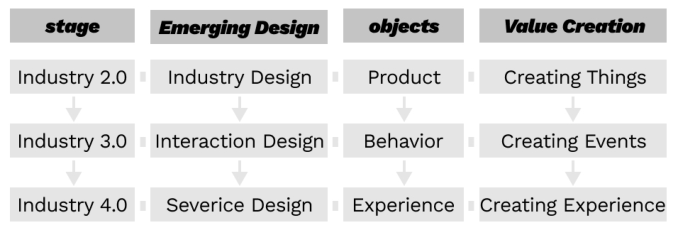
Experience design is committed to building a full-process user experience, and the richer the experience content built, the greater the user experience value of the product, and the easier it is to obtain greater user satisfaction. With the development of the times, the object of experience design evolves from the product to the behavior in the entire use process, and then to the experience of the system, in order to achieve the purpose of creating an experience with a beautiful experie- nce for the user (see Figure 1). In Industry 4.0 trend, the experience design of CIME involves the system experience of the LC, including improving the user experience of products and services, the experience of users when purchasing
Evolution and Development Trends for Experience Design 119
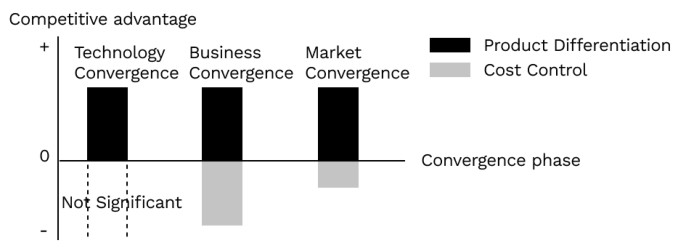
Figure 1: The objects’ of EXD evolution (Wu, 2010, Xin, 2015, Xin, 2019).Figure 2: The fusion stage for manufacturing companies (M. Pan et al. 2022).
products or services, and the manufacturing experience and work experience of improving the LC management and collaboration of products.
On the one hand, for consumer groups, manufacturing enterprises create new products and new services (market integration) that meet the individual needs of users through experience design, bringing people a new life expe- rience. People are pleasure to pay a premium for a product or service that leads to a good life experience (Schmitt 1999, Pine and Gilmore 1999). On the other hand, experience design for specific functional groups can improve the work efficiency of enterprise employees, as well as bring employees a work experience that is easy and convenient to communicate and collaborate, and promote enterprise business integration. Through the above two experi- ence designs, it is possible to achieve product differentiation that is difficult for competitors to replicate, realize the generation and value appreciation of new value, and bring sustainable competitive advantage to enterprises (see Figure 2).
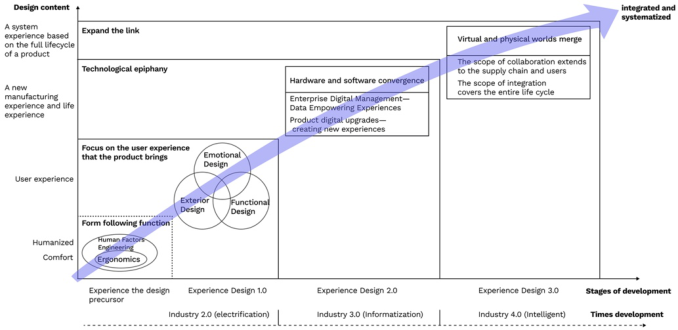
EXD Evolution and Trend of CME With the development of the industrial age and the EXD, the application of EXD in the manufacturing field has achieved 3 major evolutions (see Figure 3). The EXD of CME has undergone an evolution path from a sin- gle product experience to a user experience in which industrial products and interaction design are integrated, and then to a system experience in which the virtual world and the physical world are mixed. With the development of
Figure 3: The evolution and trend of EXD in manufacturing (Roberto Verganti, 2013).
technology, EXD is committed to alleviating the confusing of technology on people, and using technology to bring people a new life experience and manu- facturing experience. The integrated and systematic development of EXD is committed to building more convenient and richer experiences and creating greater value.
EXD Issues for CME In Industry 4.0, CME have the following 3 problems in the process of intelligent transformation and upgrading: 1. Nowadays, people begin to pursue deep-level and individualized needs for social interaction, respect, self-involvement, collaboration, sense of control, emotional identity, and belonging. Personalization means that consumers want to consume products and services that are customized for individuals at a specific time, space and scene according to their own needs and consumption preferences. Deep level refers to the integration of consumer demand (A package solution for suppli- ers’ production and service needs) and facilitation (Consumers pursue what they think is an economical and convenient way of spending) (Rui Mingjie, 2021, Yang Qingfeng, 2019). However, there is a lack of effective links betw- een manufacturers and users, making it difficult to manufacture to meet the needs of consumers’ individualization, integration, and convenience. 2. There is a lack of effective links between the knowledges of design innovation, teams, and businesses. There is a lack of a good communication, collabora- tion and information sharing platform between various teams and business departments. It is not conducive to design innovation, providing a consi- stent user experience and efficient business cooperation and management. 3. Lack of design integration and maintenance between different enterprises and teams. The lack of system integration and collaboration based on the LC in production, manufacturing, quality assurance, sales, service and other links hinders the possibility of manufacturing efficiency and product added value to a certain extent.
Evolution and Development Trends for Experience Design 121
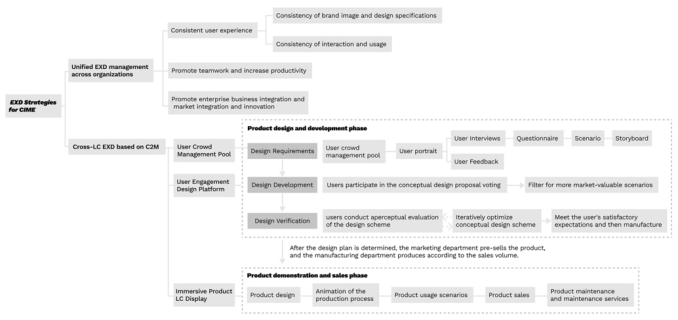
Figure 4: EXD strategy of CIME (Luo Shijian et al. 2010, Tan Hao et al. 2020).
EXD STRATEGIES OF CIME In the context of Industry 4.0, CIME build unified EXD management across organizational and cross-LC EXD based on C2M (see Figure 4) to promote business integration between teams and achieve a smart manufacturing model that integrates production and use (Yang Qingfeng, 2019), bringing a new manufacturing experience and product value.
Build EXD Management Across Organizations Manufacturing companies do not have user experience centers, only indu- strial design centers. The EXD between the teams of each organization within the manufacturing enterprise is dotted and separated with the indu- strial design. In this case, user experience design is not uniformly managed, affecting the user’s consistent experience of the user’s cognition and usage habits of various products (David Sward, 2007). In addition, the experience design of dot separation is not conducive to data management, migration and sharing between teams in various organizations of the enterprise, reducing employee productivity. Provide cross-organizational management of user experience, can not only solve the above problems, but also coordinate enter- prise resources, promote interdepartmental and inter-team resource sharing, promote enterprise business integration and market integration, and create new products and new solutions from the level of product significance.
Build C2M-Based EXD Across the LC The Internet C2M platform builds a user crowd management pool to supply energy for design needs: Through the collection and analysis and calcula- tion of consumer personalized demand information data, the Internet C2M platform constructs user portraits with different characteristics, forms a user population management pool, and achieves the purpose of subdividing the population to achieve the personalized needs of users. Designers can obtain personalized demand data and product experience feedback from target users through the platform, providing important support for product innovation design needs and product iterative optimization design needs.
User Engagement Design Platforms (UEDP) improve product user experie- nce and achieve on-demand production: In the design needs collection stage, CIME build a platform for designers to talk with users by participating in user interviews, questionnaires, scenarios, storyboards and other functional services, let the designers understand the real situation and personal experi- ence of the users’, and identify the key problems that need to be solved. In the design development stage, the UEDP allows users to participate in sele- cting the concept plans through the program voting statistics, so that the product can be recognized by the users and realize on-demand production. In the design testing stage, the UEDP can verify and adjust the design results through testing methods such as perceptual evaluation, until the ideal user experience expectations are met and then mass production is carried out. By building a series of online interactive services for UEDP, it can provide timely and effective data feedback for design decisions, improve product user experi- ence, reduce enterprise manufacturing risks, and increase enterprise revenue. And before the product is sold, it can increase user expectations for produ- cts and even pre-order product sales in advance to achieve the on-demand production mode of production by sales and production while using.
Immersive product LC display puts users and producers in a unified system: Through digital display and virtual reality technology, CIME can build virtual immersive and interactive LC display scenarios. This is a method that puts users and producers in a unified system to achieve the integration of production process and use process, production scene and use scenario. Users can interact with virtual scenarios such as product design, production pro- cess, usage scenarios, sales, maintenance to better understand product design, function, performance and maintain the product. This approach, which makes remote and invisible manufacturing close and transparent, increa- ses product appeal and user control, and improves user decision-making efficiency.
CONCLUSION
By building cross-organizational EXD management and EXD based on C2M cross the LC, CIME can promote communication and collaboration between various teams, build effective links between products and user needs, pro- mote business integration and market integration innovation, and enhance enterprise design and manufacturing, management, sales efficiency and effe- ctiveness; to provide users with products that meet individual needs, and even to bring users a new life experience. The implementation of the EXD strategy does not require a large cost, which can achieve high value-added enterprise manufacturing mode innovation and product innovation, bring huge benefits to enterprises, and help intelligent manufacturing enterprises achieve benign transformation. The era of industrial Internet has come, and CIME need to combine the actual situation to introduce EXD talents and cultivate industrial designers’ EXD capabilities to help enterprises enhance manufacturing value and product experience value. Achieve cost reduction and efficiency increase, and get rid of the dilemma of low profitability, low industrialization degree, and low added value of products.
Evolution and Development Trends for Experience Design 123
ACKNOWLEDGMENT
This research was funded by the National Social Science Foundation of China’s Major Art Project “ Research on China’s Design and Manufacturing Collaborative Innovation Model”. Fund NO: 20ZD09
REFERENCES
Daniel L. (2000) Understanding User Experience. Web Techniques.pp. 42–43. Gao Nan. (2019) Gao Nan: Cross-border integration centered on industrial design opens up a new channel for “China’s intelligent manufacturing”. Design, 32, 60–62. Luo Shijian, Zhu Shangshang, Ying Fangtian & Zhang Jinsong. (2010) Context-
based user experience design in mobile interface. Computer Integrated Manufa- cturing Systems, 16, 239–248. M. Pan, M. B, Xiaoxiao Ren. (2022). Does internet convergence improve manufacturing enterprises’ competitive advantage? Empirical research based on the mediation effect model. Technology in Society, 69. Norman D A. (2004) Emotional Design. New York: Basic Books. Ouyang Sheng, Kong Deyang. (2018) A new way out for China’s manufacturing
industry in the era of Industry 4.0 - Recommended reading of Lean Intelligent Manufacturing China Mechanical Engineering, 29, 2010–2015. Pine II, B. J. and Gilmore, J. H. (1999) The Experience Economy, Harvard Business School Press, Boston, Massachusetts. Rui Mingjie. (2021) The nature of “new manufacturing” and its future development
People’s Forum, 32–36. Roberto Verganti. (2013). “The Third Innovation: How Design-Driven Innovation Creates a New Law of Competition”, China renmin university press. Schmitt, B. (1999) Experiential Marketing, New York: The Free Press. Sward D. (2007) User Experience Design: A Strategy for Competitive Advantage.
13th Americas Conference on Information Systems. Tan Hao, You Zuo, Peng Shenglan. (2020) A Review of Big Data-Driven User Experience Design. Packaging Engineering, 41, 7–12+56 Wu Qiong. (2010) Domains and boundaries of interaction design. decoration, 34–37. Wu Qiong. (2018) User Experience Design Discernment. Decoration, 30–33. Xin Xiangyang. (2015) Interaction Design: From Physical Logic to Behavioral Logic
decoration, 58–62. Xin Xiangyang. (2019) From user experience to experience design. Packaging Engineering, 40, 60–67. Yang Qingfeng. (2019) Production-use convergence – the fifth manufacturing para-
digm driven by intelligent technology clusters Journal of the Chinese Academy of Sciences, 34, 32–41. Yang Qingfeng , Ren Jinluan. (2019) Policy recommendations for the evolution of manufacturing paradigms and the development of new manufacturing. Journal of the Chinese Academy of Sciences, 34, 1421–1430. Zhang Meng. (2021) Chengdu manufacturing intelligent development path. Techno-
logy and Industry, 21, 174–179.
LISTED IN THE AHFE DIGITAL BOOKSTORE CATALOGUE
Explore the complete digital volume
Interdisciplinary Practice in Industrial Design
Read this individual research paper free through the original publisher, or explore the full digital proceedings book.
ISBN 978-1-958651-24-7
Explore this ISBN in the AHFE Bookstore ↗Listed in the July 2026 bookstore catalogue; search by ISBN to confirm current availability · Digital book purchase optional