Zixin Zhuang, Yonghong Liu, Qingxia Chen (2024). Integrating Causal Layered Analysis into Design: Enhancing User Research for Deeper Insights. In: Interdisciplinary Practice in Industrial Design. AHFE Open Access, vol. 144, pp. 101–111. https://doi.org/10.54941/ahfe1005122
In the process of enterprise product innovation, user input plays a crucial role. This paper aims to better uncover deep-seated user needs by introducing the Causal Layered User Research Framework (CLURF), derived from the cognitive framework and hierarchical analysis of the futures studies theory, Causal Layered Analysis (CLA). This methodology categorizes user input into four layers: the Observation Layer, Influenced Discourse Layer, Cultural Concept Layer, and Deep Self Layer, providing structural guidance for semi-structured interviews and subsequent data organization. The research, conducted with the support of Shuhua Sports Co., Ltd., utilized CLURF and Grounded Theory to successfully capture critical user needs. The approach contributes significantly to understanding user behavior and motivations, uncovering deep-seated user needs, and exploring future trends in home treadmill usage. It offers high-quality design inputs for the development of new products in enterprises. This paper introduces CLURF as an innovative research tool, applying CLA to uncover deep user needs, providing design practitioners with a novel approach to user research and offering insights for the expansion of futures studies methodologies in the design domain.
The conventional workflow of industrial design always encompasses user inputs at many stages. In the current emphasis on “user-centered” design, user studies are particularly crucial to assisting designers in identifying pain points and providing comprehensive guidance. With the rapid iteration of innovative tools and AIGC, design expression becomes easier, which requires designers being involved more in the early stages of design, necessitating future designers to focus more on posing questions and their solutions (Sheng, 2024). Given the variability and ambiguity of user needs (Zhang et al., 2018), this paper intentionally develops a new method of user research to delve into the deeper user needs. Accordingly, the author proposes an innovative user research framework—the Causal Layered User Research Framework
(CLURF), drawing inspiration from the problem deconstruction approach of Causal Layered Analysis (CLA) in futures studies. CLURF consists of four progressive information classification levels, serving as the foundational framework for user interviews and classification reference in data analy- sis phase. This method injects inspiration from futures studies into design research, bring in future visions in user research, expecting user interviews using this method present richer and more authentic user voices.
CURRENT SITUATION The Overview of User Research Methods
User research is pivotal for enhancing user experience, particularly in the context of user-centered design principles. It encompasses discovery and evaluative research, respectively occurring in early and later design stages. The discovery research focuses in the excavation of user information, where CLURF focuses most. “User research” specifically refers to this stage in the following text. In today’s digital age, user data has become more accessi- ble, aided by the proliferation of information and advancements in creative tools, including Artificial Intelligence Generated Contents (AIGC). While expressing becoming easier than ever, it’s crucial for designers to ask the right questions and address the critical issues (Hippel, 2006). Meanwhile, explor- ing deeper user needs becomes critical for companies seeking to differentiate their brands. All of these lead to an academic fervor in user research since the 21st century (Ullah & Ameen, 2023). Traditional research methods, despite their drawbacks in efficiency and workload, still hold an irreplaceable position due to their characteristic of direct interaction with users. Among which, the most frequently employed method is the questionnaire survey (72%), followed by user interviews (14%) (Ullah & Ameen, 2023). Additionally, methods such as field research, diary studies, and focus groups are often interwoven into practical research processes.
The Significance of User Research for Enterprises Incorporating user inputs as a primary source of innovation enables enter- prises to heighten product diversity and novelty, attaining a sustained compet- itive edge (Henkel & Hippel, 2005; Yu & Yan, 2017). This is especially clear in emerging markets, which requires corporate designers to gather extensive user data and thoroughly understand user needs, and grasp market trends accurately during product development. Ongoing focus on user psychological experiences throughout the product lifecycle, from development to opera- tion, is crucial. Therefore, research on acquiring key user requirements in new product development and establishing effective paradigms for business and designer use of user data is highly important (Niu et al., 2023).
ADAPTING FUTURES STUDIES INTO DESIGN Causal Layered Analysis (abbreviated as CLA) was initially proposed by Sohail Inayatullah in 1998, a theory based on post-structuralist research
Integrating Causal Layered Analysis Into Design: Enhancing User Research 103
methods: deconstructing problems into four progressively deeper levels. The first one is the “litany level”, which describes the appearance of things or events objectively, emphasizing external manifestations and obvious features of the problem. The second one is the “social/systemic causes level”, empha- sizing the in-depth analysis of the social roots of the problem, with a systemic perspective that considers various factors such as social, political, historical, and technological influences on the shaping of viewpoints or phenomena. The third one is the “discourse/worldview level”, highlighting the ways of thinking and values influenced by social and cultural factors, focusing on different interpretations and viewpoints of a problem, as well as how these viewpoints influence potential solutions. The fourth is the “myth/metaphor level”, which explores deeper psychological patterns, symbolic meanings, and subconscious influences, helping to reveal the deeper underlying causes of the problem and its connection to individuals (Inayatullah, 1998).
In describing the CLA method, Inayatullah stated, “Rather than predict- ing specific futures, the Causal Layered Analysis is more about creating alternative futures through insights into the present and past (Inayatullah, 2019).” The primary application of CLA can occur either before construct- ing scenarios—by analyzing historical and present typical patterns to envision new scenarios with more possibilities in the future (Bradfield et al., 2016), or later in testing and deepening existing scenarios (Heinonen et al., 2016). As a method of futures studies, CLA is commonly applied in various fields such as social sciences, strategic planning, and organizational development, encompassing a wide range of populations and organizations. Its research subjects range from exploring different stakeholders’ perspectives on the low productivity in South Africa (Adebowale & Agumba, 2023), to revealing the impact of historical learning in higher education on the spiritual edu- cation and historical consciousness of the public (Liu, 2023). Bishop and Dzidic drew on CLA as a novel qualitative problem analysis method, apply- ing it in psychology to deconstruct and analyse complex social psychological issues (Bishop & Dzidic, 2014). Additionally, Bussey provided insights into the essence, characteristics, and possibilities of CLA, suggesting that it offers a process theory of knowledge that can serve as both a classification method in academic fields and a process method in applied fields (Bussey, 2014). In the era where everyone can contribute viewpoints on political topics, the Causal Layered Analysis unarguably provides a comprehensive understand- ing of complex problems and is a forward-thinking, effective, and dynamic theory.
Why Incorporate CLA in Design?
CLA advocates face-to-face communication with users/consumers/stakehold- ers. In the field of branding and market research, the implementation process and objectives of this method closely align with commercial design, provid- ing the possibility for this futures-oriented approach to be utilized in design research. More scholars are attempting to integrate futures studies into design pedagogy, as they believe that future designers need to possess the capability to design frameworks for the future (Evans & Sommerville, 2005).
Anna Barbara et al. conducted a three-year teaching exploration at the School of Design of Politecnico di Milano, combining futures studies architec- ture with traditional design processes through a futuristic and spatiotemporal design perspective. They pointed out that future studies are a time-based design method. This case emphasizes the foresight inherent in design tools (Barbara & Ma, 2023). Similarly, Berkan et al. also recognized that design- ers need to keep pace with the times and highlighted the importance of future studies in design research. They applied the methodology of future studies to design workshops, creating the Long-term Future-Oriented Design (LFD) method. In the workshop process, the CLA method was used as the main method, combined with the Six Pillars framework (Inayatullah, 2008). The method’s effectiveness was verified through comparative experiments (Berkan et al., 2017). These validated future-oriented design methods in academia demonstrate the feasibility of introducing such interdisciplinary theories into the design process and guide the evolution of new design methods.
RESEARCH METHODS The author integrates the analysis approach of CLA theory with design research methods, created “Causal Layered User Research Framework” (CLURF), which contains four levels similar to CLA that are better under- stood and utilized in the design context: the “observation level”, “influenced discourse level”, “cultural concept level”, and “deep self level”. Compared to the wide range of social topics addressed by CLA, the focused problem domain and solution path of CLURF are narrower, confined within existing realms of design concern. Hence, this method requires suitable modification to serve as interview guidance during discovery research (see Table 1). For example, concerning the second level of CLA—“social causes”, a more fit- ting explanation in the context of design is “influential perspectives from industry leaders, social topics or surroundings.” This description identifies both apparent and invisible stakeholders around users along with their influ- ences, thus renamed as “influenced discourse” in CLURF. The meanings of the first, third, and fourth levels of CLA are also slightly adjusted, which will be further elaborated in practical experiments.
Table 1. Comparison of interpretations of levels between CLA and CLURF.
Table available in the original PDF paper.
New Naming
Original Level in CLA
Design Studies Explanation
Futures Studies Explanation (Inayatullah, 2019)
Observation
Litany Official description of the problem, externalized reality
Objective representation, statement of observed phenomena
Social/Systemic Causes
Influenced Discourse
Typical short-term analysis, exploring the influence of history, policies
Views influenced by Key Opinion Leaders or surroundings (Continued)
Integrating Causal Layered Analysis Into Design: Enhancing User Research 105
Table 1. Continued
Table available in the original PDF paper.
New Naming
Design Studies Explanation
Original Level in CLA
Futures Studies Explanation (Inayatullah, 2019)
Cultural Concept
Discourse/ Worldview
Views shaped by long-term cultural influences and empiricism
Distinguishing the different worldviews mirrored behind the problem with critical thinking
Deep Self Personal values and latent desires
Myth/Metaphor Profound stories, the unconscious dimension of the problem
Applying CLA’s layered perspective in user interviews effectively addresses the initial design query of “how to inquire,” thus assisting researchers in understanding user needs from various angles. Apart from capturing surface- level functional requirements, it delves into users’ deeper psychological needs along with the cultural influences behind. For instance, while users may artic- ulate a need for exercise equipment like a treadmill, their undisclosed desires may be values such as health, aesthetics, and social identity. Specifically, the advantages of using CLURF in user research are as follows:
1. Comprehensive analysis dimensions: With a more comprehensive analyti- cal framework, CLURF could unveal the diversity and complexity of user needs. 2. Understanding user behavior and motivation: The tracing of causality helps reveal the decision factors and driving forces behind users’ choices, which can also help build more accurate user personas. 3. Exploring potential trends and future needs: Analyzing social causes provides insights into future scenarios, enhancing product foresight for businesses. 4. Reflecting cultural diversity: Analyzing user viewpoints horizontally iden- tifies differences among users from diverse cultures or stages, which helps designers and businesses identify core user groups and potential users. 5. Comprehending deep motivations: the deep self level unveils the moti- vations and psychological patterns of user groups, which is valuable for product/service positioning and innovation.
Similar to CLA, CLURF is also based on the premise of encouraging user narratives, with its fundamental purpose being to unearth deep-seated user needs. The anticipated needs to be revealed comprise the following:
1. Dissatisfaction with existing products and the reasons behind; 2. Envisioning of future idealized product usage scenarios; 3. Self-analysis of worldviews and values associated with product usage; 4. Unique individual needs and underlying reasons varying among users.
DESIGN RESEARCH To validate the practical applicability of the CLURF method, the author conducted a user research experiment applying CLURF while designing a
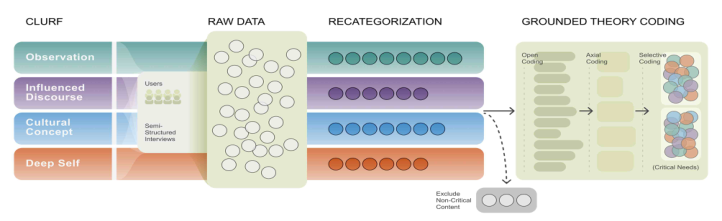
home treadmill for Shuhua Sports Co., Ltd. in China. The research goal was to gather user attitudes and requirements regarding home treadmills. The research path is illustrated in Figure 1. The four levels of CLURF served as a guiding framework for the interview outline and were also used in reclas- sifying raw data. The qualitative research process combined CLURF with Grounded Theory (Hutchison et al., 2010) for key information extraction to get user requirements.
8 users were interviewed in total, consisting of four potential users, desig- nated as P1 to P4, who had treadmill usage experience but had not formed a running habit, and 4 leading users, designated as L1 to L4, who were habitual indoor runners. All participants were from the urban young generation, rang- ing in age from 24 to 40. The interviews lasted approximately 300 minutes in total, generating 501 pieces of raw data.
Figure 1: The research path involving CLURF and grounded theory.Table 2. The interview framework applied CLURF.
Table available in the original PDF paper.
Expected Outcome Common Questions Interview Framework Basic Information Obtain the user’s category, understand their interest and level of involvement in running.
- What recent fitness activities have you participated in? - How would you rate your overall health status? Observation (A)
Gather the user’s basic views on treadmills, exercise habits, and preferences.
- What would most likely motivate you to purchase a treadmill for your home? - How much do data and reports after running affect you? Influence Discourse (B)
Understand the user’s environmental characteristics and the extent to which they are influenced by the fitness community.
- How prevalent is the topic of fitness in your social circle? - How do social factors influence your fitness choices, such as friends, social media, or cultural trends? Cultural Concept (C)
Explore the user’s attitude towards exercise and the cultural reasons behind it.
- Why do you want to run? - What stories or people influenced this desire? - What are your earliest memories of running? Have your views on running changed significantly since then? Why? Deep Self (D)
Understand the user’s deeper personality traits and their general attitudes towards products and life.
- Would your life be complete without running? Why? - What kind of person do you aspire to be in the fit- ness field? - Do you agree that “exercise is part of self-growth”? - What personal insights do you have?
Integrating Causal Layered Analysis Into Design: Enhancing User Research 107
The CLURF Process The interviews with both kinds of users adhere to one framework, aiming to comprehend diverse attitudes and preferences regarding exercise and run- ning, and to unveil underlying motivations through CLURF. The interview framework is outlined in Table 2. For easy reference in later sections, the four levels of CLURF are respectively designated as A, B, C, and D.
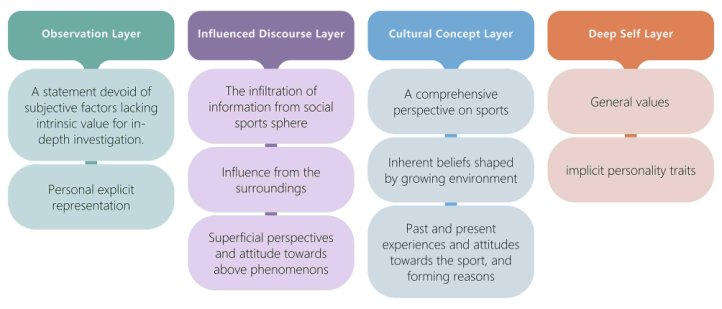
When processing interview data, it is common for users’ responses to not align with the level of corresponding questions. Therefore, at the initial stage of organizing the raw data, both the concise extraction of interview quotes and their reclassification are carried out simultaneously. For example, in the interview with user P1, a question from level A – “How much do data and reports after running affect you?” – received two responses that belong to Level B and Level C respectively. Among these, the response “Interested in knowing how fast to run to achieve weight loss effects.” reflects the inter- viewee’s concern on “weight loss effects.” This viewpoint is predominantly shaped by the interviewee’s surroundings and societal atmosphere, hence classified under Level B. The response “Hope to receive more personalized advice” extends from the interviewee’s self-expression regarding the signifi- cance of personalized advice, reflecting a personal value perspective, and is thus categorized under Level C. For the convenience of reclassification, the criterion of each level in CLURF is specified based on research objectives, as shown in Figure 2.
Figure 2: The specific interpretations of each level in CLURF in this experiment.
After undergoing reclassification, the original transcripts yielded a total of 206 quotes for Level A, 100 for Level B, 144 for Level C, and 51 for Level D. The distribution of these pieces of raw data generally adheres to the expected pattern of Level A being the most abundant while Level D being the least. This aligns with the expectation of CLURF that users tend to notice surface features more, while deeper insights are usually more difficult to elicit. It is noteworthy that among the raw data contributed by four potential users, the quantities of Level B and Level C are roughly equal, while the raw data of Level C is approximately 80% more than Layer B as for leading users. This
indicates that leading users contribute more to deeper-level opinions, and their viewpoints and influences within the industry are more profound. They are often able to identify product defects earlier than ordinary users, thus providing more insightful, valuable knowledge, methods, and even design proposals (Urban & Hippel, 1986).
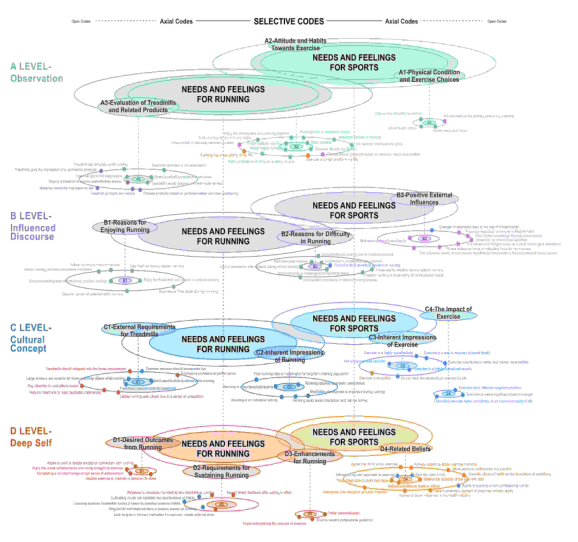
The Grounded Theory Operational Process The grounded coding process was conducted collaboratively by an expert group consisting of three design researchers, with each coding decision requir- ing consensus from all three members to ensure the validity of each coding level. Throughout the entire grounded process, the author maintained the cor- responding relationship between each level of coding and CLURF. Therefore, while obtaining key requirements, some variations in the CLURF method during the data processing phase were observed, which helped enhance and refine the interview process based on this approach. The entire coding results are illustrated in Figure 3. A total of 104 open codes, 14 axial codes, and 2 selective codes were obtained.
Figure 3: An overview of grounded theory coding and corresponding CLURF levels.
From the grounded theory process, it’s obvious that the open codes, when translated into axial codes, align closely with the corresponding CLURF lev- els. Users’ deeper needs and attitudes are predominantly concentrated in levels C and D. Following statistical analysis, the experiment identifies sev- eral high-frequency co-occurring key requirements and directions for further
Integrating Causal Layered Analysis Into Design: Enhancing User Research 109
design: 1) Fun and personalization on appearance and services for tread- mills; 2) Specialization of treadmills; 3) Deepening the immersive experience of treadmills; 4) Low-burden sense of ritual; 5) Creating a sports community atmosphere to motivate users to run. Among these, the high-interest points for potential users are “sports community atmosphere” and “low-burden sense of ritual”, while for leading users, the focus lies on “immersive expe- rience” and “specialization”, with “fun and personalization” being favored by all users. These refined design directions were discussed with both users and enterprise designers, gaining their approval, and subsequently prepared for further product design and development.
CONCLUSION
After this experiment, CLURF, as a user research framework imbued with futures studies, proved to be highly effective. “I feel that this interview format is very close to psychological counseling, helping me discover some hidden perspectives that I may not usually delve into” as quoted by User L1. In the phase of grounded analysis, CLURF actually served to mark important information—because in this experiment, the key requirements summarized ultimately mostly originated from levels C and D, which in some senses are causally related to the preceding levels. In short, CLURF demonstrates more of its advantages: It fosters candid responses by reducing psychologi- cal barriers, and allows interviewers to develop comprehensive impressions of users, aiding in topic selection during interviews and contributing to the creation of more accurate user profiles during review sessions. Also, by prob- ing every superficial phenomenon without disrupting users’ habitual thought patterns, CLURF could get more valuable insights and help interviewees form thorough understanding of the topic.
The experiment also reflects some improvement suggestions for CLURF usage: The format of interviews can be varied according to different themes. One-on-one semi-structured interviews may lead to individual perspectives that are unique to a particular respondent, lacking statistical significance. In fact, the author observes that for broad topics, it is preferable to involve all respondents in a focus group discussion, which also helps to encourage spontaneous interaction among users and fostering deeper insights.
ACKNOWLEDGMENT
Project: Key Technology Development and Application of Intelligent Fitness Equipment Based on Industrial Design (2023GZ3).
REFERENCES
Adebowale, O., & Agumba, J. (2023). Construction SMEs labour productivity: Causal layered analysis. Journal of Engineering, Design and Technology. https: //doi.org/10.1108/JEDT-11-2022-0583 Barbara, A., & Ma, Y. (2023). Futures Studies for Design Systems and Social
Transformation from Time/Space-Based Perspectives. Systems, 11(11), 552. https: //doi.org/10.3390/systems11110552
Berkan, S. T., Er, Ö., & Jonas, W. (2017). Interrogating Futures in Industrial Design Education. The Design Journal, 20(sup1), S1118–S1129. https://doi.org/10.1080/ 14606925.2017.1353055 Bishop, B., & Dzidic, P. L. (2014). Dealing with Wicked Problems: Conducting
a Causal Layered Analysis of Complex Social Psychological Issues. American Journal of Community Psychology. https://doi.org/10.1007/s10464-013-9611-5 Bradfield, R., Derbyshire, J., & Wright, G. (2016). The critical role of history in scenario thinking: Augmenting causal analysis within the intuitive logics scenario development methodology. Futures, 77, 56–66. https://doi.org/10.1016/j.futures. 2016.02.002 Bussey, M. (2014). Causal Layered Analysis: Towards a Theory of the Multiple.
https://www.semanticscholar.org/paper/Causal-Layered-Analysis%3A-Towards- a-Theory-of-the-Bussey/2d0ea3c1ae948ab2ea78826a99c2f2e097e0d0f9 Evans, M., & Sommerville, S. (2005). Designing Tomorrow: A Methodology for Future Orientated Product Design. Global Chinese Industrial Design Conference 2005. Heinonen, S., Minkkinen, M., Karjalainen, J., & Inayatullah, S. (2016). Testing trans-
formative energy scenarios through causal layered analysis gaming. Technological Forecasting and Social Change, 124. https://doi.org/10.1016/j.techfore.2016.10. 011 Henkel, J., & Hippel, E. (2005). Welfare Implications of User Innovation. The Journal of Technology Transfer, 30, 73–87. https://doi.org/10.2139/ssrn.425820 Hippel, E. (2006). Democratizing Innovation. In Research Technology Management
(Vol. 48). Hutchison, A. J., Johnston, L. H., & Breckon, J. D. (2010). Using QSR-NVivo to facilitate the development of a grounded theory project: An account of a worked example. International Journal of Social Research Methodology, 13(4), 283–302. https://doi.org/10.1080/13645570902996301 Inayatullah, S. (1998). Causal layered analysis: Poststructuralism as method. Inayatullah, S. (2008). Six pillars: Futures thinking for transforming. Foresight,
10(1), 4–21. https://doi.org/10.1108/14636680810855991 Inayatullah, S. (2019). Causal Layered Analysis A Four-Level Approach to Alternative Futures Relevance and Use in Foresight. Futuribles. Liu, H. (2023). Studying History Education of High School in Taiwan by Causal Layered Analysis. Journal of Literature and Art Studies. https://www.semanticscholar.org/paper/Studying-History-Education-of-High -School-in-Taiwan-Liu-History/9ec93fd01181a524f306096abd917971afacf97b Niu F., Li C., Ge J., & Luo B. (2023). Survey on User Feature Requests Analysis and
Processing. Journal of Software, 34(8), 3605–3636. https://doi.org/10.13328/j.cn ki.jos.006558 Shen Z., & Wang S. (2023). Domestic Leading user research: Identifying methods and innovation performance. Journal of Xingtai University, 38(4), 79–87. Sheng, Y. (2024). Exploring the coexisting relationship between Artificial Intelligence-Generated Content (AIGC) and designer. Applied and Computational Engineering, 34, 23–30. https://doi.org/10.54254/2755-2721/34/20230290 Ullah, A., & Ameen, K. (2023). Growth, subject areas, and application of research
methods in user studies: A content analysis of articles produced by Pakistani authors. Journal of Librarianship and Information Science, 55(4), 1068–1077. https://doi.org/10.1177/09610006221124626 Urban, G., & Hippel, E. (1986). Lead User Analyses for the Development of New Industrial Products. Management Science, 34. https://doi.org/10.1287/mnsc.34.5. 569
Integrating Causal Layered Analysis Into Design: Enhancing User Research 111
Yu F., & Yan L. (2017). The innovation effect and opinion inquiry of user innovation in innovation community. Science and management of science and technology, 38(2), 55–67. Zhang, Q., Chen, D., & Yu, S. (2018). User requirement analysis method based on
FBS framework in product design. Journal of Machine Design, 35(7), 119–123.
LISTED IN THE AHFE DIGITAL BOOKSTORE CATALOGUE
Explore the complete digital volume
Interdisciplinary Practice in Industrial Design
Read this individual research paper free through the original publisher, or explore the full digital proceedings book.
ISBN 978-1-964867-20-5
Explore this ISBN in the AHFE Bookstore ↗Listed in the July 2026 bookstore catalogue; search by ISBN to confirm current availability · Digital book purchase optional