Adam Feld (2024). Curricular Development in Industrial Design: An Initial Dive into Understanding. In: Interdisciplinary Practice in Industrial Design. AHFE Open Access, vol. 144, pp. 141–147. https://doi.org/10.54941/ahfe1005126
The Industrial Designers Society of America (IDSA) lists 36 industrial design programs accredited by the National Association of Schools of Art and Design (NASAD). Each program is reviewed on a 10-year +/- schedule which can be daunting for some programs considering the speed of advance in the profession and the difficulty/refusal in more experienced faculty to keep current. When reviewed, each school must demonstrate “Essential Competencies, Experiences, and Opportunities” to be NASAD accredited as a school for Industrial Design. However, the list, A-K, has a wide range of necessary competencies, experiences, and opportunities providing each program the academic freedom to teach what they think is necessary in preparing students to practice industrial design. This can be fueled by the local industry, professional and academic backgrounds of the faculty, the mission of the university and specific program, and/or the student population. In addition, NASAD states that all faculty “must be represented and taught primarily by instructors with appropriate industrial design education and professional experience.” Appropriate industrial design education does not, necessarily, mean appropriate educational preparedness when teaching industrial design. Most preparedness comes from experience but experience comes slowly with many advances and setbacks along the way. Just like parameters in an assignment, structure in an Industrial Design Curriculum (IDC) provides educators, new and experienced, the ability to focus on content, thereby, providing opportunity for developing assignments that can support and foster creativity in their students. This paper will reflect upon the exploration of a program undergoing a, roughly, thirty-year curricular review.
INTRODUCTION/BACKGROUND There is a saying from George Bernard Shaw’s 1905 stage play Man and Superman that says, “those who can, do; those who can’t teach.” This comment is based on a belief that if person had the ability, they would be pro- fessionals rather than educators; but that is not exactly true. As all collegiate level faculty can agree, teaching at that level is not a simple task. Teachers in design, especially industrial design, need to have mastery of many aspects of the field as well as current knowledge of the profession and expectations of future employers. Design Education can link its origins to the European guild system, “…the ways of the artist or craftsman…” (Giard, 1999) where mas- ters would train apprentices “to maintain high standards of craftsmanship
at each threshold for advancement to master status” (Davis, 2017). In this sense, dissemination of craft was the foundation of teaching design, meaning that those who could “do” passed on that knowledge and ability to keep a high level of quality in produced goods. Master and apprentice was a system used for many years but was limited to very few persons and limited in accep- tance of new skills and methods such as use of machinery. “Henry Cole, the English design activist, perceived design as an alliance between fine art and manufacture” (Giard, 1999). As society grew the need for goods and services increased putting a strain on craftsman and apprentices for production. As society and demand grew, so did the need for more apprentices.
As it stood, the European guild system does still have relationship to current design studies. “The apprentice system also set the tone for the rela- tionship between student and master that is reflected in some contemporary design classrooms” (Davis, 2017). In this sense, the teacher could be consid- ered a “master” of a particular subject or skill and it is there responsibility to disseminate their knowledge to a class of students. However, what makes a teacher prepared to stand up in front of a class and teach?
“Anyone wanting to work in design need not have studied design to do so. Today it is simpler than ever before to teach yourself the specialist knowl- edge required covering all details of vocational practice” (Spitz et al., 2021). To practice you do not, technically, need any degree but to teach an advanced degree is a must. Typically, teaching, has the requirement of a Master’s degree but the developing and writing a thesis does not always deal in the subject matter of teaching rather the desire to produce something to give back to the design community. Unlike a formal College of Education degree, requiring courses on classroom management, teaching curricula, and observed student- teaching experiences, design faculty are often hired based on their research initiatives. Research in design rarely focuses on the study of teaching rather the application and experimentation of projects and content that generate monies for the university. It is hoped that these research endeavours will then be applied to content for university courses but that does not always hap- pen. So if college faculty are not always classically trained in teaching rather designing, how can students know that the degree for which they are earning will prepare them for the professional world?
Design Pedagogy Teaching is the dissemination of knowledge. “Pedagogy is the method of practice of teaching. It is both art and science.…Lee Shulman described signature pedagogies as characteristic forms of instruction used to develop future practitioners or scholars within a field” (Davis, 2017). In Mered- ith Davis’ book Teaching Design: A guide to curriculum and pedagogy for college design faculty and teachers who use design in their classrooms, she states that Lee Shulman described three dimensions of any pedagogy: the surface structure (operational aspects of teaching), the deep structure (theory, thinking like a professional and passing on knowledge), and the implicit structure (professional attitudes and values). Each signature ped- agogy is present but not always equal. For example, a foundational-level
Curricular Development in Industrial Design: An Initial Dive Into Understanding 143
studio has more need of surface structure rather than implicit structure while a senior-level professional practice course may have equal amounts of deep and implicit structures. In this example, it is the belief of the author that foundational-level studios can benefit from more direct teaching rather than larger conceptual/abstract thought in the development of project directions or skills learned. This is not to say that abstract thought has no place in foun- dation studios rather that it is not, always a focus for projects. In addition to signature pedagogy, there is also a pedagogical style.
A pedagogical style involves the “…particular approach to the signature pedagogy that characterized their work in classrooms” (Davis, 2017). Not always something teachers actively decide rather an approach to particu- lar course levels, and current class situations. Meredith Davis writes about three main styles: Art-Direction, The Socratic Method, and the Coaching approach. Like signature pedagogies, many faculty’s style are a fluid combi- nation of all three as appropriate for the situation and student/course level. Each style has benefits and drawbacks. For example, “…a consistently art- directed student has work that varies widely in quality under different faculty and from school to the workplace” (Davis, 2017). The Socratic Method is strong for more advanced students who have more ownership in their project but can be “off putting”or frustrating not to get a straight answer. In addition to any pedagogical style lies the inherent bias that all individuals have.
“Design is never bias-free, and faculty impart values and perspectives throughout their interactions with students in the classroom” (Davis, 2017). Teaching involves disseminating knowledge but that knowledge also contains particular perspectives of the faculty. This can be both positive and negative and has the ability to be tempered by having a diverse faculty to show dif- ferent world views and perspectives. That being said, all of the discussion to this point involves the faculty, perspective, styles, and teaching preparedness. How does a program know how and what to teach?
Industrial Design Program Accreditation and Assessment The National Association of Schools of Art and Design (NASAD) got its beginning 1944 as a collection art and design representatives (faculty) being invited to the New York Metropolitan Museum of Art to discuss “primar- ily upon the new field of industrial design through the schools that had or could develop design education programs.” Through a yearly “conference of schools of design” the association was started and originally named The National Association of Schools of Design. In 1966 the name changed to The National Association of Schools of Art and changed to its current name in 1981 for which name is still used today (National Association of Schools of Art and Design, n.d.). This group has since developed national criteria for schools who have offerings in both art and design programs.
The NASAD handbook states that all accredited schools are based on a 120-credit degree. “Studies in industrial design; supportive courses in design, related technologies, and the visual arts; and studies in related visual art- s/design histories and theory normally total at least 65% of the curriculum” (National Association of Schools of Art and Design, n.d.). With a 120-credit
144 Feld
degree that equals 78 credits in industrial design related course material. Industrial Design is grouped with five other programs under the Specific Professional Baccalaureate Degrees in Design. Each program must demon- strate common curricular elements regardless of subject matter if the degree is considered a professional baccalaureate degree. The NASAD Handbook section F. Industrial Design: states these programs “must be represented and taught primarily by instructors with appropriate industrial design education and professional experience”. In the NASAD Handbook section F. subsec- tion 3. Essential Competencies, Experiences, and Opportunities describes (a-k) what a students from an industrial Design program should be able to do upon graduation. This can be seen as a roadmap to designing the program offerings.
Design Curriculum
Figure 1: Post-it notes of curricular planning.
This paper has discussed a brief history of design teaching origins, teach- ing styles, and accreditation but what does that have to do with a design program’s curriculum? Simply put, a design curriculum, or any curriculum is an agreement between the university and student. “The relationship between institutions and students is contractual. Students enroll in a college or univer- sity program with the expectation that the content of their design education will be relevant at the time they graduate” (Davis, 2017). There are no stacks of paper waiting for students and faculty to sign on the first day of their
Curricular Development in Industrial Design: An Initial Dive Into Understanding 145
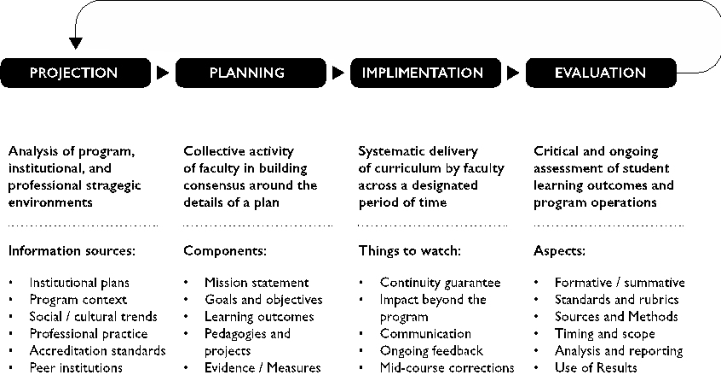
academic career. Rather a curriculum is promise from faculty to students to provide education that is relevant and hire-able. “From the very begin- ning, design has involved not only a critique of given conditions but also self-criticism” (Spitz et al., 2021). Self-reflection and criticism are not only things that students need do but faculty need to do as well especially with curriculum. There are many reasons to review a curriculum changeover of faculty, address declining relevance, exploring new areas of study, aligning with the university’s mission and values. “Programs really want curricula that are agile, anticipatory of changes in the field, open to individual faculty con- tributions and manageable in scope and scale” (Davis, 2017). One benefit of serious review of any curriculum is to “open the program to new audiences” (Davis, 2017). Ultimately, a curricular review involves a cyclical and criti- cal critique of the program involving “projection, planning, implementation, and evaluation.”
Figure 2: Curricular design process chart from meredith davis’ book teaching design.
The chart in Figure 2 highlights the cyclical method for redesigning a cur- riculum. There are many aspects and stakeholders at each stage of the process some of which faculty have a measure of control over such as program con- texts, missions, goals and objectives, student learner outcomes, and evidence and measures. But some aspects faculty do not have much control over such as Institutional plans, social / cultural trends, professional practice, accred- itation standards. When redesigning a curriculum, it is advised for faculty to develop a plan with longevity in mind and to be evaluating and assessing curriculum often rather than continual redesign. However when doing any redesign or trying something new, issues may crop up. “Anyone who acts will make mistakes. …We’re usually wiser after the fact. And what do we learn from this? – From the very beginning, design has involved not only a critique of given conditions but also self-criticism” (Spitz et al., 2021). The ability to critically review curriculum and act according will provide students with the best possible skillset in the profession.
146 Feld
CONCLUSION
“The content of an educational experience needs to ensure that students grasp the concepts at the heart of the discipline and the overarching content of a strong general education in order to make sense of more profound changes in the culture at large” (Davis, 2017). For a program to have a relevant curricu- lum there needs to be clear goals for the faculty and students. “Because design is a rapidly evolving field, faculty must anticipate the lifespan of different kinds of knowledge” (Davis, 2017). This is an easy statement but with tech- nology and manufacturing growing at exponential rates it can be extremely difficult to keep up. It can be argued that when a faculty member graduates from a master’s degree, their skillset is already out of date. Keeping up with technology and trends can be daunting when coupling that with a teaching load. Rapid advances also have the potential to create trends which, by their definition, do not have a long life. The goals of a program can be overarching but also need to not be based on elements that change often.
The Methods of a program come from the faculty. For young faculty, this has the potential to be how they learned. But as faculty gain experience with the workload, they free up time to focus on researching new and updating outdated methods, not be working to produce more of the same. “If many of our intrinsic values remain similar, our operational methods have signifi- cantly changed. And with these changes should come attitudinal differences and pedagogical shifts in industrial design education” (Giard, 1999). What this means is that faculty have a toolkit and work to disseminate that toolkit to students. But the toolkit is not seen as the be-all-end-all of ways of design. To assume that there is one way to design anything is a top-down, myopic view. That view is based on a hierarchy that places the teacher always above the student, similar to historical design education and the “stand-alone- designer” ideal. Being open to new methods and new avenues of learning means that a faculty member may be a student as well as a teacher.
As faculty progress, the subject matter may be similar but the delivery can always be questioned and improved. In the 2011 film Jiro Dreams of Sushi, a story of Jiro Ono, a Michelin rated sushi chef considered to be the best in the world. Jiro is quoted to say “I do the same thing over and over, improving bit by bit. There is always a yearning to achieve more. I’ll continue to climb, trying to reach the top, but no one knows where the top is” (Jiro Dreams of Sushi, 2011). Developing a course is difficult, at first, but once it has been developed and delivered, faculty can continually work on its improvement.
This paper has dealt with the understanding of why curricular design is necessary. The abstract stated that the paper reflect upon the exploration of a program undergoing a, roughly, thirty-year curricular review. However, in the decision to explore, more information was needed to understand how and where to begin. In a small program, with roughly 60 students from first- year through fourth-year and current faculty hiring happening, the reflection has produced more questions than answers. But the research has led to an organic beginning of what does the program stand for (mission statement), how do we differentiate ourselves (region and faculty pedagogy), who are our students, and most importantly how can we best serve them?
Curricular Development in Industrial Design: An Initial Dive Into Understanding 147
REFERENCES
Davis, M. (2017). Teaching design: A guide to curriculum and pedagogy for college design faculty and teachers who use design in their classrooms. New York, Ny: Allworth Press. pp. 4, 9, 46, 48, 77, 81, 83. Giard, Jacques. Industrial Design Education: Incompatibility with Education in Art
and Architecture. July 1999, pp. 103–106. Jiro Dreams of Sushi. (2011). [Documentary] Magnolia Pictures. National Association of Schools of Art and Design. (n.d.). NASAD Handbook.
[online] Available at: https://nasad.arts-accredit.org/accreditation/standards-guid elines/handbook/ [Accessed 27 Jan. 2024]. pp. 129–130. Spitz R., Böninger C., Schmidhuber, S. and Frenkler, F. (2021). Designing design education: Weissbuch zur Zukunft der Designlehre. Stuttgart: Avedition GmbH. pp. 18–27.
LISTED IN THE AHFE DIGITAL BOOKSTORE CATALOGUE
Explore the complete digital volume
Interdisciplinary Practice in Industrial Design
Read this individual research paper free through the original publisher, or explore the full digital proceedings book.
ISBN 978-1-964867-20-5
Explore this ISBN in the AHFE Bookstore ↗Listed in the July 2026 bookstore catalogue; search by ISBN to confirm current availability · Digital book purchase optional