Adam Feld (2025). Haptic Affordance: A Study in Object Recognition and Feedback. In: Interdisciplinary Practice in Industrial Design. AHFE Open Access, vol. 183, pp. 179–187. https://doi.org/10.54941/ahfe1006439
Firefighters use the fire hose and hose couplings for navigation in burning structures that have low visibility due to smoke. However, current fire hose couplings are designed for a watertight seal but not for providing information to the firefighter. Fire-rated protection gloves reduce tactile sensation thus reducing the corresponding information perceived from objects, resulting in possible harm to the firefighter. This paper investigates the correlation between tactile information and how it is perceived, understood, and applied in high-stress firefighting situations. Research into visual and haptic perception as well as mnemonic learning methods was applied to the redesign of the fire hose coupling for non-visual, low-tactile-sensation situations to provide lifesaving information to firefighters.
Firefighters enter a burning structure for many reasons: to search for the origin of the fire, to reveal certain risk factors for the particular fire, and/or to search and rescue victims or fellow firefighters. Search and rescue being the most important factor for entering a burning structure. When firefighters train, they do so under controlled conditions: not under severe stress and can sometimes, but not always, see. When they are on the job, they are in uncontrolled conditions, under stress and vision is severely diminished/removed due to smoke. At this time, they have to rely on their other senses for information input. Due to lack of sight, they have an increased chance of becoming disoriented. To combat disorientation, firefighters have techniques to help keep them oriented inside a burning structure. A few of those orientation techniques/tools are: a left/right hand search, a Wide Area Search (W.A.S.) Rope, and the fire hose & fire hose coupling. The left/right hand search means the firefighter will start at a doorway, put their right or left hand on the wall and keep contact with it until they reach the person or go all around the room and end up back at the doorway. If they find the person before they get to the doorway, they know that all they have to do to exit the room is to turn 180
and put their other hand on the same wall they came in on, keep contact with that wall, and follow it back to the doorway. Sometimes a person will be in the middle of a larger room and a firefighter cannot reach them while keeping in contact
with the wall. In this case, a W.A.S. Rope is used. The W.A.S. Rope is a 100-foot length of rope, attached outside of the room or building and has a series of knots every 20 feet. The knots are in a pattern that consists of two knots close together (two–three inches apart) and then one knot that is an arm’s length away. They use the knot configuration to provide information on which direction is toward the outside. This information can be misread or misinterpreted.
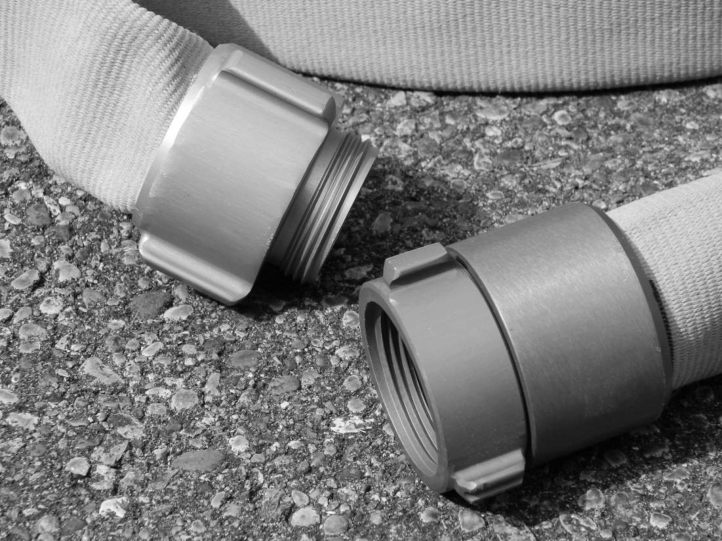
Figure 1: Male and female hose coupling.
If neither of those techniques work, they use the fire hose and hose coupling. To do so, they get on hands and knees and grope around on the floor to locate the hose. When they locate the hose, they follow it until they find a coupling. At this point, they grasp the coupling anyway they can to gain the most information from it, mainly the coupling lugs (see Figure 1). Lugs are projections on the exterior of the couplings, used for tightening and loosening hose sections. Firefighters are taught to feel for the lugs on a hose coupling. On the current coupling, the lugs on the female section are shorter in overall height and length, the male section are larger in both categories and often called the “long lug”. Firefighters use that knowledge to differentiate with side of the coupling is male and female. “However, you can determine which the “long lug” is, which is the male end coming up, that is what you follow” (Fire Chief interview). They use gloved hands to feel the coupling and it tells them which way is towards the fire and which way is out of the fire. They then follow the hose back to the truck and safety.
Haptic Affordance: A Study in Object Recognition and Feedback 181
This is possible because the hose is always connected in the same way with the male end on the side of the truck and the female end on the side of the fire. The problem with these techniques is that fire rated gloves are worn and the visual/haptic information can easily be misread or misinterpreted causing possible life-threatening danger to the firefighter. One firefighter said, “We try to use this to figure out how to get ourselves to safety and it’s tough to figure out which way to go.” The fire Chief goes on to state, “Once they get to the hose, and they determine which way is out, they will keep one hand on the hose and one hand out in front of them to make sure the floor is still there. Then you just keep following the hose and hope you made the right choice to go the correct direction.” This procedure is not something that firefighters want to have happen because if they have to employ this technique, it means they are in trouble. At times like this, firefighters hear alarms sounding in their helmet and could potentially be breathing heavily, using up more of the remaining oxygen from their tank. It is an extremely stressful situation. According to the U.S. Fire Administration, 1917 firefighters died from January 01, 2000 to December 25, 2014 (U.S. Fire Administration). Roughly 170 of those deaths were from being caught or trapped in the burning structure and nearly 800 were from stress or over exertion. BUT as much as they train, they are in a stressful situation and have the potential to misread the coupling. One firefighter said, “no matter how much they train, if you are wearing gloves, that coupling can be misread.” Since a firefighters’ first priority is their own safety, this is an opportunity to design a product that can make that situation less difficult to comprehend and therefore potentially save time and lives.
LITERATURE REVIEW
When we come into this world, we start learning, through our senses; primarily touch. That touch is referred to as Haptic Perception. The word Haptic is defined as being “able to lay hold of” something. This means a person can feel the objects and environment around them with their body. The Haptic System, James J. Gibson says, “has no ‘sense organs’ in the conventional meaning of the term” (Gibson, 1966: 53). The system uses the entire body from the skin to the muscles to the joints, all in conjunction for input. Gibson states that the hands and extremities are “exploratory sense organs.” Those “sense organs” allow a person to gather the information of their environmental surroundings and the objects that occupy them.
The fingers are separate and combined receptors. They can feel an object individually and in combination. This allows us to get a three-dimensional understanding of the object we hold. “…The haptic system can yield information about solid objects in three dimensions…” (Gibson, 1966: 102). This is important when we use our fingers to dynamically explore an object and are capable of gaining a better sense of what we are touching. “Note that when five fingers all touch an object, there are five distinct sensations of touch but there is a perception of only one object. Multiple touching of this sort yields haptic perception in the literal meaning of “laying hold of” (Gibson, 1966: 97). It can be said that when we do this, we not only understand what
182 Feld
we are touching in three-dimensions, but can also get a better understanding of the meaning or purpose of what we are touching. When we touch, we are searching for things that Gibson calls “tangible” properties, which are: 1) geometrical variables like shape, dimensions and proportions, slopes and edges, or curves and protuberances, 2) surface variables like texture, or roughness/smoothness, and 3) material variables like heaviness or mass or rigidity/plasticity. Yet we do not usually think of our hands or fingers as sense organs. We normally rely on our vision for our perception of objects and we use our hands and fingers to manipulate those objects rather than explore them. But touch “always accompanies and underlies visual sensitivity when the eyes are open and the observer is looking…. We become aware of haptic perception as such only when we must work in the dark, or without looking” (Gibson, 1966: 123). Gibson is saying that we use our haptic perception for many things and it is usually in support of our vision but we become more aware of it when we are put in a situation where we lose our sight.
As we age, and our brain develops, we are capable of understanding larger amounts of information. We start to use our vision, more than touch, to create memories. Eventually, we rely on our vision to drive our interactions with our environment and the objects and products that populate it. This is not to say that vision is the only way we perceive, but it tends to become dominant.
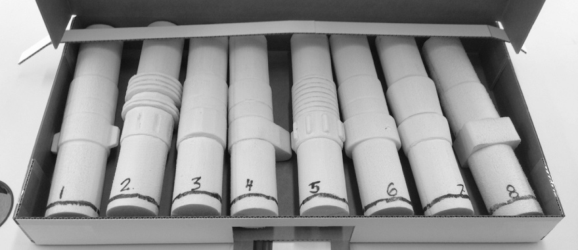
The term Affordance, originally defined by James J. Gibson (Gibson, 1950) refers to the visual understanding of our environment, as well as the objects within. In 2002, Donald Norman updated the term Affordance to Perceived Affordance to include, in the definition, objects not found in nature such as products (Norman, 2011: 228). Perceived Affordance means that we see a product and understand its use or interaction. Learning perceived affordances continues throughout our lives, however the term is primarily based on our visual perception. If we combine information from our visual and haptic perception, we can get a greater understanding. When we see a product, as adults, touch memories (haptic perception) are recalled and combined with our vision to get clues for its use. “Therefore the redundant, double guarantee of information” (Gibson 1966: 53), using touch and sight, has the ability to create stronger, more easily accessed memories, when dealing with products. But what happens when we cannot see? Can the touch memory be strong enough to provide the information necessary? Can our perceived affordances be strong enough to be accessed and understood by touch alone? Fire rated gloves reduce the tactile sensation to such a degree that a new design for the hose coupling is needed. The concept of Haptic Affordance means we can understand more about designs when we can see as well as touch. Modelling allows for a deeper level of conversation. Referring to what James Gibson says with exploratory sense organs you can create a 3D understanding of your model by touching it and that understanding is added to its visual perception” (Gibson 1966: 99). Models, machined on a 3-axis Computer Numeric Controlled (CNC) mill, have real dimensionality and allow physical interaction (Figure 2). This new design will utilize five key criteria that allow the retrieval of tactile information, while wearing fire rated gloves: 1) edge, 2) shape difference, 3) size difference, 4) pattern, and 5) repetition of shape.
Haptic Affordance: A Study in Object Recognition and Feedback 183
Figure 2: Milled coupling models.
METHODS AND PROCESSES Experiment ONE
The control experiment, delivered to non-firefighters, consisted of eight concept models, a pair of gloves (a representation of a firefighter glove), a pair of swim goggles with the lenses blacked out, and three questions/responses recorded with a video camera. Concept models had markings to indicate which side is the truck/safety and which side is the fire/danger. Respondents had no prior knowledge of the project and were given only a brief description of the research so they could answer the questions based on the concept models. Here is the text from the description: “This project deals with Haptic Affordances and the retrieval of information from objects. The project is the redesign of the fire hose coupling. When firefighters train, they train in ideal conditions meaning they are not in a stressful situation and they have the ability to see. However, in working conditions, the first thing that is removed is sight because of the smoke produced by the fire. Because of the lack of sight, they have an increased chance of getting into dangerous situations like disorientation. If a firefighter gets disoriented, they use the fire hose to tell them which direction is out. This is possible because the hose is always connected in the same way with the male end on the side of the truck and the female end on the side of the fire. The current problem is that the information can easily be misread or misinterpreted causing possible severe danger to the firefighter. The goal is to create a hose coupling that will provide better tactile information to the firefighters to allow a greater chance of escaping a fire safely.”
As they held the models, they would answer the questions based on what they felt through their gloved hands. They were asked three questions: What do you feel? Which way is out? Why?
Things Learned from Experiment ONE
Models need more realistic dimensionality in details; limitations of the CNC mill.
The gloves, simulating firefighting gloves, were not correct.
Respondents would describe the shape changes in terms of direction of water flow.
184 Feld
Experiment TWO A modified version of the control experiment one was performed with the assistance of three firefighters but with a different description of the experiment, due to the fact that information about the fire hose coupling and evacuation procedures, would have been redundant. Here is the modified text for the second experiment.
“This thesis deals with Haptic Affordances and the physical retrieval of information from objects. The project is the redesign of the fire hose coupling. Information can easily be misread or misinterpreted causing possibly severe danger to the firefighter. The goal is to create a hose coupling that will provide better information to the firefighters to allow a greater chance of escaping a fire safely.”
Things learned from the firefighters in Experiment TWO-
Could not determine information designed into the models.
Looked for a frame of reference, which is the separation of the male and female sides of the coupling. On these foam models, that separation was not pronounced.
Could not feel subtle changes in size or shape.
Designed attributes that were round just felt like a larger cylinder.
Female end should be physically larger, to be able to house the male end.
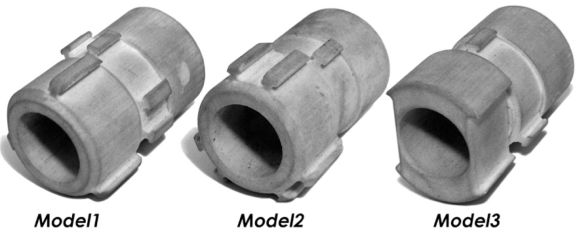
The first two experiments lead to a refinement of the design utilizing the feedback from both groups resulting in three new coupling designs (see Figure 3). These models were shown to a fire engine company. In this instance, firefighters had the opportunity to see the models first and then to feel them wearing gloves and a hood covering their face. Feedback revolved around liking shape and scale variation but concern with interaction with the debris from fire.
Figure 3: Refined concept models.
Experiment THREE This experiment took place at a Fire Training Facility with four instructors and thirty-two recruit trainees. It was similar to the initial experiments except that the firefighters did not sit at a table or wear goggles; rather they stood and closed their eyes or looked up at the ceiling.
Haptic Affordance: A Study in Object Recognition and Feedback 185
Things Learned in Experiment THREE
When dynamically exploring, Firefighters relied on pinching and rubbing with the flat part of their thumb or forefinger over edges.
Hose Models 1 and 3, they could not feel the separation in the small or large lugs. The gap between them should either be larger to allow for the feel of a difference or closer together and add a third lug to the set.
They heavily used mnemonics when dynamically exploring with the intent to “feel” what their mnemonics explained.
Greater dimensionality of the 3D printed parts provided a better frame of reference between the male and female coupling parts.
Pointed the male end directly away from their body, when describing the way out.
The long lug, on the male side, is something they feel for as a starting point.
The second and third hose coupling models were more “obvious” and made the decision easier for differentiation.
The final design needs to work with a spanner wrench because of the need to disconnect the coupling and drain the hose after a fire.
RESULTS
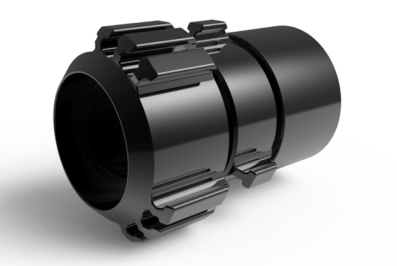
When dealing with touch alone, visual memory is necessary. Gibson taught that haptic perception allows us to feel things like edges, differences in shape and size, patterns, and the repetition of shapes (Gibson, 1966: 117). We learned from Don Norman that, as we age, our interactions with products become primarily vision based (Norman, 2011). That touching creates a three-dimensional mental image that relates to things in their touch memory. For example, when the firefighters felt the hose coupling models, they described features they knew by sight such as the lugs or the “swivel” portion of the female coupling. The design helped to overcome any confusion by creating a haptic difference (using size and repetition of shape) based on existing firefighter knowledge. The discussion revolved around having a big enough difference to make the decision easy. Observations showed that mnemonics, anything that aids in the understanding and retention of information, play a role in the retrieval of information from an object. Mnemonics provide not only a verbal description of something physically tangible but also a visual representation, thus creating a mental image. Firefighters have extensive training and rely heavily on mnemonics to assist in retention. They use mnemonics as verbal descriptors of visual and tactile sensation. “2 to 1 to the sun” is used in reference to the W.A.S. rope. “Little to Big to the Rig” and “Smooth-Bump-Bump-to-the-Pump” in reference to the lugs on the fire hose. These mnemonics provide the firefighter a mental image to seek out using their hands and fingers. After the three experiments, it was determined that hose-coupling 3 was the most successful as the addition of the two lugs, the object still worked with current tools as well as had the Haptic Affordance that could be felt while wearing fire rated gloves. If we combine these three learned concepts: haptic memory, perceived affordance,
186 Feld
and mnemonics, we get a Haptic Affordance. In a Haptic Affordance, the user can touch an object, get a picture of it in their mind, and retrieve information from that object as to its use.
CONCLUSION
Human beings come into the world relying on touch and, as they get older, rely on visual perception of the world. People are visual creatures and mental images help understanding of the world they touch. In visual perception, if we are searching for something lost our brain makes an image of that something and filters objects that do not match its description. Haptic Affordance builds off of our visual perception and attempts to match the mental image with the tactile sensation. This can be difficult since physically touching objects can be misread especially while wearing fire rated gloves. It is at these times that mnemonics act as a filter and provide a mental image to help understand objects faster. It therefore can be said the redundant, “triple” guarantee of information, using touch, sight, and mnemonics has the ability to create stronger, more easily accessed memories. Understanding and using objects faster and safer, through the use of touch, provided the means for the creation of a new hose coupling for firefighters. Research into haptics and affordance provided the information to make that possible.
Figure 4: Final concept.
REFERENCES
Buxton, B. (2007). Sketching user experiences. San Francisco: Morgan Kaufmann. Cincinnati’s firefighting history. (n.d.). Retrieved January 20, 2011 from http:// www.cincyfiremuseum.com/history-timeline. Cognition. (n.d.). Retrieved October 21, 2012 from http://en.wikipedia.org/wiki/
Cognition. Firefighting. (n.d.). Retrieved, November 19, 2012 from http://en.wikipedia.org/ wiki/Firefighter. Gibson, J. (1976). The theory of affordances. Hillsdale: Lawrence Erlbaum Associates, Inc. Gibson, J. (1966). Senses considered as perceptual systems. London: George Allen &
Unwin Ltd: 53, 97, 102, 117, 123.
Haptic Affordance: A Study in Object Recognition and Feedback 187
Haptic perception. (n.d.). Retrieved September 11, 2012 from http:// en.wikipedia.org/wiki/Haptic_perception. Kelley, T. (2001). The art of innovation. New York: Doubleday: 71. Martin, B., & Hanington, B. (2012). Universal methods of design. Beverly, Massachusetts: Rockport Publishers: 92. Norman, D. (2004). Emotional design. New York: Basic Books. Norman, D. (2011). Living with complexity. Cambridge, Massachusetts: The MIT
Press: pp. 228–29. Norman, D. (1988). The design of everyday things. New York: Basic Books. Schon, D. (1983). Reflective practitioner. New York: Basic Books. United States Army, U.S. Army Missile Command. (1992). Human factors engineering design for army materiel metric (MIL-HDBK-759B). Redstone, AL: Department of Defence. U.S. Fire Administration (n.d.) Retrieved January 5, 2017 from http:// apps.usfa.fema.gov/firefighter-fatalities/#search.
LISTED IN THE AHFE DIGITAL BOOKSTORE CATALOGUE
Explore the complete digital volume
Interdisciplinary Practice in Industrial Design
Read this individual research paper free through the original publisher, or explore the full digital proceedings book.
ISBN 978-1-964867-59-5
Explore this ISBN in the AHFE Bookstore ↗Listed in the July 2026 bookstore catalogue; search by ISBN to confirm current availability · Digital book purchase optional