Pascal Rommel, Enzo Castagna, Daniel Holder, Thomas Maier (2026). Morphing Systems: Analysing the Influence of Different Parameters on the Perception of Morphing. In: Intelligent Human Systems Integration (IHSI 2026): Disruptive and Innovative Technologies. AHFE Open Access, vol. 200, pp. 639–649. https://doi.org/10.54941/ahfe1007122
Gestalt-changing products allow customers to tailor a product to their individual needs or enable the product to adapt to them. While the initial and target states of such changes are often clear, the kind of change and how it is perceived by the user are often unclear but essential. Morphing is a special form of gestalt change, in which the transformation is perceived as a smooth change over time (Rommel et al. 2025). The defined characteristics help to categorize morphing and allow a comparison to other types of gestalt changes. At the same time, different parameters were identified which allow a high degree of variety. This paper analyses these parameters in detail to determine how they influence the perception of a gestalt change as morphing. To investigate these parameters, an online survey was conducted with n = 103 participants. In the survey, 11 different gestalt changes were presented and evaluated. Two of these served as references: one representing a purely morphing change and the other a purely distinct change. According to Seeger (2005), a product’s gestalt can be divided into four subgestalts: layout, shape, colour and surface and graphic. To assess whether a change in a single subgestalt is perceived as morphing, and to identify which subgestalt is most dominant in shaping this perception, four animations were designed in which only one subgestalt changed. Additional models were included to examine how combinations of smooth and erratic transitions affect the perception of a gestalt change as morphing. The study also explores the impact of transition speed and animation curves. After viewing each animation, participants completed a questionnaire assessing both, the overall perception of the gestalt change and the specific morphing characteristics observed during the transition.The results of the online survey provide a basis for distinguishing morphing from other types of gestalt changes. More importantly, they suggest morphing should be understood as a spectrum, where specific parameters can enhance or diminish the perception of a change as morphing. The data also shows that certain subgestalts have a stronger influence than others. Specifically changes in layout have a high impact on a change being perceived as morphing. Moreover, it can be seen that short changing times, combining distinct and morphing changes and certain animation curves can disrupt or even break the perception of morphing entirely. Finally, changes in specific subgestalts, like the layout, more strongly contribute to perceiving the resulting gestalt as a distinctly new one.The article provides reliable statements on the possible parameter spectrum for morphing. Based on these results, further investigations are possible, especially in comparison to other types of gestalt change. Rommel et al. 2025 Rommel, Pascal; Holder, Daniel; Schmid, Peter; Maier, Thomas: Morphing Systems: Defining the Characteristics of Morphing in Modern Product Design. In: Stuttgarter Symposium für Produktentwicklung SSP 2025: Tagungsband zur Konferenz, 2025, p.199-209Seeger 2005 Seeger, Hartmut: Design technischer Produkte, Produktprogramme und -systeme: Industrial Design Engineering. Berlin, Heidelberg: Springer Berlin Heidelberg, 2005
Gestalt-changing products allow customers to tailor a product to their needs or enable to adapt to them. While the initial and target states of such changes are often clear, the type of change and how it is perceived remain less defined but crucial (Rasmussen et al., 2012).
Morphing is a specific type of gestalt change, defined as a transformation which is perceived as a smooth change over time (Rommel et al., 2025). The defined characteristics allow morphing to be distinguished from other types of gestalt changes. However, these characteristics have different parameters with a wide variety. The central question, therefore, is how these parameters must be set for a change to be perceived as morphing and how they influence the perception of the gestalt change.
This paper presents an online survey examining how parameters such as subgestalt changes, duration and the animation curves affect the perception of a gestalt change. Particular attention is given into morphing, exploring whether it should be seen as a spectrum in which certain parameters amplify or diminish the morphing effect.
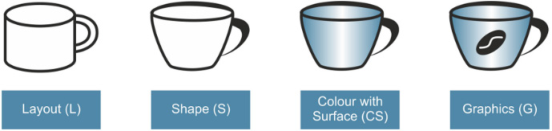
State of the Art One key parameter under consideration are the subgestalts of an object. According to Seeger (2005) and Holder et al. (2019), the gestalt of an object can be divided into four subgestalts: layout, shape, colour/surface and graphics.
The layout refers to the arrangement and proportions of the basic bod ies an object is made of (Seeger, 2005; Holder et al., 2019). For example, in Figure 1, the cup consists of a small cylinder for the handle and a large cylinder for the cup body.
The shape is the sum of all uncoloured forms of the unlabelled gestalt. This includes all lines and the surface transitions (Seeger, 2005; Holder et al., 2019). In Figure 1 the cup’s layout remains consistent, but the basic bodies adopt more conical and curved shapes.
Colour and surface describe all texture elements given to the unlabeled gestalt (Holder et al., 2019). These include hue, saturation, brightness and surface texture. In Figure 1, the cup is shown in bright blue colour with a glossy finish.
Graphics cover applied graphical elements such as symbols and letters (Seeger, 2005; Holder et al., 2019). In Figure 1, for instance, the cup bears a coffee bean symbol.
Figure 1: Subgestalts layout, shape, colour and surface and graphics (Holder, 2019).
Based on this definition, a gestalt change occurs whenever one of the subgestalts change (Rommel et al., 2025). This raises the question of how changes in individual subgestalts influence the perception of morphing com pared to changes to the entire gestalt.
Rommel et al. (2025) define five key characteristics of morphing.
1. A change in one or more subgestalts, 2. An integrative gestalt for the initial and target states, (Bürdek, 2015) 3. A change occurring over time, 4. Perceivability of the change and 5. A smooth transition (achieved through sufficient intermediate states with integrative gestalts).
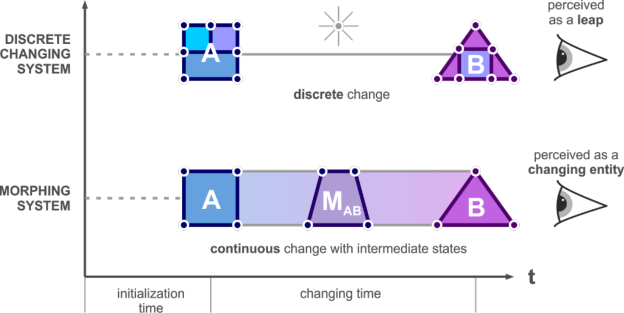
These characteristics are illustrated in Figure 2, which contrasts morphing with a discrete change. In a discrete change, the transition from initial to tar get state is instantaneous. In a morphing change, by contrast, the initial and target states are experienced as a unified whole, changing smoothly and con tinuously over time. Whereas a discrete change appears as a leap, morphing is perceived as a gradual, perceivable transformation (Rommel et al., 2025).
Morphing Systems: Analysing the Influence of Different Parameters 641 While these characteristics define morphing, they also involve a wide range of parameters to be investigated. For instance, although a change in a single subgestalt constitutes as a gestalt change, it remains unclear how its impact on the morphing effect compares to changes in other subgestalts or whether such differences exist at all. Similarly, the required timeframe for a gestalt change to be perceived as morphing is undefined.
Figure 2: Comparison morphing to a discrete change (Rommel et al., 2025).
Another important aspect is the role of the animation curve. Even when changes occur within the same overall timeframe, different distributions of change can lead to different perceptual effects. It is therefore necessary to compare the perception of the morphing effect of a standard linear transition to other non-linear transition curves.
Methodical Approach To investigate these parameters, eleven different gestalt changes were ani mated using Blender (Blender, 2025). In most cases, simple basic bodies were used to minimize the number of changing elements to ensure that the atten tion was focused on the parameter under study rather than multiple simulta neous elements changing.
The animations include a morphing change, in which all subgestalt change, four animations in which only one subgestalt changes and one with a dis crete change. The morphing animation, with every subgestalt changing, and the discrete change are used as references to draw conclusions about the other animations and to validate the morphing definition and characteris tics proposed by Rommel et al. (2025). By comparing the single subgestalt changes to these reference cases, the influence of the individual subgestalts on the perception of morphing can be analysed.
In addition, one animation combined morphing and discrete changes by showing a morphing layout and shape change in combination with a discrete colour and graphics change. This setup was designed to investigate whether a mixture of change types disrupts the perception of morphing. Another ani mation maintained a constant volume throughout the transformation, as real
products conserve volume when their layout changes. This allows for an anal ysis of whether a constant volume influences the perceived morphing effect. To approximate a more realistic product scenario, an additional animation depicting a cyan teacup with a tea-bag graphic morphing into a cappuccino cup with a coffee-bean graphic, is added. The graphical transformation was implemented with the help of a Reeb diagramm (Kanonchayos et al., 2002).
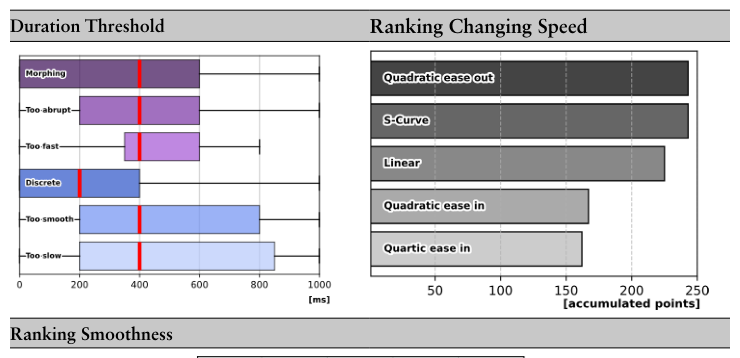
Two further animations examined the effects of duration and animation curve on the perception of morphing. In both cases, five objects were ani mated simultaneously to allow direct comparison and to shorten the overall survey duration. In the first animation, the five objects differed in transfor mation time (200, 400, 600, 800 and 1000 ms) to explore how duration affects the perception of a morphing change. In the second, all animations shared the same duration but followed different animation curves (linear, quadratic ease-in, quadratic ease-out, S-curve and quartic ease-in) to analyse how the curve shape influences perceptual outcomes.
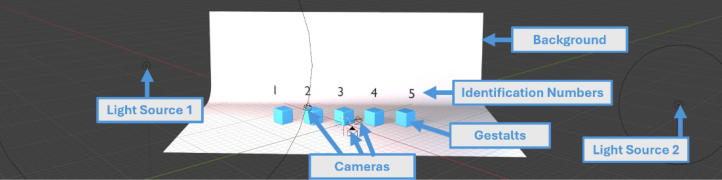
All animations were five seconds long, consisting of 120 frames, unless otherwise specified. The discrete change was derived from the morphing ani mation by setting the transformation duration to 1 frame. To ensure con sistent conditions across all stimuli, a standardized studio environment was created in Blender with identical lightning and background settings, which can be seen in Figure 3.
Figure 3: Created studio background in Blender.
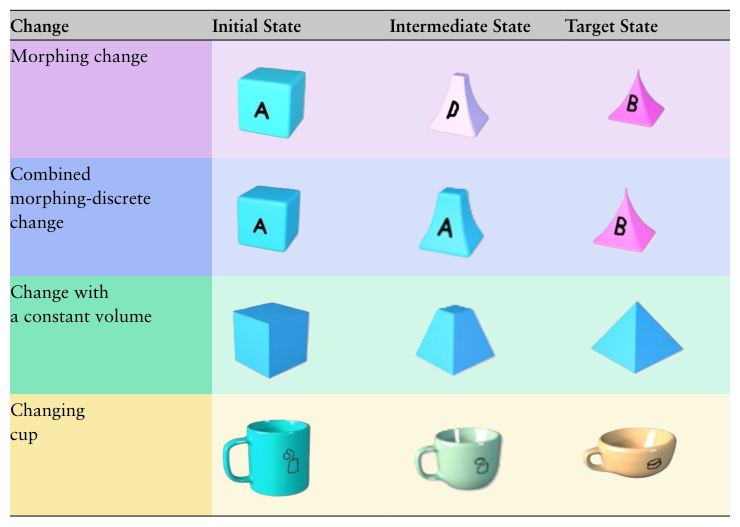
The resulting animations are summarized in Table 1. The first row shows the morphing animation, in which the layout changes from a cube to a pyra mid, the form becomes narrower, the colour transitions from blue to purple, and the graphic changes from “A” to “B”. Based on this animation, four addi tional versions were created in which only one subgestalt changes, while the others remain constant. For the layout change a cube turns into a pyramid, for the form change the layout starts as a pyramid and during the duration the edges of the pyramid become narrower, for the colour change the blue square changes into a purple square and for the graphic change the label A on a blue square change into a B.
The second row depicts the combined morphing-discrete change, followed by the constant- volume animation in the third row. The fourth row presents the cup transformation.
Morphing Systems: Analysing the Influence of Different Parameters 643 For the time and animation curve comparison, the animation from row one was used as a base. because the difference of these animations wasn’t noticeable enough, without a direct comparison.
Finally, an online survey was conducted via soscisurvey.com (SoSci2025) to reach a broad audience. In this survey, participants are shown the eleven different gestalt changes in a randomised order and asked to evaluate them. After each animation, a questionnaire is presented, containing seven evalu ation questions (originally in German), which can be seen in Table 2 in the second column, for the nine animations, with only a single gestalt change.
All questions are answered using a six-point Likert scale (Reinecke, 2022), except the first question, which required a binary “yes” or “no” response. For question 2 to 6, the scale ranged from “I totally disagree” to “I totally agree”. A six-point scale was chosen deliberately to avoid a neutral midpoint and to capture clearer tendencies in the participants responses.
Table 1: Animated gestalt changes in blender.
The aim of these questions is to assess to what extent the presented gestalt changes fulfill the defining characteristics of morphing and how strongly they were perceived as morphing.
For the two comparison animations, different sets of questions are used. In the time comparison, participants are asked to select the animations that they perceived as a threshold to the aspects, which can be seen in Table 2 in the third column.
Table 2: Questions of the survey.
Table available in the original PDF paper.
Questions to: Single Gestalt Animation Comparison Animations
1. Did you perceive a change? Too fast for morphing
2. Did you perceive the change as morphing?
Too erratic to be perceived as Morphing Classifiable as a discrete change
3. Did you perceive the change as a discrete change?
4. Did you perceive the gestalt during the change as one entity?
Too slow to be perceived as a discrete change
5. The target state seems like a new gestalt.
Too smooth to be perceived as a dis crete change Classifiable as morphing
6. Did you perceive the change as smooth?
For the animation curve comparison, participants are asked to sort the animations in two ways: first, from the softest to the most erratic, and sec ond, from the slowest to the fastest.
As in many online studies, some questions or terms may be misunderstood due to the absence of a supervisor who can provide clarification. To miti gate this risk, the survey included an introductory page explaining all key terminology, and each subsequent page provided the option to revisit these explanations. The explained terms included gestalt, morphing and its defin ing characteristics, as well as the concepts of additive and integrative gestalt.
Results
The online survey was completed by n = 104 participants, whose responses were included in the analysis. Of these participants 67,31% identified as male, 31,73% as female and 0,96% as diverse. The participants ages ranged from 17 to 57, with the majority between 20 to 30 years old.
Table 3 presents the results for question 1 to 6. For the questions 2 to 6 the statistical significance was assessed using the Friedman test to determine whether overall differences existed. The Friedman test showed an extreme sig nificance for the questions, perceived as morphing (χ² = 231, p = 1.50e^−45, W = 0,278), perceived as a discrete change (χ² = 206, p = 6, 07e^−50, W = 0,303), perceived as one entity changing (χ² = 231, p = 1, 56e^−71, W = 0,425), perceived as a new gestalt (χ² = 480, p = 1,18^−98, W = 0,577) and perceived as a smooth change (χ² = 381,p = 2.15e^−77, W = 0,458). Subsequently, post-hoc comparisons with a Bonferroni correction were conducted to iden tify where these differences occurred.
The first question (“Did you perceive a change?”) was answered with a “yes” by the majority of participants.
The results of the second question (“Did you perceive the change as mor phing?”) indicate that, except for the fully discrete change, the animations were generally perceived as morphing. However, variations were observed in the degree of agreement. In particular, animations involving layout changes were rated significantly more as morphing than those involving other subge stalts, with the exception of the combined morphing-discrete change.
Morphing Systems: Analysing the Influence of Different Parameters 645 These findings are supported by the results of question 3 (“Did you per ceive the change as a discrete change?”), which show an inverse pattern rela tive to question 2. An interesting exception is the combined change, in which layout and shape morphed while colour and graphics changed discretely. This animation was perceived both as morphing and as a discrete change, suggesting a mixed perceptual categorization.
Apart from the discrete and combined changes, which have a significant difference to the other animations, participants generally agreed that the transformations were perceived as one continuous entity and as smooth changes.
Regarding question 5 (“The target state seems like a new gestalt”), the results show that transformations involving more than one subgestalt were more often perceived as resulting in a new gestalt than those with a single changing subgestalt. When only the shape, colour, or graphic changed, the final state was typically not perceived as a new gestalt. In contrast, changes in layout were consistently significantly more associated with the perception of a new gestalt.
Table 3: Results of the singular gestalt changes.
Table available in the original PDF paper.
Was a Gestalt Change Perceived? Perceived as Morphing
Perceived as a Discrete Change Perceived as One Entity
Continued
Table 3: Continued.
Table available in the original PDF paper.
Perceived as a New Gestalt Perceived as a Smooth Change
Table 4 presents the results of the comparison between the five simultane ously displayed gestalt changes. The findings indicate that a duration of 400 ms was perceived by most participants as the threshold between a morphing and a discrete change. To evaluate the overall ranking of the different ani mation curves, a point-based system was applied, in which curves ranked as the fastest or smoothest by a participant received four points, while the lowest-ranked curves received zero points. The results show the accumulated points over all participants.
Table 4: Results of the five simultaneous changes.
DISCUSSION
The results of the study demonstrate that morphing is not a discrete state but rather a continuous spectrum in which different parameters influence the perceived effect. The first parameter examined was the type of subgestalt involved in the change. The findings show that although all subgestalts can produce a morphing effect, the strength of this effect varies. Changes to the body-related subgestalt, namely layout and shape, were rated more as mor phing, while surface-related subgestalts, such as colour and graphics, elicited a weaker morphing impression. Especially layout has a significant difference to the other subgestalts, while not having a significant difference to the com pletely morphing change.
Although all subgestalts fulfilled the formal characteristics of morphing to a similar degree, a clear difference emerged in whether the final state was perceived as a new gestalt. Here, layout changes have a significant stronger influence, suggesting that the perceptual difference between the initial and final states correlates positively with the perceived strength of the morphing effect. However, the results for the discrete change indicate that fulfilling the morphing characteristics remains a necessary condition for the effect to occur.
If only one subgestalt changes, layout changes tend to produce the impres sion of a new gestalt, whereas changes in shape, colour, or graphics are gen erally perceived as modifications of the same gestalt. When comparing the morphing-discrete change to the single-subgestalt changes, the combined transformation produced the lowest perceived morphing effect yet a non-sig nificant difference in being perceived as a new gestalt compared to layout. This can be explained by its perception as more erratic, abrupt, and faster than the other changes. The combined change also showed a significant lower level of agreement regarding the perception of a single continuous entity. As this animation was the only one classified simultaneously as morphing and as a discrete change, it can be hypothesized that combinations of different change types may be perceived as two separate gestalts transforming rather than one continuous transformation. The constant-volume change, which involved only a layout transformation, can be directly compared with the standard layout change. The results don’t show a significant difference in one of the questions. This indicates that, for a morphing effect to occur, the body does not necessarily need to increase or decrease in size, shifts in pro portion alone are sufficient. The cup transformation, a change in which all subgestalts were modified, including proportional adjustments to the layout, was perceived differently. Despite involving all subgestalts, the final state was significantly less often identified as a new gestalt compared to the other full-gestalt changes. This suggests that particularly the transformation of the basic body structure within the layout has a strong influence on whether the final state is perceived as a new gestalt.
The analysis of duration and animation curves further show that a gestalt change is perceived as too fast or abrupt when the amount of change (chang ing volume) is too high for the given timeframe. The results in Table 3 show that for this linear animation, approximately 400 ms represents the thresh old between a morphing and a discrete perception. However, this threshold is
likely dependent on the gestalt being changed and varies with the magnitude of the changing volume, but confirms that such a threshold does exist.
In the comparison of animation curves, linear changes were perceived as both the smoothest and of average speed, likely because the changing volume was evenly distributed over the transformation duration. The high ratings for the quadratic ease-out and S-curve animations indicate that transformations with an early leap of changing volume are perceived as faster than those with a late leap, even when the latter involves a stronger leap. The smoothness ratings further show that the more evenly the changing volume is distributed over time, the smoother the transformation is perceived.
SUMMARY This paper presents an online study in which eleven different gestalt changes were evaluated to analyse the parameters influencing the characteristics of morphing transformations. The findings show that morphing is a gestalt change in which different parameters can intensify, weaken or even disrupt the perceived effect. The results indicate that the type of subgestalt has a sig nificant impact on this perception. Changes affecting the body of the object produce a stronger morphing impression, whereas surface-related changes contribute less to the effect. A similar pattern was observed in the percep tion of the final gestalt: transformations involving layout changes were more often perceived as resulting in a new gestalt than those limited to surface modifications.
Furthermore, the study highlights the crucial role of changing volume dis tribution over time. When the degree of change is evenly distributed across the transformation duration, the result is perceived as smooth and thus more characteristic of morphing. In contrast, spikes or uneven distributions of change volume lead to perceptions of abruptness, diminishing or even breaking the morphing effect. Overall, the findings demonstrate not only how morphing can be effectively achieved through the adjustment of key parameters but also how these parameters influence the perceptual qualities of a gestalt change to varying degrees. These insights enable a more precise categorization and combination of gestalt change types, providing a foun dation for future research on additional parameters and their effect on user perception and experience.
ACKNOWLEDGMENT
This research was supported by the German Federal Ministry for Economic Affairs and Climate Action on the basis of a decision by the German Bundestag in the research project “SALSA – Smart, Adaptive and Learnable Systems for All”.
REFERENCES
Blender (October 15, 2025) Blender Institute B.V.; The Blender Website: https:// www.blender.org/. Bürdek, B. E. (2005). “Der Ingenieur und seine Designer” 4. Aufl. Springer-Verlag
Berlin Heidelberg, Berlin.
Morphing Systems: Analysing the Influence of Different Parameters 649 Holder, D., Inkermann, D.; Krasteva, P; Vietor, T., Maier, Thomas (2019): “Integrated
Product Gestalt Design Method for the Analysis and Definition of Interface Elements Regarding Exterior and Interior.” In: Springer, Cham: Proceedings of the 20th Congress of the International Ergonomics Association, 2018, volume 824, pp. 888–897. Kanonchayos, P; Nishita, T; Yoshihisa, S. und Kunii, T. L. Kanonchayos, P; Nishita, T; Yoshihisa, S; Kunii, T. L. (2002) “Topological morphing using Reeb graphs”, in First International Symposium on Cyber Worlds, 2002. Proceedings, 6–8 Nov. 2002, Tokyo, Japan, IEEE Comput. Soc, pp. 465–471. Rasmussen, M. K; Pedersen, E. W; Petersen, M. G. und Hornbæk, K. (2012), “Shape-
changing interfaces”, in Konstan, J. A., Chi, E. H. und Höök, K. (Hg.), Proceedings of the SIGCHI Conference on Human Factors in Computing Systems, 05 05 2012 10 05 2012, Austin Texas USA, ACM, New York, NY, USA, pp. 735–744. Reinecke, J. (2022) “Grundlagen der standardisierten Befragung”, in Baur, N. und Blasius, J. (Hg.), Handbuch Methoden der empirischen Sozialforschung, Springer Fachmedien Wiesbaden, Wiesbaden, pp. 949–967. Rommel, P., Holder, D., Schmid, P., Maier, T. (2025) “Morphing Systems: Defining
the Characteristics of Morphing in Modern Product Design.” in Stuttgarter Symposium für Produktentwicklung SSP 2025: Tagungsband zur Konferenz, 2025, pp. 199–209. Seeger, H. (2005). Design technischer Produkte, Produktprogramme und-systeme: Industrial Design Engineering. Berlin, Heidelberg: Springer Berlin Heidelberg, 2005. SoSciSurvey (October 15, 2025) SoSci Survey GmbH; The SoSci Survey Website:
https://www.soscisurvey.de/de/index.
LISTED IN THE AHFE DIGITAL BOOKSTORE CATALOGUE
Explore the complete digital volume
Intelligent Human Systems Integration (IHSI 2026): Disruptive and Innovative Technologies
Read this individual research paper free through the original publisher, or explore the full digital proceedings book.
ISBN 978-1-964867-76-2
Explore this ISBN in the AHFE Bookstore ↗Listed in the July 2026 bookstore catalogue; search by ISBN to confirm current availability · Digital book purchase optional