Lars Gadermann, Lutz Fischer, Daniel Holder, Niklas Ihle, Julius Schlecht, Thomas Maier (2023). Design strategies compared: How eHMI are perceived in relation to the exterior design of automated vehicles. In: Ergonomics In Design. AHFE Open Access, vol. 77, pp. 573–584. https://doi.org/10.54941/ahfe1003417
1 Institute for Engineering Design and Industrial Design, Dept. Industrial Design Engineering, University of Stuttgart, Pfaffenwaldring 9, 70569 Stuttgart, Germany ↗
Communication between road users, especially between vulnerable road users and drivers, is an important part of road traffic. Often, small nuances such as gestures, facial expressions or eye contact determine the subsequent behaviour of those involved. For example, eye contact with the driver helps pedestrians to make a decision about when to cross the road. With automated vehicles (AVs), the ability to communicate with the person in the driver's seat is limited, as they no longer necessarily control the vehicles behaviour. AVs perceive their environment via a multitude of sensors. Towards the environment, however, a communication channel has been missing until the latest research about external human-machine interfaces (eHMI). For eHMIs, there are various concepts and studies on design, modality and positioning. So far, there is a lack of experience on the integration of eHMIs into the exterior design of vehicles in terms of their perception by pedestrians and other road users. A large number of studies have already shown that vehicle exterior design has an influence on people's subjective perception and associated actions. In this paper, this preconditioning will be investigated in relation to the degree of integration of eHMI in interaction with visible or invisible sensor clusters. For this purpose, different degrees of eHMI integration are applied to a concept car and investigated in an eye-tracking study with regard to their influence on the sensations of other road users. This results in findings for the design of safety-relevant eHMIs to strengthen the trust in AVs among the general population.For this paper, we conducted a literature review on the design and limitations of designing of eHMIs. In particular, studies on the location of eHMIs, their modality (light, symbol or text) and colour stood out. In order to be able to make statements about the integration of eHMI into the vehicle exterior design, the research results were categorised according to the degree of integration into additive, integrative and integral eHMI.Since visual attention plays a significant role when viewing vehicles with eHMIs, the study was designed with eye tracking anaylsis. In this, the test persons are shown renderings in ¾ front and ¾ rear perspective of a concept vehicle on the screen, which represent different degrees of integration of eHMI. The stimulus patterns show additive eHMI in the form of attached roof bars, surrounding light text bands on the roof, as integrative eHMI as well as integral eHMI in the exterior design in the form of central, fully integrated display surfaces at the front and rear. In addition, to test interactions with the visibility of sensor clusters, each configuration was combined with both visible and invisible sensor clusters.The test persons evaluated each of the stimulus patterns by means of a questionnaire regarding their subjective impression in the context of use cases (road crossing scenario). The evaluation with regard to different factors provides statements about the system trust through eHMI, the appealing and recognisability of eHMIs as well as the interaction with the sensor clusters typical for automated vehicles.RESULTS AND CONCLUSIONThe research has shown that the type and degree of integration of eHMI into the vehicle exterior design is of relevant importance for design perception, evaluation and thus design. The degree of integration has an impact on perceptual factors such as recognisability or appealof AVs. To replace the subtle but efficient communication between driver and pedestrian in the context of a future vehicle exterior design, it is beneficial if the eHMI represents a salient stimulus and can be interpreted clearly.OUTLOOKFurthermore, it should be investigated whether vehicles with a personifying exterior design and a human-interacting eHMI (cf. Jaguar Eye-Pods) show more positive effects on communication and recognisability than conventional, machine-like eHMI. This would come close to merging classic vehicle design with robotic design, meaning the transfer of human characteristics to machines.ACKNOWLEDGEMENTSThis research was supported by Federal Ministry for Economic Affairs and Climate Action in the national research project RUMBA.
Communication between road users, especially between vulnerable road users and drivers, is an important part of road traffic. Often, small nuances such as gestures, facial expressions or eye contact determine the subsequ- ent behaviour of those involved. For example, eye contact with the driver helps pedestrians to make a decision about when to cross the road. With automated vehicles (AVs), the ability to communicate with the person in the driver’s seat is limited, as they no longer necessarily control the vehicles beh- aviour. AVs detect their environment via a multitude of sensors. Towards the environment, however, a communication channel has been missing until the latest research about external human-machine interfaces (eHMI). For eHMIs, there are various concepts and studies on design, modality and positioning (Carmona et al., 2021). So far, there is a lack of experience on the integra- tion of eHMIs into the exterior design of vehicles in terms of their perception by pedestrians and other road users. A large number of studies have already shown that vehicle exterior design has an influence on people’s subjective perception and associated actions (cf. Mandel et al., 2015; Reichelt et al., 2020).
In this paper, this preconditioning will be investigated in relation to the degree of integration of eHMI in interaction with visible or invisible sensor clusters. For this purpose, different degrees of eHMI integration are applied to a concept car and investigated in an eye-tracking study with regard to their influence on the sensations of other road users. This results in findings for the design of safety-relevant eHMIs to strengthen the trust in AVs among the general population.
THEORETICAL BASICS Automated vehicles have so far differed from conventional vehicles in their external appearance. Particularly noticeable are the sensors of AVs, which detect environmental influences and regulate the respective driving functions (Fischer et al., 2021). There is potential to optimally integrate these into the exterior design (Fischer et al., 2021). According to Fischer et al. (2021), sen- sors can be supplemented additively or integratively into the vehicle design. The same applies to eHMI. The external human-machine interface, which in the future will handle most of the communication between the AV and other road users, must be considered as part of the exterior, just like the sensors. While sensors have to fulfil certain positioning requirements with regard to the technical boundary conditions (Fischer et al., 2021), quick and clear recognisability is of great importance for the eHMI. The art of vehi- cle designers is to ensure this recognisability, for example via salient stimuli (Anderson et al., 2011), while at the same time maintaining a coherent and aesthetic exterior design. For eHMIs, there are already studies that deal with the modality, the positioning on the vehicle or the design of the interface. Eisma et al. (2020) found that positioning the eHMI in the grill, on the wind- screen or on the roof offers the best performance in terms of recognisability. The location of the eHMI in these positions does not have a significantly different impact on the perception of the respondents, but a positioning on the grill and windscreen is more in line with the usual visual behaviour of pedestrians and therefore useful (Guo et al., 2022). Eisma et al. (2020) also found in the study that an eHMI is also helpful on the side of the vehicle when the front is not visible, for example, when turning. This is supported by the research of Troel-Madec et al. (2019), where the vehicle fronts of a queue of cars were partially obscured and thus not visible to passers-by.
There are various studies on the modality of eHMI (cf. Beggiato et al., 2017; Burns et al., 2019; Carmona et al., 2021; Dey et al., 2021; Lim and Kim, 2022). Bazilinskyy et al. (2019) concluded that the text form with direct address of passers-by is best suited for quick information transfer for most people.
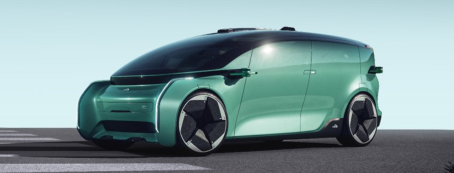
As it turns out, there are already various studies and knowledge of eHMI design, related to modality, positioning as well as the design and recogni- sability of eHMI itself. What has not been considered much so far, is a methodical and design-strategic investigation of the integration of eHMIs into the exterior design. In this paper, the integration possibilities of eHMI will be investigated on the basis of the exterior design of an example vehicle. The example used is a concept car from the federally funded research project RUMBA, see Figure 1.
Design Strategies Compared: How eHMI Are Perceived in Relation 575
Figure 1: RUMBA concept car.
The vehicle was designed by the design studio studiokurbos in Stuttgart as part of the project. It is an IC body with a rising front (I) and a cubic rear end (C) (Holder, 2016). This example vehicle is used to show the dif- ferent possibilities of integrating eHMI into the exterior design of vehicles. The type of integration is divided into additive, integrative and integral design (cf. Ferraris et al., 2017). In additive design, the eHMI is added to the actual vehicle design by means of a roof bar. The shape of the vehicle changes visi- bly. This is in contrast to integral design. Here, the eHMI is integrated into the existing vehicle design as far as possible. For this example vehicle, this is done via central displays in the black areas of the design. The vehicle design is hardly changed, the eHMI appears more like an additional graphic on the existing design, which is covered with colour. The third option of integrating the eHMI into the vehicle’s exterior is a kind of compromise between the two previously mentioned options. With integrative design, the eHMI is not fully integrated into the existing shape as in integral design, but the shape is not changed as much as in additive design. In this case, the eHMI is visualised via a quasi circumferential display below the vehicle roof.
METHODS
To find out what influence the integration of eHMI into the vehicle exterior has on the design perception of automated vehicles, a two-part eyetracking study was developed. One part dealt with the integration of sensor clusters into the exterior design and the other part with the integration of eHMI into the exterior design and possible interactions with the sensor clusters. In this paper, only the part on eHMI and the interactions with sensor technology is presented. The test persons were shown renderings in 3/4 front and 3/4 rear perspective of a concept car on the screen, which represent different degrees of integration of eHMI. In one half of the stimulus patterns, the vehicle exterior contained only the eHMI, the other half showed the exterior with eHMI and sensors. The stimulus patterns were shown to the participants for 20 seconds each in order to obtain meaningful and comparable results with a real traffic situation. During this time, the subjects’ eye movements were recorded with a Tobii eye-tracking system. After each shown stimulus pattern, the subjects rated each of the stimulus patterns by questionnaire regarding their subjective impression in the context of a use case (Road Crossing Scenario, following Joisten et al. (2021)). The order of the different parts of the study as well as the order of the stimulus patterns within a part of the study were randomised.
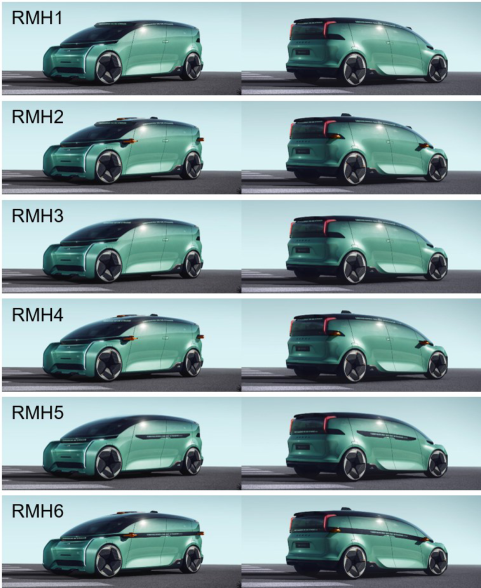
In the study, the test persons were shown six stimulus patterns for evalu- ation. The stimulus patterns are divided into three pairs with specific eHMI
configurations, each without and with visible sensors. The eHMI configura- tions are based on the “additive, integrative and integral” design strategies described above for integrating eHMI into the vehicle exterior.
The positioning of the eHMI depends on the level of integration and is chosen based on the findings of Eisma et al. (2020). Text was chosen as the modality, according to Bazilinskyy et al. (2019). This is shown on the front, side and rear of the vehicle. The colour of the text is based on the colour of the vehicle’s paint. The stimulus pattern RMH1 shows the vehicle with additive eHMI in the form of an attached display on the roof, above the windscreen. At the sides and rear, the eHMI also runs at the height of the roof edge. Sensors are not visible here. The stimulus pattern RMH2 shows the same configuration as RMH1, but is additionally equipped with sensors on the exterior. These are clearly highlighted in contrasting colour (orange). The sti- mulus patterns RMH3 and RMH4 show the integrative eHMI. Here, the text display is integrated into the windscreen below the edge of the roof. At the sides and rear, the text again runs below the edge of the roof. RMH4 shows the sensors in contrast colour in addition to the configuration of RMH3. The stimulus patterns RMH5 and RMH6 show the integral design of the eHMI. Here, the text runs in the black area at the front of the vehicle, below the windscreen. The display is thus completely integrated into the vehicle’s exte- rior design. At the side and rear of the vehicle, the display is also integrated into a black area at the level of the belt hight. RMH 6 shows the sensors in contrasting colour in addition to the configuration of RMH5. Figure 2 shows an overview of the six described stimulus patterns.
Figure 2: Stimulus patterns of the concept car with eHMI presented to test persons.
Design Strategies Compared: How eHMI Are Perceived in Relation 577
The questionnaire of this part of the study consisted of a total of 15 items that remained the same for all stimulus patterns. The items were rated using a six-point Likert scale (1 = “strongly disagree” to 6 = “stron- gly agree”). The aim of the survey was to gain insights into the influence of the type of integration of eHMI in the vehicle exterior on the four sub-areas of recognisability, system trust, safety perception and appeal. In addition, a possible interdependence through the visibility of sensors was to be investigated. For the recognisability of the eHMI, adapted items accor- ding to Bazilinskyy et al. (2019) as well as self-developed items were used. System trust was assessed using relevant, adapted items from the Trust-in- Automation questionnaire according to Körber (2018) and Ekman (2020). Items according to Arndt (2010), Salonen (2018) and Bazilinskyy et al. (2019) were used to assess the perception of safety. The appeal was evalu- ated with items according to Holder (2016) as well as further self-developed items.
RESULTS AND DISCUSSION
In the following, the results of the eye tracking study on the integration of eHMI into the exterior design of automated vehicles are presented. A total of 36 subjects took part in the study. The sample consisted of 15 female and 21 male participants aged between 18 and 65 years (see Figure 3). The majority of the test persons (n = 32) were between 18 and 30 years of age.
Figure 3: Gender and age distribution of participant collective.
The statistical evaluation of the questionnaire of the main study is shown in the following boxplot diagrams. The boxplot diagrams are clustered accor- ding to the items in the above-mentioned categories of recognisability, system trust, perception of safety and appeal. For all questions, an ANOVA with repeated measures and Huynh-Feldt correction with subsequent Bonferroni- corrected comparisons in pairs of the significant stimulus patterns were carried out as part of the statistical evaluation. The statistical results can be found in Table 1–4.
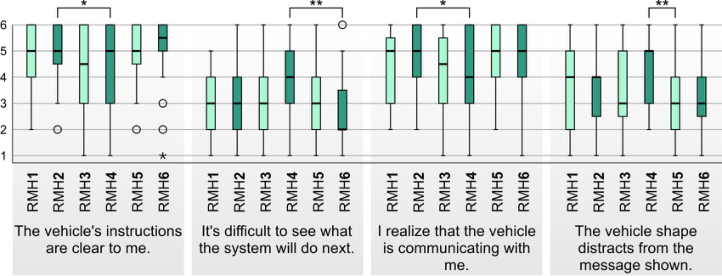
Figure 4 shows a positive trend in the recognisability of the eHMI. All design strategies seem to be recognisable well. Especially the additive and the integral design perform well. The integrative design is significan- tly less recognisable. A significant influence of the visibility of sensors is not seen, except that RMH5 distracts less from the message shown than RMH4.
Table 1. Statistical evaluation of the questions on recognisability.
Table available in the original PDF paper.
Recognisability quest. 1
Recognisability quest. 2
Recognisability quest. 3
Recognisability quest. 4
Mauchly-W(2) = .440
Mauchly-W(2) = .565
Mauchly- W(2) = .312
Mauchly- W(2) = .702 p = .019 p = .170 p < .001 p = .632 HF = .874 HF = .970 HF = .805 HF = 1.000 F(21.968, 184.532) = 4.167 F(18.278, 192.389) = 3.325
F(20.556, 185.778) = 3.873 F(19.426, 228.907) = 5.000 p = .002 p = .007 p = .005 p = .013 partial η2 = .106 partial η2 = .087 partial η2 = .100 partial η2 = .078
Figure 4: Boxplots for recognisability.
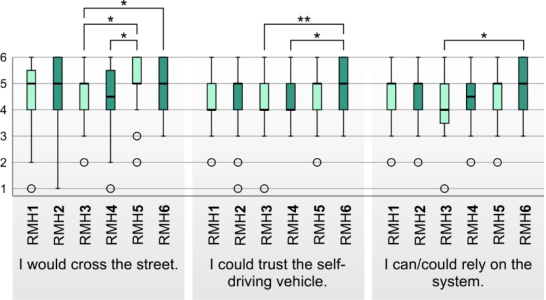
Figure 5 shows the results of the questions on system trust. Here, too, a tendency in a positive direction can be seen for all stimulus patterns. The stimulus pattern RMH3 with integrative design without sensors was rated significantly worse in all three questions than the integral design with sen- sors RMH6. In general, the integral design was also rated better than the integrative design.
Table 2. Statistical evaluation of the questions on system trust.
Mauchly-W(2) = .445 p = .021 p = .527 p = .039 p = .003 HF = .854 HF = 1.000 HF = .924 HF = .765 F(15.597, 105.569) = 5.171 F(11.037, 98.630) = 3.917
F(8.097, 97.736) = 2.900 F(20.412, 116.088) = 6.154 p <.001 p = .002 p = .018 p < .001 partial η2 = .129 partial η2 = .101 partial η2 = .077 partial η2 = .150
Design Strategies Compared: How eHMI Are Perceived in Relation 579
Figure 5: Boxplots for system trust.
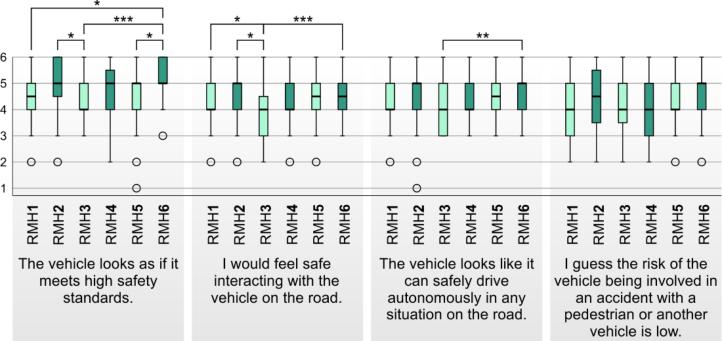
The ratings of the questions on safety perception are shown in Figure 6. Especially the diagram for the first question shows that the interaction of eHMI and the visibility of sensors has significant effects on the perception of safety standards. Stimulus patterns with sensors are rated significantly bet- ter than stimulus patterns without sensors. With regard to the perception of safety, the integrative design without sensors (RMH3) was perceived signifi- cantly worse than the additive design variants and the integral design with sensors (RMH6).
Table 3. Statistical evaluation of the questions on the perception of safety.
F(6.856, 78.977) = 3.039 F(5.815, 90.852) = 2.240 p < .001 p < .001 p = .014 p = .057 partial η2 = .150 partial η2 = .112 partial η2 = .080 partial η2 = .060
Figure 6: Boxplots for safety.
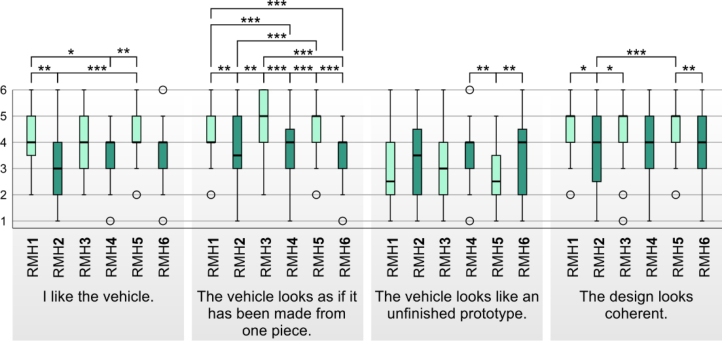
As Figure 7 shows, there are clear significant differences between the design variants with regard to appeal. In terms of subjective appeal, all variants with sensors were rated significantly worse than the variants with- out sensors. The variants with sensors also scored significantly worse in the second question. The sensors in the RMH2, 4 and 6 variants tended to be perceived as disturbing in terms of design effect, in some cases even significantly disturbing.
Table 4. Statistical evaluation of the questions on the appeal.
F(24.222, 171.778) = 4.935 F(25.690, 135.810) = 6.621 p < .001 p < .001 p < .001 p < .001 partial η2 = .156 partial η2 = .316 partial η2 = .124 partial η2 = .159
Figure 7: Boxplots for appeal.
Table 5 shows the significances between the stimulus patterns evaluated in the evaluation of the individual questions.
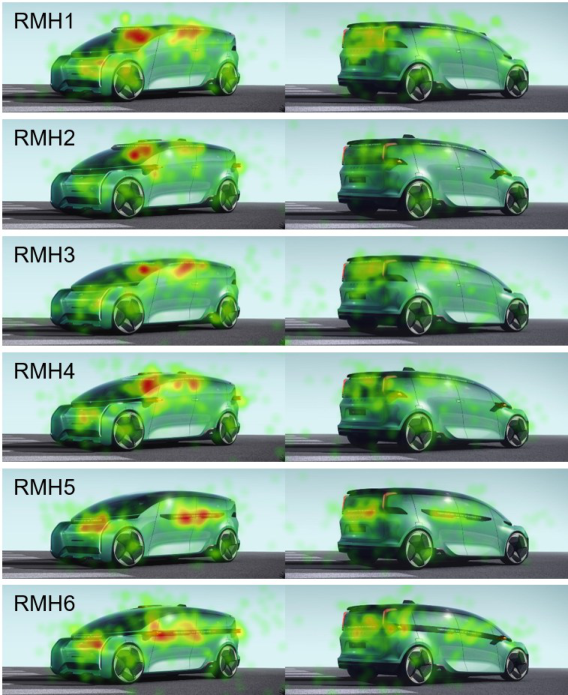
Figure 8 displays the results of the eyetracking study. The heatmaps shown describe the subjects’ fixations on the respective stimulus patterns. Due to technical problems, the evaluation of the eye-tracking data unfortunately has a high error rate. Out of a total of 36 subjects, only 19 data sets could be used to create the heat maps. The other 17 data sets were not considered for the graphical evaluation of the eye-tracking. The evaluation of the heat maps shows across all stimulus patterns that the front of the vehicle was predo- minantly observed. The stimulus patterns without sensors (RMH1, RMH3, RMH5) clearly show a fixation of the eHMI at the front of the vehicle as well
Design Strategies Compared: How eHMI Are Perceived in Relation 581
Table 5. Significances between the stimulus patterns.
Table available in the original PDF paper.
Recognisability quest. 1
Recognisability quest. 2
Recognisability quest. 3
Recognisability quest. 4 RMH 2–4: p = .031 RMH 4–6: p = .007 RMH 2–4: p = .023 RMH 4–5: p = .009 System trust question 1 System trust question 2 System trust question 3 RMH 3–5: p = .012 RMH 3–6: p = .006 RMH 3–6: p = .031 RMH 3–6: p = .041 RMH 4–6: p = .028 RMH 4–5: p = .016 Safety question 1 Safety question 2 Safety question 3 Safety question 4 RMH 1–6: p = .021 RMH 1–3: p = .024 RMH 3–6: p = .004 - RMH 2–3: p = .025 RMH 2–3: p = .039 RMH 3–6: p <.001 RMH 3–6: p = .001 RMH 5–6: p = .041 Appeal question 1 Appeal question 2 Appeal question 3 Appeal question 4 RMH 1–2: p = .003 RMH 1–2: p = .003 RMH 4–5: p = .006 RMH 1–2: p = .016 RMH 1–4: p = .022 RMH 1–4: p <.001 RMH 5–6: p = .007 RMH 2–3: p = .034 RMH 2–5: p <.001 RMH 1–6: p <.001 RMH 2–5: p = .001 RMH 4–5: p = .006 RMH 2–3: p = .002 RMH 5–6: p = .004 RMH 2–5: p <.001 RMH 3–4: p = .001 RMH 3–6: p <.001 RMH 4–5: p <.001 RMH 5–6: p <.001
as at the side and rear. In the stimulus patterns with sensors (RMH2, RMH4, RMH6) it is clear that the fixations of the eHMIs decrease to a small extent and that some of the strongly focused areas shift towards the sensors at the corners of the vehicle. In the comparison of the different design strategies, the integral design of the eHMI (RMH5 and RMH6) is fixed most often by the subjects. A closer look shows that most of the gaze concentrations are dire- ctly on the eHMI. The additive design (RMH1 and RMH2) also shows clearly focussed areas, but less specifically than the integral design. The integrative design (RMH3 and RMH4) has comparatively fewer gaze concentrations in the area of the eHMI.
The predominant consideration of the front side can certainly be explai- ned by the use case of the road crossing scenario. The subjects were asked to imagine a zebra crossing where they would like to cross the road while an automated vehicle is approaching. Normally, the subjects would see the front of the vehicle at the crossing. The shift in gaze concentrations in the stimulus patterns RMH2, RMH4 and RMH6 compared to the stimulus pat- terns RMH1, RMH3 and RMH5 suggest that the sensors are the cause of the change in viewing the stimulus patterns. The tendency from the box- plots of the item “The vehicle shape distracts from the message shown” is supported by this. Even though the subjects did not explicitly state in the questionnaire that they looked less at the eHMI due to the presence of the sensors, the heatmaps show, that they did so subconsciously to a large extent.
With regard to the design strategies, it becomes clear that the additive design and the integral design perform similarly well. When looking at the
Figure 8: Results of the eyetracking analysis shown via heatmaps.
heat maps, it shows that the integrative solution performs the worst. If the results are compared with the boxplots for recognisability, it becomes clear that the integral design is best received by the test persons.
From the study results it can be concluded that an interaction between eHMI and sensors cannot be ruled out. The sensors distract the viewer’s gaze at least partially from the eHMI. For the exterior design, this means that the sensors should be designed to be as invisible as possible and that the eHMI should be a salient stimulus for quick recognition. Nevertheless, the eHMI can easily be fully or integrally integrated into the vehicle design. Compared to the additive and integrative design, the integral design also has advantages in terms of appeal and thus also contributes to the aesthetics and presumably also to the acceptance of future vehicles.
With regard to the significance of the results, the study setting must be viewed critically in terms of immersion. The static stimulus patterns shown represent an initial tendency of the test persons with regard to the questions. In order to obtain more detailed results, a dynamic presentation of the sti- mulus patterns, ideally with real vehicles at a real crossing, would be helpful. In addition, further scenarios and different vehicle concepts should be tested in order to substantiate the validity of the eHMI information.
Design Strategies Compared: How eHMI Are Perceived in Relation 583
CONCLUSION AND OUTLOOK The research has shown that the type and degree of integration of eHMI into the vehicle exterior design is of relevant importance for design perce- ption, evaluation and thus design. The degree of integration has an impact on perception factors such as recognisability or appeal of AVs. To replace the subtle but efficient communication between driver and pedestrian in the context of a future vehicle exterior design, it is advantageous if the eHMI represents a salient stimulus and is unambiguously interpreted. In order to guarantee an unambiguous interpretation of the information of the eHMI by the persons concerned, further possibilities for the creation of target- oriented external human-machine communication should be investigated. Furthermore, it should be investigated whether vehicles with a personali- sing exterior design and a human-interacting eHMI (cf. Jaguar Eye-Pods, VW Cedric) show more positive effects on communication and recogni- sability than conventional, machine-like eHMI. This would come close to merging classic vehicle design with robot design, i.e. transferring human characteristics to machines.
ACKNOWLEDGEMENT
This research was supported by Federal Ministry for Economic Affairs and Climate Action in the national research project RUMBA.
REFERENCES
Anderson, B. A., Laurent, P. A. and Yantis, S. (2011) ‘Value-driven attentional capture’, Proceedings of the National Academy of Sciences, vol. 108, no. 25, pp. 10367–10371. Arndt, S. (2010) Evaluierung der Akzeptanz von Fahrerassistenzsystemen. Modell
zum Kaufverhalten von Endkunden. Dissertation, Technische Universität Dresden, Dresden. Bazilinskyy, P., Dodou, D. and Winter, J. de (2019) ‘Survey on eHMI concepts: The effect of text, color, and perspective’, Transportation Research Part F: Traffic Psychology and Behaviour, vol. 67, pp. 175–194. Beggiato, M., Witzlack, C., Springer, S. and Krems, J. (2017) ‘The Right Moment
for Braking as Informal Communication Signal Between Automated Vehicles and Pedestrians in Crossing Situations’, in Stanton, N. A. (ed.), Advances in Human Aspects of Transportation, Cham, Springer International Publishing, pp. 1072–1081. Burns, C. G., Oliveira, L., Thomas, P., Iyer, S. and Birrell, S. (2019) ‘Pedestrian Decision-Making Responses to External Human-Machine Interface Designs for Autonomous Vehicles’, 2019 IEEE Intelligent Vehicles Symposium (IV). Paris, France, 09.06.2019 - 12.06.2019, IEEE, pp. 70–75. Carmona, J., Guindel, C., Garcia, F. and La Escalera, A. de (2021) ‘eHMI: Review
and Guidelines for Deployment on Autonomous Vehicles’, Sensors, MDPI,Vol.21, No. 9. Dey, D., Zeeuw, C. de, Bruns, M. and Pfleging, B. (2021) ‘Shape-Changing Interfaces as eHMIs: Exploring the Design Space of Zoomorphic Communication between Automated Vehicles and Pedestrians’, 13th International Conference on Automotive User Interfaces and Interactive Vehicular Applications. Leeds United
Kingdom, 09 09 2021 14 09 2021. New York, NY, United States, Association for Computing Machinery, pp. 137–141. Eisma, Y. B., van Bergen, S., Brake, S. M. ter, Hensen, M. T. T., Tempelaar, W. J.
and Winter, J. C. F. de (2020) ‘External Human–Machine Interfaces: The Effect of Display Location on Crossing Intentions and Eye Movements’, Information, vol. 11, no. 1, p. 13. Ekman, F. (2020) Designing for Appropriate Trust in Automated Vehicles - A tentative model of trust information exchange and gestalt. Dissertation, Chalmers University of Technology, Gothenburg. Ferraris, S. D., Rampino, L. and Ferraro, V. (2017) “‘Make it beautiful”. An old
request with difficult academic answers’, The Design Journal, vol. 20, sup 1, S236–S248. Fischer, L., Holder, D., Krogmann, S. and Maier, T. (2021) ‘Integration von Sensoren in das Exterieur-Design automatisierter/autonomer Fahrzeuge’, in: Binz, H. et al. (Eds.), Stuttgarter Symposium für Produktentwicklung SSP2021, Conference Proceedings, Stuttgart, pp. 523–534. Guo, F., Lyu, W., Ren, Z., Li, M. and Liu, Z. (2022) ‘A Video-Based, Eye-Tracking
Study to Investigate the Effect of eHMI Modalities and Locations on Pedestrian– Automated Vehicle Interaction’, Sustainability, vol. 14, no. 9, p. 5633. Holder, D. (2016) Gefallensurteil und Blickanalyse zum Fahrzeugdesign zukünftiger Aufbaugestalten anhand einer technischen Prognose. Dissertation, University of Stuttgart, Stuttgart. Joisten, P., Niessen, P. and Abendroth, B. (2021) ‘Pedestrians’ Attitudes Towards
Automated Vehicles: A Qualitative Study Based on Interviews in Germany’, in Black, N. L., Neumann, W. P. and Noy, I. (eds) Proceedings of the 21st Con- gress of the International Ergonomics Association (IEA 2021), Cham, Springer International Publishing, pp. 664–673. Körber, M. (2018) ‘Theoretical Considerations and Development of a Questionnaire to Measure Trust in Automation’, in: Bagnara, S. (Ed.), Proceedings of the 20th Congress of the International Ergonomics Association (IEA 2018), Volume VI: Transport Ergonomics and Human Factors (TEHF), Aerospace Human Factors and Ergonomics, Springer International Publishing AG, Cham, pp. 13–30. Lim, D. and Kim, B. (2022) ‘UI Design of eHMI of Autonomous Vehicles’, Interna-
tional Journal of Human–Computer Interaction, pp. 1–18. Mandel, R., Klarzyk, J. and Maier, T. (2015) ‘Impact of visual preconditioning on the comfort rating of the vehicle interior’, in: Bargende, M. et al. (Eds.), 15. Internatio- nales Stuttgarter Symposium, Automobil- und Motorentechnik, Springer Vieweg, Wiesbaden, pp. 725–736. Reichelt, F., Holder, D. and Maier, T. (2020) ‘Influence of the vehicle exterior design
on the individual driving style’, in: Ahram, T. (Ed.), Human Systems Engineering and Design II, Proceedings of the 2nd International Conference on Human Systems Engineering and Design (IHSED2019): Future Trends and Applications, Springer International Publishing AG, Cham, pp. 223–228. Salonen, A. O. (2018) ‘Passenger’s subjective traffic safety, in-vehicle security and emergency management in the driverless shuttle bus in Finland’, Transport Policy, Elsevier Ltd., Vol. 61, pp. 106–110. Troel-Madec, M., Boissieux, L., Borkoswki, S., Vaufreydaz, D., Alaimo, J., Cha-
tagnon, S. and Spalanzani, A. (2019) ‘eHMI positioning for autonomous veh- icle/pedestrians interaction’, Proceedings of the 31st Conference on l’Interaction Homme-Machine: Adjunct. Grenoble France, 2019. New York, NY, United States, Association for Computing Machinery, pp. 1–8.
LISTED IN THE AHFE DIGITAL BOOKSTORE CATALOGUE
Explore the complete digital volume
Ergonomics In Design
Read this individual research paper free through the original publisher, or explore the full digital proceedings book.
ISBN 978-1-958651-53-7
Explore this ISBN in the AHFE Bookstore ↗Listed in the July 2026 bookstore catalogue; search by ISBN to confirm current availability · Digital book purchase optional